The Pension Bridge Gap: Actuarial Reality, Compliance, and FIRE Strategies Under Gradual Retirement Reform
As the gradual retirement reform raises the minimum contribution threshold to 20 years by 2030, early-retired FIRE practitioners face a 20-year pension bridge gap. With proxy-payment schemes now criminalized and third-pillar accounts strictly locked, mastering minimum compliant health coverage and cross-cycle liquid assets is the only viable defense.

 Figure 1: Statutory early retirement application windows and cross-cycle funding gaps under the gradual retirement policy framework (Source: Official regulations and actuarial data).
With the comprehensive rollout of the gradual statutory retirement age policy, official announcements and state media detailing the 2030 threshold escalation—raising the minimum contribution period by six months annually, alongside strict constraints on flexible early retirement tied to original statutory ages—have sent shockwaves through the FIRE (Financial Independence, Retire Early) community. The conventional strategy of “quit and coast the moment you hit the 15-year contribution mark” faces a structural reckoning. As the Ministry of Human Resources and Social Security (MHRSS) and the State Taxation Administration intensify administrative oversight, classifying fraudulent labor affiliations and proxy-payment schemes as illegal, individuals who step away from traditional employment around age 40 must confront a formidable reality: a 20-year “pension bridge gap” coupled with compliance reconstruction.
Mechanism Breakdown: The Rigid Floor of Flexible Early Retirement and the 2030 Staircase
A common misconception persists among the public regarding “flexible early retirement,” assuming it grants the freedom to quit and draw public pensions at will upon meeting the minimum contribution years. However, under Articles 2 and 3 of the State Council Regulations on the Gradual Implementation of Postponing Statutory Retirement Ages, the flexible early retirement mechanism is bound by dual constraints:
First, the age floor is inviolable. Workers who fulfill the minimum contribution period and voluntarily opt for flexible early retirement can pull forward their retirement date by a maximum of three years. Crucially, the actual age at which benefits are drawn must not fall below the original statutory retirement age (60 for men; 50 or 55 for women, depending on occupational category). Even as the gradual policy pushes the statutory retirement age for men to 63, the earliest possible age to draw public benefits via the flexible channel remains 60. There is no structural path back to age 40 or 50.
Second, contribution years dynamically bind to the application year. Starting January 1, 2030, the minimum contribution period required to receive monthly basic pensions will gradually rise from 15 to 20 years, increasing by six months each calendar year. The MHRSS and mainstream financial media have established a definitive actuarial stance:
The minimum contribution period required for flexible early retirement is not determined by the employee’s original, postponed statutory retirement year. Instead, it is strictly governed by the statutory standard corresponding to the exact year the employee applies for early retirement. Early retirement accelerates the timeline of withdrawals; it does not reduce the aggregate contribution obligation.
| Retirement Year | Minimum Contribution Period for Basic Pension | Corresponding Months (Minimum Cumulative) |
|---|---|---|
| 2025 – 2029 | 15 Years | 180 Months |
| 2030 | 15 Years & 6 Months | 186 Months |
| 2031 | 16 Years | 192 Months |
| 2032 | 16 Years & 6 Months | 198 Months |
| 2035 | 18 Years | 216 Months |
| 2039 and Beyond | 20 Years (Hard Ceiling) | 240 Months |
For a professional born in 1990 planning a flexible retirement filing after 2030, stopping their contribution history at 15 years (180 months) will trigger an immediate system rejection at the processing window. They must top up contributions to meet the 15-year-and-6-month or 18-year threshold mandated for that specific year. A granular actuarial analysis of contribution duration versus payback cycles can be explored in China’s Social Security Actuarial Ledger: Early vs. Delayed Retirement.
The Actuarial Ledger: The 20-Year Pension Bridge Gap for 40-Year-Old Early Retirees
In a traditional career trajectory, leaving the corporate workforce and beginning public pension disbursements align closely. In the lifecycle blueprint of a FIRE practitioner pursuing minimalist, early exit, however, a perilous intertemporal chasm opens up: the Pension Bridge Gap.
Assume a core technical professional in a tier-one city reaches their asset target at age 40 (having accumulated the traditional 15-year social security minimum) and decides to leave institutional or corporate life entirely. Under the gradual retirement schedule, their statutory retirement age is extended to 63. Even if they select the most aggressive flexible early retirement channel available, the earliest they can draw their first monthly public pension is their 60th birthday.
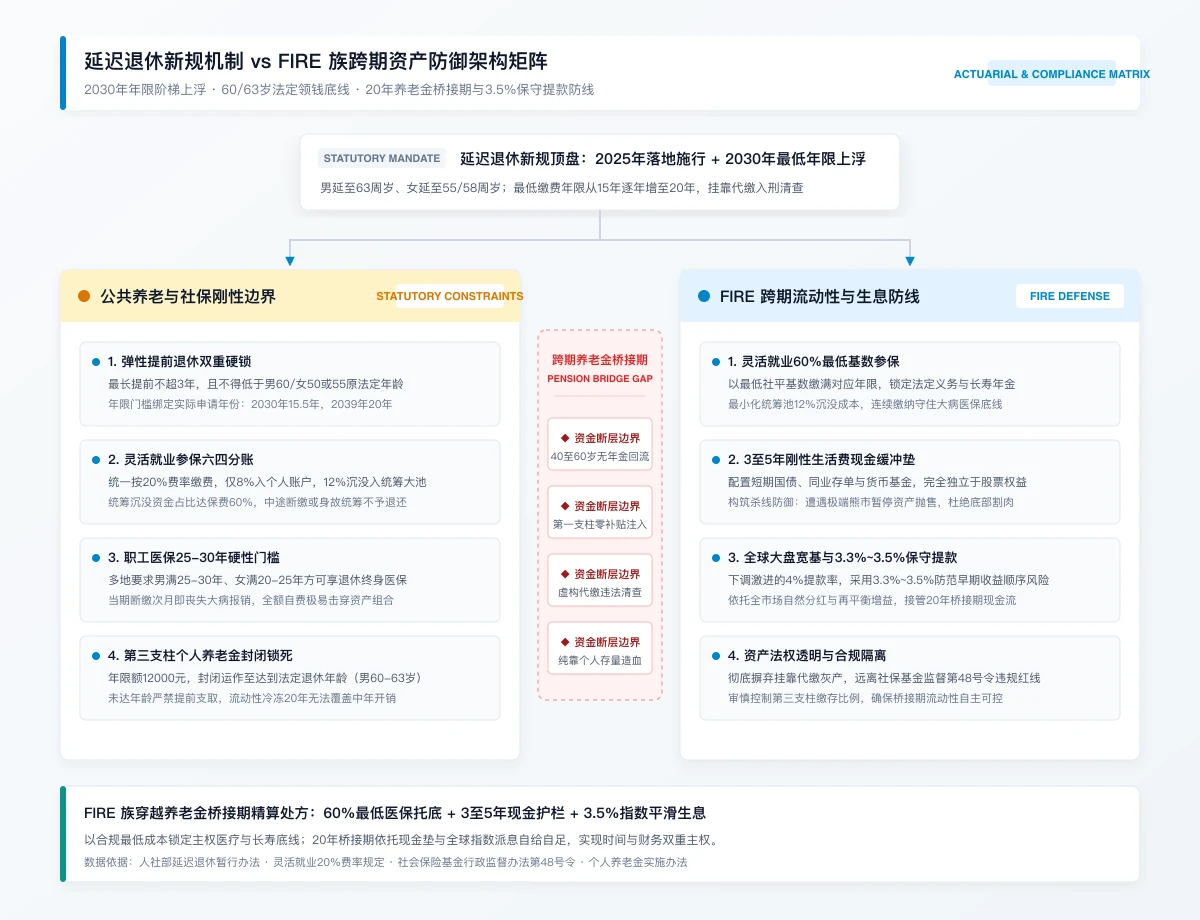 Figure 2: The interaction between flexible retirement entry mechanisms and the 20-year cross-cycle liquidity defense for FIRE practitioners (Source: V-G Think Tank).
This creates an unyielding 20-year funding vacuum between quitting at age 40 and the inflow of public pensions at age 60.
Assuming the FIRE individual maintains a modest baseline monthly living expense of RMB 8,000 (covering basic food, utilities, digital connectivity, and baseline medical consumption), ignoring inflation and catastrophic healthcare shocks, navigating this 20-year bridge requires liquidating RMB 1.92 million in principal savings. Over these 240 months, the first-pillar basic pension yields zero cash flow. Simultaneously, the individual must maintain continuous out-of-pocket cash outflows to sustain social security and medical insurance compliance.
The relationship between asset withdrawal and tail-risk market crashes is detailed further in FIRE Kill-Line Defense and Dynamic Cash Flow Reserve Mechanisms.
The Compliance Perimeter: Criminalization of Proxy-Payment Schemes and Flexible Employment Mechanics
Faced with a 20-year bridge gap, various underground shortcuts and “optimization strategies” popularized by self-media bloggers have transformed into high-risk legal minefields.
1. Fictitious Labor Affiliation (“Proxy Payments”) is Now a Criminal Offense
In the past, departing professionals seeking to maintain local residency rights or property-purchasing qualifications often turned to third-party human resources agencies to execute fictitious employment contracts for proxy social security payments. Under Article 32 of the Administrative Supervision Measures for Social Insurance Funds (MHRSS Decree No. 48) and Article 88 of the Social Insurance Law, fabricating labor relations, falsifying materials, or defrauding social security benefits constitutes a severe statutory violation.
Cross-departmental tax and social security auditing systems—integrating corporate individual income tax filings, social insurance contributions, banking flows, and industrial-commercial tax data—have launched sweeping investigations into shell intermediary agencies. Individuals caught participating in proxy schemes face the complete nullification of their reported months; contributions and intermediary “service fees” are reduced to total losses. Utilizing fraudulent records to trigger retirement or unemployment benefits incurs fines ranging from two to five times the defrauded amount. Severe cases trigger Article 266 of the Criminal Law (Fraud), leading to criminal prosecution. No rational FIRE plan can rest its retirement foundation on the shifting sands of grey-market arbitrage.
2. The “Six-Four Split” of Flexible Employment Costs
Having discarded proxy arrangements, the sole lawful channel for a FIRE individual is registering for flexible employment social security via a local resident ID or residency permit. Yet, evaluating the cash flow ledger of flexible employment requires clear-eyed realism.
Under current tax and labor policy, flexible employment enrollees pay a unified 20% contribution rate toward basic employee pension insurance, selecting a contribution base between 60% and 300% of the local average wage. The core financial reality lies in the internal allocation of this 20% contribution:
- Personal Account (8%): Belongs exclusively to the insured, accrues interest, and serves as the baseline for future monthly personal account pension disbursements. Balances are legally inheritable upon death.
- Social Pooling Fund (12%): Accounts for a full 60% of the total premium paid. This capital feeds the macro social pool to fund current retirees’ benefits. If an individual discontinues contributions or passes away prior to reaching the collection age, the 12% pooled contribution is entirely non-refundable.
As dissected in The People’s Daily “Three Pension Ledgers” Actuarial Breakdown, the macroeconomic stability of the national pooling mechanism relies on the sinking retention of pooled premiums. For a 40-year-old FIRE retiree, high-end contributions at the 300% bracket function primarily as a subsidy to the broader societal pool—an exceptionally uneconomic choice when subjected to long-term discount rate calculations.
3. The Silent Killer: Medical Insurance Vesting Periods
An even more rigid constraint than pension insurance is employee basic medical insurance. While the pension contribution floor scales to 20 years by 2039, the vast majority of tier-one and provincial capitals demand a cumulative contribution history of 25 to 30 years for men and 20 to 25 years for women to secure lifetime medical benefits post-retirement.
Crucially, employee medical insurance operates on a “pay-as-you-go, enjoy-as-you-go” mechanism. Interrupting contributions due to career separation or cash flow strain strips the enrollee of statutory medical fund coverage for major illnesses the very next month. Facing a catastrophic medical event during the 20-year bridge gap without active coverage will instantly obliterate a fragile FIRE asset portfolio.
Asset Lockup: The “Time Straitjacket” of Third-Pillar Personal Pensions
Some FIRE practitioners look to the state-backed third-pillar “personal pension” accounts prior to exiting the workforce, attempting to leverage the RMB 12,000 annual pre-tax deduction to accumulate capital for early retirement cash flow. This approach overlooks the strict statutory lockup embedded in the product design.
Under Article 33 of the Implementation Measures for Personal Pensions (RenSheBuFa [2022] No. 70), personal pension accounts operate under complete closed-loop management. Participants may only withdraw funds—either monthly or in a lump sum—upon meeting one of the following statutory conditions:
- Reaching the official state retirement age;
- Total loss of working capacity;
- Emigration or settling abroad;
- Other circumstances prescribed by the state.
This creates an irreconcilable maturity mismatch: a FIRE retiree exiting at age 40 cannot legally access a single cent of principal or yield trapped inside a personal pension account for the subsequent 20 to 23 years. The capital is deeply frozen until statutory retirement age, rendering it useless for bridging mid-life living expenses. Locking excess liquidity into the third pillar prematurely creates an artificial asset famine precisely when liquidity is most vital.
The Defense Architecture: A Four-Tier Protocol for Crossing the Bridge Gap
Synthesizing these statutory constraints and actuarial boundaries, FIRE practitioners navigating the 2030 paradigm must upgrade their cash flow models and legal frameworks, establishing a disciplined, four-tier capital defense formation:
| Defense Tier | Core Strategy & Asset Instruments | Actuarial Function & Risk Mitigation |
|---|---|---|
| Tier 1: Sovereign Floor | Flexible employment at 60% baseline + continuous employee health insurance | Secures statutory milestone requirements, hedges against catastrophic out-of-pocket medical shocks, and guarantees lifetime longevity annuities. |
| Tier 2: Kill-Line Buffer | 3 to 5 years of hyper-liquid rigid living expenses (Short-term treasuries, large-cap CDs, money market funds) | Independent of equity markets; prevents forced liquidation during deep bear market troughs. |
| Tier 3: Intertemporal Yield | Global broad-market index fund portfolio + 3.3% to 3.5% conservative safe withdrawal rate | Relies on natural dividend yields and portfolio rebalancing gains to fund the 20-year bridge gap. |
| Tier 4: Legal Isolation | Disciplined third-pillar allocation control + absolute avoidance of fictitious proxy schemes | Eliminates mid-life liquidity freezes and strictly adheres to Decree No. 48 administrative compliance boundaries. |
1. Social Security Strategy: The 60% Baseline to Secure Lifetime Healthcare
Assuming the statutory baseline (e.g., 15 years) is met, individuals should utilize flexible employment registration to contribute continuously at the local average wage 60% baseline. This accommodates the post-2030 transition to a 20-year threshold while securing lifetime medical vesting (25–30 years for men, 20–25 years for women). This strategy minimizes sunk capital costs (reducing the 12% pooling fund drag) while ensuring seamless eligibility verification and robust catastrophic medical coverage.
2. Cash Defense: A 3- to 5-Year Hyper-Liquid Living Buffer
To prevent forced liquidation at cyclical equity market bottoms during the 20-year bridge gap, portfolios must maintain an independent cash buffer. Allocating 3 to 5 times annual living expenses into high-liquidity, principal-guaranteed instruments—such as short-term sovereign debt, interbank certificate index funds, or large-cap bank certificates of deposit—acts as a structural withdrawal guardrail during severe drawdowns.
3. Yield Engine: Global Broad-Market Allocation and 3.3%–3.5% Conservative Withdrawals
Delegate the primary yield-generation task of the bridge gap to transparent, highly liquid global broad-market index assets. Over horizons exceeding 20 years, the traditional 4% withdrawal rule proves overly aggressive when confronted with Sequence of Returns Risk. Prudent modeling requires lowering the Initial Safe Withdrawal Rate (SWR) to between 3.3% and 3.5%, covering living expenses via natural dividend yields and rebalancing alpha. Mathematical models and long-term ruin probability testing can be cross-referenced in FIRE Monte Carlo Simulation and Calculator Guide.
The comprehensive rollout of gradual retirement reform does not signal the death of the FIRE movement. Instead, it serves as a ruthless cull of unrealistic financial fantasies and institutional shortcuts. Only by recognizing the objective function of the state pension system—to provide a basic safety net—understanding the statutory thresholds of flexible early retirement, and building self-controlled, liquidity-compliant cross-cycle assets for the pension bridge gap can early retirees safeguard their temporal sovereignty amid sweeping macroeconomic evolution.
Related Research & Topics
Tello Mobile eSIM
SafetyWing Nomad Insurance
* Disclosure: This post contains affiliate links. If you make a purchase through these links, V-G Journal may earn a small commission at no additional cost to you. We only recommend services we independently evaluate and trust.
FIRE and Golf:自由旅居之路
专注于为追求 FIRE 与品质生活的人群提供特惠打球权益与候鸟微度假。不持一砖一瓦,运营品质生活。