The Illusion of Luxury: Capital Network Leverage vs. True Time Sovereignty in FIRE
Ultra-luxury assets like superyachts and private jets are not mere indulgences; they are institutional leverage tools deployed by family offices to secure commercial access and credit backing. In contrast, the FIRE movement anchors itself on buying back personal time sovereignty through safe withdrawal rates—a fundamental rift in capital logic that aspiring mimetic consumers ignore at their peril.

 Figure 1: Private aviation maintenance on the tarmac. Heavy luxury assets generate steep, non-negotiable sunk costs; their true function is leverage for institutional credit and exclusive commercial access.
The curated spectacles of ultra-high-net-worth existence across digital feeds—hundred-million-dollar superyachts, transoceanic private jets, secluded island retreats, and bespoke galas—are frequently fetishized by the public as the ultimate blueprint for “financial freedom.” Yet, when dissected through the lenses of modern actuarial science and economic sociology, the luxury expenditures of the ultra-wealthy are rarely acts of simple sensory gratification. Managed through family offices and complex trust architectures, these outlays represent Capital Expenditure (CapEx)—institutional levers designed to maintain exclusive network access and balance-sheet creditworthiness.
In stark contrast, the Financial Independence, Retire Early (FIRE) movement uses safe withdrawal rates to purchase personal time sovereignty. Confusing the asset profiles and objective functions of these two worlds causes middle-class earners to engage in mimetic consumption, systematically eroding their financial safety margins.
The Veblen Effect and Pecuniary Emulation: The Divide Behind Symbols
In his 1899 treatise The Theory of the Leisure Class, economist Thorstein Veblen mapped the mechanics of “Conspicuous Consumption” and “Pecuniary Emulation.” Veblen observed that the leisure class signals its immunity from manual labor by consuming expensive, non-productive goods and services. Lower social strata, bound by anxiety over status and social validation, instinctively attempt to emulate these upper-tier consumption symbols.
Modern digital algorithms amplify this emulation exponentially. By democratizing access to video slices showcasing the top 0.1 percent, social platforms manufacture an illusion: accumulate enough cash, and this lifestyle becomes yours. But the core of Veblen’s critique remains unchanged: behind the consumer symbol lies the true determinant of class power—control over the means of production and privilege within credit networks.
[ Algorithmic Feeds ] --> Mimetic Desire --> High-Depreciation Consumption --> Depleted Capital
                                                                                |
                                                             ( Destroys Safety Margin )
The general public operates under a cognitive distortion, mistaking the possession of luxury goods for actual freedom. When middle-class households use finite, post-tax wage streams to mimic ultra-luxury markers—purchasing high-depreciation consumer goods and elite vacations—they undermine their own capital accumulation. True independence requires no performative signaling. As detailed in our analysis of FIRE Freedom Mindset and Time Sovereignty, the essence of financial autonomy lies in severing external validation mechanisms to reclaim irreplaceable personal agency.
The Physical Cost of Heavy Assets: The Sunk Costs of Yachts and Aviation
While onlookers envy the image of a billionaire navigating international waters or taking off on a private intercontinental flight, they regularly overlook the physical decay and cash drain intrinsic to heavy asset ownership. Holding high-end physical assets requires continuous liquidity depletion rather than a one-time transaction.
According to long-standing industry benchmarks from Fraser Yachts and Knight Frank, superyachts operate under a strict “10% Rule”: annual baseline operating expenses (OpEx) run between 10% and 15% of the vessel’s original purchase price. Within this annual overhead, professional crew compensation—captains, marine engineers, and specialized service personnel—accounts for 35% to 45% of total routine costs. A $100 million superyacht burns through $10 million to $15 million in unrecoverable cash every year merely sitting at dock, covering berth fees, mechanical overhauls, statutory inspections, and crew retainers. Mooring fees, scheduled maintenance, commercial hull insurance, and marine fuel consume the remainder.
Superyacht CapEx ($100M Baseline)
- Annual Cash Drain: $10M - $15M (10% - 15% OpEx)
  - Crew Payroll & Retainers: 35% - 45%
  - Dockage, Overhauls, Insurance, Fuel: 55% - 65%
Private aviation exhibits an equally unforgiving cost structure. Operating models from aviation data firms Conklin & de Decker and Business & Commercial Aviation (BCA) reveal that a ultra-long-range jet like the Gulfstream G650 incurs roughly $1,720,587 in fixed annual operating costs while parked idle in a hangar—covering dual-captain salaries, hangar leases, hull insurance, and mandatory calendar inspections. Assuming a standard utilization profile of 200 flight hours per year, variable expenses—fuel, engine maintenance reserves, and landing fees—add approximately $8,815 per hour. All told, operating a large-cabin business jet demands an all-in annual expenditure of roughly $3.48 million, or $17,418 for every single hour airborne.
The ultra-wealthy absorb these 10%+ annual asset depreciation rates not out of economic irrationality, but because these assets function as production tools in high-stakes capital allocation. Private aircraft eliminate commercial aviation delays, guarantee physical and operational security, and preserve executive time. Superyachts serve as floating, secure boardrooms on international waters for multi-billion-dollar mergers, acquisitions, and cross-border joint ventures. They are corporate and family office capital expenditures designed to trade balance-sheet yield for top-tier institutional access.
Family Office Passive Cash Flows vs. Wage-Earner Depletion
The financial engines funding ultra-luxury lifestyles operate on a model structurally distinct from the wage-based cash flows of typical professionals.
Data from UBS tracking Single Family Offices (SFOs) globally indicates an average Assets Under Management (AUM) of approximately $1.1 billion. The annual operational cost to maintain investment professionals, legal counsel, and administrative structures within these entities typically ranges from 1% to 2% of total AUM. During macroeconomic disruptions, roughly 60% of family offices systematically rebalance their strategic asset allocations to preserve overall portfolio liquidity.
[ Family Office AUM ($1.1B) ] --> 3-5% Asset Yields --> Funds Luxury CapEx (Principal Intact)
[ Wage Professional ]        --> Taxed Income    --> Depreciating Goods (Capital Destroyed)
Critically, ultra-wealthy personal expenditures are funded by the yield, dividends, and capital gains generated by underlying productive assets. Capital yields pay for consumption; the principal remains intact and productive. Conversely, when wage earners attempt to emulate these consumption patterns, they trade hours of finite lifespan for post-tax wage streams. Allocating those wages to rapidly depreciating luxury goods trades human capital for consumable overhead, destroying the liquidity buffers needed to withstand systemic shocks.
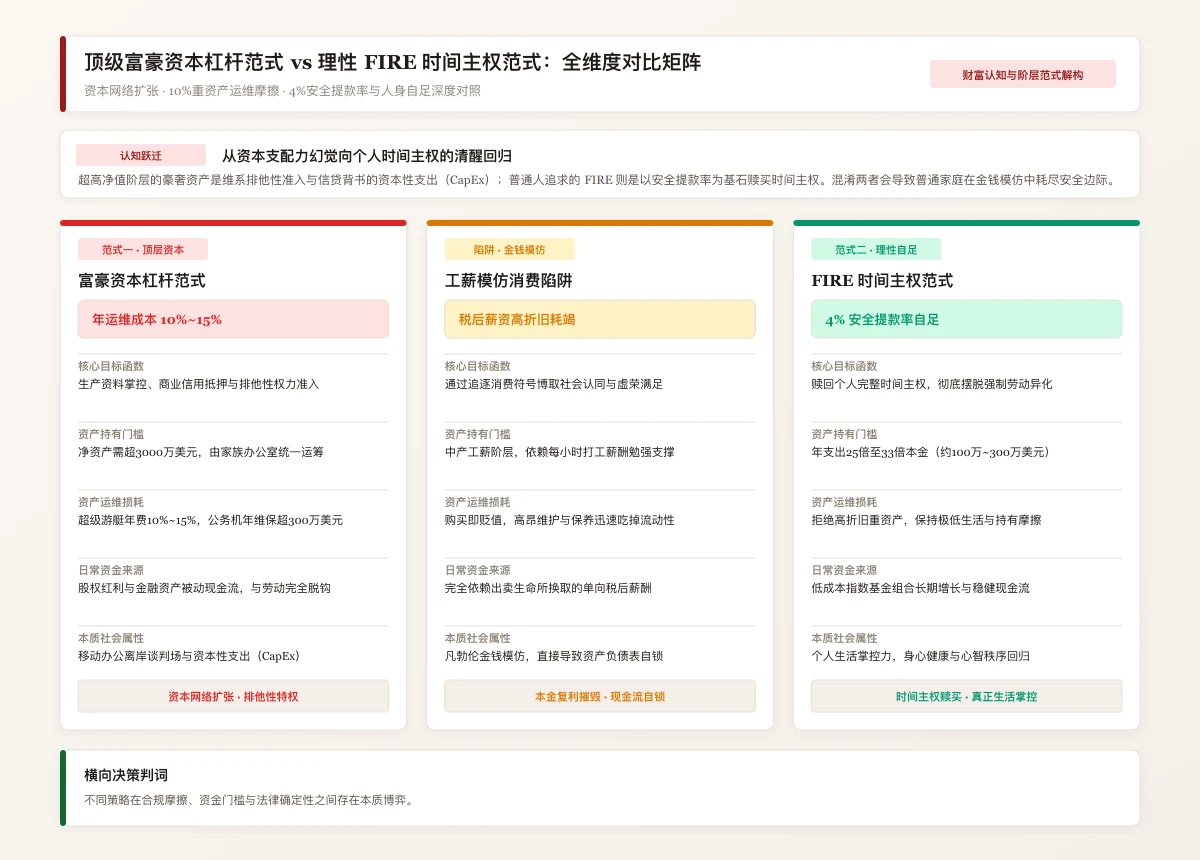 Figure 2: Architectural comparison matrix between the Ultra-Wealthy Capital Network Leverage paradigm and the Rational FIRE Time Sovereignty paradigm, illustrating two fundamentally divergent objective functions.
| Dimension | Ultra-Wealthy Capital Leverage | Rational FIRE Time Sovereignty |
|---|---|---|
| Core Objective Function | Control over means of production, political influence, and commercial access | Complete reclamation of personal time; decoupling from alienated labor |
| Asset Threshold | Net worth generally > $30M (UHNWI status) | 25x to 33x annual baseline expenses ($1M to $3M range) |
| Everyday Expense Profile | Capital Expenditure (CapEx) serving as commercial credit collateral | Living self-sufficiency focused on low friction and high utility durability |
| Heavy Asset Stance | Absorbs 10%–15% annual depreciation to secure network access | Avoids heavy, depreciating physical assets; prioritizes maximum liquidity |
| Safety Margin Source | Family office legal structures, cross-jurisdictional trusts | 3%–4% Safe Withdrawal Rate (SWR) backed by liquid reserve buffers |
This comparative framework demonstrates that mimetic consumption offers no path to structural wealth. Instead, high financial leverage coupled with illiquidity exposes emulators to acute fragility. For detailed strategies on engineering personal financial firewalls, refer to our column on FIRE Kill-Line Defense and Reserve Strategies.
Re-Anchoring FIRE: Reclaiming Autonomy Over Capital Hegemony
The modern FIRE movement is a structural critique of Veblenian consumerism. Built on the empirical foundations of William Bengen’s 1994 research and the subsequent Trinity Study, FIRE uses a mathematical baseline centered on a 4% Safe Withdrawal Rate (SWR)—or a conservative 3% target for multi-generational horizons. By accumulating capital equal to 25x to 33x annual expenditures, an individual can fund baseline living costs through long-term index growth and yield. For a standard middle-class household, this target typically sits between $1 million and $3 million.
Accumulated Capital (25x - 33x Expenses) --> 3% - 4% Safe Withdrawal Rate --> Permanent Time Sovereignty
The terminal goal of financial independence is not to acquire a Gulfstream or a superyacht, along with their millions in annual operational drag. As demonstrated by the marginal utility models in our essay on The Marginal Utility Inflection Point of Wealth Freedom at Age 57, the marginal return of material consumption on subjective well-being decays rapidly toward zero once basic self-sufficiency is reached.
True agency is the structural ability to reject coerced labor, maintain full control over one’s daily calendar, preserve physical and mental health, and cultivate deep focus. Wealth, at its core, is not a trophy for public display—it is a breakwater against external volatility. Recognizing luxury assets for what they are—institutional instruments of capital networks—allows individuals to bypass mimetic anxiety and focus on building unassailable personal time sovereignty.
Related Research & Topics
Tello Mobile eSIM
SafetyWing Nomad Insurance
* Disclosure: This post contains affiliate links. If you make a purchase through these links, V-G Journal may earn a small commission at no additional cost to you. We only recommend services we independently evaluate and trust.
FIRE and Golf:自由旅居之路
专注于为追求 FIRE 与品质生活的人群提供特惠打球权益与候鸟微度假。不持一砖一瓦,运营品质生活。