The Six-Year Exit: Cash Flow Defense and Asset Preservation for High-Income Earners
Chinese pop star Xue Zhiqian's countdown to retirement at age 44 highlights the brutal physiological depreciation and single-point-of-failure risks inherent in high-cash-flow careers. High income does not equal permanent financial security; true asset defense requires shedding heavy liabilities, building royalty-generating moats, and locking in a conservative 3% to 3.5% safe withdrawal rate before the pulse fades.


Figure 1: Transitioning from high-frequency active labor (touring) to passive asset ownership is the quintessential survival path for high-cash-flow performance artists navigating macro cycles.
In a pre-launch interview for the 2026 variety show Music Project Season 3, 44-year-old Chinese pop star Xue Zhiqian openly dropped a countdown to his career endgame: “I started doing this show when I was close to 40, and now I’m already 44. I have six years left until I retire, and I want to see more great original musicians take the baton before I step down.” The clip immediately trended across Chinese search engines, surging past 3.4 million discussion index points. Confronted by weeping fans begging him to stay on stage indefinitely, he offered a pragmatic rejoinder: “I will take care of my body as best as I can, but when I truly can’t sing anymore, I’ll stop.”
From breaking Mandarin touring records with over a hundred stadium concerts to preemptively drawing a hard retirement line at age 50, this is no impromptu celebrity confession. It is a rational, cold-blooded financial calculation executed by a high-cash-flow earner bracing against irreversible physiological depreciation and impending single-point-of-failure risks.
Flesh-and-Blood Leverage: Physiological Depreciation and the Single Point of Failure
The public consensus stubbornly views top-tier celebrities and super-freelancers as self-replenishing monetary fountains. A single commercial performance, brand endorsement, or mega-tour can generate net cash inflows in weeks that ordinary mortals cannot accumulate in a lifetime. Yet the unyielding truth of financial actuarial science is simple: pulse-like peak cash flows never equal perpetual balance sheet security.
Take Xue’s representative Extraterrestrial world tour as a case study. Spanning four years (October 2021 to February 2025), the tour crossed four continents, 10 countries, and 62 cities, executing 145 shows for over 5.08 million live attendees—setting a historic milestone as the first Mandarin solo tour to eclipse 100 stadium dates. Behind this magnitude of commercial monetization lies a terrifying operational reality: the underlying machinery relies entirely on the limits of “flesh-and-blood leverage.”
Deconstructing this through a financial lens reveals a highly polarized double-edged sword:
- The Short-Term Surge: At age 44, peak stamina and vocal power convert dense touring schedules into staggering short-term net cash inflows.
- The Inevitable Decay: Continuous physical overdraft inevitably triggers irreversible depreciation with age. Without institutionalized safety nets, an unexpected vocal cord injury or stamina cliff around age 50 will cause this massive cash flow engine to seize instantly, sparking a liquidity panic on the balance sheet.
Every three-hour high-intensity show, grueling cross-city flight, and relentless strain on the vocal cords accelerates physiological depreciation. Unlike mature corporations capable of self-propagation through organizational structures, the entertainment, sports, and hyper-personalized solopreneur sectors suffer from a fatal structural flaw: Single Points of Failure (SPOF). Once the principal’s physical engine declines past the point of no return—or an acute health crisis halts operations—the seemingly bottomless cash flow valve slams shut overnight.
This fragility makes “proactively setting a retirement countdown” an act of supreme asset preservation, rather than a retreat. The precious six-year window between ages 44 and 50 represents the final monetization dividend of an active performance career. Explicitly defining the end date of labor while strength and voice still permit high-output delivery forces a complete, timely reconstruction of one’s financial architecture. As explored in our analysis of FIRE Kill-Line Defense and Liquidity Reserves, only by erecting floodwalls while cash flow peaks can an individual gracefully withstand the arrival of physical depreciation.
From “Shang Shang Qian” to “Chaoshi Music”: Negative Alphas and the Royalty Loop
During the wealth accumulation phase, the most common cognitive trap for high-cash-flow earners is confusing cyclical industry tailwinds with universal investing genius. Once artists accumulate massive pools of primitive capital, their most frequent asset allocation blunder is blindly diving into heavy, high-friction brick-and-mortar businesses.
Xue’s early entrepreneurial trajectory offers an instructive dissection. In 2012, he co-founded “Shang Shang Qian,” a Sichuan-style hotpot chain in Shanghai that grew to nearly 30 stores nationwide at its peak. Offline dining, however, is a heavy-asset sector dependent on rigorous supply chain quality control, high sunk-cost rents, and dense human resource management—attributes entirely antithetical to the high margins and light footprints of the entertainment industry. As the novelty faded, industry hyper-competition intensified, and food safety regulations tightened, Xue quietly exited the company’s shareholder registry by 2019. The brand gradually downsized and shuttered over the following years.
| Asset Class | Commercial Characteristics & Friction Coeff. | Cash Flow Profile | Post-Retirement Anti-Cyclicality |
|---|---|---|---|
| Heavy Brick-and-Mortar (e.g., Hotpot Chain) | High sunk rent, heavy labor friction, strict regulatory compliance | Vulnerable to offline consumption cycles and single-point food safety shocks | Extremely Low (accelerates capital bleeding when the primary income halts) |
| Master Tapes & Song Copyrights (Chaoshi Music) | Near-zero marginal cost, protected by continuous streaming distributions | Steady, multi-generational passive royalty inflows | Extremely High (generates perpetual cash flow without physical presence) |
The cost of this brick-and-mortar trial-and-error proves that unvetted cross-industry investments rarely act as moats; instead, they devolve into continuous cash-burning negative alpha traps. Conversely, Xue systematically reconstructed his core music assets into an ownership-driven closed loop.
By founding and operating Beijing Chaoshi Culture (Chaoshi Music), he secured 100% control over his master recordings and publishing rights, directly acting as the producer and controller of his 100-show stadium tours. This model bypasses the parasitic intermediaries of traditional entertainment supply chains. More importantly, it establishes durable asset barriers:
As articulated in The Fundamental Divergence Between Digital Nomads and FIRE, true freedom is not swapping physical locations while continuing to sell your time and body. It is upgrading your production factors from “disposable biological consumables” to “deterministic assets with self-generating yields.”
The Exit Actuarial Science for High-Net-Worth Earners: Three Defenses and the 3%–3.5% SWR Cap
When an earner accustomed to tens or hundreds of millions in annual cash flow decides to halt high-frequency labor at age 50, what kind of balance sheet restructuring is required to ensure purchasing power survives forty-plus years of inflation and black swan events?
According to modern financial engineering and asset isolation models, a professional high-cash-flow exit must rest upon three layers of depth:
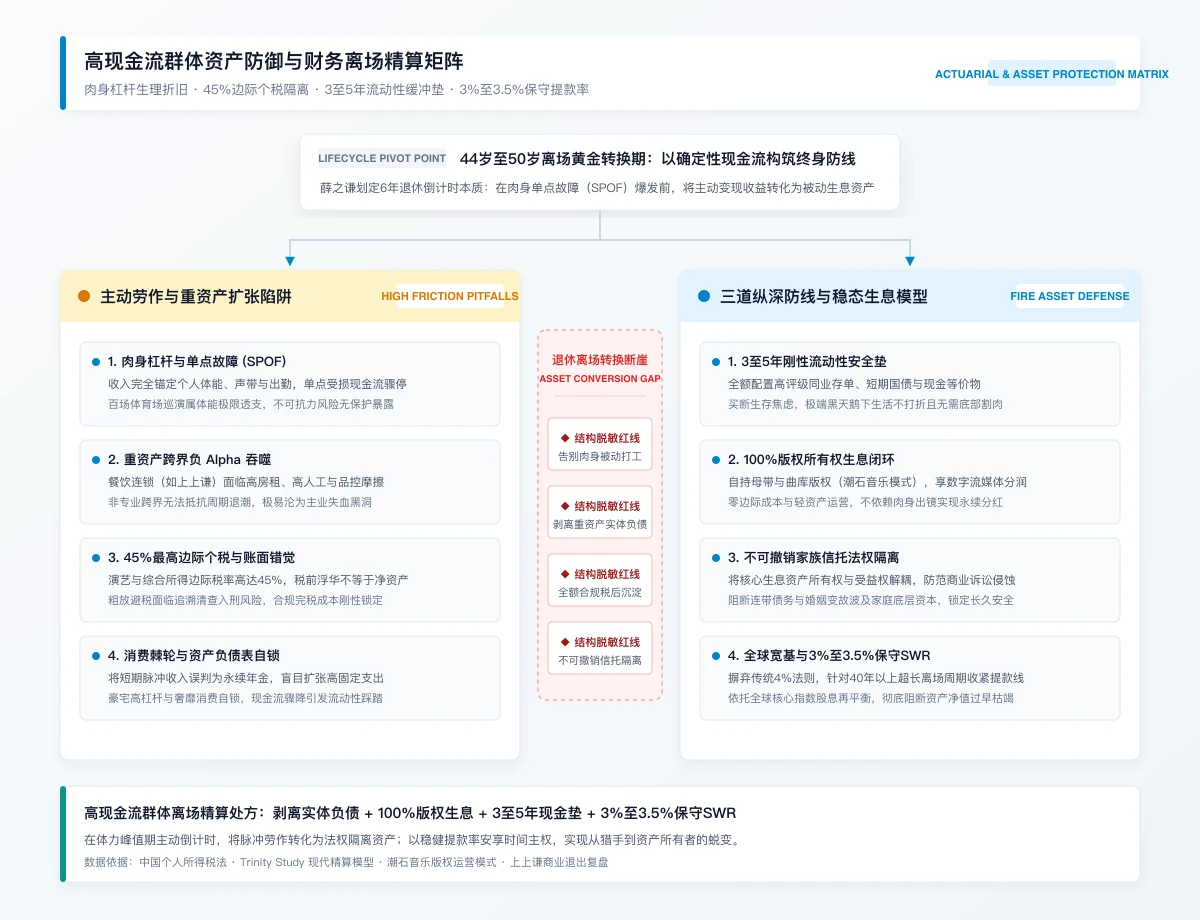
Figure 2: The financial exit architecture for high-cash-flow earners must integrate a liquidity buffer, irrevocable legal isolation, and a low-friction yield foundation.
Defense Layer 1: The Post-Tax Liquidity Safety Cushion
Under progressive tax codes, the highest marginal tax bracket for high-income earners and talent can consume nearly half of nominal earnings. High earners must strip away un-taxed paper illusions and use clean, post-tax cash as their baseline for actuarial math.
The absolute priority of an exit is not chasing speculative yields, but establishing a pure liquidity buffer isolated from high-risk investments. This pool must be fully allocated to zero-default cash equivalents, high-rating negotiable certificates of deposit, and short-to-medium-term government bonds, sized strictly to cover 3 to 5 years of rigid, high-quality family living expenses and catastrophic medical reserves. The sole mission of this capital is to buy out survival anxiety—ensuring that if macro markets suffer a black swan collapse, family living standards remain intact without forcing the liquidation of core underlying assets.
Defense Layer 2: Legal Isolation via Irrevocable Trusts
Celebrities and prominent entrepreneurs enjoy the spotlight’s dividends while sitting permanently exposed to commercial litigation, joint liability from endorsements, and matrimonial disputes. If all assets remain in their natural person name, a single commercial storm or unexpected liability can freeze and shatter the household balance sheet overnight.
By utilizing offshore or onshore compliant irrevocable family trusts, principals can legally decouple asset ownership from beneficial enjoyment. This shields the core estate from future commercial recourse, debt liabilities, and unexpected legal assaults. Once assets enter a compliant trust, they cease to be executable personal bankruptcy property, permanently severing the transmission channel between external business risks and the family’s core yield-generating assets.
Defense Layer 3: The Conservative 3%–3.5% Safe Withdrawal Rate (SWR) and Low-Friction Yield Portfolios
The classic Trinity Study, predicated on a traditional 65-year-old retirement and a 30-year time horizon, popularized the 4% Safe Withdrawal Rule. However, for high-net-worth individuals exiting at 50 or earlier, the retirement planning horizon stretches across 40 to 50+ years. Mechanically applying a 4% extraction rate drastically increases the probability of premature portfolio depletion when facing Sequence of Returns Risk early in retirement.
Accounting for long-term structural inflation stickiness, asset valuation mean-reversion, and ultra-long lifespans, the rational Safe Withdrawal Rate (SWR) for early exitters at age 50 must be compressed into a conservative 3% to 3.5% corridor.
Under this model, core exit capital is deployed into low-fee global broad-market index funds (such as the S&P 500 and Nasdaq 100), multinational high-credit-tier bonds, and deterministic high-dividend asset baskets. Combined with the dynamic withdrawal mechanisms validated in FIRE Monte Carlo Simulations and Calculator Guides—pulling maximum caps in bull years and pausing equity liquidations to draw directly from Defense Layer 1’s cash cushion during bear markets—this completely severs portfolio values from cyclical erosion.
Operational Takeaways for Solopreneurs and Corporate Elites: Surviving the Income Plateau
Xue Zhiqian’s public retirement countdown at age 44 holds profound implications that stretch far beyond the vanity metrics of the entertainment industry. It offers a vital mirror for solopreneurs, big-tech executives, and specialized professionals navigating high-volatility, high-income trajectories.
During peak earning years, high-income professionals frequently fall victim to the “Income Plateau Perpetual Syndrome”: the erroneous belief that current bonus multipliers, industry tailwinds, and abundant stamina will last forever. This income leap is almost invariably accompanied by an exploding consumption ratchet—purchasing ultra-large luxury real estate backed by massive mortgages, enrolling children in elite international schools, and maintaining high-friction business social circles. This fragile ecosystem, utterly dependent on continuous active cash flow, locks individuals onto a high-speed roulette wheel. The moment a career cliff arrives at 35, an industry regulatory clampdown hits, or sudden health issues strike, the stretched balance sheet suffers immediate structural collapse.
True financial maturity is found in the courage to draw your own exit line while the applause is still deafening.
This demands cold asset discipline during your income plateau:
- Treat every pulse of high earnings as non-renewable depreciation compensation, not discretionary spending money.
- Ruthlessly suppress unnecessary fixed liabilities and avoid blindly investing in unfamiliar brick-and-mortar industries.
- Use a 3- to 5-year window to systematically swap active human capital for a resilient exit foundation composed of solid fixed-income cushions, low-friction index assets, and sustainable passive cash flows.
When Xue stated plainly on stage, “When I truly can’t sing anymore, I’ll stop,” the foundation supporting that equanimity was not empty sentimentality—it was the asset playbook he had already quietly assembled offstage. Evolving from a flesh-and-blood cash flow hunter into an asset owner who sleeps soundly through the power of systems and compounding is the ultimate defense every seeker of true freedom must master before the tide goes out.
Related Research & Topics
Tello Mobile eSIM
SafetyWing Nomad Insurance
* Disclosure: This post contains affiliate links. If you make a purchase through these links, V-G Journal may earn a small commission at no additional cost to you. We only recommend services we independently evaluate and trust.
FIRE and Golf:自由旅居之路
专注于为追求 FIRE 与品质生活的人群提供特惠打球权益与候鸟微度假。不持一砖一瓦,运营品质生活。