The Residency Trap: France’s 2026 Tax Reforms and the End of Naive Wealth Arbitrage
France's 2026 Finance Act codifies the 20% minimum effective tax rate (CDHR) while dismantling shareholder loan deductions in real estate holding entities (SCI). For cross-border FIRE practitioners, relying on the naive 183-day rule risks triggering full tax residency via family or economic anchors, exposing worldwide assets to aggressive taxation.


Figure 1: The Ministry of Economy and Finance at Bercy, Paris. France’s 2026 Finance Act establishes a minimum effective tax rate for high earners alongside aggressive asset-look-through protocols.
As France’s 2026 Finance Act aggressively targets structural fiscal deficits, the French tax administration (Direction générale des Finances publiques, DGFiP) has closed its net around high-net-worth individuals and cross-border asset holders. Institutional tax intelligence indicates that the regulatory loopholes remaining from France’s transition from the solidarity tax on wealth (ISF) to the real estate wealth tax (IFI) are being systematically sealed.
The legacy playbooks favored by international FIRE (Financial Independence, Retire Early) practitioners—such as capping physical presence under 183 days or using shell holding entities to artificially depress the net worth of French estates—have become dangerously obsolete. Judicial precedent under Article 4 B of the French Tax Code (Code Général des Impôts, CGI) demonstrates that tax authorities are looking straight through cross-border structures, using family anchors and economic focal points to claim full tax jurisdiction over unhedged global nomads.
1. Dismantling the 183-Day Myth: The Four Traps of Article 4 B
Among global nomads and mobile investors, the belief that spending fewer than 183 days a year in a given jurisdiction guarantees immunity from local tax residency is treated as an undisputed law of physics. However, a precise reading of Article 4 B CGI completely upends this assumption.
French law establishes four independent, alternative criteria. Fulfilling any single one renders an individual a full French tax resident, regardless of whether they ever cross the 183-day threshold:
- Permanent Family Home (Foyer permanent d’habitation): The core location where the individual’s immediate family habitually resides. Ruling after ruling from the French Supreme Administrative Court (Conseil d’État) confirms that if a taxpayer’s spouse or minor children reside permanently in France (e.g., maintaining a primary lease in Paris or the Côte d’Azur with children enrolled in local schools), the individual remains anchored to the French tax grid—even if they travel 300 days a year across London, Dubai, or Singapore;
- Principal Place of Abode (Lieu de séjour principal): If a permanent family home cannot be established, scrutiny shifts to physical presence. Crucially, the standard is relative duration, not an absolute majority of the year. If an individual spends merely 120 days in France, but their time in every other single sovereign state is less than 120 days (a standard pattern for perpetual nomads), France asserts primary residency rights;
- Principal Professional Activity (Activité professionnelle principale): Engaging in substantial gainful employment or independent commercial operations within French territory. For digital nomads and independent consultants, delivering intellectual work or executing contracts while physically present in a French villa or café triggers this clause;
- Center of Economic Interests (Centre des intérêts économiques): The primary locus of an individual’s investments, asset management headquarters, or dominant revenue stream.
Triggering Article 4 B stripped-down non-resident status entirely. Not only do worldwide dividends, interest, and capital gains become subject to French progressive income tax at rates up to 45%, but global real estate portfolios are drawn directly into the scope of France’s real estate wealth tax.
2. Piercing Corporate Shells: IFI Thresholds and Anti-Avoidance Mechanisms
The 2018 French tax overhaul replaced the comprehensive wealth tax (ISF) with the Real Estate Wealth Tax (Impôt sur la Fortune Immobilière, IFI), exempting financial assets like stocks, bonds, cash, and digital assets. This was initially lauded by international investors. However, for FIRE strategists relying on real estate to anchor defensive cashflows, IFI enforcement in 2026 presents an unprecedented look-through threat.
Under Articles 964 and 977 CGI, the net taxable asset threshold for IFI is fixed at €1,300,000. Once a household’s net global real estate assets cross this line, tax is calculated retroactively starting from €800,000 at progressive rates ranging from 0.5% to 1.5%. The top rate applies to net real estate holdings exceeding €10,000,000.
Historically, foreign buyers routinely used French civil property holding companies (Société Civile Immobilière, SCI) or layered offshore entities (e.g., in Luxembourg or Cyprus) to acquire high-value real estate. They would fund these entities via shareholder current accounts (Comptes courants d’associés, CCA), creating massive book liabilities that offset the property’s market value. By reducing the entity’s net balance sheet value to zero, investors routinely circumvented the €1,300,000 IFI threshold.
The 2026 enforcement regime renders this maneuver ineffective. Under Article 973 CGI and revised anti-avoidance doctrine: loans granted directly or indirectly by the taxpayer, their immediate family, or a controlled entity cannot be deducted when calculating the taxable net value of real estate equity. The artificial shareholder debt is pierced, leaving the full market value of the property exposed. Furthermore, if a property owned through such a structure is occupied rent-free by family members, tax auditors can impute market-rate rents and assess taxes on taxable benefits-in-kind (Avantages en nature).
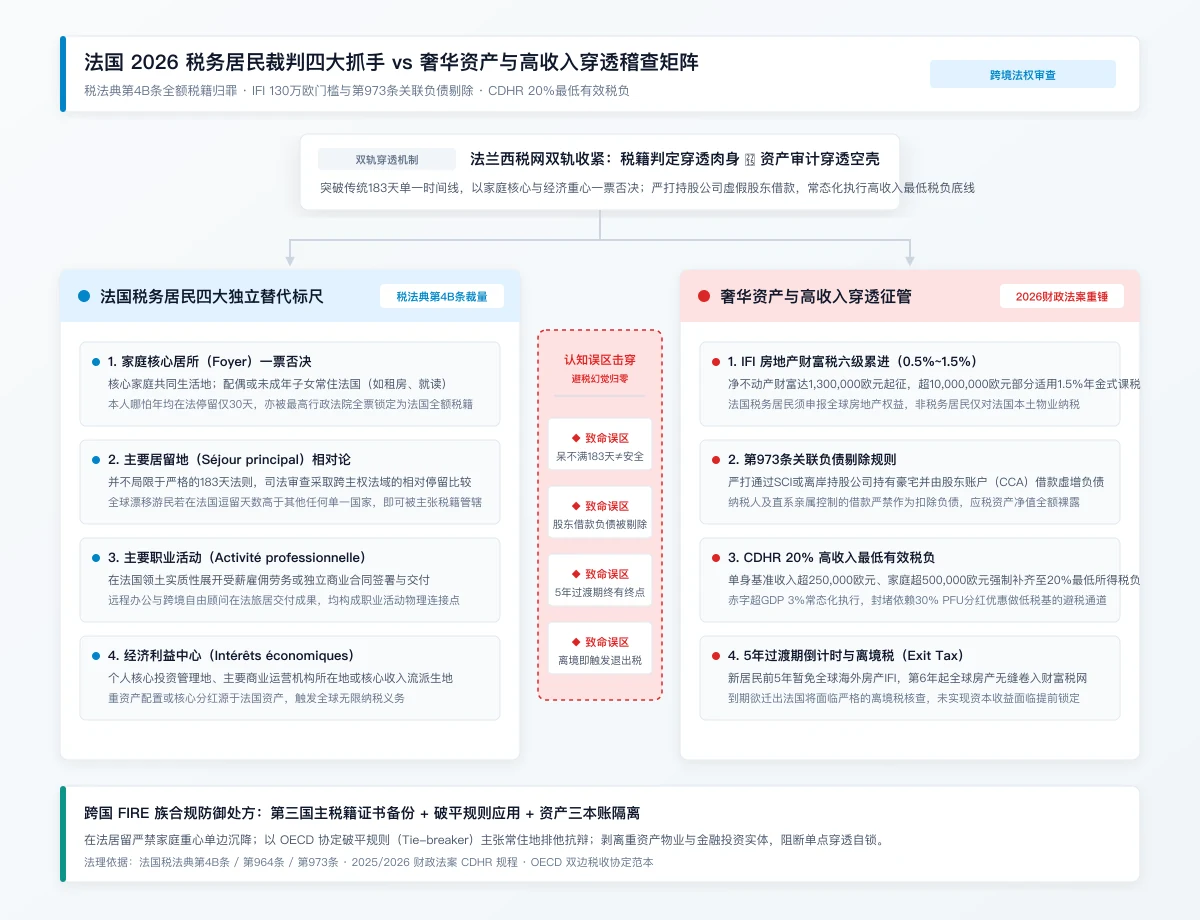
Figure 2: Four-dimensional tax residency evaluation under CGI Article 4 B and the IFI asset look-through decision framework.
3. The 2026 Fiscal Mandate: The 20% CDHR Floor and the 5-Year Expat Trap
Faced with mounting fiscal deficits, France introduced in 2025—and codified permanently in the 2026 Finance Act—the High-Income Differential Contribution (Contribution Différentielle sur les Hauts Revenus, CDHR). This mechanism is explicitly designed to prevent high-net-worth individuals from using tax credits or flat-rate regimes to dilute their tax liabilities.
Under standard rules, capital gains and dividends are taxed at a 30% flat rate (Prélèvement Forfaitaire Unique, PFU—comprising 12.8% income tax and 17.2% social charges). The CDHR imposes an absolute floor: for single taxpayers with baseline incomes exceeding €250,000 (or €500,000 for married couples), their effective personal income tax rate must reach a mandatory 20% floor. As long as the French national deficit remains above the European Union’s 3% threshold, the CDHR operates as a permanent fiscal levy. For FIRE investors relying on concentrated equity liquidations or dividend yields, complex tax deductions can no longer push effective taxation below this threshold.
An equally dangerous trap lies in the temporary 5-year IFI exemption for new residents. Under transitional rules, individuals who were non-French tax residents for the five calendar years preceding their move enjoy a five-year exemption on foreign real estate for IFI purposes.
This temporary shield creates a false sense of security. In the sixth tax year, global real estate titles automatically become subject to French IFI reporting. Should the investor attempt to sell off assets and relocate offshore at that point, they trigger France’s aggressive Exit Tax provisions, which assess and tax unrealized capital gains and cross-border equity holdings upon departure.
4. Wealth Defense for the Global FIRE Movement: Building Multi-Jurisdictional Architecture
In an era of European fiscal consolidation and automated tax data sharing, relying on informal timing strategies or shell entities is a structural mistake. Navigating cross-border FIRE requires a rigorous legal architecture spanning multiple jurisdictions:
1. Leveraging Double Taxation Treaties (DTA Tie-Breaker Rules)
Operating without the backing of a bilateral Double Taxation Agreement (DTA) creates unmitigated exposure. When two sovereign states claim an individual as a tax resident, international law resolves the dispute via the standard OECD Tie-Breaker hierarchy: Permanent Home $\rightarrow$ Center of Vital Interests $\rightarrow$ Habitual Abode $\rightarrow$ Nationality. Before securing housing in France, investors must establish an indisputable Tax Residency Certificate (TRC) in a primary jurisdiction to neutralize unilateral enforcement under Article 4 B CGI.
2. Hedging Sovereign Debt Cycles
As detailed in our analysis of sovereign fiscal pressures in France’s Debt Turmoil and the FIRE Hedging Guide, deficit-burdened states will consistently target mobile capital over domestic wage earners. Recognizing this institutional bias is essential to protecting capital from sovereign wealth transfer.
3. Exploring Alternative European Jurisdictions
For individuals seeking an European lifestyle without heavy capital extraction, jurisdictional design matters. As explored in Portugal Golden Visa CRS Cross-Border Tax Audit 2026, while broad tax amnesties are sunsetting across Europe, jurisdictions like Portugal and Cyprus maintain structural distinctions in how they treat foreign non-real-estate assets compared to France’s look-through framework.
4. Asset Class Segmentation and Legal Firewalls
True mobility relies on asset decoupling. Following the model outlined in The Three-Ledger Retirement Framework and Nomad Golden Visa Defense, cross-border FIRE practitioners must draw strict legal boundaries between personal consumption capital, core productive investments (low-cost global index funds, high-yield sovereign paper), and illiquid real estate. Personal residences should never be commingled with core investment capital under a single entity or jurisdiction.
In an era of automated, look-through tax enforcement, lasting financial independence requires respecting how sovereign states define residency and asset ownership. Abandoning improvisational tax strategies is the first step toward securing personal capital on the global stage.
Related Research & Topics
Tello Mobile eSIM
SafetyWing Nomad Insurance
* Disclosure: This post contains affiliate links. If you make a purchase through these links, V-G Journal may earn a small commission at no additional cost to you. We only recommend services we independently evaluate and trust.
FIRE and Golf:自由旅居之路
专注于为追求 FIRE 与品质生活的人群提供特惠打球权益与候鸟微度假。不持一砖一瓦,运营品质生活。