The Self-Strengthening Movement's Systemic Deadlock: Why Late Qing Acquired Warships, But Never Reformed Its Governance
This essay dismantles the simplistic post-hoc myth that the late Qing merely acquired Western technology without reforming its political system. It dissects the inevitable systemic deadlock of the Self-Strengthening Movement, tracing its roots from fiscal original sin and property rights vacuum to the irreversible strangulation by a privileged bureaucratic apparatus.

Curator’s Note: The most common epitaph for the Self-Strengthening Movement goes something like this: “They imported Western technology without importing Western institutions.” It rolls off the tongue nicely in a high school textbook. But as an account of what actually happened inside a collapsing empire’s political economy, it is pure armchair hindsight — the kind of verdict delivered by someone who imagines the late Qing statesmen sitting in an air-conditioned boardroom with a multiple-choice exam in front of them, pencils in hand, who saw the correct answer labeled “modern institutions” and, out of sheer stupidity and stubbornness, circled “steam engines and ironclads” instead. History never works that cheaply. Inside that riddled, privilege-saturated operating system of the late Qing, “importing institutions” was never a question of political will. It was a systemic deadlock — physically unrunnable at the hardware level.
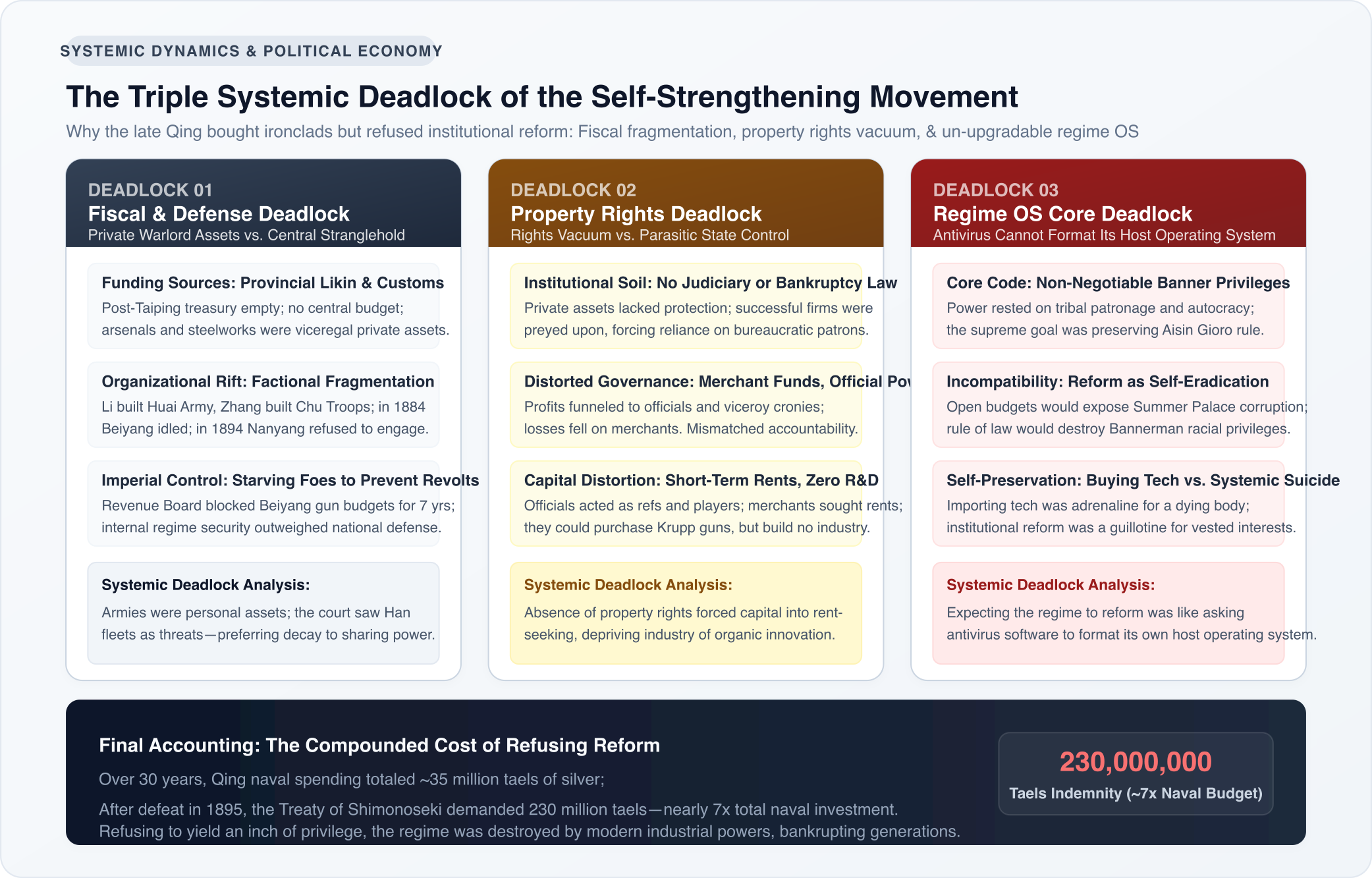
I. The Original Sin of Fiscal and Military Power: Not National Industrialization, But Warlord Reserves
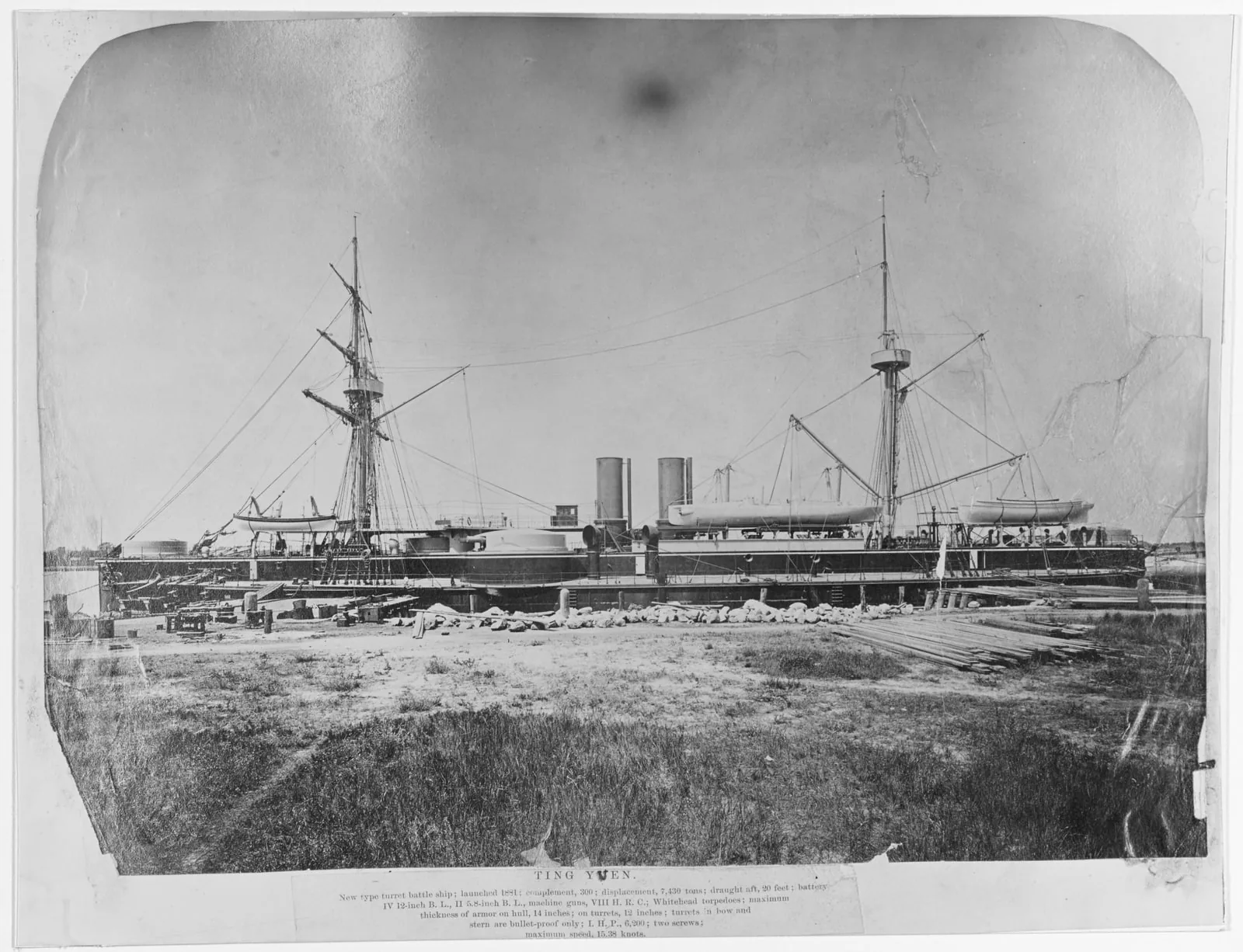 The Beiyang Fleet’s flagship, the ironclad Dingyuan. Nominally flying the Imperial Yellow Dragon Flag, it was in substance the private reserve of the Huai clique — sustained by likin tax revenue and customs duties controlled by the Viceroy of Zhili.
The first illusion that must be shattered when reading the actual fiscal ledgers of the Tongzhi and Guangxu reigns is this: the Self-Strengthening Movement was never a nationwide industrialization program directed by a centralized state.
After the Taiping Rebellion, the Qing central treasury was long since empty. The Board of Revenue could barely scrape together enough to pay the routine salaries of Beijing’s own officials. The men who actually took the field and ran the yangwu enterprises — Zeng Guofan, Li Hongzhang, Zuo Zongtang, Zhang Zhidong — were a cohort of Han provincial strongmen who had risen to power by suppressing the Taipings.
Building factories and buying warships required astronomical sums of silver. Where did the money come from? The central government couldn’t produce a single tael of dedicated appropriation. Every yuan of startup capital and ongoing costs was self-financed by the provincial governors within their own jurisdictions: first, the foreign customs receipts siphoned off from the coastal treaty ports; second, the “likin” — internal transit levies extorted from merchants at checkpoints along the inland trade arteries.
The funding source determined the nature of the assets: the Jiangnan Arsenal, the Hanyang Ironworks, the China Merchants’ Steam Navigation Company, and the Beiyang Fleet flew the Imperial Yellow Dragon Flag in name, but their underlying code was entirely the private chips and warlord property of the regional power brokers.
- Li Hongzhang’s painstaking cultivation of the Beiyang Navy and the Tianjin Machine Bureau was, at its core, about maintaining political leverage for the Huai clique;
- Zhang Zhidong’s iron-smelting and arms manufacturing in Wuhan was fundamentally aimed at arming his own Chu Army base;
- Zuo Zongtang’s founding of the Fuzhou Shipyard was likewise about building a logistical backstop for his Xiang-Chu military apparatus.
When cannons and warships are each faction’s private life insurance, there is simply no operational logic for coordinating a modern national defense system.
In the 1884 Mawei naval battle during the Sino-French War, the Fujian Fleet was annihilated to the last ship while the Beiyang Fleet, anchored just over the horizon, stood by in cold silence without moving a gun. Ten years later, when the Battle of the Yalu River opened the First Sino-Japanese War, the Nanyang Fleet likewise cited “separate defensive responsibilities” and watched from the sidelines as the Beiyang Fleet fought the Japanese Combined Fleet alone.
The more lethal undercurrent ran through the walls of the Forbidden City itself. Grand Secretary Weng Tonghe and his allies on the Board of Revenue cut off the Beiyang Navy’s funding for a full seven years — not a single new fast cruiser, not a single rapid-fire gun. Later popular accounts tend to reduce this to a personal vendetta between Li Hongzhang and Weng Tonghe, which entirely obscures the survival logic of the Qing ruling elite:
The true nature of the underlying conflict: The Manchu court harbored a bone-deep terror of Han viceroys building their own armed power base. The Board of Revenue’s use of “empty treasury” as pretext to starve the Beiyang Navy of men and materiel was not ignorance about the need to upgrade ironclad technology — it was the central power apparatus deploying the most primitive of mechanisms, the funding cutoff, to prevent the Han regional strongmen from slipping entirely out of control and turning on the dynasty.
Measured against the supreme imperative of preserving the Aisin Gioro family’s dynastic grip, national defense and military effectiveness had to stand down without a moment’s hesitation.
II. The Parasite Born of a Property Rights Vacuum: The Bloodsucking Loop of “Official Supervision, Merchant Operation”
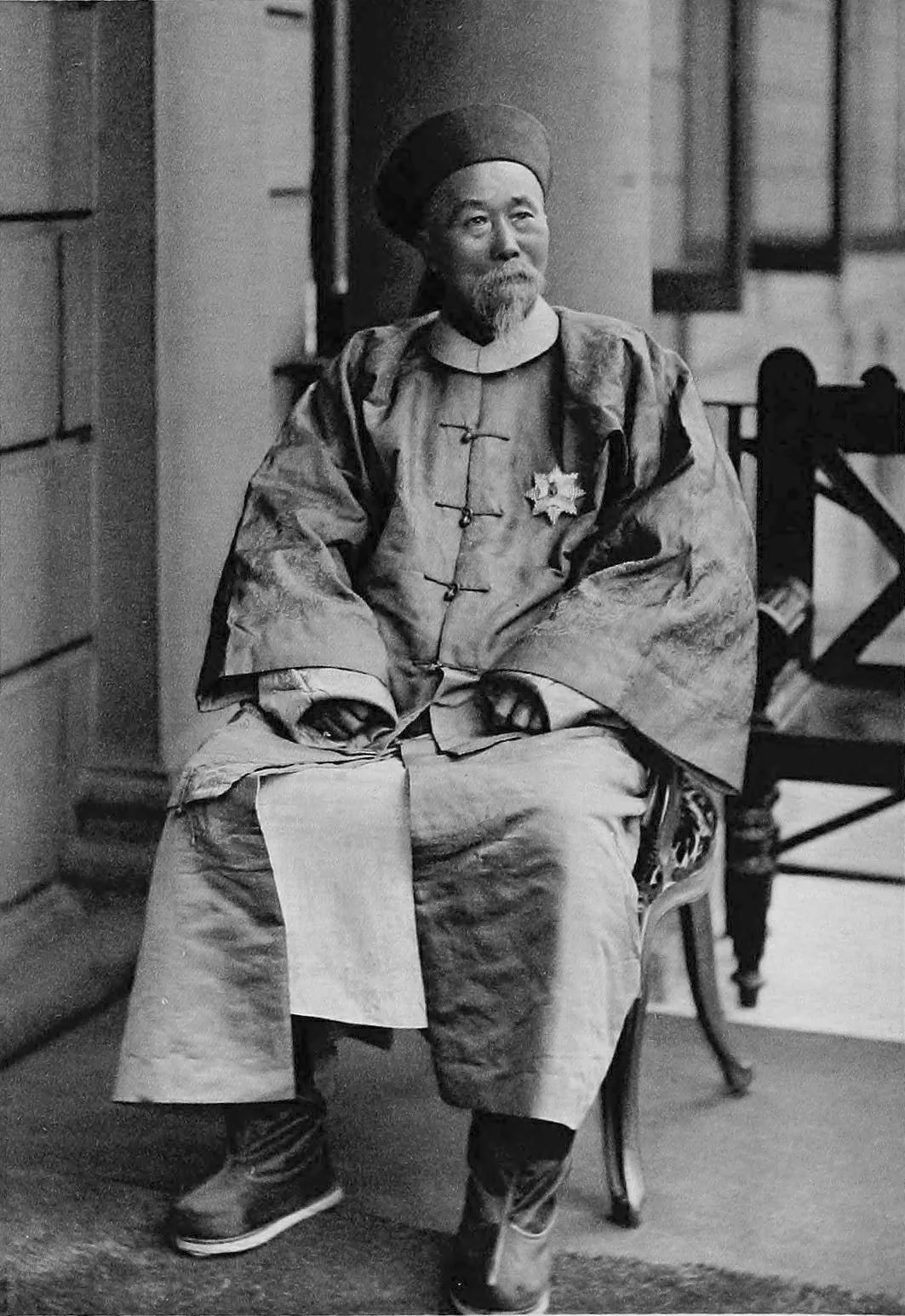 Li Hongzhang, Viceroy of Zhili and Superintendent of Trade for the Northern Ports. In an environment entirely without modern courts or bankruptcy law, “official supervision, merchant operation” became a grotesque hybrid of bureaucratic patronage power fused with distorted private commercial capital.
A second common objection runs: if the government treasury was bankrupt, why not simply open everything up to private enterprise — why not just take the path of genuine modern commercial capitalism?
The answer is equally brutal: the legal and property rights substrate of the Qing Empire lacked even the minimum conditions necessary for independent modern private enterprise to survive.
In a late Qing society with no independent judicial guarantees, no modern commercial code, and no bankruptcy law, any private industrial venture that grew large enough to show profit would be stripped to the bone — within three months — by the predatory assessments, extortion, and bone-gnawing levies of every layer of local officialdom. Private capital dared not, and structurally could not, invest independently in heavy industry. The only viable escape routes were: fly a foreign flag and shelter under consular jurisdiction, or prostrate oneself before a provincial viceroy and beg for political cover.
This structural defect bred the “guandu shangban” (official supervision, merchant operation) system — the peculiar grotesque of the late Qing era.
Take the China Merchants’ Steam Navigation Company, founded by Li Hongzhang, as a case study:
- Decoupled investment and management: Private merchants put up real silver to buy commercial shares, while the government installed expectant magistrates and prefects — men whose credentials were a peacock feather and a button — as general managers with sole command authority;
- Profit distribution and risk transfer: When there were operating surpluses, the first claim went to greasing every rung of the bureaucratic ladder with kickbacks and privilege dividends; when the enterprise hemorrhaged losses, the officials walked away clean while the merchant shareholders absorbed every cent;
- Parasitic overstaffing: The Company’s payroll was stuffed with the viceroys’ hometown cronies, household advisers, relatives, and failed examination candidates. An expectant circuit intendant with zero knowledge of modern navigation or commerce could sit in an official yamen and draw several hundred taels of public funds per month in dry salary.
The engine of a modern enterprise system — the engine that actually releases productive capacity — runs on clear property rights, limited liability, and market competition.
But in the late Qing commercial experiment, bureaucrats simultaneously wrote the exclusive rules of the game, served as de facto custodians of enterprise assets, and retained the power to overturn the table and confiscate everything in the name of moral authority. Merchants bought in at knifepoint. What they were after was never patient long-term industrial accumulation or technical R&D — it was how to leverage the viceroys’ monopoly privileges to extract fast money in one sweep.
This underlying logic of profit-sharing could purchase a ready-made British ironclad or a German Krupp cannon. But it structurally sterilized every last cell of any endogenous, self-sustaining modern industrial capacity.
III. Systemic Architecture Deadlock: The Antivirus Cannot Format Its Own Host OS
Viewed through the lens of systems architecture, “importing institutions” was never a reform option — it was a fatal deadlock at the system level.
Modern political and market institutions — open parliamentary budget review, independent judicial adjudication, inviolable private property rights, modern central banking and unified national taxation — are not standalone hardware modules you can plug into an old chassis at will. They are an entire tightly interlocked operating system kernel that rewires the underlying distribution of power throughout the machine.
What was the source code of the Qing dynasty’s old machine? It was “Bannerman livelihoods must not be abolished; all power under heaven belongs to one clan” — absolute monarchical autocracy rooted in tribal blood patronage, personal bondage, and privileged extraction.
The highest-priority system process of this OS, from first boot to final crash, was one and only one: guarantee the perpetual survival of the Aisin Gioro imperial house and the Manchu-Mongol aristocratic privilege class.
Run the logic forward once: if the late Qing statesmen had actually launched a full-scale importation of “modern institutions,” what would have happened to this machine?
| Modern Institutional Element | Systemic Chain Reaction upon Introduction | Actual Shock to the Late Qing Ruling Class |
|---|---|---|
| Parliamentary open review of the national budget | The Board of Revenue’s diversion of Beiyang Navy funds to rebuild the Summer Palace would have been impeached and prosecuted on the spot; every item of Imperial Household expenditure would have been exposed to the public record. | The throne could no longer treat state funds as a private garden account at will; the credibility of autocratic power would have collapsed immediately. |
| Independent judiciary and private property protection | The privileged channels for Banner clan land seizures, official embezzlement, extortion, and arbitrary assessment would have been legally severed at the root. | Millions in the parasitic Banner class would lose their extra-legal survival privileges; the core tribal base the Manchus depended on for rule would dissolve overnight. |
| Free-competition modern commercial law | The officially monopolized salt, iron, and grain transport franchises; inland likin checkpoints; and licensed-rent extraction systems would have collapsed on the spot. | The patronage pool that sustained the loyalty of provincial viceroys and the entire bureaucratic apparatus would have run completely dry, bringing the official machinery to a halt. |
The point becomes clear: there was no shortage of clear-eyed observers at the time, both at court and in the provinces. They were not ignorant of how effectively Western institutions functioned. The Qing dynasty’s operating system was simply physically incompatible with a self-upgrade.
Asking a clique that sustains its rule through tribal privilege and feudal patronage to actively push through modern institutional reform is the equivalent of asking the antivirus software running on an old computer to format the very host operating system on which it runs.
For the imperial household and the Manchu-Han power elite of the era:
- Importing Western technology: was injecting a cardiac stimulant into a decaying, disease-ridden body — incapable of a cure, but capable of buying a few more years of survival;
- Importing modern institutions: was voluntarily removing one’s own armor, and stepping onto the political scaffold that would strip the existing holders of privilege of everything they had.
Faced with that survival calculus, they chose the former without a moment’s hesitation. This was not the “ignorance and obstinacy” of a scholar’s pen. It was the rational, inevitable calculation of an interest group.
IV. The Deferred Bill of the End Game
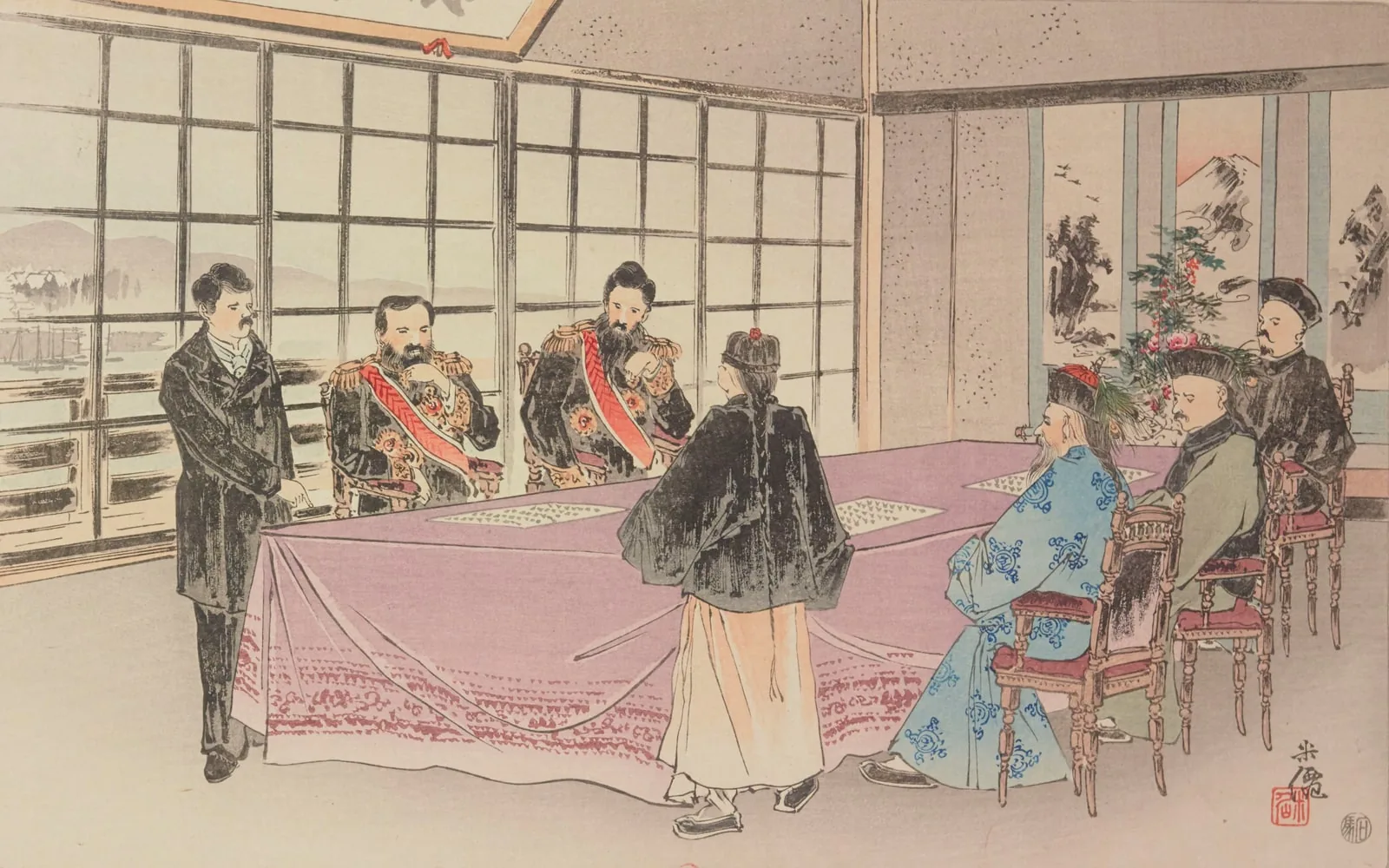 April 17, 1895: the signing ceremony of the Treaty of Shimonoseki at Shunpanrō. Refusing to yield even a sliver of privilege at the level of foundational institutions and property rights — the ultimate price was 230 million taels of silver.
When war broke out in 1894, the fires on the Yellow Sea and the warships sinking beneath the waves consumed not only the Zhiyuan and the Dingyuan. They incinerated thirty years of patched-up, stopgap bookkeeping — the entire parasitic ledger — and reduced it to ash.
The Beiyang Fleet that Li Hongzhang had spent more than three decades building from scratch was met with a dimension-reduction annihilation at the hands of a modernized Japan that had cleared its own privilege class, established a modern state mobilization apparatus, and unified its national taxation system.
Final accounting of the end game: Over the thirty years of the Self-Strengthening Movement, the Qing court’s total expenditure on Beiyang Navy armaments, warship procurement, and base construction amounted to approximately 35 million taels of silver; The Treaty of Shimonoseki, signed after the catastrophic defeat, imposed war reparations and territorial ransom payments totaling 230 million taels of silver. 230 million taels — nearly 7 times the Beiyang Fleet’s entire thirty-year operating cost, equivalent to roughly three full years of the Qing government’s total fiscal revenue at that time.
Refusing to cede a single sliver of privilege at the level of foundational institutions and property rights protection. Refusing to grant the Han viceroys any legitimate modern fiscal authority. Deploying the funding cutoff out of a terror of internal betrayal. The historical settlement that came due for all of this — compounded, with interest — was the pulverization of the blood, sweat, and marrow of multiple generations of an entire nation, handed over to the competition on a silver platter.
History never honors the mythology of the “one fateful misstep.” It is, and has always been, a cold and implacable game-theoretic algorithm: when a system’s supreme objective is to protect parasitic privilege rather than raise overall productive capacity, any single-front advance at the technological level will ultimately be strangled in the deadlock and driven toward irreversible systemic collapse.
Related Research & Topics
Tello Mobile eSIM
SafetyWing Nomad Insurance
* Disclosure: This post contains affiliate links. If you make a purchase through these links, V-G Journal may earn a small commission at no additional cost to you. We only recommend services we independently evaluate and trust.
FIRE and Golf:自由旅居之路
专注于为追求 FIRE 与品质生活的人群提供特惠打球权益与候鸟微度假。不持一砖一瓦,运营品质生活。