Contractual Spirit and the Myth of Ethical Trust: The Institutional Logic of Commercial Reliability
The perceived decline in contractual spirit is not a moral failing but an institutional mismatch. This essay deconstructs the tension between traditional Confucian 'relational trust' and modern legal contracts, arguing that market reliability depends on property rights, limited state power, and effective judicial recourse.

Editor’s Note: A common refrain in contemporary discourse is: “Without trust, a society cannot stand. Why has our society lost its contractual spirit?” This inquiry rests on an unexamined assumption—that we once possessed a mature contractual culture and somehow misplaced it during modernization. From the perspective of institutional economics, this is a fundamental category error. The “moral trust” of traditional patriarchal ethics and the “contractual spirit” underpinning modern commercial civilization are products of entirely different governance systems. Confusing moral preaching with legal obligation does not build market trust; it merely obscures the structural pillars upon which contracts must rest.

Figure 1: John Locke (1632—1704), whose “Two Treatises of Government” established the foundations of private property, social contract theory, and limited government—the bedrock of modern legal-contractual civilization.
I. The Conceptual Mismatch: Relational Ethics vs. Legal Contract
Confucian classics emphasize that “without trust, one cannot stand,” and Legalist thinkers like Shang Yang famously demonstrated the power of credibility through the “shifting of the pole.” Yet, the “trust” found in these classical narratives is fundamentally distinct from the “contractual spirit” required by a modern market economy.
1. Relational Hierarchies vs. Legal Equality
The prerequisite for a modern contract is the absolute equality of the contracting parties’ legal personhood. A contract binds the powerful as rigidly as it binds the weak; no external authority may unilaterally declare a contract void.
In contrast, traditional agrarian society was embedded in what sociologist Fei Xiaotong termed “differential modes of association” (chaxu geju). Relationships were defined by bloodlines and hierarchical status. Obligations were unidirectional—flowing from subject to sovereign, or child to parent. In the face of patriarchal or imperial authority, individual commitments were always subordinate to moral obedience. When parties lack fundamental equality, their agreements are not contracts, but instruments of submission.
2. Reputation vs. Institutional Rigidity
Traditional trust relied on the closed loops of village life and clan law. In a low-mobility society where everyone knew everyone, the cost of “breaching faith” was social death. This was a byproduct of repeated games in a small circle, not a belief in abstract rules.
Once industrialization and urbanization shattered these networks, individuals entered a world of anonymous, large-scale collaboration. When the reputation-based chain of the village breaks, moral exhortation alone cannot sustain trust. Without rigid, external legal enforcement, the system inevitably collapses under the weight of individual opportunism.
II. The Three Pillars of Modern Contractual Spirit
Contractual spirit is not the result of saintly advice; it is an equilibrium forced by the logic of incentives and institutional costs. A promise without institutional backing is fragile when faced with real-world interests.
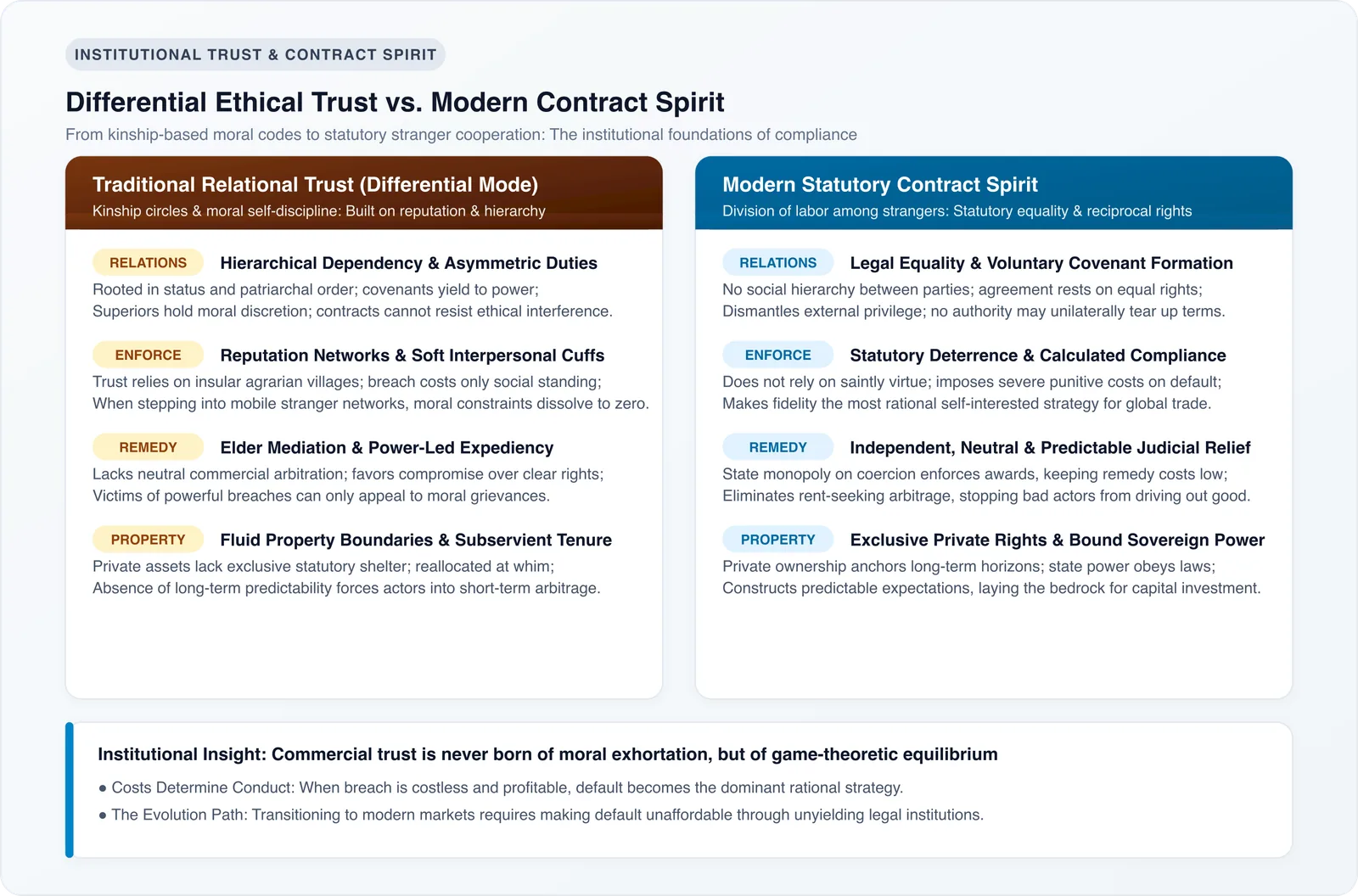
Figure 2: The core dimensional contrast between traditional relational trust and modern legal-contractual spirit.
1. Exclusive Protection of Private Property
The economic essence of a contract is the legitimate transfer and intertemporal exchange of property rights. If the boundaries of private property are blurred—subject to “the greater good” or arbitrary seizure—long-term contracts lose their anchor.
“Those without secure property have no steady heart.” When the future is uncertain, the optimal strategy for market participants shifts to short-term extraction and opportunistic breach. In environments where property rights are insecure, the system effectively punishes the long-term player and rewards the short-term defector. Breach is not a moral failing; it is a rational hedge against an insecure environment.
2. The Constraint of Public Power
The ultimate litmus test for a contractual society is whether the state itself is bound by the rule of law.
If the most powerful actor is exempt from procedural constraints—if industrial policies shift overnight or administrative directives override civil contracts—it creates a destructive top-down demonstration effect. When the public witnesses the powerful tearing up commitments without consequence, the “law of the jungle” is internalized: rules become chains for the weak, while breach becomes a privilege of the strong.
3. Independent, Neutral, and Efficient Judicial Recourse
Contracts are enforced not by the conscience of the parties, but by the predictable cost of breach.
In a mature legal market, breach triggers punitive damages and credit-system exclusion. However, if the cost of seeking justice—legal fees, protracted litigation, and enforcement failures—exceeds the value of the claim, the system effectively subsidizes the breacher. When keeping a contract becomes a net liability, the market inevitably suffers from “Gresham’s Law,” where bad behavior drives out the good.
III. The Structural Distortion of the Transition Period
The current public frustration with broken promises stems from structural distortions in our transition:
| Dimension | Institutional Reality | Behavioral Distortion | Impact on Contractual Environment |
|---|---|---|---|
| Social Structure | Collapse of clan networks; rise of anonymity | Loss of reputation-based constraints | One-off games replace repeated games; moral self-discipline fails |
| Cost of Justice | High cost of litigation; enforcement gridlock | Expected gain from breach > risk of penalty | Rational actors test the limits of breach |
| Power Imbalance | Monopoly platforms; unilateral rule changes | Asymmetric information and bargaining power | Formal consent masks substantive coercion |
| Exit Rights | Lack of viable alternatives for the weak | Forced compliance or passive-aggressive breach | Legitimate game theory fails; turns into subversion |
IV. The Fallacy of “Moral Decline”
There is a lazy tendency to attribute all commercial fraud and debt defaults to “the decline of public morality.” This reverses cause and effect:
- Opportunism is Universally Distributed: The human drive to maximize gain and minimize cost is constant. No culture is born with a “contractual gene.”
- Contractual Civilization is a Product of Deterrence: People in rule-of-law societies keep contracts not because they are inherently more virtuous, but because the institutional cost of breach is prohibitively high. Keeping the contract is simply the most rational, cost-effective strategy.
- Moral Appeals Without Institutions are Castles in the Sand: Demanding that market participants act on “conscience” in an environment where property rights are insecure and judicial recourse is a nightmare is akin to asking a prisoner to sacrifice himself in a rigged game.
V. The Path to Rebuilding Trust
Rebuilding a healthy commercial environment requires shifting from moralizing to institutional engineering. We are not “losing” an ancient virtue; we are struggling through the deep waters of transitioning from “relational self-discipline” to “legal-contractual civilization.”
The path forward requires:
- Realigning the Cost of Breach: Introduce punitive damages and streamline enforcement to ensure that malicious breach is economically ruinous.
- Binding the Powerful: Establish the principle of statutory property rights and administrative boundaries. Prohibit the arbitrary overturning of civil contracts by administrative fiat.
- From “Flexibility” to Certainty: Abandon the “relationship-first, mediation-always” mindset. Make procedural justice and contractual terms the indisputable standard for resolution.
Contractual spirit is not a decorative ornament; it is the byproduct of clearly defined boundaries between individual rights and limited power. Only when the system acts as armor for the keeper of contracts and a blade for the breaker can commercial trust evolve from a fragile sentiment into an unshakable social foundation.
Related Research & Topics
Tello Mobile eSIM
SafetyWing Nomad Insurance
* Disclosure: This post contains affiliate links. If you make a purchase through these links, V-G Journal may earn a small commission at no additional cost to you. We only recommend services we independently evaluate and trust.
FIRE and Golf:自由旅居之路
专注于为追求 FIRE 与品质生活的人群提供特惠打球权益与候鸟微度假。不持一砖一瓦,运营品质生活。