The Exile of Wang Hai: Institutional Capture and the Liquidation of Private Watchdogs
In late 2026, Wang Hai—China’s premier consumer rights investigator for over three decades—fled into overseas exile. His cross-provincial pursuit by local police exposes how municipal power structures weaponize criminal statutes to liquidate private civil rights intermediaries and protect local balance sheets.

Executive Summary: On October 11, 2026, an exclusive interview by former investigative journalist Wang Zhian confirmed the unthinkable: Wang Hai, the vanguard of private consumer advocacy and counterfeit enforcement in China for thirty-one years, fled into overseas exile on August 26. In the preceding weeks, local police from Dalian executed a sweeping, cross-provincial takedown: his Beijing testing laboratory was raided with dozens of staff carted away by the busload, legal counsel was arrested across provincial lines, and thirty bank accounts were frozen. The charge across every warrant was identical: “picking quarrels and provoking trouble.” The flashpoint was not a high-profile influencer dispute, but sixteen hundred acres of dead cherry orchards in Wafangdian—and the fatal friction generated when a private rights-defense enterprise breaches a local state-business coalition.
On October 11, 2026, following weeks of radio silence, China’s original commercial counterfeit fighter Wang Hai resurfaced publicly on the current affairs program Ju Mian. The public learned what insiders had feared: after thirty-one years navigating the sharpest edges of private rights defense, the 53-year-old had quietly fled mainland China alongside his family on August 26 to seek shelter abroad.
What followed his departure was a textbook campaign of structural decapitation. His chief assistant was intercepted by border control and criminally detained; the retained attorneys representing aggrieved farmers were arrested across provincial borders; an entire busload of dozens of testing technicians and administrators was hauled away from his independent laboratory in Beijing; a veteran agricultural investigative journalist overseeing case vetting was taken into custody in Xiamen; more than thirty corporate and personal bank accounts were frozen; and the primary cherry farmers who had initiated the petition found themselves behind bars.
Every warrant issued by the Wafangdian and Dalian police bore the same omnibus statutory rubber stamp: picking quarrels and provoking trouble (寻衅滋事).

Figure 1: Wang Hai, the defining figure of private anti-counterfeiting in China. His signature sunglasses, worn for three decades, functioned both as a physical shield against retributive violence and as a visual metaphor for the perilous equilibrium between private litigation and sovereign power.
Public discourse frequently defaults to thirty-year-old moralistic cliches: Is Wang Hai an altruistic champion of the consumer, or a mercenary profiteer? Does purchasing counterfeit goods with advance knowledge forfeit the moral high ground? These debates completely misdiagnose the crisis.
Wang Hai’s collapse and subsequent exile is not the routine downfall of an aggressive online watchdog. It is a quintessential case study in institutional economics, the micro-foundations of local state-corporate cartels, and the asymmetric weaponization of public authority against private mediation.
I. The Orchards of Wafangdian: When Redress Threatens the County Balance Sheet
The epicenter of this confrontation was not the algorithmic theater of live-streaming commerce, but the orchard beds of Wafangdian, a county-level city under Dalian, Liaoning Province.
Beginning in 2022, local cherry growers applied a line of specialized agricultural inputs marketed under the “Cherry Sister” brand, distributed by the politically entrenched Dalian Dianlong Agricultural Inputs Co. Within weeks of application, over 1,600 mu (approximately 260 acres) of mature, high-yield cherry trees withered and died. Certified forensic appraisals pinned direct economic damages north of 50 million RMB ($7 million USD). For agrarian households whose multi-decade capital cycles are sunk entirely into orchard yields, the sudden death of mature trees represented the catastrophic erasure of family balance sheets for an entire generation.
Faced with stonewalling from local administrative bureaus, the desperate farmers turned to Wang Hai’s firm.
Wang’s commercial machinery has never hidden its economic model: minor consumer claims operate on statutory bounty splits, while complex class-action commercial torts operate on a contingency-fee, litigation-funding basis. Wang’s team fronted upwards of one million RMB of their own capital to finance evidentiary filings, logistical operations, independent chemical testing, and top-tier civil litigation, while bringing in veteran agricultural investigative journalist Hong Guangyu to enforce factual discipline on public disclosures.
| Metric / Stage | The Wafangdian Agricultural Input Dispute |
|---|---|
| Aggrieved Parties & Scope | Hundreds of farming households; >1,600 mu of prime cherry orchards destroyed |
| Appraised Damages | Direct economic losses exceeding 50 million RMB; long-term operational cash flows zeroed |
| Private Litigation Model | Wang Hai team advanced >1 million RMB in self-funded costs via contingency-fee risk proxy |
| Official Inquiry Finding | Local governmental task force ruled “fungal root rot,” conspicuously lacking agronomist signatures |
| Statutory Relief Pursued | Formal applications for administrative reconsideration, administrative lawsuits, civil product liability torts |
Under the theoretical assumptions of a mature rule-of-law marketplace, this constituted a textbook product liability tort. It ought to have been resolved through forensic discovery, cross-examination of expert witnesses, and civil tort jurisprudence.
Instead, the dispute rapidly shattered the boundaries of civil procedure:
- A municipal task force concluded the trees died of “unrelated fungal blights”—a report conspicuously lacking the signature of any accredited agronomist, while ignoring adjacent plots that had used competing inputs and remained entirely undamaged.
- The defendant company enjoyed unbroken legal dominance locally. In one instance, a farmer who published a critical post that generated barely one hundred impressions was ordered by a local court to pay over 200,000 RMB in corporate defamation damages.
- When Wang Hai’s team exhausted administrative reconsiderations, freedom-of-information filings, and public interest disclosures to compel regulatory intervention, they tripped the tripwire of the local state-business protection umbrella.
In the micro-anatomy of county-level economies, enterprises embedded in the local fiscal machinery—supplying tax receipts, regional employment, and patron-client ties—are synonymous with administrative stability. When an outside investigative enterprise attempts to breach that perimeter and claw back 50 million RMB in actual damages, it is no longer mounting a civil claim against a corporate peer. It is triggering the defensive reflexes of the local municipal apparatus itself.
II. The Architecture of Cleansing: Asymmetric Criminalization
Between the initial leak from an insider in late August 2026 and the coordinated police sweep across multiple provinces in September, the operation against Wang Hai’s network displayed devastating operational economy:
- Severing Legal Representation: Retained litigation attorneys Huang Youqi and Chen Tao were taken into custody via cross-provincial arrests, paralyzing ongoing civil filings.
- Cutting Information Conduits: Former investigative journalist Hong Guangyu was seized in Xiamen to extinguish journalistic coverage.
- Dismantling Forensic Infrastructure: A chartered bus was dispatched to Wang Hai’s independent testing laboratory in Beijing, seizing physical apparatuses and detaining testing personnel en masse, effectively destroying evidentiary production capacity.
- Financial Exsanguination: Thirty personal and institutional bank accounts tied to Wang Hai and his circle were frozen, terminating payroll and litigation capital.
- Inverting the Status of the Injured: Four lead cherry farmers who organized the original petition were placed in criminal detention, executing a clean inversion from victim to offender.
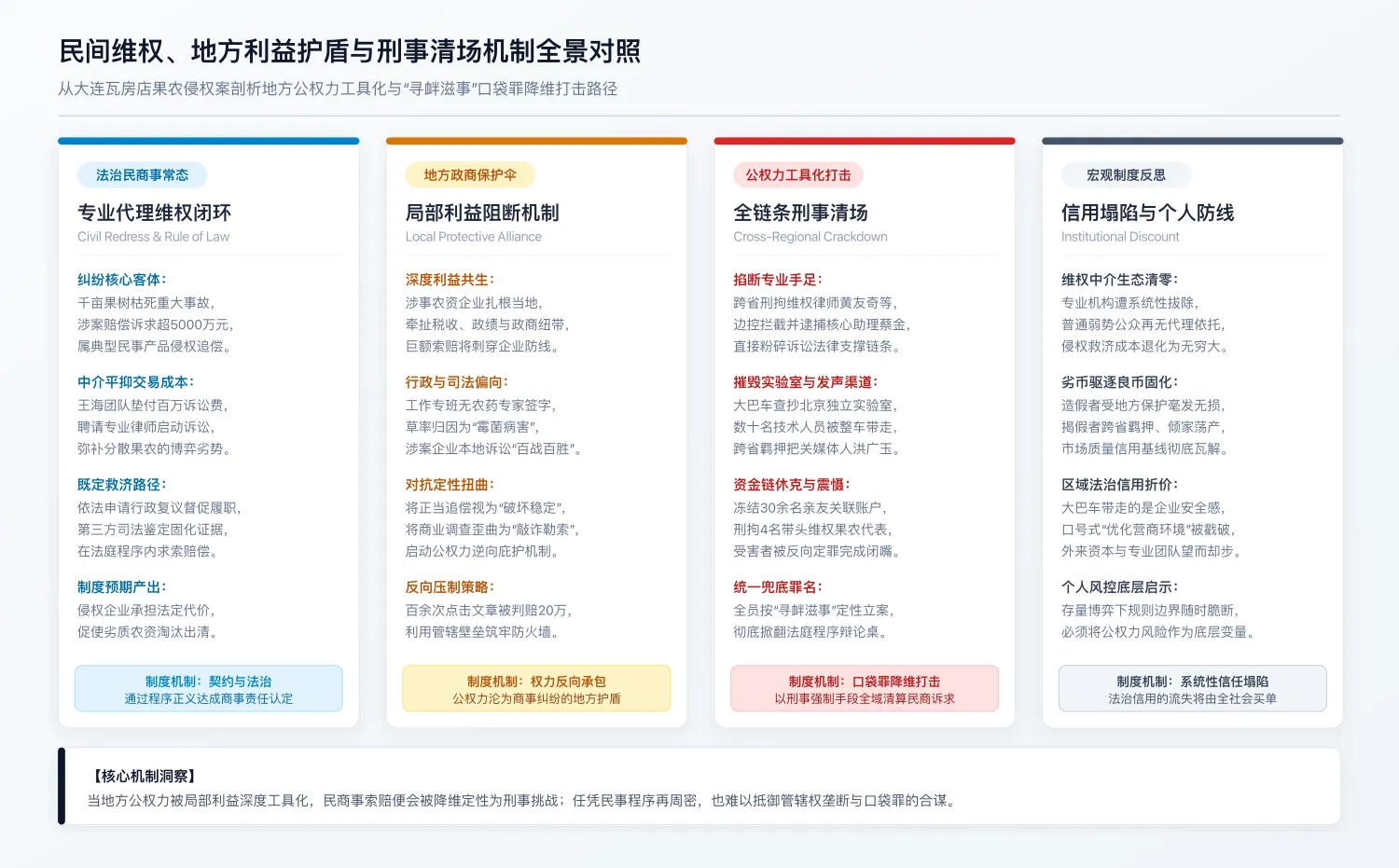
Figure 2: The systemic escalation path from civil tort mediation to jurisdictional weaponization and criminal elimination. When local fiscal entities face crippling liability, public enforcement machinery is deployed to overwrite civil jurisprudence entirely.
The strategic core of this sequence is obvious: the deliberate, unilateral escalation of a civil contract and product liability dispute into a criminal “public order” violation. By criminalizing the plaintiffs’ ecosystem, the state monopoly on violence flips the civil game board, rendering evidence and procedural due process utterly moot.
Modern corporate literature often treats compliance manuals and technical statutory fidelity as impenetrable shields. Wang Hai’s downfall exposes the harsh operational reality: in the absence of robust, cross-jurisdictional checks and balances, hyper-localized commercial disputes invariably see sovereign enforcement “subcontracted” by parochial economic cartels. As explored in parallel analyses regarding the systematic vulnerability of independent commercial benchmarking, whenever an independent watchdog lacks the institutional buffer of an impartial, extra-territorial judiciary, technical proficiency collapses against local administrative fiat.
Wang Hai understood every inch of Chinese civil jurisprudence. He built his strategy strictly within statutory lines. But he could not solve the fatal paradox of private enforcement under municipal capture: You recite the statutes to them; they cite their jurisdictional sovereignty to you. You confront them with forensic exhibits; they answer with the penal code.
III. The Liquidation of Redress: Systemic Deadweight Loss
The physical exile of Wang Hai and the systemic dismantling of his investigative network leave deep structural scars on the Chinese commercial landscape.
1. The Destruction of Specialized Rights Intermediation
A mature market economy relies on specialization not merely in production, but in the mechanisms of legal redress. The solitary consumer or farmer faces structural, asymmetric disadvantages in information, capital, and legal literacy when confronting concentrated corporate entities.
Professional watchdogs and contingency-funded private investigators serve a vital macro-function: they utilize financial leverage to absorb the crippling transaction costs of justice for fractured, atomized victims. If an organization possessing millions in operating reserves, elite evidentiary protocols, and thirty years of legal institutional memory can be liquidated overnight, the ordinary consumer is left entirely defenseless. Redress reverts to an operational dead end.
2. Structural Gresham’s Law: Subsidizing the Defective
Classifying legitimate damage claims as criminal disruption while shielding predatory manufacturers sends a corrosive economic signal to capital markets:
- The marginal cost of negligence and counterfeit manufacturing is compressed toward zero.
- The friction and transaction costs of investigative disclosure are elevated to bankruptcy, imprisonment, and forced exile.
When an institutional framework systematically penalizes the whistle-blower while indemnifying the bad actor, honest enterprises bearing high compliance costs are economically outcompeted by unprincipled rivals. Societal trust degrades exponentially.
3. The Permanent Repricing of Regional Rule-of-Law Risk
Municipalities expend immense marketing capital promising “optimized business environments” to attract external private investment. Yet true institutional credibility is not forged in municipal press conferences; it is tested when private economic interests directly challenge local monopolies.
The chartered bus that rolled into Beijing to empty Wang Hai’s laboratories did not merely detain technicians; it liquidated regional judicial credibility. Rational private capital and professional talent observing this case will naturally apply a punitive jurisdictional risk premium to any future deployment of assets in the region.
IV. Coda: Institutional Risk Profiles in a Zero-Sum Era
In 1995, a twenty-one-year-old Wang Hai walked into a Beijing department store, purchased two sets of counterfeit Sony headphones, and used the newly promulgated Consumer Protection Law to pioneer private anti-counterfeiting in post-reform China. For decades, official state media celebrated him as an iconic symbol of civic legal consciousness.
Three decades later, at fifty-three, that same pioneer was forced to pack his bags and vanish across an international border within forty-eight hours of an investigative leak.
The thirty-year arc is a grim institutional paradox.
For solo entrepreneurs, independent operators, and business owners navigating shifting macroeconomic terrain, Wang Hai’s flight is an unambiguous signal. As growth margins compress and regional economies slide into defensive, zero-sum dynamics, local administrative instincts grow increasingly aggressive. Traditional legal protections can be abruptly bypassed when challenged by stressed local budgets.
In managing any balance sheet, personal or commercial, systemic sovereign risk can no longer be treated as a marginal tail risk—it is the foundational baseline of any meaningful stress test.
When private dispute resolution demands exile as the price of survival, every municipal intervention to protect bad actors consumes the very institutional capital upon which the broader economy depends.
Related Research & Topics
Tello Mobile eSIM
SafetyWing Nomad Insurance
* Disclosure: This post contains affiliate links. If you make a purchase through these links, V-G Journal may earn a small commission at no additional cost to you. We only recommend services we independently evaluate and trust.
FIRE and Golf:自由旅居之路
专注于为追求 FIRE 与品质生活的人群提供特惠打球权益与候鸟微度假。不持一砖一瓦,运营品质生活。