The Silence of the Sensors: Auto Review Takedowns and the Systemic Death of Consumer Supervision
As independent automotive safety tests are systematically scrubbed from the internet, technical critique is increasingly weaponized as ideological betrayal. When corporate PR co-opts grand national narratives to silence feedback, it welds shut the market's pressure valves—inviting catastrophic systemic failure.

Executive Summary:
The automotive industry is a cold, unyielding calculus of physical laws and mechanical engineering. Braking distances, structural deformation, and thermal runaway thresholds are objective realities that should be settled by telemetry, crash test dummies, and reproducible data. Yet, the recent wave of takedowns targeting independent automotive reviews on platforms like Dongchedi reveals a far more insidious reality: when commercial competition parasitizes grand national narratives, technical scrutiny is swiftly reframed as moral treason.
As professional watchdogs are silenced by corporate legal machines and platform algorithms, the cost of speaking truth is externalized entirely onto the physical bodies of individual consumers. A system that seeks to engineer a sterile illusion of perfection by suppressing negative feedback does not eliminate physical risk; it merely welds shut the pressure valves, guaranteeing a catastrophic, brittle fracture down the line.
1. Ideological Weaponization: How “Labeling” Became the Ultimate Corporate Moat
In a healthy market, third-party testing is a rigorous, adversarial audit of engineering tolerances. Brake pedal bracket strength, A-pillar deformation, cold-weather battery degradation, and the erratic boundaries of autonomous driving systems—all of these are engineering problems with empirical answers.
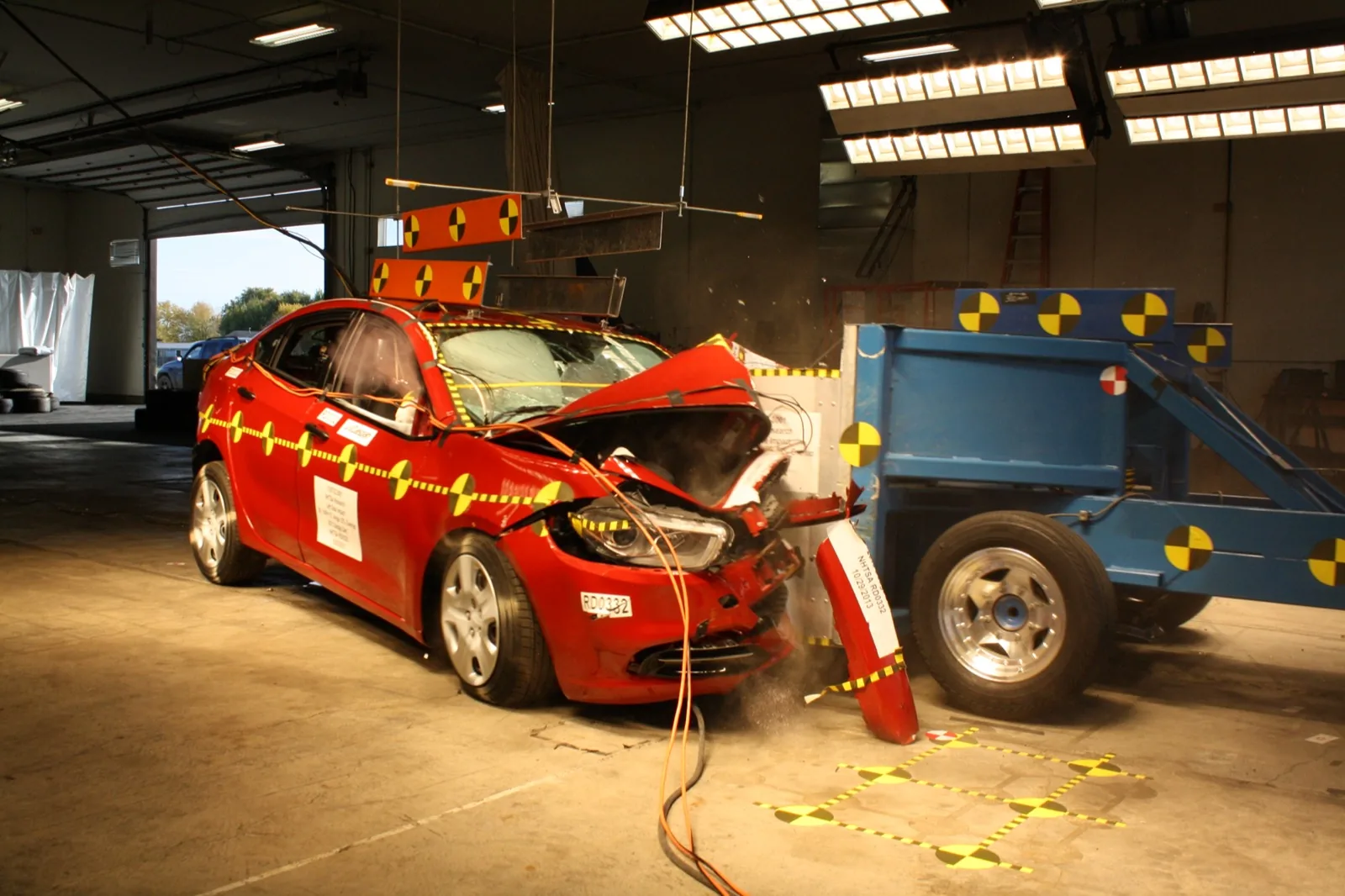
Figure 1: Passive safety crash testing. Industrial reliability answers only to the laws of physics; material fatigue and mechanical flaws cannot be wished away by PR rhetoric.
However, when commercial players wrap themselves in the flag of grand national narratives, ideological labeling becomes a highly efficient tool of asymmetric warfare to dodge engineering accountability:
- Delegitimizing the Critic: By branding objective product testing as “sabotaging national industry,” “ideologically compromised,” or “funded by foreign adversaries,” automakers bypass the need to defend their metallurgy or quality control. They instantly pivot a technical debate into a binary test of tribal loyalty.
- Shifting the Burden of Proof: The manufacturer’s duty to guarantee physical safety is quietly swapped for a loyalty test imposed on consumers and media. Anyone pointing out that the emperor has no clothes is stripped of their right to speak on moral grounds long before their technical data can even be audited.
As we have previously analyzed in the cold ledger of manufacturing and financial models, the real gap between industrial competitors is a matter of unit economics and engineering discipline. Replacing engineering proofs with ideological posturing not only insults the professional dignity of technical workers but builds an impenetrable PR moat around latent product defects.
2. Institutional Silence and Ecological Desertification: The Individual as the Ultimate Risk Absorber
When well-funded testing platforms choose to pull their videos under pressure, they are making a highly rational, cold-blooded cost-benefit calculation:
| Decision Path | Potential Reward | Realized Cost & Risk Exposure |
|---|---|---|
| Maintain Independent Testing & Hard Scrutiny | Preserving long-term credibility (delayed and difficult to monetize) | Algorithmic shadowbanning, ruinous defamation lawsuits, relentless legal warfare, and personal safety risks |
| Capitulate, Takedown, or Pivot to Sponsored PR | Lucrative advertising budgets and corporate procurement contracts | Complete loss of independence; degradation into a glorified PR megaphone |
When even dominant testing platforms—equipped with professional tracks, telemetry gear, and dedicated legal teams—cannot bear the marginal cost of telling the truth, the ecosystem of consumer supervision undergoes rapid desertification.
The barrier to entry for dissent is raised to an impossible height. An individual car owner facing a multi-billion-dollar corporate legal apparatus and its coordinated PR matrix is a statistically insignificant, isolated anomaly. Their cost of seeking justice is infinite; their expected return is near zero. When a catastrophic failure occurs—whether it is brake failure, un-deployed airbags, or sudden power loss—the owner is rarely met with engineering humility. Instead, they face a weaponized army of brand fanboys and a coordinated campaign to pathologize and discredit their claim.
As explored in the dynamics of mass psychology and crowd behavior, collective emotion is easily weaponized into an exclusionary cudgel. When professional institutions fall silent to survive, the safety net is pulled away, leaving the flesh-and-blood consumer to absorb the unmitigated physical consequences of engineering failures.
3. The Perversion of the Market Contract: Would You Buy a Car You Aren’t Allowed to Criticize?
The bedrock of market capitalism is contract enforcement and information symmetry, not unilateral emotional blackmail.
A brand that relies on takedown notices, comment moderation, and ideological labeling to maintain a “flawless” image is selling something coercive:
- Unsupervised Industrial Goods Inevitably Degenerate: Manufacturing is governed by cold physics. A snapped axle does not heal because a press release was beautifully written. Without the corrective pressure of external criticism, internal quality control inevitably yields to cost-cutting. When the cost of hiding a defect is lower than the cost of re-engineering the assembly line, cutting corners becomes the only “economically rational” choice.
- The Invisible Transfer of Liability: When you buy a vehicle that cannot be criticized, you are paying for more than just a machine; you are signing an implicit non-disclosure agreement on your own safety. In handing over your money, you actively surrender your right to know, your right to warn others, and your path to legal recourse.
- Adverse Selection in the Marketplace: If society tolerates this silencing mechanism, ethical manufacturers who invest heavily in safety and quality control will be outcompeted by PR-driven firms that excel at narrative manipulation and ideological bullying.
To reward brands that strip away your right to supervise them is to help lay the bricks of the prison walling you in. When every dollar spent becomes a vote for corporate arrogance, the market’s self-correcting feedback loops are dead.
4. The Dual-Track Feedback Model: Is a Silent System Safer or More Dangerous?
A silent alarm does not mean there is no fire; it usually means someone cut the wire.
Negative feedback and critical voices are the essential sensory receptors of any complex social system. By mapping the mechanics of market self-correction against PR-driven suppression, we can trace two divergent evolutionary paths:
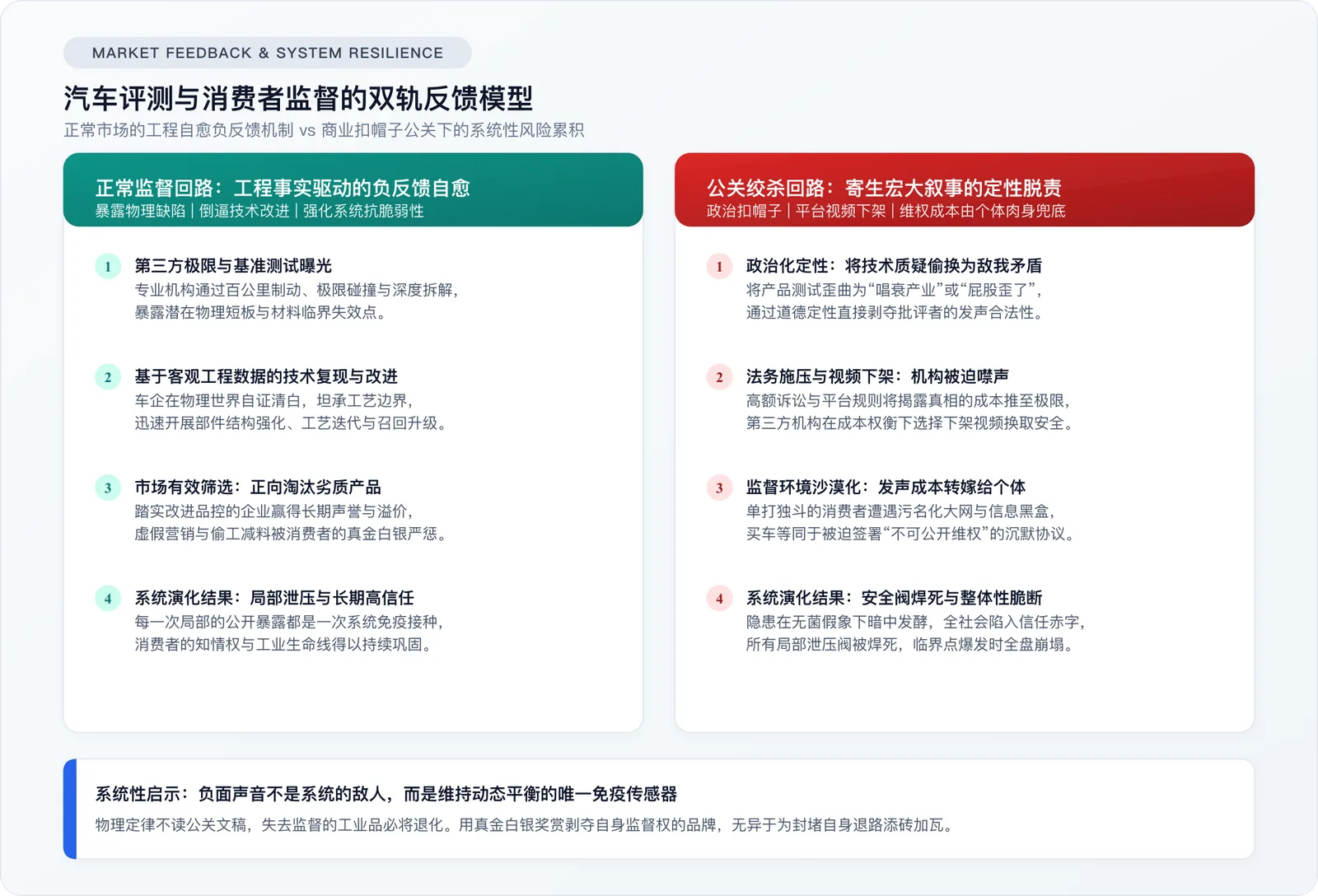
Figure 2: The dual-track feedback model of consumer supervision. Healthy markets rely on engineering negative feedback loops to self-correct; PR suppression and video takedowns dismantle supervision, quietly accumulating systemic risk toward a brittle fracture.
From the perspective of systems dynamics and information theory, eliminating negative feedback guarantees systemic collapse:
- The Illusion of Stability and Subterranean Risk: A sterile environment devoid of criticism offers a manicured, artificial certainty. But engineering flaws do not vanish because they are censored; they fester beneath the surface. Every suppressed brake failure, battery fire, or software glitch accumulates as unreleased tectonic stress.
- The Brittle Fracture of Welded Valves: Media exposure, consumer complaints, and independent testing are the pressure relief valves of an industrial society. When these valves are welded shut, the feedback loop breaks. Both executives and the public lose the ability to perceive the true state of the system. When the risk finally reaches its critical threshold, it does not release gradually; it manifests as a sudden, catastrophic, systemic failure.
- The Irreversible Trust Deficit: When public channels are saturated with mandatory praise, the public develops a deep, defensive skepticism: “Because I am forbidden from seeing any criticism, I can no longer believe the praise.” The cost of trust across society rises to an unsustainable premium.
5. Conclusion: Reclaiming Common Sense and Rational Choice
Independent watchdogs willing to speak out, commercial brands secure enough to accept scrutiny, and a public square that permits debate and error-correction—these are the anti-fragile pillars of a modern market economy.
For the individual navigating this landscape of weaponized narratives and severed alarm wires, the only viable survival strategy is simple: reject grand rhetoric, refuse to subsidize manufactured hysteria, and respect only the physical facts that can be openly reproduced.
The laws of physics do not read corporate press releases, and the principles of mechanics do not care about political alignment. Tolerating criticism is not just a safeguard for consumer lives; it is the only antidote to the systemic brittle fracture of an entire industry.
Related Research & Topics
Tello Mobile eSIM
SafetyWing Nomad Insurance
* Disclosure: This post contains affiliate links. If you make a purchase through these links, V-G Journal may earn a small commission at no additional cost to you. We only recommend services we independently evaluate and trust.
FIRE and Golf:自由旅居之路
专注于为追求 FIRE 与品质生活的人群提供特惠打球权益与候鸟微度假。不持一砖一瓦,运营品质生活。