The Geo-Arbitrage Mirage: Why Real Estate Yields Are Liquidity Traps in Disguise
Buying 14 dilapidated apartments in an inland Chinese city promised a 7% yield and early retirement on paper. In reality, operational friction, persistent vacancies, and capital depreciation convert heavy real estate into an illiquid financial freezer.


Figure 1: The protagonist displays real estate ownership certificates purchased in Changsha’s urban core. Beneath the lure of low entry prices and attractive paper rental yields lies an operational reality plagued by heavy maintenance friction and narrow exit liquidity.
In the autumn of 2026, the story of Fan Junjie—a 30-year-old entrepreneur who spent 2.78 million RMB acquiring 14 aged, low-cost micro-apartments in Changsha to generate 210,000 RMB in annual rent and retire early—ignited widespread debate across financial media. With individual unit prices ranging between 150,000 and 245,000 RMB and headline gross yields approaching 7%, the strategy was widely hailed as the holy grail of passive cash flow.
Yet, auditing the actual balance sheet reveals a far grimmer reality. Frequent mechanical repairs, three-month vacancy voids, and transaction friction fees ranging from 5% to 10% have turned this heavy-asset land-lording strategy into a grueling operational drag. The protagonist’s recent decision to freeze further acquisitions and pivot toward liquid, high-dividend financial assets marks a broader shift: illiquid physical real estate is rapidly deteriorating from a safe harbor for early retirement into an illiquid capital freezer.
The Geo-Arbitrage Illusion: Paper Yields and the Bargain-Hunting Narrative
In contemporary lifestyle design—particularly within the Financial Independence, Retire Early (FIRE) and digital nomad movements—“geographic arbitrage” remains a compelling narrative. Its classic formulation is straightforward: accumulate capital in high-tier metropolitan areas or through high-margin entrepreneurial ventures, redeploy that capital into lower-cost inland cities with resilient rental yields, and sever the tie between personal labor and living expenses.
Fan’s execution was a textbook implementation of this playbook. Beginning in 2023, while based in Changsha for business, he identified a structural inefficiency in the second-hand housing market surrounding the Xiangya Hospital medical district in the central Kaifu District. Over two years, he combed the area with obsessive frequency—at his peak acquiring two properties in a single month—eventually deploying 2.78 million RMB across 14 aging residential units. Individual acquisition costs were strikingly low, ranging from 150,000 RMB to a cap of 245,000 RMB.
His aggressive acquisition strategy rested on exploiting a distinct structural gap in the local market:
- Market Segment Arbitrage: Near Changsha’s primary medical hub, sub-1,000 RMB monthly rentals were predominantly dilapidated, unrenovated units lacking basic domestic comforts. Conversely, modern elevator apartments commanded premium rents above 3,000 RMB. By applying standardized, low-cost micro-renovations, Fan carved out a lucrative niche, offering furnished, turnkey micro-studios priced precisely between 1,500 and 2,500 RMB.
- Headline Gross Yields: Out of the 14 acquired properties, 11 were placed on the rental market, generating between 180,000 and 210,000 RMB in cumulative annual rent. On paper, average gross rental yields flirted with 7%.
Amplified by digital financial media, this model was quickly distilled into a minimalist fairytale: Deploy 2.7 million RMB, collect 210,000 RMB in steady passive income, and retire at 30.
In rigorous financial analysis, however, gross rental yield is never synonymous with free cash flow. As demonstrated when evaluating the true arithmetic of price-to-rent ratios and rental yields, any yield metric detached from asset depreciation, vacancy friction, and maintenance labor remains a fiction restricted to spreadsheets.
The Hidden Balance Sheet of Physical Operations: When Passive Income Becomes Full-Time Labor
Every cash-flow enterprise bound to brick-and-mortar infrastructure is subject to the physical laws of heavy assets. When a real estate portfolio expands from one unit to fourteen, operational complexity does not scale linearly—it compounds exponentially.
While social media romanticizes the landlord as a leisure-class rentier casually checking bank notifications on the first of the month, operational reality transforms the role into a high-intensity, on-call property management job:
- Physical Decay of Aging Structures: Properties priced at 150,000 to 245,000 RMB are invariably over twenty years old. Burst iron drainage pipes, short-circuiting electrical grids, hidden plumbing leaks causing neighbor disputes, and failing compressor units on aging air conditioners are constant operational realities. Standardized interior cosmetics cannot shield an investor from the systemic decay of aging municipal pipe networks.
- The Erosion of Vacancy Rates: The most fatal assumption in paper yield calculations is 100% occupancy. Fan subsequently confronted the reality of newly acquired units sitting vacant for three consecutive months. In low-tier rental markets, tenant churn is notoriously high. Every turnover triggers deep cleaning, paint touch-ups, broker re-listings, and a mandatory rental void of two to four weeks. A three-month vacancy immediately wipes out a quarter of a property’s annual gross revenue.
- Remote Management Friction and Cognitive Fatigue: This burden becomes severe for cross-city investors. Shenzhen-based investor Baoma Xixi, similarly drawn to high paper yields, acquired multiple old micro-apartments in Changsha. While her portfolio achieved its target monthly cash flow of 5,000 RMB (a ~6% gross yield), managing operations remotely inflicted immense cognitive strain. Incorrect hardware orders, sudden contractor surcharges, and midnight repair requests required paying third-party coordinators for every minor emergency. After months of friction surrounding delayed tenant handovers, she abandoned her renovation-and-rent strategy altogether.
When an investor is forced to spend their week clearing clogged drains, rewiring junction boxes, chasing unpaid utility bills, and mediating tenant spats, the concept of “passive income” collapses. It does not deliver sovereignty over one’s time; it merely hires the investor as a full-time, low-wage property administrator for their own decaying housing stock.
Capital Depreciation and the Illiquidity Discount: How Eroding Principal Devours Rental Yields
If daily operational friction represents a tax on human labor, principal erosion and liquidity lock-up represent existential threats to capital preservation during macroeconomic adjustments.
Total returns on real estate consist of two distinct components: Yield and Capital Gain. In an era marked by the de-financialization of housing and a shift toward inventory absorption, asset liquidity is bifurcating sharply.
True Lifecycle Net Return Formula:
Real Net Return = Cumulative Net Rent Received − Maintenance & Repair Expenses − Vacancy Loss − Principal Capital Depreciation − Transaction & Tax Liquidation Friction
| Dimension | Core Urban Low-Cost Aged Apartments | High-Dividend Liquid Financial Portfolio |
|---|---|---|
| Capital Threshold & Scale | 14 units lock up 2.78M RMB (150k–245k RMB/unit) | Zero minimum threshold; supports granular DCA adjustments |
| Headline Gross Yield | Initial gross yield ~7% (Shenzhen sample ~6%) | Core dividend indices & SOE equity yields ~4%–6% |
| Operational Maintenance | Extremely High: Renovations, repairs, tenant spats | Zero Labor: Direct automated cash dividend distributions |
| Vacancy & Cash Flow Interruptions | Recurrent 3-month vacancies; tenant churn cuts flow | Diversified index baskets; no single-point tenant default |
| Exit Liquidity | Extremely Weak: Weeks to months to close; high discounts | Extremely High: T+1 exchange trading; instant liquidity |
| Transaction Friction & Taxes | Broker fees & transfer taxes absorb 5% to 10% | Stamp duties and trading fees measured in basis points |
| Capital Depreciation Risk | Structural decline in aging stock erodes years of rent | NAV fluctuates, but underlying earnings cover drawdowns |
Under this framework, aging micro-apartments reveal two structural vulnerabilities:
- Transaction Friction Swallows Margins: Secondary market liquidity for aging housing stock is exceptionally thin. Converting a property into cash takes weeks or months of listing and price negotiations. Crucially, total transaction costs—encompassing broker commissions, deed taxes, value-added taxes, and administrative fees—regularly consume 5% to 10% of gross property value. For a 200,000 RMB apartment, a 10,000 to 20,000 RMB friction loss instantly wipes out an entire year’s net rental earnings.
- Principal Erosion Offsets Cash Flow: Lacking modern design standards, elevator access, or premium school catchment zones, older units possess weak price resilience during market corrections. If a 200,000 RMB unit yielding 14,000 RMB annually experiences a modest 10% to 15% price drop over a cyclical adjustment, two to three years of hard-won net rental income vanish instantly. This reinforces a key economic principle outlined in the economics of selling real estate to rent in a downturn: during periods of balance sheet contraction, the capital decay of illiquid physical assets inflicts damage that modest paper cash flows cannot repair.
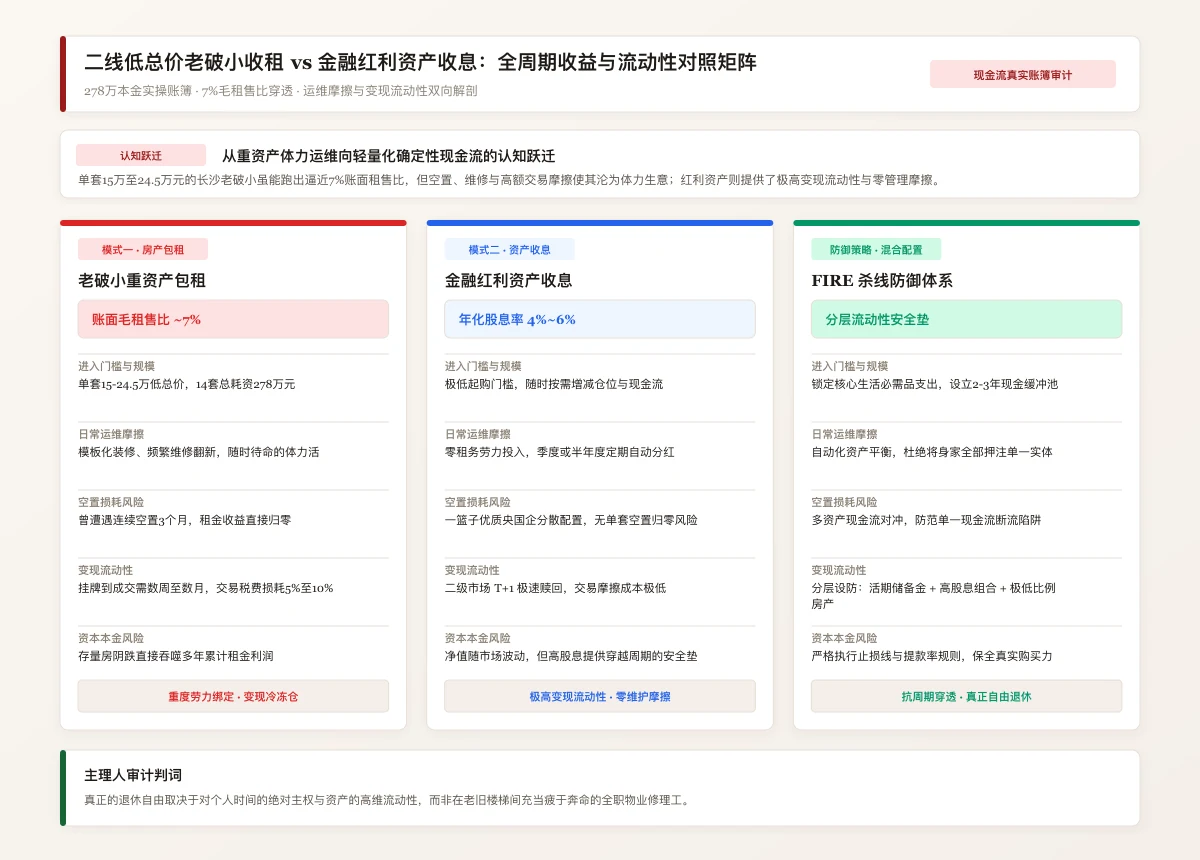
Figure 2: A multi-dimensional comparison between heavy real estate yield extraction in second-tier cities and lightweight financial dividend assets. Once the 7% gross yield is unpacked, illiquidity and structural capital depreciation emerge as the core constraints of the real estate model.
From Landlord to Dividend Harvester: The Liquidity Awakening of the FIRE Balance Sheet
Confronted by maintenance burdens and potential capital depreciation, the first generation of investors experimenting with low-cost rental portfolios is adjusting its playbook.
Fan Junjie’s strategic pivot is telling: he has publicly stated that “the optimal window for this strategy has passed” and formally paused additions to his real estate holdings. Outside of extreme mispricing opportunities, his strategy has shifted to a strict “sell-one-buy-one” rebalancing framework. Concurrently, he and investors like Baoma Xixi are redirecting incoming cash flow into public financial markets—specifically high-dividend index funds and equity yield instruments. They are transitioning from offline landlords into digital yield harvesters.
This micro-level pivot aligns cleanly with broader macroeconomic data:
- Capital Inflows into Dividend Assets: Wind data shows that by Q4 2026, total assets under management across public dividend-focused funds in China crossed 420 billion RMB, representing a 20.58% year-over-year expansion.
- Demographic Shift Toward Yield: Data from Ant Fortune reveals that search queries for “dividends” and “yield” tripled over the past year. Crucially, Gen Z and Millennial investors now account for nearly 40% of dividend index fund holders, growing 44% year-over-year.
This transition from physical rental portfolios to liquid equity yield reflects a fundamental awakening to the liquidity premium:
- Frictionless Cash Flow: Dividend index funds aggregate cash flows from state-owned enterprises in utilities, energy, and banking. They eliminate micro-operational friction: zero leaking pipes, zero tenant negotiations, and zero three-month vacancy voids. Distributions arrive automatically on a quarterly or annual schedule—delivering true, unburdened cash flow.
- Tactical Flexibility in Tail Events: Should personal circumstances require sudden capital deployment, public dividend funds settle on standard liquid timelines (T+1). Investors avoid month-long listing periods or 5% to 10% transactional friction costs.
Financial dividend strategies are not immune to risk. Corporate dividend payouts fluctuate with macroeconomic earnings, and fund net asset values experience systemic market volatility. However, compared to freezing capital inside decaying concrete, liquid financial assets afford investors the tactical flexibility to reallocate capital and preserve defensive lines as macroeconomic cycles evolve.
Ultimately, building a resilient early retirement portfolio is not about accumulating physical title deeds. It is about constructing an adaptable balance sheet anchored by liquid capital buffers. Maintaining structured expense tiers and preserving FIRE kill-line defenses and emergency reserves provides far more security than navigating the stairwells of aging residential buildings. Only when personal time is liberated from physical asset maintenance does financial independence deliver authentic autonomy.
Related Research & Topics
Tello Mobile eSIM
SafetyWing Nomad Insurance
* Disclosure: This post contains affiliate links. If you make a purchase through these links, V-G Journal may earn a small commission at no additional cost to you. We only recommend services we independently evaluate and trust.
FIRE and Golf:自由旅居之路
专注于为追求 FIRE 与品质生活的人群提供特惠打球权益与候鸟微度假。不持一砖一瓦,运营品质生活。