The Yongzhou Affair: Unexplained Capital, Civil Debt, and the Weaponized State
The viral uproar surrounding a municipal commerce chief in Hunan transcends tabloid voyeurism. Beneath the domestic melodrama lies a structural crisis: millions in unexplained liquid capital and the frictionless conversion of a private civil dispute into state-sponsored criminal prosecution.

Executive Summary:
Chinese digital discourse has long developed an immunity to bureaucratic infidelity scandals. Yet, when the ex-husband of a municipal Commerce Bureau chief in Yongzhou, Hunan, published a detailed dossier against her, the fallout was instantaneous and systemic. The public reaction was never driven by voyeuristic interest in a mid-level bureaucrat’s private life. Stripping away the domestic theater exposed two acute threats to legal institutionalism: liquid fortunes wildly divorced from civil service wage scales, and the alarming velocity with which local coercive machinery was mobilized to criminalize a private financial dispute.

Figure 1: The criminal judicial apparatus is the state’s ultimate instrument of coercive order. Its legitimacy rests entirely on procedural neutrality and the statutory principle of legality, remaining strictly insulated from private feuds. (Source: Wikimedia Commons / Public Domain)
1. The Tabloid as Algorithmic Bait: Five Million Yuan Breaks the Salary Baseline
From an attention-economy perspective, the scandal spread via proven narrative levers: a female bureau director in a fourth-tier municipality, allegations of simultaneous liaisons with local entrepreneurs and cadres, leaked chat transcripts, and bizarre hand-written “letters of guarantee.” These artifacts offered the algorithmic machinery precisely what it craves: the moralized public ruin of a mid-ranking cadre.
Morality theater, however, cannot sustain deep institutional interrogation. The real inflection point occurred when the balance sheet entered public view: a divorce settlement requiring a staggering payout, under which the official had already liquidated 3.3 million yuan ($460,000 USD) in cash, with total commitments reaching 5 million yuan.
In an inland fourth-tier city, the gross annual compensation of a division-level (chu-ji) civil servant sits within the modest band of 100,000 to 150,000 RMB after social deductions. How does an administrative bureaucrat, bound to a standardized state ledger, produce 3.3 million yuan in immediate liquidity to settle domestic discord, with millions more pledged in reserve?
The public immediately recognized that this was not a lapse in domestic discipline; it was a visible rupture in the regime of asset transparency:
- The Legitimacy of the Capital Base: What is the origin of this liquid cash flow? Does it trace back to undisclosed commercial enterprises run by extended family, or does it represent off-the-books commercial operations prohibited under cadre management rules?
- The Architecture of Rent Extraction: As the direct gatekeeper of foreign trade, strategic investment promotion, municipal subsidies, and local project approvals, the head of a Commerce Bureau commands systemic discretionary power. Does this unexplained liquidity reflect kickbacks, structural rent-seeking, and transactional corruption embedded in local capital allocation?
As demonstrated in our analysis of financial anti-corruption sentencing dynamics, private decadence is merely an epiphenomenon. The subterranean ledger—the opaque mechanism converting administrative discretion into private liquid wealth—is what obliterates institutional credibility.
2. The Weaponization of Criminal Law: Converting Civil Debt into Penal Leverage
If unexplained wealth invites moral outrage, the subsequent mobilization of the penal system triggered an existential panic regarding basic legal security.
The documented timeline of the judicial intervention traces a disquieting trajectory:
- Post-divorce, the ex-husband repeatedly demanded the remaining balance of the agreed-upon financial settlement.
- The female bureau director filed a criminal complaint with local public security, alleging “extortion.”
- The municipal justice system responded with uncanny efficiency: the police formally opened a criminal case, placed the ex-husband under criminal detention, the procuratorate approved his formal arrest within days, and he spent months in a pre-trial detention facility before being indicted on felony extortion charges.
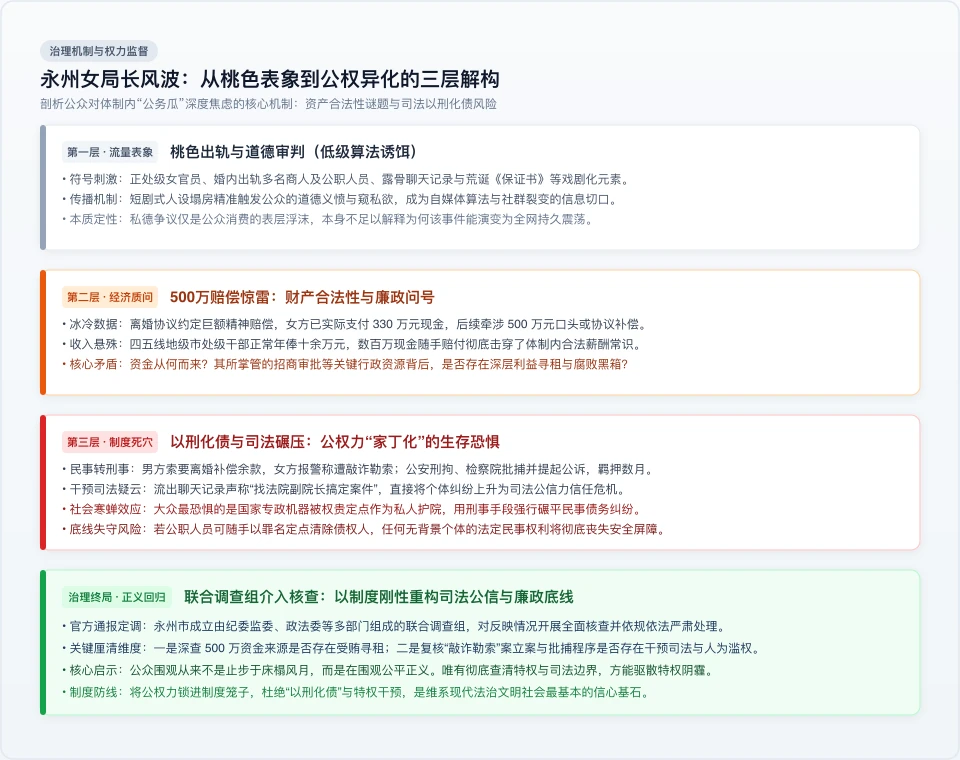
Figure 2: Deconstructing the escalation: from engagement bait to unexplained wealth, culminating in the asymmetric deployment of criminal state leverage.
The Dissolution of the Boundary Between Tort and Crime
In modern criminal jurisprudence, converting private civil disputes into extortion requires an exceptionally rigorous evidentiary bar:
- Voluntary marital compensation agreements—even those signed under extreme emotional distress or moral fault—belong unequivocally to the domain of private civil autonomy.
- When a creditor aggressively pursues the execution of an agreement, uncouth language or high-pressure tactics do not magically transmute a lawful civil claim into extortion. The foundational existence of a civil right requires resolution through civil courts; the state’s penal machinery is supposed to maintain structural restraint.
- When a high-ranking bureaucrat can bypass civil litigation entirely, deploying criminal charges to throw a financial counterparty into a detention cell, the social baseline of contractual integrity and institutional trust collapses.
The Cadre’s Praetorian Guard
The chilling effect deepens when reviewing the whistleblower’s leaked communications, which allegedly reference direct back-channel interventions with local judicial leadership to “handle the case.”
This breaches the fundamental perimeter of legal civilization. The public’s underlying dread is straightforward: When a private citizen encounters a dispute with an administrative insider, does the state’s coercive monopoly function as an impartial arbitrator, or does it operate as an on-demand private militia for the local ruling class?
If proximity to institutional power allows an individual to mobilize detectives, prosecutors, and detention cells as personal debt-liquidation tools, the implications extend far beyond domestic drama. The same apparatus can be deployed with total asymmetry against entrepreneurs in contractual disputes, landowners facing eminent domain, or citizens asserting civil rights against local monopolies.
3. The Structural Safety Valve: Using Moral Grievance to Target Systemic Rent
The viral lifecycle of this scandal reveals how public discourse operates under asymmetric speech constraints.
Addressing local judicial interference or institutional rent-seeking directly is fraught with political friction and systemic moderation. Tabloid exposés detailing moral decadence and bureaucratic adultery, by contrast, function as an officially tolerated safety valve.
The public does not possess a pathological obsession with the private bedrooms of local cadres. Rather, an explosive domestic dispute punches a temporary hole in the administrative veil, providing a rare and legally defensible vector for systemic accountability:
- Moral Condemnation as a Proxy for Institutional Scrutiny: Citizens leverage the sanctioned language of moral outrage to force attention onto the real questions: the provenance of millions in liquid cash and the predatory use of felony detentions.
- Piercing the Regional Information Asymmetry: The sheer volume of digital scrutiny prevents local authorities from quietly resolving the dispute behind closed doors, forcing higher-tier governance mechanisms to intervene.
4. The Institutional Stakes
Municipal authorities in Yongzhou have established a multi-department joint task force to investigate both the financial irregularities and the allegations of judicial interference. This administrative escalation indicates that higher governance levels recognize the systemic damage inflicted on local legitimacy.
The intervention of an independent task force moves this dispute out of the digital colosseum and back into institutional territory. The credibility of the outcome hinges on two non-negotiable audits:
- The Capital Forensic Audit: A transparent, public tracing of the 5 million yuan in cash commitments, clarifying whether the funds stem from undeclared private enterprise or corrupt administrative transactions.
- The Procedural Audit of the Criminal Case: A rigorous review of the extortion indictment against the ex-husband, evaluating whether procedural thresholds were bent or criminal law was subverted to serve the private interests of a municipal bureaucrat.
The scrutiny directed at Yongzhou was never about the melodrama of broken vows. It is about whether procedural law can withstand proximity to administrative power. Only an uncompromising internal accounting—one that clearly marks the boundaries between private disputes and the coercive machinery of the state—can repair the baseline of institutional trust.
Related Research & Topics
Tello Mobile eSIM
SafetyWing Nomad Insurance
* Disclosure: This post contains affiliate links. If you make a purchase through these links, V-G Journal may earn a small commission at no additional cost to you. We only recommend services we independently evaluate and trust.
FIRE and Golf:自由旅居之路
专注于为追求 FIRE 与品质生活的人群提供特惠打球权益与候鸟微度假。不持一砖一瓦,运营品质生活。