The Mechanics of Incarceration: Reconciling China's Crime Statistics, Regional Judicial Fault Lines, and Asymmetric Risk
Behind China's paradox of negligible street crime and catastrophic penal exposure lies a dual-track sorting mechanism that filters petty misconduct into administrative detention. By dissecting provincial indictment disparities and the fiscal incentives driving cross-regional enforcement, this essay outlines a concrete framework for mitigating institutional and regulatory risk.

Executive Summary: The persistent divergence between China’s exceptionally low violent crime statistics and the public’s visceral fear of judicial entanglement is not an analytical anomaly; it is an engineered outcome of institutional mechanics. While judicial metrics indicate that the country has entered an “era of petty offenses”—with over 85% of criminal convictions resulting in sentences under three years—the micro-level fallout remains existential. This asymmetry is driven by an administrative-criminal dual-track sorting mechanism, an effective conviction rate exceeding 99.97%, structural pre-trial detention inertia, and generational collateral sanctions. Paradoxically, per-capita indictment rates in the affluent southeastern seaboard far exceed those in the interior. In a landscape where overt street violence has been replaced by predatory regulatory enforcement and fiscal extraction by debt-distressed jurisdictions, rational preservation requires a disciplined alignment of geography, corporate compliance, and interpersonal risk aversion.
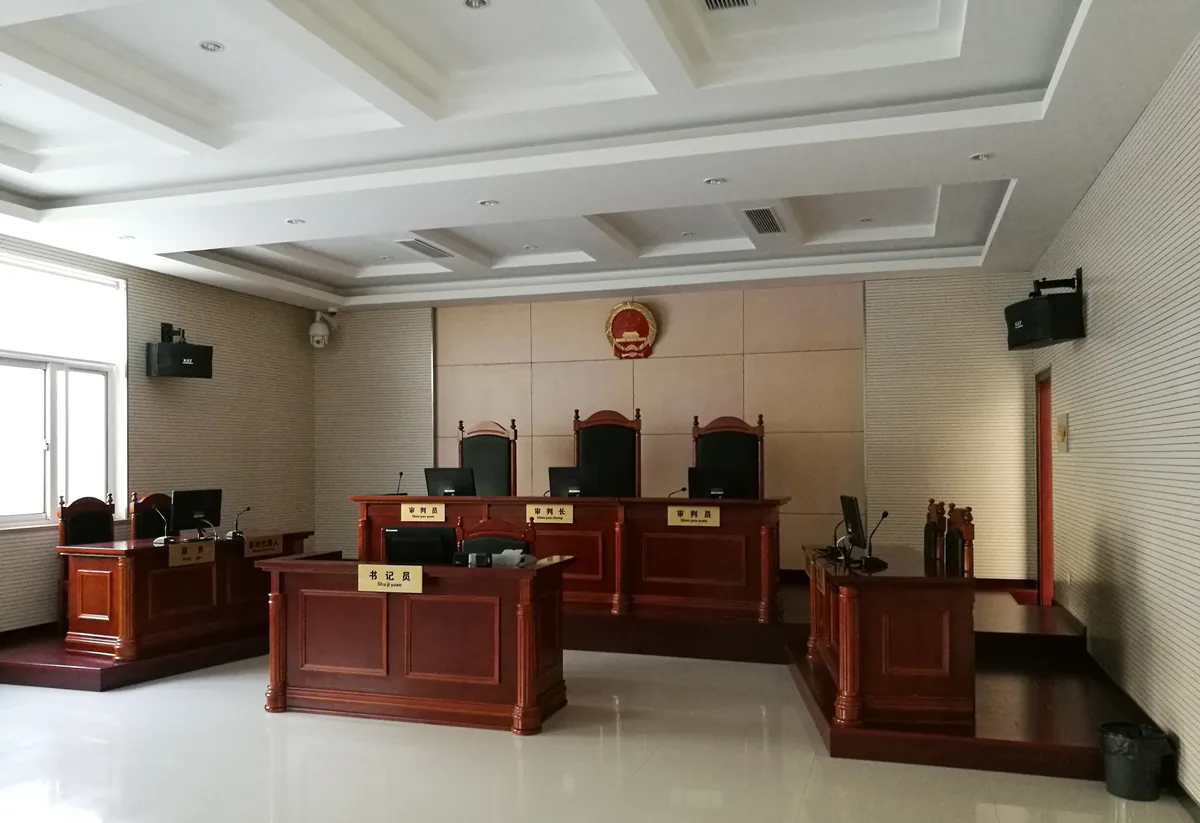
Figure 1: The bench of a Chinese basic-level people’s court. Under the dual-track sorting funnel, any case entering the formal criminal trial hall has already cleared an exceptionally high-threshold prosecutorial threshold.
I. Deconstructing the Paradox: Low Base Crime Rates vs. Existential Penal Impact
Observers of China’s public security and legal landscape frequently confront an intuitive contradiction. Macro statistics consistently position the country as one of the most physically secure jurisdictions globally, with homicide and violent assault rates near historical and international floors. Yet, among entrepreneurs, white-collar professionals, and private citizens, the onset of formal criminal proceedings carries a nearly irreversible presumption of personal, financial, and generational ruin.
This divide between macro safety and micro ruin is produced by three structural mechanisms.
1. The Dual-Track Administrative Filter
Most Western legal systems employ a unitary criminal architecture: infractions from minor retail theft to disorderly conduct or unlicensed vending are formally classified as offenses (misdemeanors or violations) and incorporated directly into national criminal statistics. This institutional design yields national crime counts in Europe and North America that routinely range between 3,000 and 6,000 cases per 100,000 residents.
China, by contrast, operates a bifurcated administrative-criminal apparatus. The Criminal Law of the People’s Republic of China applies a dual criteria test: an act must satisfy both a qualitative threshold (nature of the act) and a quantitative threshold (gravity of damage or illicit gains). Minor physical scuffles, modest property theft, brawls, gambling, and localized public order disturbances do not cross the criminal Rubicon. Instead, they are resolved at the precinct level under the Public Security Administration Punishments Law (PSAPL)—frequently dubbed the “sub-criminal code”—via fines or administrative detentions capped at 15 days.
Public security organs process between 8 and 13 million administrative public security cases each year—roughly double the volume of formal criminal indictments. This administrative sorting dam absorbs vast quantities of ambient social friction before they can enter the criminal statistical denominator. Consequently, China’s official “criminal rate” reflects an intensely distilled sample: any dispute that reaches the formal criminal dock has already been categorized by the state apparatus as an intolerable violation of collective order.
2. The Divide Between Nominal Sentencing Data and Punitive Reality
Statistically, the narrative that China imposes crushing custodial terms across the board has been obsolete for years:
- Sentences exceeding three years’ imprisonment—including life sentences and capital punishment—have declined from 45.4% of total convictions in 1999 to under 15% today.
- Sentences of three years or fewer, public surveillance, criminal detention, and independent fines now account for over 85% of all criminal adjudications. The system operates primarily as a processor of minor statutory infractions.
If more than four-fifths of all defendants receive short sentences, why does the visceral fear of the criminal apparatus remain so acute? The answer lies beyond the calendar length of a sentence:
- Near-Absence of Systemic Acquittals: The historical acquittal rate in Chinese criminal trials hovers below 0.03% (fewer than three acquittals per 10,000 verdicts). Investigation, prosecutorial approval, and judicial trial operate in close administrative alignment. Once public security formally requests arrest and the procuratorate issues an indictment, institutional incentives heavily penalize procedural exoneration. Entry into the formal criminal process is practically synonymous with conviction.
- Pre-Trial Custody Inertia and Limited Non-Custodial Sentencing: Outside narrow exceptions such as standard drunk driving, the application of non-custodial penalties (independent fines, control, or probation) remains constrained compared to advanced civil law systems. For offenses carrying theoretical sentences under one year, pre-trial detention remains the standard operating procedure; suspects frequently spend months in detention centers prior to sentencing.
- Systemic and Generational Collateral Sanctions: The primary penalty in contemporary Chinese society is rarely the physical duration of confinement; it is the comprehensive legal and institutional disqualification that follows. Even a suspended sentence or brief criminal detention triggers mandatory termination of public office, permanent forfeiture of professional licenses (legal, medical, corporate directorships), and an indelible criminal record. Crucially, the institutionalized political screening (zhengzhen) regime extends these liabilities to direct descendants, effectively barring children from civil service roles, the military, intelligence apparatuses, state-owned enterprises, and specialized university programs. The penalty is not merely penal; it is institutional social liquidation.
3. Minimalist Governance Cost Preferences
The fundamental drive of large-scale governing architectures is to minimize the marginal cost of maintaining civil order.
Mounting intricate adversarial jury trials, funding individualized community corrections programs, and maintaining expansive probation infrastructure are resource-intensive propositions. By contrast, a high prosecution threshold paired with deterministic guilt, low parole rates, and devastating collateral sanctions yields maximum deterrence at minimal administrative expenditure. This framework ensures that individual exposure to the criminal apparatus remains rare, but catastrophic when triggered.
II. Provincial Disparities: Inversion Paradoxes and Real Institutional Risk
Public evaluations of regional risk often rely on intuitive assumptions that equate regional development with lower formal indictment counts. An inspection of prosecutorial work reports and judicial filings from provincial high courts reveals an unexpected pattern: per-capita criminal indictment rates in the hyper-developed southeastern littoral (Zhejiang, Shanghai, Fujian, Guangdong) consistently outpace those of the interior and northern heartlands (Sichuan, Henan, Heilongjiang, Tibet).
1. Comparative Provincial Justice Ecosystems
Synthesizing data from the Supreme People’s Procuratorate, the Supreme People’s Court, and regional judicial bulletins clarifies the divergent structural dynamics across key administrative divisions:
| Region / Province | Indictment Scale & Per-Capita Rates | Core Case Typologies | Structural Drivers & Environmental Realities |
|---|---|---|---|
| National Benchmark | Dangerous driving (~230,000), digital telecom fraud & laundering (>100,000), petty property theft; violent crime is ~3.8% | Overt street violence has vanished; statutory offenses (mala prohibita across economic compliance, cyber, and traffic) dominate the docket. | |
| Zhejiang | Peak 19.3 per 10k (2019); 89,833 indicted in 2025 (~13.5 per 10k) | Disrupting financial order (>10,000), cyber offenses (11,000), violent crimes at only 3.3%; probation rates reach 34% | Reflects intense private-sector commerce and millions of interprovincial migrants, combined with digitized policing that minimizes case suppression. |
| Shanghai | ~18.3 per 10k (Nationally elevated) | Financial fraud, IP infringement, cross-border data violations; top national rank in timely trial metrics and pre-trial detention rule of law (0.94) | Closed-loop digital docket systems eliminate hidden cases; courts maintain top ratings in commercial adjudications; minimal street violence. |
| Guangdong / Fujian | Fujian at 17.1 per 10k, Guangdong at 16.0 per 10k | Intensive manufacturing hubs; cross-border logistics, supply-chain fraud, tax disputes, and emerging cyber offenses; rapid processing | Massive demographic turnover from domestic migrant labor creates substantial policing friction; property protection remains robust in Tier-1 metros. |
| Jiangsu | 102,306 indicted in 2024 (~12.0 per 10k, most balanced in the east) | Market order offenses (~8,600), violent crimes at 3.05%; Southern Jiangsu leads national public security satisfaction | Dense county-level economies; strong pre-litigation administrative mediation filters disputes before formal indictment. |
| Beijing | 75,000 prosecutorial cases in 2025; formal arrests down nearly 15% YoY | Property theft and street crimes at structural lows; focus centered on complex financial schemes, IP, and state-level compliance | Concentrated security apparatus; street-level risk is near zero; highly sophisticated evidentiary thresholds in formal criminal proceedings. |
| Interior & Rustbelt (Sichuan, Henan, Heilongjiang, etc.) | Indictment rates remain among the lowest nationally (frequently <7–8 per 10k) | Interpersonal conflicts, domestic altercations; higher baseline re-incarceration rates within prison samples (~24.4%) | Significant outbound migration of working-age labor reduces commercial friction; clan-based mediation resolves issues informally, though procedural defense leverage is constrained. |
2. Dissecting the Inversion Paradox
The elevated per-capita indictment rates across coastal powerhouses do not signal social instability. Rather, they are structural consequences of commercial integration:
- The Frictional Toll of Liquidity and Labor Density: Coastal provinces host tens of millions of transient workers. Unprecedented transaction velocity, contractual density, and digital payment flows naturally generate elevated rates of contractual friction, account freezes, and traffic infractions.
- Administrative Transparency and Lower “Dark Figures”: In highly digitized urban centers, discretionary dropping or informal burial of cases by precinct-level officers has been dismantled by automated logging. Conversely, in remote inland counties, many low-level altercations are settled off the record through kinship networks and traditional community mediation.
- The Eradication of Traditional Street Crime: The elevated coastal numbers consist almost entirely of non-violent, statutory offenses (mala prohibita). Pervasive surveillance infrastructure and a cashless economy have driven predatory street violence—such as muggings or armed robberies—to near statistical extinction, with capital murder clearance rates effectively at 100%.
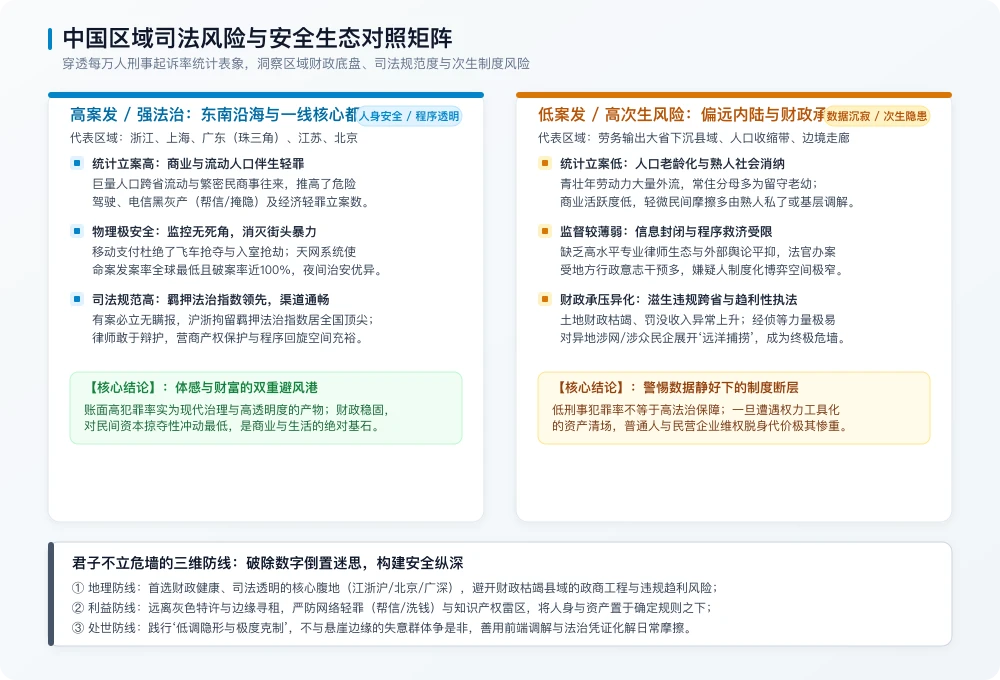
Figure 2: Regional judicial risk matrix: looking past headline statistics to distinguish between physical safety, procedural sophistication, and institutional exposure.
3. The Real Institutional Risk: Extraterritorial Predatory Enforcement
As physical violence has receded, the primary vector of existential risk for capital and its stewards has shifted toward predatory, revenue-motivated cross-regional enforcement by fiscally exhausted local jurisdictions (colloquially termed “distant-water fishing” or yuanyang bukao).
As peripheral county and lower-tier municipal budgets face mounting fiscal pressure from property-sector downshifts and local debt overhang, the proportion of local non-tax revenue derived from judicial fines and confiscations (famou shouru) has spiked in distressed jurisdictions. Operating with limited local industrial tax bases, some remote public security units have utilized broad statutory interpretations of “network pyramid schemes,” “illegal business operations,” “money laundering,” or “contract fraud” to launch extraterritorial criminal raids targeting profitable private enterprises located in coastal economic centers.
These operations frequently bypass normal jurisdictional checks to freeze corporate accounts, detain founders or key engineers, and coerce settlements designed to fill distant municipal coffers. The scale of this issue prompted central authorities to launch nationwide supervisory campaigns in 2025, which corrected 19,900 instances of illicit cross-regional enforcement and unverified asset seizures, releasing 2.63 billion RMB in unlawfully frozen funds. For the modern executive, technologist, or allocator, this distortion of the penal apparatus represents a critical operational risk.
III. Strategic Insulation: Navigating Modern Structural Vulnerabilities
Classical statecraft dictates that strategic individuals do not linger under unstable structures. In the contemporary institutional ecosystem, real insulation is not achieved through defensive retreat, but through a calculated understanding of where institutional boundaries hold firm. Defense must be organized across three distinct dimensions.
1. The Geographic Layer: Anchoring in Fiscally Solvent Jurisdictions
- Locate Primary Physical Assets and Key Entities in Fiscally Resilient Metros: Corporate entities, main bank accounts, and core personnel should remain anchored in core economic clusters—Southern Jiangsu, Northern Zhejiang, Shanghai, Beijing, or core districts of Shenzhen and Guangzhou. These areas offer higher procedural transparency, professionalized judiciaries, and administrative oversight that constrains predatory extraction. Local courts and procuratorates in these jurisdictions are far more willing to accept legitimate corporate compliance arguments and grant bail pending trial (qubao houshen).
- Avoid Entanglement with Distressed Sub-Tier Jurisdictions: Exercise extreme caution when dealing with peripheral, debt-laden municipalities. Concessions such as discounted industrial land, tax holidays, or informal promises from local officials rarely offset the risks of unpaid public procurement contracts. Under severe fiscal strain, commercial disputes over deferred payments can quickly be reframed into criminal accusations, using detention as an informal mechanism to force debt write-downs.
2. The Regulatory and Compliance Layer: Safeguarding Against Statutory Landmines
The legal exposure facing modern professionals rarely stems from classic moral crimes (mala in se); it emerges almost entirely from ambiguous statutory offenses (mala prohibita):
- Preserve Absolute Sanctity of Payment Rails and Bank Accounts: With more than 60% of modern indictments involving internet-based infrastructure, scrutiny of capital flows is intense. Never lease, lend, or share personal or corporate bank accounts, corporate seals, or merchant payment portals. Avoid informal cross-border currency clearing, OTC cryptocurrency liquidations, or third-party balance warehousing. Such activities frequently trigger direct prosecution under the broad umbrellas of “Aiding Information Network Criminal Activities” (Article 287-2, Bangxin) or “Concealing and Disguising Criminal Proceeds” (Article 312).
- Enforce Strict Demarcation of Data and Proprietary Code: Prosecutions targeting trade secrets and intellectual property theft are increasingly weaponized in executive mobility. Retaining legacy algorithm code, proprietary hardware schematics, or deploying aggressive automated web scrapers across proprietary datasets can cross the boundary from civil contract breach to the criminal offense of “Illegally Obtaining Computer Information System Data.”
- Eliminate Algorithmic Assumptions Regarding Traffic Liability: Dangerous driving remains the single largest prosecutorial category nationwide. Precedent is established: operating a vehicle while intoxicated with Level 2 or Level 3 Autonomous Driving / ADAS actively engaged incurs full criminal liability under DUI statutes. The law assigns full operational accountability to the human driver.
3. The Interpersonal Layer: De-escalation and Strategic Invisibility
- Recognize Asymmetry of Stakes in Ambient Disputes: Amid structural macroeconomic adjustments, individual psychological resilience can fray. Minor traffic frictions, public altercations, or service delivery disputes can rapidly escalate into severe physical confrontations. A rational actor must internalize an absolute asymmetry of stakes: an individual with an established career, familial assets, and future mobility faces staggering systemic losses upon criminal exposure. An individual in severe distress may have nothing left to lose. In public confrontations, immediate de-escalation, rapid financial settlement, and physical exit are standard risk-mitigation measures.
- Rely Exclusively on Institutional Documentation: When operational or civil disputes become unavoidable, avoid informal private enforcement. Relocate to zones covered by public surveillance, preserve rigorous written and digital paper trails, and channel resolution exclusively through official traffic police, municipal mediation centers, or formal civil litigation.
- Maintain High Asset Liquidity and Low Ostentation: Mitigate conspicuous profiles in volatile operational environments. Capital that is highly liquid, unencumbered by opaque regional guarantees, and detached from public displays of wealth substantially reduces the risk of attracting predatory administrative scrutiny.
True long-term security is not built on the assumption that external environments will remain stable. It requires recognizing the institutional machinery of state authority and positioning one’s capital, career, and physical presence within jurisdictions where procedural discipline remains intact and systemic frictions are minimized.
Related Research & Topics
Tello Mobile eSIM
SafetyWing Nomad Insurance
* Disclosure: This post contains affiliate links. If you make a purchase through these links, V-G Journal may earn a small commission at no additional cost to you. We only recommend services we independently evaluate and trust.
FIRE and Golf:自由旅居之路
专注于为追求 FIRE 与品质生活的人群提供特惠打球权益与候鸟微度假。不持一砖一瓦,运营品质生活。