The Anatomy of China's Shadow Debt: Sovereign Balance Sheets, Local Insolvency, and the Microeconomics of Austerity
An unvarnished deconstruction of China’s local government financing vehicles (LGFVs), the multi-trillion-yuan sovereign debt swap, and how the sunset of land finance is dismantling public-sector compensation, corporate receivables, and household wealth.

Executive Brief:
For three decades, China’s high-velocity urbanization ran on a relentless tripartite engine: municipal land concessions, aggressive leverage via off-balance-sheet financing vehicles, and capital-intensive infrastructure buildouts. This closed-loop mechanism generated an unprecedented economic miracle—and a labyrinthine mountain of shadow debt.
As the real estate paradigm undergoes a secular contraction and the windfall of land finance evaporates, this credit engine has arrived at an existential inflection point. Beijing’s programmatic multi-trillion-yuan debt swaps represent far more than technical balance-sheet engineering. They mark an irreversible systemic reset dictating public-sector payrolls, commercial supply chain liquidity, and the baseline yield of household capital.
I. Explicit Sovereignty vs. Shadow Leverage: The Two Realities of Municipal Balance Sheets
Public debate routinely conflates statutory local debt, LGFV (Local Government Financing Vehicle) bonds, and shadow debt into an undifferentiated risk pool. A rigorous financial assessment demands separating statutory on-budget debt from off-balance-sheet implicit liabilities:
- Statutory Explicit Debt: General and special-purpose bonds authorized by the National People’s Congress (NPC) and local legislative bodies. These instruments carry the direct fiscal backing of the state, operate within rigid statutory ceilings, and reside entirely inside the official budget.
- Implicit (Shadow) Debt: Liabilities accumulated outside statutory quotas through municipal financing platforms, disguised government procurement schemes, structured Public-Private Partnerships (PPPs), and illicit municipal comfort letters. While legally corporate, these obligations rely on the de facto assumption of fiscal backstops.
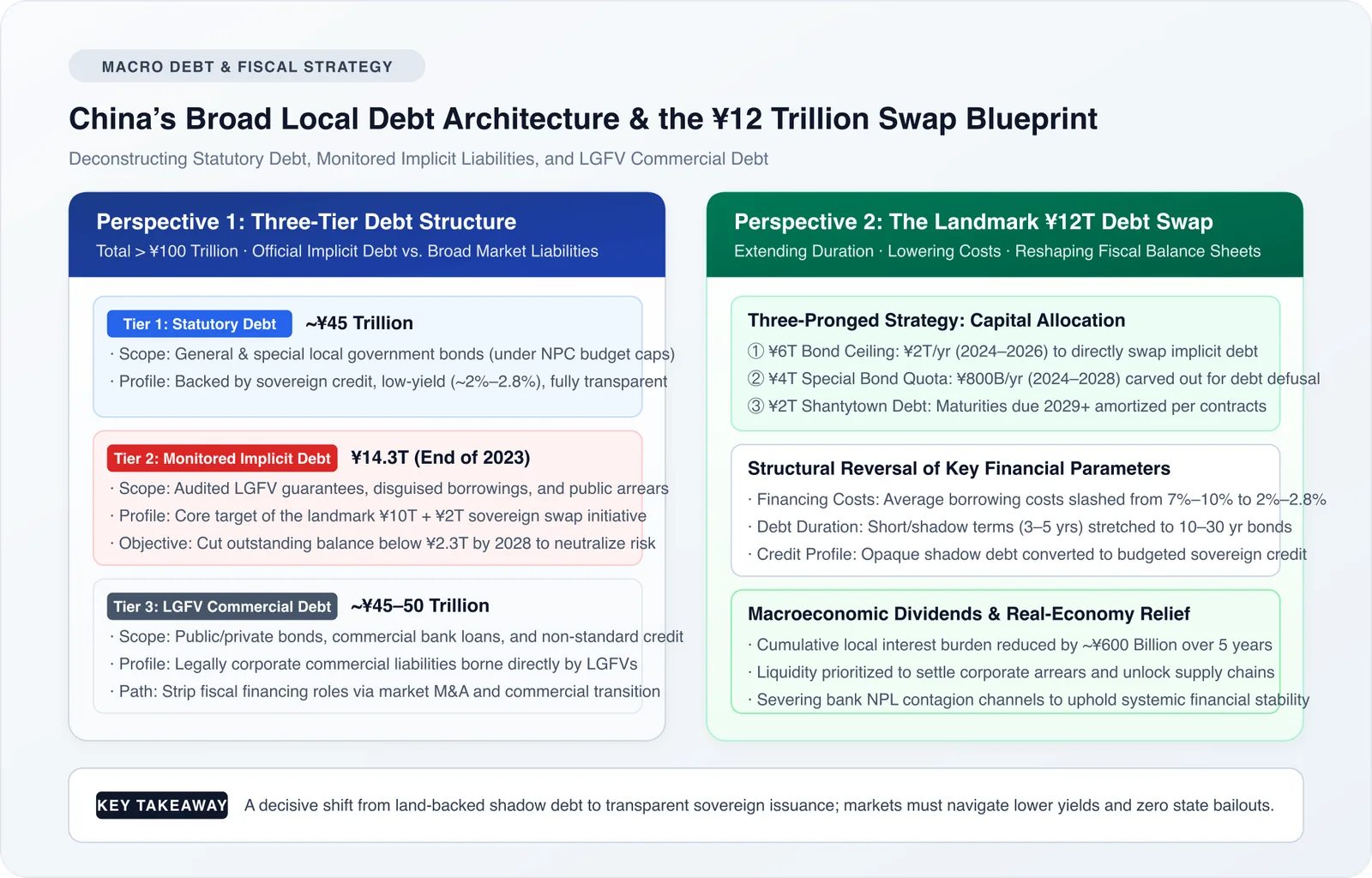
This three-tier framework delineates the legal perimeters and restructuring paths separating sovereign credit, state-guaranteed shadow liabilities, and commercial corporate debt:
| Accounting Metric | Core Institutional Scope | Estimated Scale | Credit Profile & Resolution Mandate |
|---|---|---|---|
| Statutory Explicit Debt | Municipal General & Special Purpose Bonds | ~45 Trillion RMB | Integrated into formal deficit ceilings; backed by explicit sovereign credit |
| Official Implicit Debt | Certified off-budget liabilities documented via the central monitoring matrix | 14.3 Trillion RMB | Carries explicit or illegal local fiscal guarantees; the primary target of the multi-year swap program |
| Broad LGFV Interest-Bearing Debt | Public corporate bonds, syndicated bank loans, trust loans, financial leasing | 55–65 Trillion RMB | Legally corporate commercial obligations, inextricably entwined with municipal infrastructure |
1. The Official Baseline: 14.3 Trillion RMB
In late 2024, the Ministry of Finance delivered a historic disclosure to the NPC Standing Committee, establishing the state’s verified baseline: as of year-end 2023, the national inventory of verified implicit local government debt stood at 14.3 trillion RMB.
Publishing this precise figure dismantled years of hyperbolic overseas speculation regarding a bottomless shadow-debt abyss, establishing an explicit, auditable balance sheet for Beijing’s risk containment campaign.
2. The Broad Market Metric: 55 to 65 Trillion RMB
Capital markets and macroeconomic analysts take a wider view, tracking the total interest-bearing debt of thousands of LGFVs nationwide. Across syndicated bank lines, enterprise bonds, and shadow trust allocations, this broad exposure totals between 55 and 65 trillion RMB.
The divergence between the official baseline (14.3 trillion RMB) and the broad market figure (roughly 60 trillion RMB) lies in the rigorous delineation of legal liability:
- Only liabilities incurred via illegitimate municipal guarantees for purely public-welfare projects are classified as state-backed “implicit debt” requiring sovereign resolution.
- The remaining liabilities—tied to utilities, tollways, gas networks, and industrial park operations with operational cash flows—are categorized as enterprise commercial debt, legally quarantined within the LGFVs as independent corporate entities.
In practice, this legal quarantine has historically been porous. Because regional governments control LGFV assets and executive appointments, mainland capital markets long operated on an unwritten assumption of state backing: the so-called “LGFV faith” (Chengtou Faith).
II. The Evolution of Debt Governance: From Opaque Acceleration to Algorithmic Surveillance
Over the past two decades, Chinese municipal borrowing evolved through four distinct institutional phases:
The Four Eras of Local Debt Architecture
- Phase I (2008–2014): Off-Balance-Sheet Proliferation ➔ In the wake of the global financial crisis, budget laws prohibited municipalities from issuing direct bonds. Capital hunger was diverted into LGFVs, land collateralization, and shadow trust networks.
- Phase II (2015–2018): The First Comprehensive Swap ➔ The revised Budget Law opened the front door to explicit municipal bonds while attempting to shut the back door, executing a 12.2-trillion-yuan swap of legacy liabilities.
- Phase III (2018–2023): The Algorithmic Surveillance Grid ➔ The Ministry of Finance implemented a unified, transaction-level digital monitoring platform, locking in individual contracts, assets, and officials, while banning net-new implicit borrowing.
- Phase IV (2024–Present): Universal Disinfection and Sovereign Absorption ➔ The 14.3-trillion-yuan baseline was opened to the public, accompanied by an aggressive sovereign debt swap program designed to refinance the entire high-risk overhang.
1. The Structural Distortions of Opacity
Under the old paradigm, structural regulatory avoidance yielded profound economic friction:
- Compounded Intermediation Costs: To bypass regulatory red tape, local officials turned to non-standard trust channels, local financial asset exchanges (FAEs), and synthetic financial leasing. All-in capital costs regularly climbed to 7%–10%, bleeding municipal balance sheets through high commissions and rent-seeking intermediaries.
- Structural Opacity: Underlying assets were obscured across multi-layered SPVs. Project cash flows were commingled, and prime land plots were pledged multiple times across overlapping credit consortia beyond the visibility of auditors or regional legislatures.
2. The Transparent Regime
The centralized debt-monitoring matrix closed these loopholes:
- Algorithmic Auditing: The central government maintains granular visibility over every district, platform, creditor, and loan coupon nationwide.
- Lifetime Liability: Career-spanning accountability mechanisms severed the historic moral hazard wherein cadres leveraged debt for short-term GDP metrics and exited before maturity dates arrived. The channel for net-new implicit debt has been welded shut.
III. The Mechanics of the Workout: Trading Time for Space
The fundamental vulnerability of Chinese local debt has never been an absolute deficiency of underlying assets; it is a severe structural duration and liquidity mismatch.
Municipalities built utility corridors, inter-city expressways, cross-river bridges, and civic greenbelts—assets engineered to generate public utility dividends across a 30- to 50-year horizon. Yet these assets were funded using 3-year shadow banking trusts and short-duration commercial notes bearing high yields. When residential land sales cratered, the precarious machinery of rolling over short-term debt collapsed under its own weight.
1. The Structure of the 12-Trillion-Yuan Refinancing Program
Beijing’s response constitutes a masterclass in sovereign balance-sheet re-engineering:
- A 6-Trillion-Yuan Expansion of Statutory Debt Quotas: Allocated across a three-year cycle (2024–2026) at 2 trillion RMB annually, explicitly dedicated to absorbing verified off-budget implicit debt.
- A 4-Trillion-Yuan Special-Purpose Bond Carve-Out: Spread across five consecutive years (2024–2028) at 800 billion RMB annually, ring-fenced specifically to redeem legacy implicit obligations.
- 2 Trillion RMB in Organic Shanty-Town Redevelopment Debt: Retained under original contracts, amortizing naturally past 2029 through standard contractual cash flows.
This architecture compresses the stock of regional implicit debt from 14.3 trillion RMB down to 2.3 trillion RMB by 2028. High-yield, fragile shadow obligations are systematically replaced with transparent, low-cost, ultra-long-duration sovereign-grade paper.
Refinancing Dynamics: Old Regime vs. New Regime
- Legacy Shadow Debt (Old Regime): 7%–10% blended yield ➔ 3–5 year duration (intense refinancing walls) ➔ Hidden off-balance-sheet, compounding systemic vulnerability.
- Statutory Replacement Bonds (New Regime): 2%–2.8% coupon ➔ 10–30 year duration (aligned with asset life cycles) ➔ Fully visible, integrated into official budgets, anchored by sovereign credit.
2. The Financial Logic of the Sovereign Swap
- Massive Interest Savings: Compressing funding costs from roughly 7% to approximately 2.5% saves local governments an estimated 600 billion RMB in cumulative interest across five years, freeing cash for baseline operations.
- Duration Immunization: Spreading liquidity cliffs that once clustered inside 12-to-36-month windows across a multi-decade repayment curve re-aligns debt servicing with actual public infrastructure yields.
- Containment of Systemic Contagion: Converting private shadow credit into transparent public paper stops liquidity defaults at weak LGFVs from triggering a cascading run on commercial bank balance sheets.
IV. The Microeconomics of Austerity: How Macro Deleveraging Reaches the Individual
Macroeconomic debt metrics are never mere accounting abstractions. They exert a direct gravitational pull on individual careers, corporate cash flow, and household balance sheets:
1. The Bureaucracy and Public Sector: Structural Compensation Compression
- Elimination of Non-Standard Bonuses: During the zenith of land finance, prosperous regional districts distributed performance bonuses, investment-attraction incentives, and cultural development awards sourced from land premiums and LGFV liquidity. Under hard budget constraints, fiscal resources are restricted to the strict non-negotiable baseline: ensuring payroll, operational continuity, and basic public welfare. Total public-sector compensation is reverting to the national mean.
- Retrenchment of Off-Budget Personnel: Municipal agencies and public institutions are eliminating outsourced support teams, auxiliary personnel, and contract staff.
2. Commercial Supply Chains: Breaking the Arrears Bottleneck
- Emergency Cash Injections for Private Contractors: Over recent years, strapped municipal budgets passed cash-flow distress onto the real economy by withholding payments to corporate vendors across civil construction, landscape architecture, surveillance systems, enterprise software, and medical devices. This generated acute liquidity crises, corporate bankruptcies, and secondary layoffs.
- Unfreezing the Liquidity Chain: Guidelines for the debt-swap proceeds state that funds must prioritize settling overdue receivables owed to private enterprises. Liquidating these debts unfreezes tangled webs of intra-company arrears, stabilizing operating cash flows for thousands of commercial enterprises.
3. Wealth Management and Household Portfolios: The Evaporation of Risk-Free Yield
- The Death of “LGFV Faith”: For over a decade, mass-affluent and high-net-worth investors parked capital in municipal investment trusts and local FAE direct-financing products yielding 7% to 10%, grounded in the assumption that regional governments would step in before allowing a default. Under ironclad rules prohibiting new off-budget debt, implicit guarantees have broken. High-yield non-standard products are defaulting, restructuring, or accepting severe principal haircuts. The era of high-yield, zero-risk fixed income is over.
- A Permanent Secular Decline in Yields: As regional authorities stop competing for speculative shadow capital at 8% interest, pristine assets have vanished from the credit market, inducing an institutional asset famine. With tier-one commercial bank deposit yields dropping below 2%, households must confront a permanent structural downshift in the risk-free rate of return.
4. The Citizen Experience: Infrastructure Deceleration and Public Utility Inflation
- Market-Rate Realignment of Public Goods: Historically, urban transit, municipal tap water, residential natural gas, and district heating enjoyed low consumer pricing sustained through hidden subsidies from land revenues and LGFV absorption. As state budgets retreat to explicit boundaries, utility tariffs across major urban centers are entering upward revision cycles, shifting public services toward cost-recovery pricing.
- The Elimination of Vanity Works: Capital-intensive, speculative civic developments—grandiose secondary city districts, vanity museums, and synthetic historical towns—have been scrapped. Infrastructure capital is now restricted to maintenance and upgrades: underground utility pipes, elevator installations in aging urban walk-ups, and baseline public healthcare facilities.
5. Asset Prices: The Re-Anchoring of Real Estate Value
- The Collapse of Speculative Greenfield Premiums: The speculative cycle—wherein a district borrowed billions for high-speed rail hubs, pumped land values, and lured retail homebuyers on the promise of perpetual urban expansion—has ended. Deprived of credit injections, far-flung suburban developments without genuine demographic inflow or industrial moats face evaporating transaction liquidity.
- The New Urban Darwinism: Municipal resilience no longer hinges on a city’s capacity to leverage debt for physical infrastructure. It is entirely determined by its legal architecture, industrial innovation capabilities, and the organic vitality of its private enterprise base.
V. The Strategic Pivot: From Credit Hypertrophy to Steady-State Defense
The balance-sheet challenges confronting China’s municipal ecosystem are not merely operational hitches; they are the inevitable structural legacy of a thirty-year development model fueled by debt-financed investment and synthetic land values.
The nationwide debt-swap campaign signals the end of that chapter:
- At the Macro Level: It deploys the balance-sheet credibility of the central sovereign to neutralize the volatile tail risks of local shadow leverage. It uses duration to purchase structural transition space, re-anchoring fiscal governance within the bounds of administrative law.
- At the Micro Level: It dispels illusions of perpetual debt-driven asset inflation. In an economic regime shaped by hard budget constraints, stripping speculative leverage, honoring fundamental commercial math, and safeguarding clean liquidity constitute the only durable defensive posture.
Related Research & Topics
Tello Mobile eSIM
SafetyWing Nomad Insurance
* Disclosure: This post contains affiliate links. If you make a purchase through these links, V-G Journal may earn a small commission at no additional cost to you. We only recommend services we independently evaluate and trust.
FIRE and Golf:自由旅居之路
专注于为追求 FIRE 与品质生活的人群提供特惠打球权益与候鸟微度假。不持一砖一瓦,运营品质生活。