The Semantic Trap of *Quanli*: Power, Rights, and the Institutional Architecture of Civic Liberty
An autopsy of the homophonic confusion between power and rights in the Chinese linguistic sphere. From Legalist subjugation and the non-justiciability of constitutional guarantees to the digital panopticon, this essay traces the systemic divide between authoritarian domination and civic liberty.

Core Thesis: In the Chinese linguistic realm, quanli operates as an exceptionally deceptive homophone. A single character separates 权力 (power) from 权利 (rights), yet between them lies the civilizational chasm that divides despotic servitude from modern constitutional order. In public discourse surrounding governance, regulatory overreach, and individual redress, these opposing concepts are routinely conflated. Deconstructing this confusion requires dismantling the common canard that “the Chinese lack power consciousness.” By interrogating Western etymology, path-dependent imperial institutional designs, and the structural loopholes of nominal constitutionalism, we can delineate the actual operational perimeter of modern civic rights.

Figure 1: Lady Justice bearing the scales of equity (private rights) and the sword of coercive state enforcement (public power). Fountain of Justice, Römerberg, Frankfurt.
I. Jurisprudential Demarcation: The Structural Divide Between Power and Rights
Within modern jurisprudence and political philosophy, power and rights occupy diametrically opposed and mutually adversarial domains. They diverge fundamentally across etymology, legal subjectivity, operational mechanics, and baseline rule-of-law doctrines:
| Analytical Dimension | Public Power (Power / Authority) | Civic Rights (Rights / Entitlements) |
|---|---|---|
| Etymological Core | Power (physical dominance, coercive capacity) / Authority (legitimated administrative office) | Right (derived from moral rectitude and substantive justice) / Liberty (inviolable statutory immunity) |
| Subject of Ownership | Governing apparatus, state organs, bureaucratic systems, or delegated public agents | Autonomous individuals, sovereign citizens, natural persons, and commercial legal entities |
| Operational Mechanism | Top-down coercive subjugation: an exclusive monopoly on force compelling compliance | Bottom-up legal perimeter: an unassailable qualification to refuse unlawful intrusion, expropriation, or dispossession |
| Teleological Purpose | Order maintenance and resource allocation; naturally tends toward self-expansion and predatory rent-seeking | Shielding bodily integrity and private property; securing self-determination against external predation |
| Governing Maxim | “Prohibited unless expressly authorized by law”: Public authority must remain strictly bound within procedural cages | “Permitted unless expressly prohibited by law”: Unbounded negative liberty across any space untouched by legitimate statute |
| Alienability & Waiver | Inalienable and non-waivable: Discretionary inaction or abandonment constitutes dereliction of official duty | Freely exercised or waived: Save for non-derogable baselines like physical life, private claims may be voluntarily disposed of |
Distilled to its essence: Power is the coercive capacity to control others; a right is the legal boundary that forbids arbitrary control by others and the state.
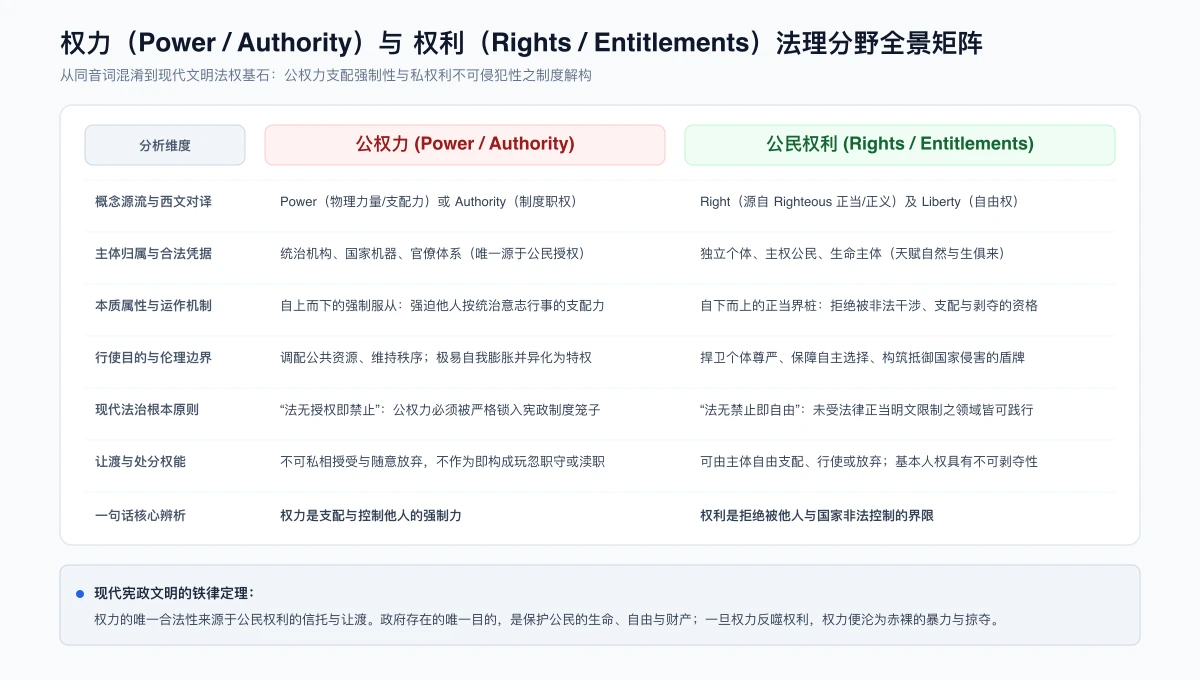
Figure 2: The jurisprudential divide: the coercive mechanics of public power versus the inviolable boundaries of private rights.
Under constitutional theory, their structural hierarchy is unambiguous: The sole legitimacy of public power derives from the alienation and fiduciary delegation of private rights by individual citizens. Governments are instituted to defend life, liberty, and estate through pooled collective mechanisms. The moment public authority transcends its fiduciary boundaries to consume private rights, it forfeits its ontological legitimacy and degenerates into naked despotism.
II. Institutional Pathology: A Deficit of Power or a Deficit of Rights?
A persistent misdiagnosis in cultural commentary suggests that Chinese society suffers from an “absence of power consciousness.” This claim stands reality on its head: Chinese society has never lacked an obsession with power (Power); what has been systematically atrophied, suppressed, and excised is any cognition of inherent individual rights (Rights).
Across imperial legacies and modern bureaucratic reflexes, the worship of power is ubiquitous:
- Proverbs reveal the cultural compass: “To become an official is to secure divine fortune,” “A contact in the imperial court guarantees a smooth appointment,” and “Use authority before it expires.”
- Social intelligence is measured by the ability to divine bureaucratic hierarchies, seat allocations, and the subtle whims of institutional gatekeepers.
- When confronted with administrative predation, the instinctual reaction of the average subject is rarely to demand legal remedies through independent courts, but rather to petition higher tiers of authority—hoping to leverage a superior coercive instrument against a subordinate one, or praying for a legendary, incorruptible official to intervene.
This is not a deficit of power consciousness. It is a pathological addiction to top-down domination and an instrumental reliance on bureaucratic patronage. The historical desertification of rights consciousness is maintained by three institutional pillars:
1. Legalist Enfeeblement and Confucian Filial Servitude
As demonstrated across the evolution of imperial paternalism versus modern human rights, classical Chinese political thought lacked a framework for asserting individual legal rights against sovereign authority:
- The Legalist tradition (The Book of Lord Shang, Han Feizi) reduced statecraft to zero-sum domination: “directing all profit through a single aperture,” systematically exhausting, impoverishing, and weakening the populace to convert subjects into interchangeable consumables for state agrarian and military mobilization.
- Confucian ritual order (Li) subsumed the political sphere into an extended patriarchal household: “Ruler and subject, father and son.” Under this ethical framework, subjects bore unilateral obligations of obedience, loyalty, and filial piety. They possessed no inherent rights independent of the throne and the clan. Benevolence (En) was an arbitrary, top-down dispensation from the Son of Heaven, not an entitlement secured by civic covenant.
2. Totalitarian Resource Monopoly and Bodily Dependency
From the imperial doctrine of “All lands under heaven belong to the king” to the modern Danwei (work unit), Hukou (household registration), and Dang’an (cadre dossier) systems, sovereign authority monopolized the fundamental conduits of survival: land, capital, employment, food rations, and reproductive authorization.
When an individual’s basic existence depends entirely on administrative rationing, they possess zero material leverage to negotiate with the state. Claiming rights under such a regime entails asymmetric opportunity costs and immediate survival penalties. The rational strategy under these constraints is total submission—or frantic pursuit of entry into the apparatus of distribution itself.
3. Linguistic Degradation and the Stigmatization of Assertion
State ideological narratives deliberately sanitize bureaucratic overreach as “prioritizing the collective interest,” “macro-level coordination,” and “organizational care.” Conversely, the legitimate assertion of individual statutory rights is systematically coded as “hyper-individualism,” “disrupting social stability,” or the catch-all criminal offense of “picking quarrels and provoking trouble.”
Decades of conceptual poisoning have conditioned subjects to feel existential guilt when defending their legal entitlements, stripping them of the moral clarity required to push back against institutional overreach.
III. Statutory Illusions and Structural Trapdoors: The Anatomy of Constitutional Non-Enforcement
On paper, Chapter II of the Constitution of the People’s Republic of China presents an expansive inventory of fundamental citizen entitlements:
- Political Franchises: Universal suffrage for citizens aged 18 and older to elect and stand for election (Article 34);
- Civil Liberties: Freedoms of speech, press, assembly, association, procession, and demonstration (Article 35);
- Religious Liberty: Freedom of religious belief (Article 36);
- Bodily Protections: Inviolability of personal freedom (Article 37), human dignity (Article 38), and the home (Article 39);
- Communications: Inviolability and confidentiality of correspondence (Article 40).
In operational reality, this statutory framework remains paralyzed. This paralysis is engineered through two structural trapdoors within the institutional design:
1. The Article 51 Kill-Switch
Article 51 of the Constitution establishes an overriding restriction: “The exercise by citizens of their freedoms and rights may not infringe upon the interests of the state, of society, and of the collective, or upon the lawful freedoms and rights of other citizens.”
In the absence of an independent judiciary or constitutional court, the authority to define what constitutes “the state interest” or “collective stability” is monopolized by administrative agencies and party security organs. Consequently, Article 51 functions as an institutional override. The moment an individual’s assertion of statutory rights challenges municipal revenue designs, infrastructure agendas, or bureaucratic stability mandates, this provision acts as an instant procedural circuit-breaker.
2. The Non-Justiciability Doctrine and the Remedial Vacuum
In constitutional democracies, when an executive decree or administrative action breaches fundamental rights, citizens can mount a direct constitutional challenge via judicial review. Within China’s legal infrastructure, the Supreme People’s Court has explicitly enforced the doctrine of the non-justiciability of the constitution.
Judges in civil, criminal, and administrative matters are formally prohibited from citing constitutional provisions as the direct ratio decidendi for their rulings. Deprived of a functional constitutional remedy or an independent tribunal, the rights declared on paper are systematically stripped of their institutional teeth.
IV. The Institutional Chasm: Civilizational Baselines Versus Realized Practice
When measured against the core baselines of constitutional democracies, China’s institutional reality reveals a stark structural divide across six pillars of civil liberty:
1. Substantive Elections and Political Franchise
- The Civilizational Baseline: Genuine political competition with ballot access for independent candidates, public policy debate, unhindered voter registration, and direct, secret balloting that enables the peaceful transfer of executive power.
- The Operational Reality: Local People’s Congress elections are managed via internal party shortlists, security screenings, and controlled margins. Citizens who attempt to exercise their statutory right to run as independent candidates are routinely subjected to administrative detention, electronic surveillance, physical containment, and preemptive coercion.
2. Press Freedom, Independent Scrutiny, and the Right to Information
- The Civilizational Baseline: Independent investigative journalism operating as an autonomous Fourth Estate, unimpeded data exchange, and the structural right of the public to access uncensored state records and hold governance accountable.
- The Operational Reality: The state maintains the Great Firewall (GFW), severing access to the global internet. The domestic press operates under the mandate that “all media must be surnamed Party.” Algorithmic filtering, automated keyword blacklists, account terminations, and elastic penal provisions like “picking quarrels and provoking trouble” have effectively criminalized whistleblowing and decimated domestic investigative reporting.
3. Freedom of Association and Collective Bargaining
- The Civilizational Baseline: The statutory autonomy of workers to establish independent labor unions, run collective wage negotiations, and execute protected strikes to counterbalance capital and corporate overreach.
- The Operational Reality: The law mandates a strict monopoly by the party-directed All-China Federation of Trade Unions (ACFTU); independent labor organizations are prohibited.
- The Institutional Retreat: During the 1982 constitutional overhaul, the explicit right to strike—previously guaranteed in the 1975 and 1978 texts—was quietly excised. Confronted with predatory platform algorithms, involuntary unpaid overtime (e.g., the “996” schedule), or systemic wage arrears, labor remains utterly atomized. Any horizontal, cross-enterprise labor coordination is immediately suppressed as an existential public security threat.
4. Due Process and Habeas Corpus
- The Civilizational Baseline: A judiciary structurally insulated from executive authority, the presumption of innocence, the privilege against self-incrimination, transparent search and arrest warrants issued by independent magistrates, and unhindered legal counsel.
- The Operational Reality: The political-legal apparatus operates under unified political direction, formally binding police, prosecutors, and the judiciary into an administrative conveyor belt. Under the Criminal Procedure Law, provisions for Residential Surveillance at a Designated Location (RSDL) permit state organs to disappear individuals suspected of state-security or high-level corruption offenses into secret black sites for up to six months. Detainees are held incommunicado, cut off from family and legal counsel, fundamentally nullifying procedural due process and protections against forced confessions.
5. Sanctity of Private Property and Land Tenure
- The Civilizational Baseline: Absolute private property rights—anchored in the legal principle that “the poorest man may in his cottage bid defiance to all the forces of the Crown.” Real estate is held in fee simple, and eminent domain requires strict judicial scrutiny, provable public necessity, and immediate fair-market indemnification.
- The Operational Reality: All urban land is owned by the state, while rural land is owned by collectives. Citizens do not own land; they purchase finite residential use rights lasting between 40 and 70 years. Local states maintain a monopoly over primary land sales and remain structurally addicted to land-transfer fees. Property owners facing administrative demolition lack absolute property titles to halt state-backed development machinery.
6. Freedom from Fear and the Right to Privacy
- The Civilizational Baseline: Robust statutory frameworks that restrict public data collection, require judicial warrants before state surveillance can occur, and hold public officials civilly liable for unwarranted domestic privacy breaches.
- The Operational Reality: The Skynet and Sharp Eyes surveillance projects, coupled with ubiquitous facial-recognition networks, mandatory national SIM and online real-name registration, and algorithmic tracking, create a continuous digital panopticon. Citizens are fundamentally transparent before the state. Dissent carries the threat of extra-legal collective punishment—including travel bans (exit bans) and career blacklisting that extends to immediate family members—maintaining society in a state of self-censoring paralysis.
V. The Civilizational Threshold: Transcending the Cult of Power
Ideological polemics aside, the true demarcation between modern civilization and medieval barbarism is not determined by aggregate fiscal capacity, the size of a state’s standing armies, or the brute efficiency of its mobilization apparatus.
The ultimate benchmark of an institutional order is whether its most vulnerable, unremarkable citizen possesses a lawful shield when confronted by the full weight of the state machinery; whether that individual has the structural standing to look an agent of the state in the eye and say: “This is my statutory right. You have no authority here.”
When the collective unconscious of a society continues to celebrate the circumventing of rules via elite connections (Guanxi) as “competence,” views the arbitrary deployment of institutional power to subordinate others as “success,” and treats the lawful assertion of individual boundaries as aberrant defiance, that society remains locked in an institutional jungle.
In an ecosystem devoid of constitutional rights, the cult of power ultimately consumes its own architects. Absent procedural shields, every bureaucrat within the machine is merely a precarious subject awaiting arbitrary harvest the moment they collide with a higher echelon of coercive power.
Escaping this centuries-old homophonic trap—recognizing that power is a dangerous beast that must be restrained, and that rights are non-negotiable boundaries that must be defended—is the indispensable cognitive leap every society must make to cross the threshold into modernity.
Related Research & Topics
Tello Mobile eSIM
SafetyWing Nomad Insurance
* Disclosure: This post contains affiliate links. If you make a purchase through these links, V-G Journal may earn a small commission at no additional cost to you. We only recommend services we independently evaluate and trust.
FIRE and Golf:自由旅居之路
专注于为追求 FIRE 与品质生活的人群提供特惠打球权益与候鸟微度假。不持一砖一瓦,运营品质生活。