The Forensic Tax Audit of Social Security: Systemic Balance Sheets, Demographic Cliffs, and Personal Cash Flow Defense
An autopsy of China's aggressive transition to tax-administered social security audits and delayed statutory retirement. Analyzing the mathematical strain on pay-as-you-go pooling amid shrinking local fiscal backstops, dispelling collapse myths, and outlining a sovereign framework for household balance sheet defense.

Executive Summary: Over recent quarters, policy mandates standardizing social security collection have accelerated. Backed by big-data analytics and the Golden Tax surveillance architecture, fiscal authorities are aggressively auditing baseline wage reports, eradicating third-party proxy payroll schemes, and pairing these moves with a phased delay in statutory retirement ages alongside elevated minimum contribution horizons. Viewed narrowly, this appears to be a mere technical cleanup of historical tax non-compliance. In reality, it represents a systemic defense of sovereign liquidity forced by an irreversible demographic cliff and the exhaustion of municipal fiscal backstops. Navigating this shift requires peeling back the administrative rhetoric to evaluate the underlying actuarial arithmetic and institutional game theory, restructuring one’s personal financial architecture for a macro regime shift.

Figure 1: The sustainability of social security funds is fundamentally an intergenerational compact expressed through multi-cycle actuarial balance sheets.
1. The Underlying Drivers: Penetrating Audits and Demographic Geometry
The escalation in social security enforcement is not an isolated administrative reflex. It represents a coordinated state maneuver to reconcile irreversible demographic aging with an acute restructuring of public finance.
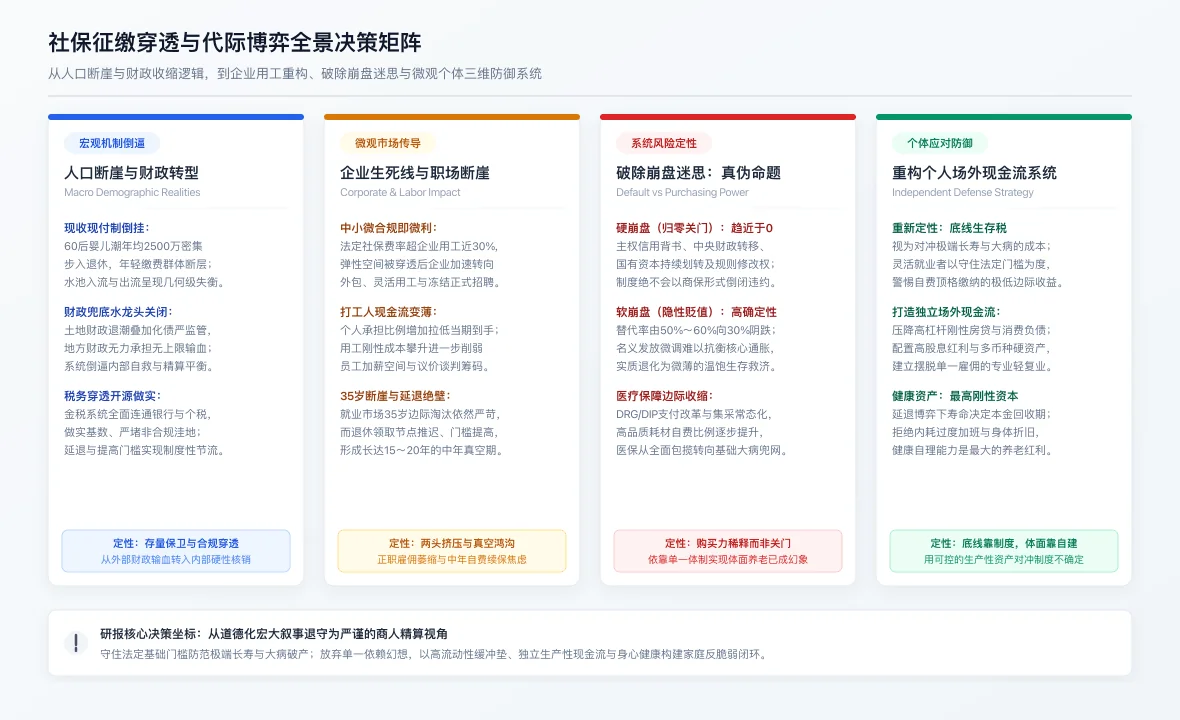
Figure 2: Forensic social security collection and the intergenerational game-theoretic decision matrix.
The Actuarial Arithmetic of Pay-As-You-Go
The most pervasive misconception regarding statutory basic pension insurance is the belief that employee monthly contributions accumulate in a personal vault, accruing interest until distributed at retirement.
In reality, the baseline public pooling pool of urban employee pension insurance operates strictly as a Pay-As-You-Go (PAYGO) engine. Current payroll deductions from today’s active workforce do not enter a time capsule; they are disbursed within the calendar month to fund payouts for today’s retired cohort.
This intergenerational pact relies on a classic demographic pyramid: a vast, expanding foundation of contributing laborers sustaining a comparatively narrow apex of retirees. That demographic geometry has permanently inverted:
- The Impending Retirement Tsunami: The colossal birth cohorts born between the early 1960s and early 1970s—averaging 25 to 28 million births annually—are crossing statutory retirement thresholds en masse.
- A Thinning Inflow Pipeline: The incoming cohort of replacement labor is contracting sharply, with recent birth cohorts falling well below ten million per year.
The resulting degradation of the system dependency ratio (active contributors per pensioner) creates a hydraulic bottleneck: incoming flows narrow while statutory disbursements explode. Absent adjustments to collection baselines or disbursement mechanics, solvency pressures are an unavoidable consequence of basic arithmetic.
The Closure of the Municipal Fiscal Backstop
For two decades, regional governments injected trillions of yuan into basic pension pools to absorb structural shortfalls. This recurrent balance-sheet infusion relied entirely on rapid corporate tax expansion and buoyant land concession revenues.
As property development cycles structurally recalibrated, municipal land revenues declined, and local debt restructuring entered an era of hard budget constraints, local governments lost the balance-sheet latitude required to underwrite unlimited pension deficits.
With external fiscal transfers circumscribed, systemic equilibrium demands internal balance-sheet re-engineering:
- Revenue Expansion: Mobilizing cross-departmental data under the Golden Tax architecture to scrutinize actual bank payroll disbursements against reported contribution baselines, permanently closing the historical grey zone of reporting at statutory minimums.
- Disbursement Compression: Incrementally deferring the statutory retirement age toward 63–65, while elevating the minimum contribution floor from 15 to 20 years—lengthening the capital-inflow horizon while truncating the net payout lifecycle.
Liquidating the Transition Costs of the 1990s
When China overhauled its pension architecture in the late 1990s, the system inherited a massive transition liability: an entire generation of state-sector workers retired under legacy promises without having accumulated personal account balances. Their pre-reform working tenures were classified as “deemed contribution years” (视同缴费工龄).
This implicit sovereign liability was never fully neutralized through upfront state-asset transfers; instead, it was amortized across three decades of hyper-growth. As analyzed in The Three Dimensions of Pension Disparity, when the broader economy downshifts from hyper-expansion to structural maturity, the marginal burden of amortizing this historical debt shifts onto the productive private sector and incoming cohorts of young workers.
2. Transmission Vectors: The Microeconomic Squeeze
Forensic tax collection and multi-system data reconciliation have erased the informal cushions that businesses and individuals once took for granted. The economic consequences are cascading through the real economy.
Enterprise Labor Re-engineering: When Compliance Eradicates Margin
Across competitive, low-margin sectors—light manufacturing, hospitality, retail, and traditional services—statutory social charges (spanning an employer-side 16% for pensions, roughly 8–10% for healthcare, alongside unemployment and injury insurances) represent a markup of nearly 30% above nominal wages. Historically, small and mid-sized enterprises (SMEs) survived by pegging contributions to minimum allowable thresholds or dispersing compensation via non-tax allowances.
With tax algorithms reconciling banking transaction flows, individual income tax withholdings, corporate operational expense ledgers, and social security filings, this operational discretion has collapsed. Confronting a step-function jump in statutory labor overhead, corporate actors respond predictably:
- Headcount Compression: Accelerating the transition to contract labor, offshore outsourcing, and contingent staffing, replacing open-ended employment contracts with transactional, project-based arrangements.
- Nominal Compensation Discounting: Depressing starting base wages for new hires or restructuring year-end bonuses into variable, performance-linked pay designed to offset statutory liabilities.
- Labor-to-Capital Substitution: Accelerating digital workflows and automation across production and service layers to reduce reliance on labor-dense positions.
The Double Squeeze on Take-Home Cash Flow
For non-state private-sector professionals, enforcing statutory contribution baselines forces an immediate increase in employee-side deductions (8% for pensions, 2% for medical), translating directly into diminished take-home monthly liquidity.
A more subtle impact occurs at the bargaining table: because employer contributions represent non-negotiable cash overheads, rising compliance costs swallow the marginal balance-sheet capacity that would otherwise fund discretionary raises or performance bonuses.
The Mid-Career Liquidity Chasm
The acute vulnerability generated by this structural reset is an institutional mismatch: the friction between an age-biased private labor market and an extended retirement horizon.
- Market Reality: The private sector continues to display sharp structural bias against mid-career professionals beyond age 35, radically suppressing career mobility and earning power for middle-aged white-collar workers.
- Institutional Thresholds: Statutory retirement horizons are moving outward, while the qualifying hurdle rises to 20 years of verifiable contributions.
This creates a perilous 15-to-20-year mid-career liquidity chasm: a knowledge worker displaced at 40 must survive two full decades before qualifying for their first statutory distribution. Whether to fund both employer and employee shares out-of-pocket as a self-employed contributor or allow contributions to lapse becomes a high-stakes balance-sheet calculation. For a deeper analysis of this dynamic, see Human Capital Depreciation and Passive Career Exits.
Rising Costs for Solo Operators
For self-employed professionals, platform operators, independent consultants, and freelance creatives, the tightening landscape introduces mounting contribution hurdles.
Flexible employment enrollment under the urban employee pension program typically levies a flat 20% contribution rate (with 8% allocated to the individual account and 12% absorbed into the public social pool). Because the baseline contribution floor is tied to average regional social wages (全口径城镇单位就业人员平均工资)—a metric that trends upward on an annual basis—the absolute cash cost of maintaining coverage climbs year after year. For self-employed individuals managing cyclical, volatile income, the risk-adjusted return on self-funded contributions faces severe downward pressure.
3. Dissecting the Collapse Thesis: Hard Default vs. Soft Dilution
As demographic aging accelerates and compliance deepens, public discourse frequently descends into catastrophic predictions of a systemic pension “collapse.” Evaluating this risk requires drawing a sharp line between structural insolvency and strategic parameter adjustments:
| Risk Category | Operational Characteristics | Actuarial Probability | Structural Underpinnings & Countermeasures |
|---|---|---|---|
| Hard Default (Technical Insolvency) | Liquidity depletion, system shuttering, cessation of statutory baseline payouts. | Approaches Zero (< 1%) | 1. Sovereign Legitimacy: The social safety net is the foundational covenant of modern public governance. 2. Fiscal Backstops: National council asset pools, strategic reserve shifts, and equity transfers from state-owned enterprises. 3. Rule-Making Primacy: The sovereign holds the power to unilaterally adjust statutory retirement ages, contribution baselines, and disbursement formulas, precluding standard commercial liquidation. |
| Soft Dilution (Real-Term Degradation) | Decoupling from purchasing power, secular decay of replacement rates, degradation to bare-minimum survival floors. | Near-Certain (High Probability) | 1. Downward Drift in Replacement Rates: Historic replacement rates of 50–60% for urban employees will drift toward ~30% as dependency ratios deteriorate. 2. Purchasing Power Erosion: While nominal payouts adjust upward via modest indexing, real purchasing power over essential care and healthcare will narrow to a basic survival stipend. 3. Healthcare De-risking: The institutionalization of DRG/DIP payment mechanisms and centralized procurement pushes advanced diagnostics and cutting-edge therapeutics off state balance sheets and onto private balance sheets. |
The public pension apparatus will not experience a sudden, commercial-style bankruptcy. Instead, it will manage liabilities by revising operational parameters, moving the goalposts, and diluting benefits across generations.
The system is shedding its popular misconception as a guarantor of comfortable retirement, returning to its intended functional purpose: a minimalist social safety net guarding against absolute poverty and catastrophic medical destitution.
4. Personal Cash Flow Defense: Countering Single-Path Vulnerability
Navigating an unyielding macroeconomic shift requires replacing moralized frustration with cold balance-sheet accounting.
Redefine the Vehicle: A Floor Survival Tax, Not an Investment Engine
The first imperative is shedding the illusion that statutory contributions operate as a compounded wealth-generation vehicle. Urban employee social insurance is effectively a progressive payroll tax combining risk-pooling with wealth redistribution.
- Retain the Floor: Abandoning the system entirely is a tactical error. The lifetime longevity hedge embedded in basic employee pensions (insuring against outliving your capital reserves) alongside the catastrophic coverage within statutory employee healthcare provide a cheap firewall against absolute late-stage poverty.
- Avoid Over-Allocation: For freelancers, creators, and independent founders operating outside state-subsidized frameworks, contributing at the maximum threshold out-of-pocket is an inefficient capital allocation. Once the minimum vesting threshold is met (e.g., the 15-to-20-year phased horizon), the marginal internal rate of return (IRR) on excess discretionary contributions drops significantly. For empirical modeling on these payout curves, refer to China’s Social Security: Early vs. Delayed Retirement.
Tailoring Coverage to Employment Status
- Standard Corporate Employees: Maintain full statutory compliance. Maximize the employer-funded 16% matching contribution alongside housing provident fund contributions. This formal participation remains tethered to core municipal privileges, including metropolitan real estate transaction rights, resident registrations, and tier-one public schooling access.
- Independent Contractors and Career Transitioners:
- If personal cash flows contract during cyclical downswings, self-funding top-tier employee contributions out-of-pocket strains personal liquidity. Avoid borrowing to fund contributions. Fall back to the lower-cost Urban and Rural Resident Basic Insurance framework (城乡居民保) as an interim measure.
- Re-evaluate transitioning back to the comprehensive employee tier only after positive operational cash flow returns, preventing fixed social insurance bills from impairing short-term liquidity reserves.
Build Sovereign Off-Balance-Sheet Reserves
What carries a household across the mid-career vacuum is not an institutional promissory note, but direct ownership of productive assets and resilient cash-generating engines:
- Deleverage Rigid Long-Duration Liabilities: In an environment marked by employment dispersion and unpredictable income streams, eliminate excessive consumer and mortgage leverage. Maintain an unencumbered liquid cash cushion covering 12 to 24 months of essential operational burns.
- Diversify Asset Allocations: Channel operational surpluses into hard, productive holdings resilient to geographic policy shifts—high-yield dividend cash flow engines, global multi-currency liquid reserves, and sovereign-insulated physical assets.
- Strategic Evaluation of the Third Pillar (Private Pension Accounts): For earners within upper marginal tax brackets, the annual tax-advantaged private pension allotment (currently capped at 12,000 RMB) provides clear deferred-tax utility and structural savings discipline. However, for individuals within lower tax tiers, the liquidity discount of locking capital until statutory retirement age often outweighs the modest upfront tax saving.
- Develop Low-Overhead Autonomous Operations: Cultivate independent, lean consulting engines, cross-border digital services, or niche digital assets insulated from corporate age ceilings. An independent operation yielding even modest monthly cash flows provides a decisive liquidity backstop during corporate career shocks.
Treat Physical Vitality as Prime Capital
Under deferred retirement timelines and revised life-expectancy accounting tables, an individual’s internal rate of return on the PAYGO engine hinges on two core parameters: total lifespan and the duration of unassisted mobility.
- Maximize the Inflow Window: Prolonging health and physical independence maximizes the total lifecycle duration of pension capital collection.
- Close Late-Stage Capital Drains: Under progressive healthcare rationing, the premier source of late-stage household capital destruction is not daily consumption, but protracted functional dependency, memory care, and out-of-pocket medical hardware. Protecting metabolic health, cardiovascular capacity, and musculoskeletal durability preserves more late-stage net worth than over-allocating into statutory contribution pools.
Understanding the mechanics of institutional accounting is not an exercise in fatalism. It is a prerequisite for sovereign decision-making: discarding false assurances, securing household vulnerabilities, and relying on productive personal balance sheets to navigate structural shifts.
Related Research & Topics
Tello Mobile eSIM
SafetyWing Nomad Insurance
* Disclosure: This post contains affiliate links. If you make a purchase through these links, V-G Journal may earn a small commission at no additional cost to you. We only recommend services we independently evaluate and trust.
FIRE and Golf:自由旅居之路
专注于为追求 FIRE 与品质生活的人群提供特惠打球权益与候鸟微度假。不持一砖一瓦,运营品质生活。