The Solvency Paradox: Pension Deficits, Entrenched Privilege, and the Decay of China's Social Contract
An autopsy of China's public pension crisis at the intersection of actuarial insolvency and structural inequality. How legacy privileges drain the Pay-As-You-Go pool, triggering an opt-out cascade among the young that bureaucratic extraction can no longer contain.

Executive Summary: In mainstream policy discourse, the pension system’s balance sheet crisis and its distributive inequities are frequently framed as a technocratic trade-off: do we plug the fiscal hole first, or do we engineer institutional fairness? From the mechanics of actuarial science and intergenerational game theory, this is a false binary. The reservoir is not running dry by demographic accident alone; it is draining because its distributive architecture guarantees massive, unearned payouts to an entrenched state-affiliated class while offloading the liabilities onto an increasingly precarious productive base. Solvency and fairness are not separable levers. By choosing unilateral extraction over structural reform, the state is actively exhausting the underlying currency of any social contract: trust.

Figure 1: The Ministry of Human Resources and Social Security. As the operational nerve center of China’s social safety net, it stands caught between impending insolvency and the structural refusal to overhaul legacy entitlements.
I. The Technocratic Smokescreen: A Manufactured Binary
Posing “solvency first” against “fairness first” is an administrative sleight of hand—a deliberate downscaling of systemic contradiction into manageable engineering metrics.
In official narratives, the liquidity crisis of the social security fund is framed as an imminent, objective emergency: pensions must clear on schedule to prevent social unrest. Distributive equity, by contrast, is patronizingly relegated to an aspirational, long-term luxury—something to be addressed only after the aggregate pie has been re-inflated. This posture rests on a disingenuous premise: that the reservoir is drying up solely due to an external demographic winter, and that if every citizen simply contributes more, the machine will return to equilibrium.
Within a Pay-As-You-Go (PAYGO) framework, however, the financial depth of the pool and the subjective trust of its contributors are identical variables. China’s pension reserves are evaporating at record speed precisely because decades of an institutional dual-track structure turned the fund into an extractive engine: a mechanism where an insulated minority enjoys guaranteed, hyper-indexed cash flows, while the unshielded private majority is handed an open-ended obligation to absorb the shortfall.
When the state sidesteps distributive restructuring and instead raises minimum contribution thresholds and extends retirement ages, it is issuing a naked demand: that the precarious, disenfranchised generations subsidize the historical privilege of an untouchable legacy class. Treating fiscal solvency as separate from institutional reform does not rescue the system. It accelerates the liquidation of its remaining legitimacy.
II. The Structural Funnel: The Pool Did Not Evaporate on Its Own
Actuarially, any pension architecture operating on a Pay-As-You-Go basis rests upon two non-negotiable pillars: a supportive demographic pyramid and uncompromising civic faith in the underlying contract.
When birth rates collapse and dependency ratios invert, macroscopic strain is inevitable. Yet China’s accelerating pension depletion cannot be explained through demography alone. Beneath the actuarial headlines lies decades of systemic leakage engineered into the system’s design:
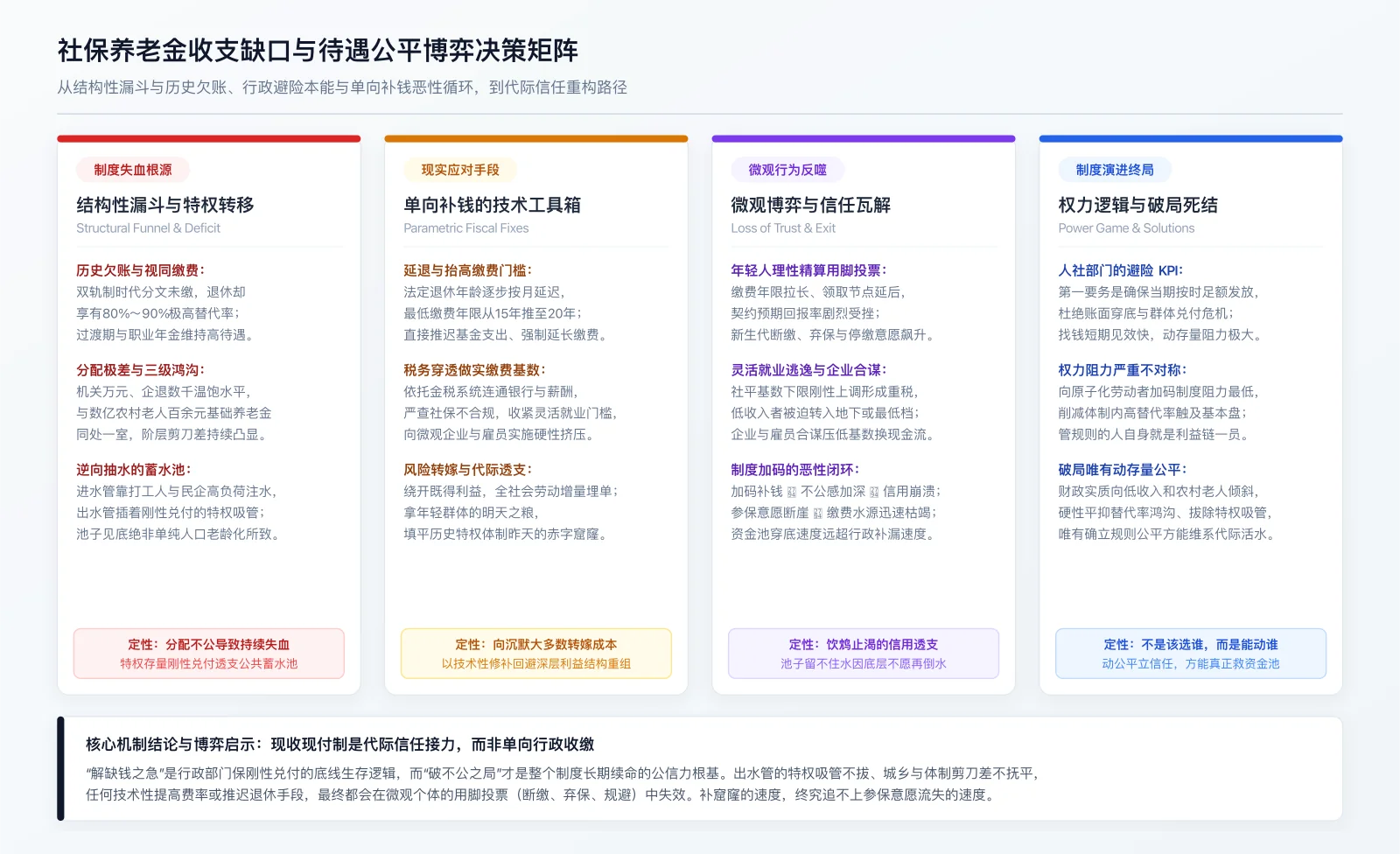
Figure 2: The systemic deadlock between structural insolvency and distributive equity.
1. Legacy Arrears and Transferred Privilege: The Fiction of “Deemed Contributions”
Prior to the formal integration of public sector and civil service pensions, state employees operated within a non-contributory welfare enclave for decades. Individuals and work units contributed zero capital to the social pool. Upon retirement, however, their benefits were pegged directly to final salary brackets, yielding baseline replacement rates between 80% and 90%—wholly underwritten by fiscal transfers.
As explored in The Pension Gap: Dimensions, Realities, and Endgames, the subsequent “integration” and its decade-long transitional framework—paired with mandatory supplementary occupational annuities for the civil apparatus—perpetuated these structural asymmetries. Without allocating dedicated sovereign capital to pre-fund these liabilities, tens of millions of high-benefit retirees were simply dumped into the social pooling account. In real terms, the state externalized the staggering transition costs of its own bureaucracy directly onto private-sector enterprises and young payroll workers.
2. The Three-Tier Caste System
While nominal coverage is now comprehensive, the payout architecture operates along rigid, hierarchical tiers:
- Tier 1 (Civil Servants & Public Institutions): Typical payouts range from thousands to tens of thousands of RMB per month, paired with comprehensive, hyper-subsidized healthcare coverage and supplementary stipends.
- Tier 2 (Urban Enterprise Employees): Payouts average roughly 3,000 to 4,000 RMB monthly—sufficient only for subsistence living, with actual wage replacement rates languishing around 40%.
- Tier 3 (Hundreds of Millions of Rural and Non-Working Urban Residents): The monthly basic pension frequently hovers between 100 and 200 RMB. It functions not as retirement security, but as a symbolic welfare gesture incapable of sustaining physical survival.
This gulf exists within the same sovereign territory, exposed to the same cost-of-living realities. When the working-class majority observes that their aggressive monthly payroll deductions secure only marginal future returns, while retired administrative cadres draw pensions exceeding the full-time salaries of prime-age urban workers, the foundational moral claim of “social pooling” ceases to exist.
3. The Extractive Mechanics: Who Fills the Tank, Who Drains It
The current pension architecture is not a uniformly shared reservoir. It is a one-way funnel, filled under heavy regulatory coercion by private enterprises and gig workers, and tapped by open-ended administrative siphon tubes.
Employers carry mandatory pension contributions nearing 16% of employee wages, while workers see another 8% stripped directly from their paychecks. These significant cash flows do not compound into clear, individual property rights; they are routed through the PAYGO pipeline to fund immediate, non-negotiable payouts to early-generation retirees holding state-backed privileges. As long as these legacy payouts remain immune to market reality, any additional capital injected into the system simply vanishes into a fiscal sinkhole.
III. Extraction Without Equity: The Reflexive Death Spiral
When policymakers decide to treat the deficit strictly as a math problem—leaving legacy privileges untouched—their regulatory toolkit shrinks to an unimaginative playbook of administrative extraction:
- Extending the Minimum Contribution Period: Progressively raising the vesting bar from 15 to 20 years.
- Raising the Statutory Retirement Age: Sequentially delaying payouts to retain cash on the state’s balance sheet.
- Tax Auditing and Regulatory Enforcement: Deploying the Golden Tax IV architecture to link banking records directly with corporate payrolls, aggressively closing informal exemptions as documented in The Social Security Tax Audit and Defense Playbook.
This emergency triage offloads the entire burden onto the productive economy. It is an explicit expropriation of tomorrow’s youth to liquidate the unearned promises made to yesterday’s state apparatus.
1. Policy Dimensions: Solvency Enforcement vs. Institutional Legitimacy
The philosophical rift between paper solvency and actual social equity directly dictates the tools chosen and their systemic blowback:
| Analytical Dimension | Solvency-First Strategy (Preserving Nominal Payouts) | Fairness-First Strategy (Preserving Systemic Legitimacy) |
|---|---|---|
| Core Tension | Fund depletion driven by demographic decline, inverted dependency ratios, and cash-flow shortfalls. | Extreme disparities in cost-to-benefit ratios between the state apparatus, private workers, and rural populations. |
| Operational Priority | Statutory payouts are a non-negotiable legal obligation; a technical default triggers immediate system-level risk. | Foundational legitimacy: determining whether incoming generations choose to participate or exit the formal economy. |
| Primary Levers | Delaying retirement ages; extending vesting horizons; auditing enterprise payroll bases; cross-provincial fund pooling. | Compressing elite replacement rates; redirecting central fiscal revenues to rural baselines; writing off unfunded legacy obligations. |
| Systemic Blowback | Squeezing payers (higher costs, longer waits, lower yields) triggers capital flight, informalization, and opting out. | Structural resistance from the entrenched bureaucratic apparatus; direct friction with key political constituencies. |
2. The Microeconomic Revenge: Voting with One’s Feet
Administrative institutions consistently underestimate the economic agency of the individual. When the terms of a social contract become punitive, the payoff window recedes into the distant future, and visible inequities widen, rational economic actors organize an orderly retreat:
- Actuarial Realism Among the Young: Confronting decades of payment obligations against a collapsing replacement yield, younger workers are choosing to halt contributions, withdraw where possible, or stop precisely at the statutory minimum.
- The Flight of Flexible Labor: As the mandatory contribution floor scales upward alongside nominal local “average wages”—bearing zero correlation to actual gig-economy incomes—self-employed and contract workers face crushing fixed overheads. Dropping social coverage becomes an instinctual preservation of immediate cash flow.
- Covert Corporate-Labor Collusion: Small-to-medium enterprises fighting for survival partner tacitly with employees seeking higher take-home pay. Together, they bypass formal social security mandates through contractor agreements, minimum-wage reporting, and off-the-books remuneration.
The result is a classic tragedy of the commons: Financial strain triggers regulatory extraction ➔ Extraction sharpens perceived unfairness ➔ Unfairness breaks civic trust ➔ Broken trust accelerates systemic opt-outs ➔ Revenue collapses further.
Attempting to solve solvency without addressing fairness is drinking poison to quench a thirst. The reservoir is not draining from natural evaporation; the people pumping water into it have simply laid down their tools.
IV. The Institutional Calculus: Administrative Self-Preservation
From the perspective of macroscopic welfare economics, the policy sequence is straightforward: restore fairness to re-establish trust; re-establish trust to stabilize the contribution base; stabilize the base to resolve the solvency crisis.
Inside the administrative state, however, institutional survival dictates the exact reverse.
1. Risk-Aversion Metrics: The Path of Least Resistance
The bureaucratic mandate of the Ministry of Human Resources and Social Security revolves around a single, existential Key Performance Indicator: guarantee nominal, uninterrupted pension delivery to avoid immediate, high-visibility public crises.
Under this narrow framework, securing cash flow becomes the sole imperative. By decreeing delayed retirement, increasing minimum contribution periods, and tightening corporate tax scrutiny, the bureaucracy disperses the financial pressure across hundreds of millions of atomized, politically unorganized private-sector workers. The societal friction may be high, but the institutional friction along the administrative chain is minimal. It is familiar, technically viable, and delivers immediate balance-sheet relief.
2. The Asymmetry of Political Resistance
Conversely, engineering distributive fairness requires systemic self-surgery.
Genuine fairness does not mean raising rural baseline pensions by a token five or ten yuan a year. It demands an aggressive, downward compression of elite civil-service replacement rates, the abolition of unearned institutional allowances, the curtailment of VIP medical privileges, and the reallocation of capital to the baseline social safety net.
This strikes at the core economic interests of the state apparatus itself. Crucially, the officials tasked with designing, executing, and enforcing these policies are themselves members of this privileged class. Demanding that an administrative elite voluntarily strip away its own legacy rents in the name of long-term social equilibrium encounters near-total structural paralysis.
V. The Endgame: Structural Solvency Requires Structural Sacrifice
The institutional debate over whether to solve insolvency or unfairness exposes a profound rift between theoretical economics and political reality:
- Through the Lens of Political Economy: Without addressing systemic inequality and removing the institutional drains on the collective pool, technocratic extraction is an exercise in denial. Once the younger generation permanently disengages, the system will face an uncontrolled hard landing in both solvency and credibility.
- Through the Lens of Bureaucratic Reality: The machinery of the state will invariably fall back on familiar extractive reflexes—delaying payouts and hunting for taxable enterprise cash—while packaging distributive justice as a vague, distant objective that must never perturb incumbent entitlements.
Ultimately, this was never a technocratic debate over policy sequencing. It is an unvarnished confrontation over political power: who must sacrifice, and who is permitted to extract.
Balancing the books is a mechanical exercise in short-term survival; restoring structural fairness is the sole condition under which the system deserves to survive at all. If the state continues to squeeze the margins of an unprotected labor force while leaving institutional privileges untouched, no administrative machinery will be fast enough to catch up with the speed at which societal buy-in collapses.
The architects who draft the rules, after all, have never had to rely on a hundred-yuan monthly pension to protect their dignity in old age.
Related Research & Topics
Tello Mobile eSIM
SafetyWing Nomad Insurance
* Disclosure: This post contains affiliate links. If you make a purchase through these links, V-G Journal may earn a small commission at no additional cost to you. We only recommend services we independently evaluate and trust.
FIRE and Golf:自由旅居之路
专注于为追求 FIRE 与品质生活的人群提供特惠打球权益与候鸟微度假。不持一砖一瓦,运营品质生活。