The Actuarial Value of a Worker: Labor Standards and Livestock Rights in the Sino-Swiss FTA Upgrade
The upgraded Sino-Swiss Free Trade Agreement introduces unprecedented non-derogation clauses to prevent the suppression of labor welfare for export advantage. Contrasting Switzerland’s hyper-quantified statutory protections for actual livestock against the systemic burn-out of corporate workers exposes the economic game theory dividing heavy capital preservation from disposable human labor.


Figure 1: Dairy cattle grazing in the Swiss Alps, enjoying statutory social grouping and outdoor access. Behind Europe’s strictest animal welfare regulations lies an actuarial system designed to preserve livestock as high-value fixed assets.
In the autumn of 2026, China and Switzerland formally signed the protocol upgrading their bilateral Free Trade Agreement (FTA), pushing zero-tariff coverage beyond 99%. Crucially, the protocol introduced a dedicated chapter on “Trade and Sustainable Development,” explicitly establishing the suppression of labor welfare for competitive advantage as a violation of bilateral trade principles.
This clause triggered widespread resonance among Chinese corporate workers, who frequently self-identify through dark internet humor as niuma—literal “oxen and horses.” Yet piercing through the self-deprecation reveals a striking empirical paradox: in Europe, and in Switzerland specifically, literal beasts of burden enjoy the world’s most hyper-quantified statutory guarantees. From enforceable social rights against loneliness and minimum stall dimensions to mandatory 35°C work-stoppage thresholds, this divergence is not mere humanitarian sentimentality. It represents a defensive self-locking mechanism by high-welfare economies against social dumping, intersecting with an industrial powerhouse’s internal imperative to escape hyper-involutionary price wars.
I. The New FTA Landscape: Non-Derogation Clauses and the Anti-Social Dumping Doctrine
In the upgraded Sino-Swiss FTA negotiations, the variable drawing the closest scrutiny from international trade economists and labor law scholars was the substantive expansion of high-level institutional rules. Unlike the original 2013 framework, which focused heavily on conventional tariff reductions, the 2026 protocol systematically bolstered chapters on competition policy and sustainable development.
Central to this upgrade is a foundational pillar of modern progressive trade agreements: the Non-derogation of Labor Standards clause. Its legal doctrine is unequivocal: neither contracting party may waive, dilute, or fail to enforce its domestic labor standards—such as statutory working-hour ceilings, minimum wage floors, occupational safety mandates, and basic social security—as a strategy to attract foreign investment or lower export prices.
In international trade theory, this mechanism serves as a barrier against social dumping. For Switzerland, establishing this rule carries immense domestic political necessity:
- Defensive Self-Locking of High-Cost Economies: Swiss domestic labor enjoys world-leading wage levels and robust social safety nets. Consequently, compliance and operational costs for Swiss firms are exceptionally high. While industry bodies like Swissmem and labor unions like UNIA endorsed 99% zero-tariff access to the vast Chinese market, their baseline requirement was safeguarding domestic manufacturing from external goods produced through welfare suppression, uncompensated overtime, or social security arbitrage.
- Internal Structural Alignment for China: From a macro governance perspective, China’s acceptance of high-standard sustainable development rules was not merely a concession to external demands. It aligned with a strategic top-level pivot. Facing persistent domestic “involution” (neijuan), destructive price wars, and suppressed household consumption ratios, China’s policy agenda has increasingly targeted predatory competition that squeezes labor margins. Embedding labor protections into international treaties provides a structural external lever to push domestic supply chains out of the “low-wage trap” toward value-added innovation.
II. Pixel-Level Audit: The Quantified Statutory Welfare of European Livestock
When corporate professionals label themselves “beasts of burden,” they express a systemic feeling of burnout. However, examining the Swiss Animal Protection Act (TSchG) and its accompanying Animal Protection Ordinance (TSchV) reveals that European law accords actual livestock an intricate network of physical protections defined down to the decimeter, hour, and degree Celsius:
| Welfare & Safety Dimension | Statutory Swiss (TSchV) / EU Livestock Standard | Corporate Worker Reality |
|---|---|---|
| Social Rights & Anti-Isolation | Calves may be housed individually for only the first 2 weeks; group housing is mandatory after 2 weeks, and tethering under 4 months is strictly illegal. Stall partitions must be perforated to guarantee visual, auditory, and tactile contact. Horses cannot be kept in isolated confinement. | Open-plan office spaces outfitted with privacy screens; algorithmic desk-occupancy tracking; corporate restrictions on cross-departmental interaction; performance markdowns for informal workplace socialization. |
| Minimum Living & Activity Space | Individual horse stalls must measure at least twice the square of shoulder height (e.g., a 1.65m horse requires at least 10.9 m²), with ceiling heights 1.5 times shoulder height. Farms must provide at least one designated lying area per cow. | Young urban professionals routinely live in partitioned micro-apartments driven by inflated urban rents; individual office workstations frequently measure under 2 m². |
| Outdoor Access & Rest Guarantees | Tethered cows must receive at least 60 days of pasture access during the vegetation season (30 days in winter); unridden horses require at least 2 hours of outdoor free movement 2 days per week. | The standard legal 40-hour work week routinely expands past 48 hours in practice; paid vacation usage remains low, relying heavily on national shift-work schemes (tiaoxiu) to stitch together multi-day breaks. |
| Transport & Transit Limits | Live animal transit within Switzerland is capped at a strict 6-hour maximum (EU caps transit at 24h for horses, 29h for cattle, with mandatory hydration breaks). | Super-commuting exceeding 1.5 hours each way; frequent corporate reliance on red-eye flights and overnight sleeper trains to compress business travel expenses. |
| Overwork & Heat Stress Circuit Breakers | EURCAW mandates clean drinking water every 4 hours for working equines; equine labor is strictly prohibited above 35°C. 40% of official welfare inspections are unannounced spot-checks. | On-demand delivery riders managed by algorithmic countdowns during heatwaves and rainstorms; high-temperature stipends rendered nominal; employees working through illness to protect attendance bonuses. |
This granular regulatory detail illustrates how modern European agricultural law deconstructs animal behavior:
- Preserving Social Instincts: The Swiss Animal Protection Ordinance categorizes the deprivation of social contact for social animals as a direct legal infraction. Farms must raise young horses in group environments, and stall partitions are required to feature mesh or window openings so animals can hear, smell, and see their neighbors.
- Direct Subsidies for Outdoor Welfare: Through the federal RAUS program (Regular Outdoor Exercise for Livestock), the Swiss government provides direct financial incentives to farmers who meet strict grazing benchmarks. Over 90% of Swiss dairy farms voluntarily participate, granting cows enforceable access to outdoor pastures and sunlight.
- Painless Veterinary Standards: Swiss law strictly prohibits the dehorning of calves without anesthesia. Enforced transparency rules mandate clear labeling on meat and dairy products indicating whether production involved unanesthetized procedures, using consumer-side visibility to enforce humane farm management.
III. The Cold Calculus of Capital: Fixed Assets vs. Variable Consumables
Why are European agricultural enterprises willing to incur such high compliance costs for livestock?
As explored in our analysis of Clarkson’s Farm and the Economics of Livestock Depreciation, this dynamic is rooted less in moral benevolence than in the economic calculus of asset ownership.
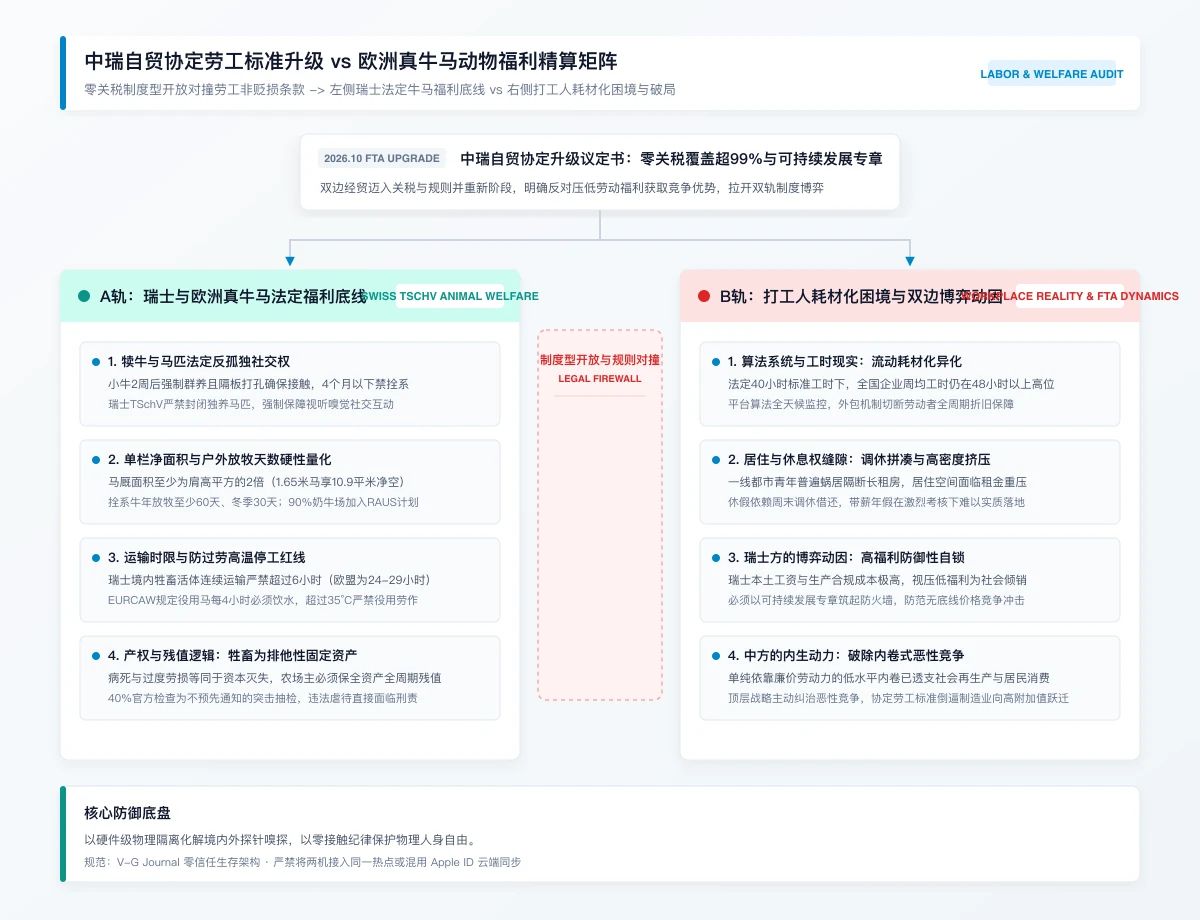
Figure 2: The dual-track matrix of FTA labor standards and livestock welfare economics—juxtaposing Swiss heavy-asset preservation and statutory baselines against worker asset-depreciation and bilateral trade game theory.
1. Livestock as Fixed Capital Assets: Depreciation and Residual Value
On the balance sheet of a European family farm, a high-yield Holstein cow or a draft horse represents a significant capital asset costing thousands of Swiss Francs:
- Death as Capital Destruction: If bad stall hygiene leads to hoof disease, or if dehydration during transit causes sudden death, the farm owner suffers a direct, unrecoverable capital write-off.
- Maximizing Residual Value: Allowing dairy cows to graze on soft pasture and maintaining low stress levels in working equines functions as capital expenditure (CapEx) designed to minimize abnormal wear and tear and extend the productive lifespan of the asset. Government schemes like RAUS offset these maintenance costs at the margin, sustaining a stable compliance equilibrium.
2. Workers as Variable Costs: The Consumable Labor Model
By contrast, in modern platform economies and hyper-optimized corporate environments, the structural contract between enterprise and worker has undergone a radical transformation:
- Zero Residual Liability and High Substitutability: In labor markets with abundant supply, platforms and corporate employers do not hold long-term asset liabilities for the worker’s lifecycle. By utilizing flexible staffing, third-party dispatch, and independent contractor frameworks, enterprise contributions to social safety nets are minimized or legally bypassed.
- Externalizing Asset Depreciation: Spinal fatigue, vision deterioration, cardiovascular strain, and clinical burnout do not appear as depreciation lines on corporate balance sheets. As analyzed in The Evolution of Rest: From the Sabbath to 996 and The Economic Accounting of Compressed Holiday Schedules, physical wear and tear is externalized onto public health systems and family safety nets. When an employer bears no financial responsibility for the residual value of human capital, the short-term rational commercial choice is to extract maximum output until exhaustion, then rotate the worker out.
This creates a paradoxical economic landscape: livestock, protected as private capital assets, enjoy statutory spatial allowances, heat-stress work stoppages, and pain-management mandates. Meanwhile, corporate workers, despite holding legal personhood, face structural pressures that treat their physical labor as a consumable operating expense.
IV. Game Theory and Structural Breakthrough: Labor Rights as a Catalyst for Productivity
The inclusion of labor-standard non-derogation clauses in the upgraded Sino-Swiss FTA represents an institutional attempt to address this asymmetry in international commerce.
1. Eliminating the “Race to the Bottom”
When international free trade evaluates goods strictly on free-on-board (FOB) prices while ignoring labor cost suppression in the production process, it risks triggering a global Race to the Bottom:
- Enterprises that adhere to statutory hours, contribute fully to social security, and maintain workplace safety are undercut by competitors that systematically stretch work hours and externalize labor costs.
- This market dynamic can penalize high-compliance firms, disincentivizing long-term investment in technological innovation and brand equity in favor of short-term labor cost suppression.
By insisting on enforceable labor baselines in trade agreements, high-welfare economies build a regulatory buffer against price undercutting driven by domestic labor deregulation.
2. Breaking Involution and Rebuilding Internal Consumption
For export-oriented manufacturing economies, shifting away from cost suppression is equally vital for long-term structural health.
Building export competitiveness primarily through depressed labor costs and uncompensated overtime yields diminishing returns. Internationally, it triggers trade frictions, anti-dumping investigations, and supply-chain due diligence legislation. Domestically, it suppresses the labor share of national income. When workers lack disposable income and leisure time, household consumption remains muted, constraining macro transitions toward domestic consumption-led growth.
Sustainable national competitiveness relies not on enduring severe working conditions or suppressing wages, but on driving Total Factor Productivity (TFP), high-precision manufacturing, and institutional efficiency. Just as rigorous animal welfare laws incentivized agricultural innovation and precise asset management across European farms, modern industrial workforces cannot serve merely as low-cost inputs for hyper-involutionary price wars.
Moving from internet memes about corporate “beasts of burden” to establishing baseline labor standards in international free trade agreements represents a necessary institutional shift. Eliminating regulatory arbitrage based on welfare suppression forces enterprise capital to compete on technological innovation and organizational design—ensuring that human labor dignity takes precedence over the balance-sheet logic of asset depreciation.
Related Research & Topics
Tello Mobile eSIM
SafetyWing Nomad Insurance
* Disclosure: This post contains affiliate links. If you make a purchase through these links, V-G Journal may earn a small commission at no additional cost to you. We only recommend services we independently evaluate and trust.
FIRE and Golf:自由旅居之路
专注于为追求 FIRE 与品质生活的人群提供特惠打球权益与候鸟微度假。不持一砖一瓦,运营品质生活。