The Cyprus Pension Overhaul of 2027: Nomad Social Security Traps and Offshore Asset Defense
Cyprus is finalizing its most radical pension overhaul in 50 years, set for January 2027. We break down the 20.6% self-employed social security burden, the lack of bilateral recognition for third-country nationals, and how to utilize Non-Dom status and IBC structures as an airtight defense.


Figure 1: The House of Representatives in Nicosia, Cyprus. The government is advancing the most sweeping social insurance and pension restructuring in half a century, slated to take full effect on January 1, 2027.
The Mediterranean island nation of Cyprus is finalizing the most profound restructuring of its pension system in nearly half a century, set to take effect on January 1, 2027. Spearheaded by the Ministry of Labor and Social Insurance, this legislative overhaul is designed not only to address the actuarial deficit of the sovereign social insurance fund, but also to tighten enforcement on non-traditional employment and self-employed digital nomads residing on the island. For cross-border freelancers and FIRE (Financial Independence, Retire Early) practitioners who have long relied on local non-domiciled status to harvest low-tax dividends, these new regulations puncture the complacent assumption that foreign social security is a negligible overhead cost, exposing third-country expats to severe sinking-fund risks within a fragmented regulatory architecture.
The 2027 Overhaul: Reshaping the Social Security Foundation
The current social insurance and pension framework in Cyprus largely crystallized in 1980. Decades of demographic aging, rulings by the European Court of Human Rights, and fiscal raiding during the sovereign debt crisis have left the long-term actuarial balance of the legacy fund facing severe strain.
According to the roadmap disclosed by the Ministry of Labor and Social Insurance, the 2027 pension reform is a multi-layered structural adjustment centered on four core dimensions:
- Transition Periods and Phased Implementation: The reform establishes a 15-year transitional protection period (extending to 2041) to ensure that workers nearing retirement age have adequate adaptation windows. Adjustments to the baseline pension and provisions for low-income retirees will be phased in through a three-year step mechanism, preventing sudden annual fiscal shocks.
- Early Retirement Actuarial Penalties: Current regulations enforce a rigid 12% actuarial reduction for individuals retiring early at age 63. Backed by International Labour Organization (ILO) actuarial models, the new policy softens this penalty to 7.5%—or waives it entirely—for participants with exceptionally long contribution histories or those engaged in arduous physical labor.
- Fiscal Independence and Transparent Reserve Governance: The legislation formally terminates the government’s legacy practice of drawing interest-free overdrafts from the Social Insurance Fund (SIF). It also establishes a modern investment committee and disclosure framework for the fund’s roughly 12 billion euro reserve, insulated from cabinet interference.
- Tighter Audits on Non-Traditional Employment: Digital nomads and cross-border freelancers have historically compressed social security outlays by declaring industry-minimum nominal earnings. The 2027 complementary regulations significantly tighten cross-border actual labor income audits and anti-avoidance enforcement.
For global nomads accustomed to exploiting regulatory arbitrage on the periphery of Europe, this reform signals a decisive shift by Cyprus away from loose oversight and toward an airtight sovereign fiscal and tax loop.
The Digital Nomad’s Social Security Ledger: 16.6% Contributions and the Cross-Border Gap
Many content creators, independent developers, and remote professionals who utilize the Cyprus “60-Day Tax Rule” or the Digital Nomad Visa focus exclusively on attractive personal income tax exemptions and dividend tax rates, while overlooking the mandatory constraints of statutory social security and healthcare contributions.
Under current Cypriot tax law, registering as a self-employed individual (Sole Proprietorship/Freelancer) triggers the following:
- Social Insurance Scheme: A mandatory statutory contribution rate of 16.6%, assessed against the Ministry of Labor’s statutory minimum and maximum Notional Insurable Earnings for specific professions.
- General Healthcare System (GeSY): An additional mandatory health contribution of 4.0% for self-employed individuals.
Combined, the total statutory social and medical security load for self-employed persons hits 20.6%. For small-scale freelancers with limited operating revenue, the tax and social security systems demand these payments based on the minimum notional earnings bracket—even if the business operates at a net loss for the year.
The more critical structural reef lies in qualification recognition and cross-border bridging gaps for social security tenure. Institutional treatment varies fundamentally depending on nationality:
- EU Citizen Pathway (Regulation EC No 883/2004): Enjoying comprehensive EU social security coordination, contribution periods and points accumulated in Cyprus can be seamlessly aggregated with pensions in member states like Germany, France, or Greece.
- Third-Country Non-EU Citizen Pathway (e.g., Chinese Digital Nomads): Because Cyprus and China lack a bilateral social security recognition agreement, the 16.6% contributions paid in Cyprus cannot be transferred to domestic accounts. Coupled with the statutory baseline pension requirement of at least 15 cumulative years of contributions—and no cash refund options for short-term residents upon departure—these payments transform entirely into sunk costs.
Citizens within the European Union are fully protected by EU Regulations No. 883/2004 and No. 987/2009. Every social insurance point paid in Cyprus can be automatically consolidated when applying for pensions in member states such as Germany, France, or Ireland (Totalisation of periods).
However, China and Cyprus have never signed a bilateral social security recognition agreement. For digital nomads holding Mainland Chinese passports, the 16.6% social security contributions made in Cyprus cannot be transferred back to domestic accounts to offset contribution years, nor can domestic work histories exempt them from paying in Cyprus.
From an actuarial and legal standpoint, the underlying logic of cross-border pooling differs entirely from privately built pensions. As we noted in our analysis of domestic tiered social security projections regarding Early vs. Delayed Retirement Actuarial Models, any pension system reliant on public pooling must clear statutory minimum thresholds to disburse annuities. In Cyprus, the statutory baseline pension requires participants to accumulate a continuous contribution history of at least 15 years (or equivalent insurance points).
The vast majority of digital nomads maintain residence cycles in Cyprus of only two to five years. When these nomads eventually migrate to Portugal, Spain, or return to Asia, third-country non-EU status restrictions prevent them from cashing out their previous years of contributions to the Cyprus social security fund, nor can they clear the 15-year threshold to claim a dignified annuity. Ultimately, these funds degrade into dead accounts yielding a few euros a month at retirement age—or becoming entirely unrecoverable.
This is not merely a compulsory expenditure devoid of liquidity; it is an overlooked certainty of sunk cost in cross-border nomadic living. Simultaneously, free agents detached from traditional domestic career safety nets require reliable medical security and safety net defenses, rather than blindly staking their chips on unredeemable foreign pooling mechanisms.
Legal Topology and Architecture Isolation: From Bare Self-Employment to IBC Asset Firewalls
Faced with the tightening of the 2027 Cyprus pension reforms, cross-border digital nomads and long-term FIRE travelers must abandon the crude approach of “registering directly as self-employed individuals and absorbing a 20.6% pooling deduction.” By deeply deconstructing local corporate and tax law privileges, one can construct a protective layer that balances legal compliance with asset isolation.
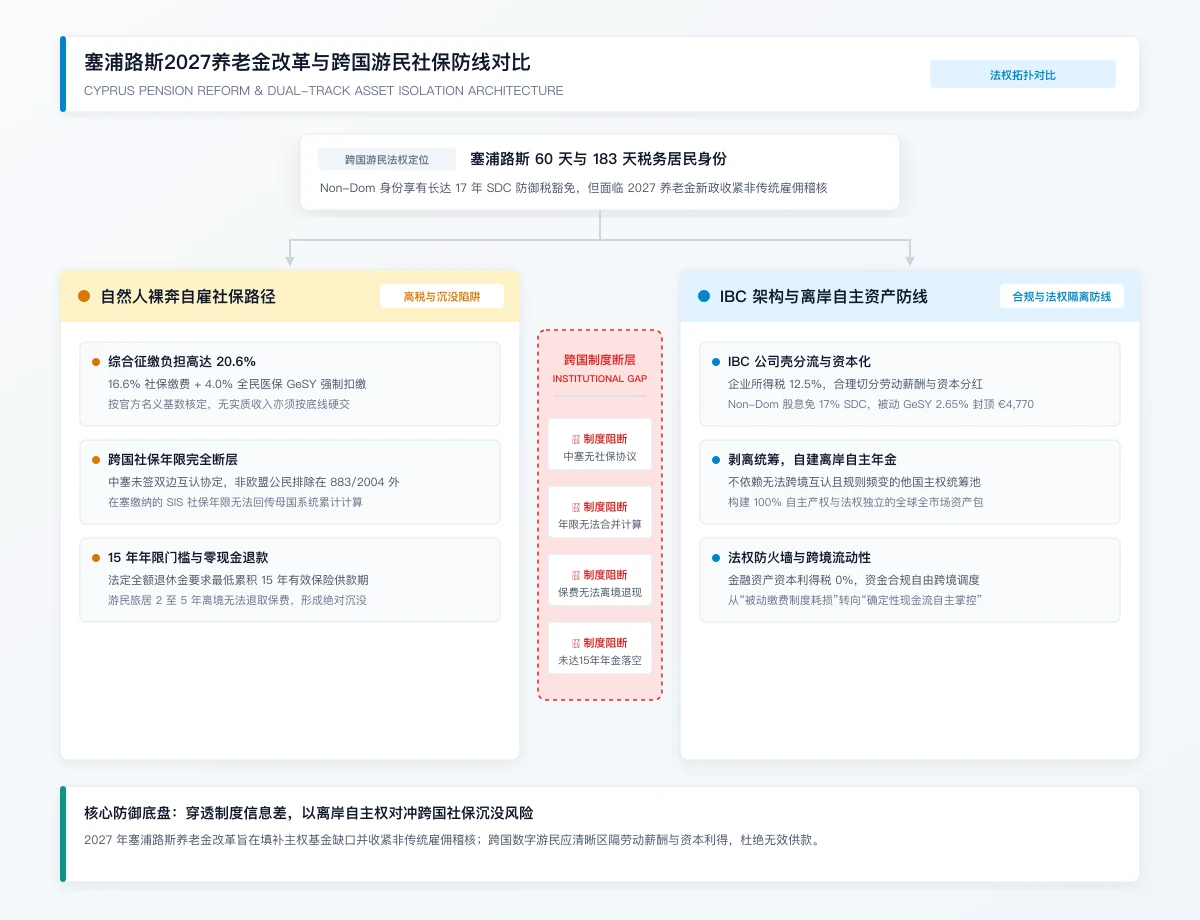
Figure 2: Dual-track pathway comparison for cross-border digital nomads in Cyprus: the sinking trap of direct self-employed social security vs. a compliant defense utilizing IBC architecture and offshore asset isolation.
The enduring appeal of Cyprus as a top-tier European living springboard lies in its Non-Domiciled (“Non-Dom”) tax regime for foreign individuals:
- 17-Year SDC Defense Tax Exemption: Any foreign national who becomes a Cyprus tax resident—provided they have not resided on the island for more than 17 out of the past 20 years—automatically enjoys a 17-year non-domiciled status. Corporate dividends (subject to a standard 17% statutory tax) and bank interest (subject to 30%) are taxed at 0% Special Defense Contribution (SDC).
- Absolute Capital Gains Exemption: Capital gains derived from the disposal of securities, foreign exchange, mutual funds, bonds, and mainstream crypto assets are taxed at a constant 0% in Cyprus (gains on domestic Cypriot real estate remain subject to a 20% tax).
- GeSY Cap on Passive Income: Non-labor passive income such as dividends and interest incurs a GeSY healthcare contribution of just 2.65%, strictly capped at a personal income ceiling of 180,000 euros per year—resulting in a maximum annual medical deduction of 4,770 euros.
Capitalizing on these legal parameters, cross-border nomads should establish a compliant Cyprus International Business Company (IBC) as their operational vehicle:
- Locking in Low Corporate Tax Rates: The standard Cyprus Corporate Income Tax (CIT) sits at just 12.5%, supported by a robust network of bilateral Double Tax Treaties (DTTs).
- Scientific Partitioning of Salaries and Dividends: Instead of channeling all overseas business revenue directly into personal self-employed labor income, nomads should route commercial contracts through their IBC. Operating as company directors, they can draw a modest salary utilizing Cyprus’s 19,500 euro personal tax-free allowance—meeting residency and work permit compliance at minimal cost while bounding social security contributions to a safe baseline.
- Converting Capital Retention into Tax-Free Dividends: Retained earnings remaining after the 12.5% corporate tax are distributed as shareholder dividends to individuals holding Non-Dom status. These dividends are exempt from the 17% SDC, incurring only the capped 2.65% GeSY healthcare levy.
Deploying a corporate firewall completely bypasses the 16.6% compulsory self-employment social security siphon, establishing an impenetrable buffer between offshore business entities and personal legal frameworks.
Reconstructing Passive Cash Flow Defenses for Cross-Border FIRE Practitioners
As demographic degradation shrinks systemic policy dividends, astute asset allocators must learn to “utilize the infrastructure while abandoning the pooling schemes.”
The underlying signal of the 2027 Cyprus pension reform is unambiguous: regardless of the welfare rhetoric propagated by European states in the past, sovereign pension systems facing dual pressures of aging and rigid social expenditures will inevitably lean toward higher contribution bases, extended retirement thresholds, and aggressive enforcement audits.
For cross-border FIRE practitioners and high-net-worth digital nomads, the core principles of passive income and asset security boil down to three ironclad rules:
1. Abandon All Illusions of Cross-Border Sovereign Pooling
Public pension pooling is fundamentally an intergenerational transfer system whose solvency depends entirely on the labor productivity of future youth cohorts and the fiscal redistribution will of the host government. As third-country expats lacking local voting rights and bilateral social security recognition, handing precious cash flows over to a foreign sovereign pension pool is a fool’s errand. Defending against global liquidity volatility and long-term purchasing power erosion requires building a 100% independent offshore asset pool registered entirely in one’s own name, immune to sovereign fiscal insolvency—as we emphasized when reviewing Cross-Border Asset Allocation and Sequence of Returns Risk Defenses.
2. Construct Globalized Private Pension Trusts
Redirect tax savings harvested via Cyprus IBC and Non-Dom frameworks—capital that would otherwise be devoured by a 20.6% social security and medical toll—into US or global all-market equity ETFs (e.g., VT, URTH), premium short-term sovereign debt, or offshore private pension vehicles (such as international SIPPs or Channel Island trusts). Because Cyprus protects securities capital gains and foreign dividends with a 0% tax rate, these asset pools compound in zero-tax environments, forging a genuine fortress of cash flow freedom.
3. Retain Legal Agility and Exit Liquidity
The foundational advantage of the digital nomad is the mobility afforded by geographic arbitrage. While utilizing Cyprus’s 60-day tax rule to lock in European tax residency and Non-Dom status, avoid anchoring core assets heavily in domestic real estate or illiquid local projects.
The year 2027 is not an apocalypse; it is a watershed. It weeds out passive nomads drifting through regulatory gray areas while rewarding clear-headed players capable of navigating systemic information asymmetries and constructing disciplined legal firewalls.
Related Research & Topics
The Three Dimensions of the Pension Gap: From Institutional Privilege to Asset Stratification
Starlink V4 and the Low-Earth Orbit Satellite Arms Race: How a 100,000-Node Optical Mesh Pierces the Submarine Cable Monopoly
Tello Mobile eSIM
SafetyWing Nomad Insurance
* Disclosure: This post contains affiliate links. If you make a purchase through these links, V-G Journal may earn a small commission at no additional cost to you. We only recommend services we independently evaluate and trust.
FIRE and Golf:自由旅居之路
专注于为追求 FIRE 与品质生活的人群提供特惠打球权益与候鸟微度假。不持一砖一瓦,运营品质生活。