The Actuarial Reality of Retirement: Early vs. Delayed Pension Claims
As China transitions to a flexible, phased retirement age, we dissect the actuarial trade-offs between early withdrawal and delayed benefits. This analysis provides a decision-making framework based on cash flow, life expectancy, and the hidden costs of social security participation.

Executive Summary: With the full implementation of China’s phased retirement age and flexible withdrawal system, the decision to retire has shifted from a mandatory exit to a strategic financial calculation. While official policy emphasizes the “long-term, high-contribution, late-withdrawal” incentive structure, the popular sentiment remains “take the money while you can.” This essay penetrates the policy surface to reconcile the conflict between monthly benefit maximization and the time value of liquidity, providing a mathematical coordinate system for your retirement planning.

Figure 1: Official design of the PRC Social Security Card.
I. Deconstructing the Formula: Where Does the “Late-Retirement Bonus” Come From?
To evaluate the trade-offs, we must first deconstruct the actuarial formula for urban employee pensions. Excluding the transitional pension for those with pre-reform service, the monthly benefit is defined as:
Monthly Pension = Basic Pension + Personal Account Pension
Both components contain built-in mathematical leverage for those who delay retirement:
1. The Compound Growth of the Basic Pension
The basic pension is tethered to the provincial average wage and the duration of contributions:
Basic Pension = (Provincial Average Wage at Retirement) × (1 + Personal Contribution Index) ÷ 2 × Years of Contribution × 1%
Delaying retirement lifts this in two ways:
- Base Inflation: Even if your contribution index remains static, the provincial average wage typically trends upward, anchoring your pension to a higher base.
- Contribution Weight: Each additional year of service increases the payout ratio by approximately 1%. A three-year delay yields a 3% permanent increase in the multiplier.
2. The Personal Account: “Larger Numerator, Smaller Denominator”
The personal account functions as a savings-payout mechanism:
Personal Account Pension = (Accumulated Account Balance) ÷ (Divisor based on Retirement Age)
- The Numerator (Balance): Continued employment means continued contributions, plus interest credited at rates generally exceeding inflation.
- The Denominator (Divisor): The government-mandated divisor decreases as age increases (e.g., 195 months at age 50, 139 at 60, and 101 at 65).
While this mathematically guarantees a higher monthly payout for late retirees, it ignores the opportunity cost of the years spent in the workforce.
II. The Break-Even Point: How Many Years to Recoup the Loss?
Financial actuarial science dictates that any future increase in cash flow must be weighed against the “sunk cost” of the immediate income forfeited.
1. The Sunk Cash Flow Base
Consider a mid-level contributor:
- If eligible for a 4,000 RMB/month pension at 60, but choosing to delay until 63:
- The “sunk” cash flow lost during those three years is:
Sunk Base = 4,000 RMB/month × 12 months × 3 years = 144,000 RMB
2. The Mathematical Payback Period
If the delayed pension increases to 5,000 RMB/month (a 1,000 RMB/month marginal gain), the time required to recoup the 144,000 RMB loss is:
Static Break-Even = 144,000 RMB ÷ 1,000 RMB/month = 144 months (12 years)
The retiree must survive and collect benefits until age 75 just to break even. If we apply a discount rate of 2.5%–3% to account for the time value of money, the break-even point pushes out to 80–82 years old.
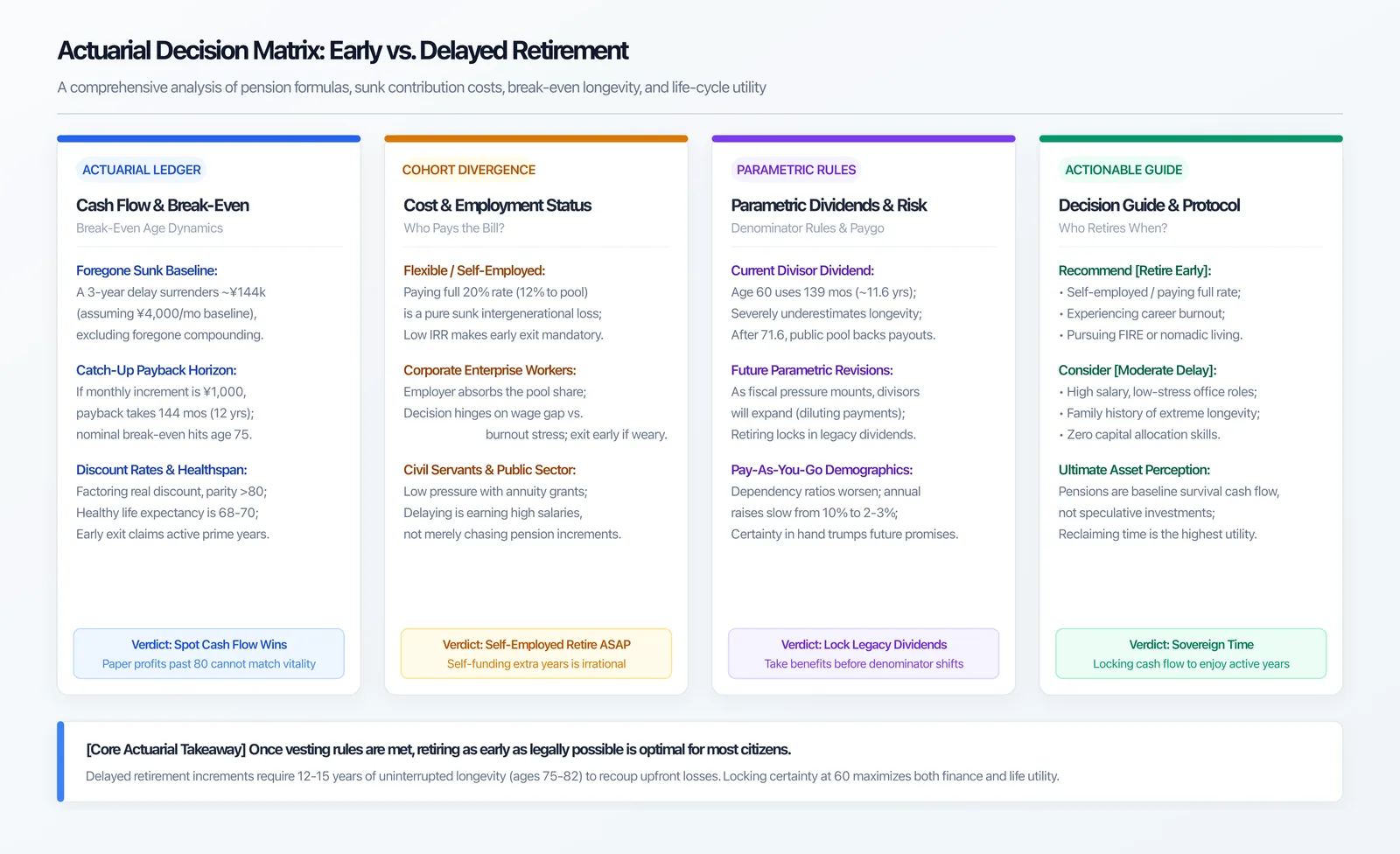
Figure 2: Decision matrix comparing early withdrawal vs. delayed benefit accumulation.
3. Life Utility Discounting
China’s average life expectancy is approximately 78.6 years, but the “healthy life expectancy”—the period without chronic illness or disability—is typically 68–70 years.
From a utility perspective, the “Golden Decade” (60–70) is when human capital can be converted into life experiences. Sacrificing liquid cash in your 60s to chase a marginal increase in your 80s is, for most, a net loss in total life utility.
III. The Identity Watershed: Who Should Delay?
1. Flexible Employees (Self-Employed)
For those paying the full 20% social security rate (where 12% goes to the social pool and only 8% to the personal account), the IRR of delaying is abysmal. You are essentially paying a “tax” to the pool for a future benefit that may never be fully realized. For this group, “retire as early as possible” is the mathematically superior strategy.
2. Corporate Employees
The decision here hinges on the “Net Wage Gap.” If your current job is high-stress and the net salary (after commuting, social costs, and health depreciation) is marginal, retiring early to live on a pension while pursuing low-stress side projects is a superior lifestyle hedge. If your job is stable and high-paying, delaying is essentially a high-yield employment contract.
IV. Macro-Game Theory: The PAYG Constraint
The pension system is a Pay-As-You-Go (PAYG) model. As the dependency ratio (workers vs. retirees) shifts due to demographic decline, the annual pension adjustments have trended toward stabilization.
The “Early Bird” Advantage: Current divisor parameters (e.g., 139 months at age 60) were set in 2005 based on lower life expectancies. There is a high probability that these divisors will be adjusted upward in the future to account for longevity, which would lower monthly payouts. Locking in your pension under current parameters acts as a hedge against future policy tightening.
V. Conclusion: Time Sovereignty as the Ultimate Asset
The “optimal” retirement age is not a universal constant; it is a function of your personal risk profile and life goals.
- Delay if: You are in a high-paying, low-stress role, have a family history of extreme longevity (85+), and lack the discipline for personal asset management.
- Retire Early if: You are a flexible worker, your current job is a source of burnout, or you value the “Golden Decade” of health over the marginal utility of an 80-year-old’s pension check.
In the final analysis, the pension is a defensive tool—a floor, not a ceiling. If you have the means to secure your own cash flow, time sovereignty is the most expensive asset you own. Do not trade your most vibrant years for a marginal increase in a future that is never guaranteed.
Related Research & Topics
Tello Mobile eSIM
SafetyWing Nomad Insurance
* Disclosure: This post contains affiliate links. If you make a purchase through these links, V-G Journal may earn a small commission at no additional cost to you. We only recommend services we independently evaluate and trust.
FIRE and Golf:自由旅居之路
专注于为追求 FIRE 与品质生活的人群提供特惠打球权益与候鸟微度假。不持一砖一瓦,运营品质生活。