Beyond the State Safety Net: Pension Math, Lock-Up Windows, and Golden Visa Arbitrage for the FIRE Nomad
Analyzing the state's official 'Three-Ledger' pension balance sheet of 9.85 trillion yuan and its limits of baseline protection. How digital nomads can construct a cross-border defense using baseline social insurance, a conservative 3.5% withdrawal rate, and Portugal's 500k-euro fund Golden Visa.


Figure 1: Under the institutional boundary where the national basic pension explicitly guarantees only a “baseline safety net,” decoupling domestic floor-level social insurance, global index withdrawal pools, and overseas residencies like Lisbon forms the core defense for digital nomads navigating the early-retirement liquidity vacuum.
State media commentary recently dissected the macro pension balance sheet across structural, equity, and long-term ledgers, deploying 9.85 trillion yuan in cumulative basic pension surpluses alongside 3.81 trillion yuan in national strategic reserves to dismantle populist narratives of a looming pension collapse. Yet beneath these headline-grabbing trillions lies a more sobering institutional reality often overlooked: state-backed provision does not mean total underwriting; the core positioning of basic public pensions is strictly to “guarantee the baseline and catch the floor.”
For digital nomads and practitioners of Financial Independence, Retire Early (FIRE) pursuing cross-border nomadic lifestyles, the true financial imperative is not fretting over sovereign default risks in state-pooled accounts. Rather, it is building a cross-jurisdictional firewall for long-term purchasing power and legal residency under the actuarial constraints of delayed retirement ages and extended lock-up periods.
Macro Foundations and Individual Discounting: Penetrating the Boundaries of the “Three Ledgers” and Lock-Up Constraints
Periodic alarms in the public sphere forecasting the exhaustion of social security pools stem from a basic category error: conflating the short-term deficit of an aging rust-belt province with a systemic solvency crisis of the national social security apparatus. Dissecting the structural, equity, and long-term ledgers reveals that the public pension foundation is bolted down by four hard sovereign assets and fiscal mechanisms:
- Current Surpluses and Trillions in Rolling Reserves: According to the Ministry of Human Resources and Social Security’s 2025 statistical communique, participants in urban employee basic pension schemes reached 547 million by the end of 2025 (an increase of 12.31 million year-on-year). Total annual basic pension revenue hit 8.87 trillion yuan against expenditures of 7.74 trillion yuan, leaving a cumulative year-end surplus of 9.85 trillion yuan (with 2.98 trillion yuan under institutional investment operations). For urban employees alone, annual revenues reached 7.92 trillion yuan versus 7.12 trillion yuan in expenditures, yielding an annual surplus of nearly 800 billion yuan and a cumulative year-end reserve of 7.87 trillion yuan. When merged with unemployment and work-injury insurances, total cumulative reserves across the triple social security fund crossed 10.2 trillion yuan.
- National Unified Cross-Province Pooling and Central Fiscal Backstops: China operates a “social pooling + individual account” dual model. Since the launch of the central adjustment system in 2018 and the integration of enterprise employee pensions into a unified national pool in 2022, surplus provinces systematically subsidize high dependency-ratio regions, shifting over 200 billion yuan annually across provincial lines (surpassing 600 billion yuan in cumulative cross-provincial transfers in the four years prior to institutional scaling). Backed by an economic aggregate exceeding 140 trillion yuan, central fiscal transfers and special subsidies to enterprise basic pensions alone top 600 billion yuan annually.
- 3.81 Trillion Yuan in Strategic Reserves and Compound Growth: Published by the National Council for Social Security Fund, the dedicated reserve pool designed to buffer the peak aging wave reached total assets of 3.808 trillion yuan by the end of 2025, with total fund equity at 3.347 trillion yuan. The fund delivered an investment return of 390.67 billion yuan in 2025—an annual yield of 13.22%—bringing its annualized return since inception to 7.62%, with cumulative investment gains totaling 2.29 trillion yuan.
- 1.68 Trillion Yuan in Transferred State-Owned Capital: Under the State Council’s mandate to transfer 10% of state-owned enterprise (SOE) equity to replenish social security funds, ownership stakes across 93 central enterprises and financial institutions have been fully transferred, injecting 1.68 trillion yuan in capital assets.
These four official ledgers confirm that public pensions face zero risk of default or interruption at the macro sovereign-credit level. However, this macro stability serves a broad-coverage “baseline” mandate. When actuarial lenses zoom in on freelancers, independent developers, and FIRE practitioners operating outside corporate subsidies, the individual cash-flow discount model exposes three rigid structural constraints:
First, the “60-40 Split” in Flexible Employment Contributions and Exit Restrictions. Under relevant social security provisions, self-employed individuals and flexible workers participating in urban employee pensions contribute at a 20% rate (assessed against local average wages ranging from 60% to 300%). Within this 20% rate, only 8% enters the individual account (representing 40% of contributions, legally owned and inheritable), while the remaining 12% (60% of contributions) is entirely siphoned into the social pooling fund. Individual accounts strictly prohibit early withdrawals. Should a participant emigrate overseas before reaching statutory retirement age while retaining Chinese citizenship, the individual account is merely frozen rather than liquidated. Even if the participant acquires foreign citizenship and formally applies to terminate their basic pension relationship, only the 8% individual account balance is refundable; the 60% siphoned into the social pool (the 12% levy) remains an irrecoverable institutional sunk cost.
First-generation demographic shifts and legislative adjustments compound this pressure:
| Constraint Dimension | Institutional Rule / Legal Basis | Micro-Level Impact on FIRE & Nomads |
|---|---|---|
| Flexible Contribution Split | 20% levy rate; 12% pool vs. 8% individual account | 60% of contributions become unrecoverable sunk costs upon emigration or early exit. |
| Delayed Retirement & Thresholds | Gradual shift to 63 (men) and 58/55 (women) by 2040; minimum contribution rises from 15 to 20 years by 2030 | Extends the principal recovery cycle and widens the capital gap during early retirement. |
| Pillar III Tax Treatment | 12,000 yuan annual cap; 3% tax upon withdrawal at retirement | Mismatched for zero-income FIRE practitioners; penalizes low-bracket earners unless unlocked via overseas residency. |
Second, the Dual Extension of Delayed Retirement to Age 63 and a 20-Year Minimum Contribution Floor. Pursuant to the Decision on Implementing a Gradual Delay of the Statutory Retirement Age, starting January 1, 2025, retirement ages will incrementally climb over a 15-year window. Male workers will shift from 60 to 63, female workers from 55 to 58 (or from 50 to 55 depending on category). Simultaneously, minimum contribution periods required to draw monthly pensions will rise from 15 years to 20 years, phasing in by 6 months annually starting in 2030 until hitting the 20-year mark by 2039. Factoring in actuarial divisor tables for individual account payouts (e.g., 139 months at age 60 versus 101 months at age 65), actuarial models of flexible retirement and break-even calculations demonstrate that rising contribution thresholds and deferred claim horizons severely stretch principal recovery cycles for high-base contributors.
Third, The Third Pillar “Personal Pension” Mismatches for Low-Bracket Earners. Institutionalized nationwide in late 2024, the personal pension scheme permits contributions up to 12,000 yuan annually into tax-deferred buckets (treasury bonds, specific savings, and index funds). Withdrawals are taxed at a flat 3% rate upon retirement, alongside standard conditions like attaining retirement age, complete disability, or emigration. For FIRE practitioners who have exited corporate employment early, lacking domestic comprehensive income or falling into the zero/3% tax brackets, continuing to fund this vehicle offers zero marginal tax-shield benefits while locking capital away for decades—unless unlocked via overseas permanent residency and the emigration clause.
Bridging the Early-Retirement Liquidity Vacuum: Portugal’s 500k-Euro Fund Golden Visa and Southeast Asian Legal Arbitrage
When digital nomads achieve financial independence and step off the corporate treadmill at ages 40 to 45, an 18- to 23-year “early retirement liquidity vacuum” stretches out before them, blocking access to the statutory age-63 pension baseline. Throughout this protracted window, domestic first- and third-pillar assets remain institutionally frozen. Nomads require both low-inflation, high-purchasing-power host jurisdictions to smooth cash flows and non-residency-trap overseas legal frameworks to serve as cross-jurisdictional redundancy for asset custody and future healthcare.
Within Europe’s remaining investment migration architecture, the Portugal Golden Visa (ARI) has long anchored global liquidity allocations due to its minimal physical presence requirements. Yet navigating post-reform legislation requires dodging outdated playbooks:
- The Total Termination of Real Estate Pathways and the 50-Million-Euro/500k-Euro Fund Standard. Amended under Law No. 56/2023, direct real estate acquisitions and real estate-linked funds are entirely barred. The primary compliant path relies on transferring a minimum of 500,000 euros into non-real estate collective investment funds (including private equity and venture capital funds) regulated by the Portuguese Securities Market Commission (CMVM). Legally mandated guardrails require funds to have a remaining maturity of at least 5 years at investment, mandate that at least 60% of assets be deployed into commercial companies headquartered in Portugal (strictly barring direct or indirect real estate exposure), and require applicants to hold fund units for a minimum of 5-years from residency issuance.
- The Ultra-Minimal 7-Day Annual Physical Presence and Administrative Fees. Golden Visa cards are initially issued for 2 years and renewable biennially. The statutory minimum stay is exceptionally lean: a cumulative or consecutive 7 days in Portugal during the first year, and 14 days per subsequent 2-year renewal cycle (averaging 7 days annually). Standard processing fees enforced by the Agency for Integration, Migration and Asylum (AIMA) stand at 842.80 euros for initial reviews, 8,418.90 euros for initial card issuance, and 4,210.30 euros per renewal (with digital applications receiving a 25% discount).
- The 2026 Nationality Law Amendment Extending Naturalization to 10 Years, While 5-Year Permanent Residency and Fund Redemption Remain Unshaken. Promulgated under Lei Orgânica n.º 1/2026, the legal residence period required for naturalization for most non-EU citizens shifted from 5 years to 10 years (with the residency clock counting from the initial permit issuance date, grandfathering only applications formally submitted prior to May 2026). Critically, under Article 80 of Immigration Law, applicants who complete 5 years of legal temporary residence while fulfilling basic Portuguese language proficiency (A2) retain the statutory right to apply for Permanent Residency (PR) and redeem their 500,000-euro fund capital upon PR approval. Consequently, the refined actuarial positioning of the Golden Visa crystallizes into a dual-stage defense: a 5-year lock to secure Schengen permanent residency and repatriate capital, paired with a 10-year naturalization option.
For younger FIRE cohorts seeking high-cost-performance cash-flow buffers without deploying heavy capital, Southeast Asian digital nomad visas provide low-friction operational bases. The Asian Digital Nomad Visa legal pathways and real ledger comparisons show that Thailand’s Destination Thailand Visa (DTV) grants a 5-year multi-entry structure permitting 180-day stays per entry (extendable once locally for another 180 days) against a modest 500,000 THB (~$14,000–$15,000 USD) bank balance proof. Malaysia’s DE Rantau Pass targets tech professionals with a $24,000 annual salary threshold ($2,000/month), renewable up to 24 months under a territorial tax regime exempting foreign-sourced income. Combining Schengen permanent residency (requiring 7 days residency per year) with Southeast Asian DTV/DE Rantau long-stays compresses living expenditures to a fraction of Tier-1 Western cities during the early retirement vacuum.
Restructuring the Digital Nomad’s “Family Three Ledgers”: Intertemporal Liquidity Matrices and Safe Withdrawal Prescriptions
Just as the state balances its macro “three ledgers” to secure 547 million participants, individuals navigating a 30- to 40-year early retirement horizon must establish an analogous, rigorously structured “family three-ledger” framework.
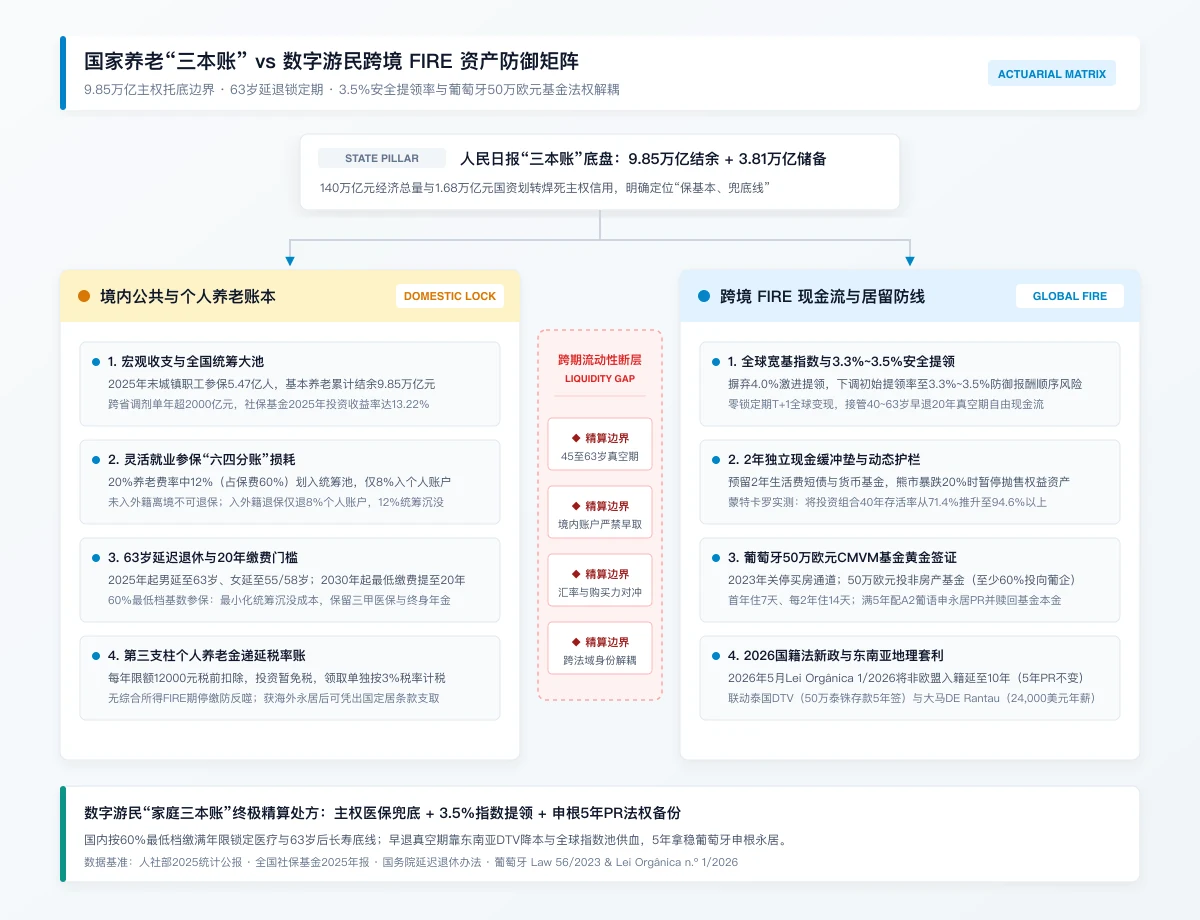
Figure 2: Reconstructing individual Pillar I, III, and overseas cross-jurisdictional residency matrices for the 45–63 early retirement vacuum and post-63 longevity phase, anchored by state macro baseline boundaries.
Placing domestic pillars alongside global index withdrawal pools and cross-border residency channels under a unified actuarial scale reveals distinct complementarities across lock-up timelines, frictional costs, and legal functionalities:
| Configuration Dimension & Ledger Role | Core Instrument / Asset Target | Capital Threshold & Contribution Split | Lock-Up Timeline & Drawdown Red Lines | Tax Treatment & Frictional Costs | Core Strategic Positioning |
|---|---|---|---|---|---|
| Ledger I: Sovereign Baseline & Longevity Hedge | China Urban Employee Basic Pension + Basic Medical (Flexible Worker Basis) | 20% rate (assessed against 60%-300% of avg. wage): 12% to social pool, 8% to individual account | Deferred to 63 (men) / 55-58 (women); min contribution shifts to 20 yrs by 2030; non-emigrated accounts non-refundable | Pension payouts tax-exempt; emigration refunds 8% individual account only (12% pool is sunk cost) | 60% Baseline Floor Participation: Minimizes sunk costs while locking in top-tier medical access and post-63 inflation-adjusted annuities. |
| Tax-Optimized Pool: Deferred Tax Arbitrage | China Personal Pension Account (Treasury Bonds & Index Funds) | Annual cap of 12,000 RMB | Statutory retirement age, complete disability, emigration, or severe illness/unemployment | Deductible pre-tax; investment untaxed; 3% flat tax upon withdrawal | Conditional Deployment: Fund only when marginal tax brackets exceed 10%; pause during zero-income FIRE periods; unlock via emigration clauses. |
| Ledger II: Early-Retirement Cash-Flow Engine | Global USD Broad-Market Index ETFs + 2-Year Cash Buffer (Short-Duration Bonds/MMFs) | Autonomous reserves of 25x (4.0% withdrawal) to 30–33x (3.3%–3.5% withdrawal) annual expenses | Zero lock-up, T+1 to T+2 global liquidity, zero age or household registration limits | Dependent on tax residency status; zero-tax optimization via territorial regimes like Malaysia DE Rantau | Fills the 40–63 Liquidity Vacuum: Elevates 40-year portfolio survival rates from 71.4% to over 94.6%. |
| Ledger III: Cross-Jurisdictional Legal & Arbitrage Ledger | Portugal 500k-Euro CMVM Fund Golden Visa (ARI) + Thailand DTV / Malaysia DE Rantau | Portugal: €500k non-real estate fund; Thailand: 500k THB balance; Malaysia: $24k annual salary | Portugal fund locked 5-years (7 days/yr stay) to secure PR and capital return; naturalization extended to 10 years | AIMA standard fees apply (€842.80 review, €8,418.90 card, €4,210.30 renewal with digital discounts) | Dual-Stage Optimization: Secures Schengen PR and principal repatriation in 5 years while utilizing SE Asian nomad visas for geographic arbitrage. |
Grounded in these actuarial comparisons, the rational digital nomad’s intertemporal defense prescription boils down to a three-step protocol:
- Adopt a “60% Baseline Base + Unbroken Medical Insurance” Strategy for Domestic Social Security. Avoid both the fatalism of abandoning contributions entirely based on systemic collapse rumors and the inefficiency of over-contributing at the 300% ceiling as an independent freelancer. Contributing at the 60% minimum floor for the mandatory 15-to-20-year term limits the sunk cost of the 60% social pool levy, preventing high fixed premiums from suffocating current disposable cash flows and maintaining safety margins for FIRE Financial Independence Kill-Line Defenses. Simultaneously, this preserves domestic public medical insurance access, treating the post-63 basic pension as a foundational longevity insurance cushion. Personal pension accounts should strictly follow a “contribute only when high-bracket deductions apply; halt during zero-income periods” rule, unlocking balances via emigration clauses once foreign permanent residency is secured.
- Deploy a “3.3%–3.5% Conservative Withdrawal Rate + 2-Year Cash Buffer” to Manage Ages 45–63. Throughout the nearly two-decade early retirement vacuum, living expenses must be funded by liquid financial assets. Traditional initial 4.0% withdrawal rates (25x expenses) risk severe Sequence of Returns Risk (SORR) if exposed to consecutive bear markets early in retirement, forcing capital liquidations at market bottoms. Per FIRE Monte Carlo Simulations and Calculator Guides, lowering initial withdrawal rates to 3.3%–3.5% while holding a dedicated 2-year cash buffer—pausing equity liquidations during market drawdowns and leaning into low-cost Southeast Asian living—boosts 40-year portfolio survival rates from 71.4% to over 94.6%.
- Decouple Identity and Purchasing Power via “Low-Cost Southeast Asian Long-Stay + Portugal 5-Year Fund Residency”. For daily living expenses, leverage Thailand’s 5-year DTV visa or Malaysia’s DE Rantau pass to enjoy low-inflation purchasing power and territorial tax advantages in tropical hubs. For long-term legal security, capital-abundant families can utilize Portugal’s 500,000-euro CMVM-regulated fund pathway: satisfying the 7-day annual stay requirement, achieving A2 language proficiency within 5 years to lock in Schengen Permanent Residency, and redeeming principal capital to navigate the post-reform 10-year naturalization horizon smoothly.
The state’s “Three Ledgers” lay bare the cards of public institutional design: 9.85 trillion yuan in basic pension reserves and 3.81 trillion yuan in strategic buffers ensure sovereign commitments will not default. Yet the explicitly stated boundary of “guaranteeing the baseline and catching the floor” dictates that public pools cannot shoulder the liquidity premium of early retirement for individuals. Seeing through the boundaries of macro pooling and micro discounting—securing basic medical and longevity floors through minimum-tier domestic contributions while building free cash flows via global index pools and cross-border residencies—is the most rational path to surviving demographic shifts and delayed retirement cycles.
Related Research & Topics
Tello Mobile eSIM
SafetyWing Nomad Insurance
* Disclosure: This post contains affiliate links. If you make a purchase through these links, V-G Journal may earn a small commission at no additional cost to you. We only recommend services we independently evaluate and trust.
FIRE and Golf:自由旅居之路
专注于为追求 FIRE 与品质生活的人群提供特惠打球权益与候鸟微度假。不持一砖一瓦,运营品质生活。