The Divergent Logics of Reconciliation: Sino-Russian Territorial Compromise vs. the US-Japan Post-War Alliance
Equating China’s border settlements with Russia to the post-WWII US-Japan alliance is a fundamental misreading of geopolitical power. This essay deconstructs the profound divide between the pragmatic ratification of historical plunder and the systemic reconstruction of a defeated aggressor.

Executive Summary:
In contemporary geopolitical discourse, observers frequently equate the resolution of historical Sino-Russian border treaties with the post-WWII US-Japan alliance—often framing both as historic “reconciliations” between major powers. However, this superficial semantic equivalence obscures the brutal causal logic of international order. These two historical encounters occupy diametrically opposed quadrants across four dimensions: the moral nature of the original conflict, the disposition of sovereign territory, the institutional quid pro quo of the post-war settlements, and the resilience of collective social memory. Conflating the unilateral ratification of historical plunder with the systemic reconstruction and integration of a defeated aggressor is a profound misreading of both history and the nature of power.
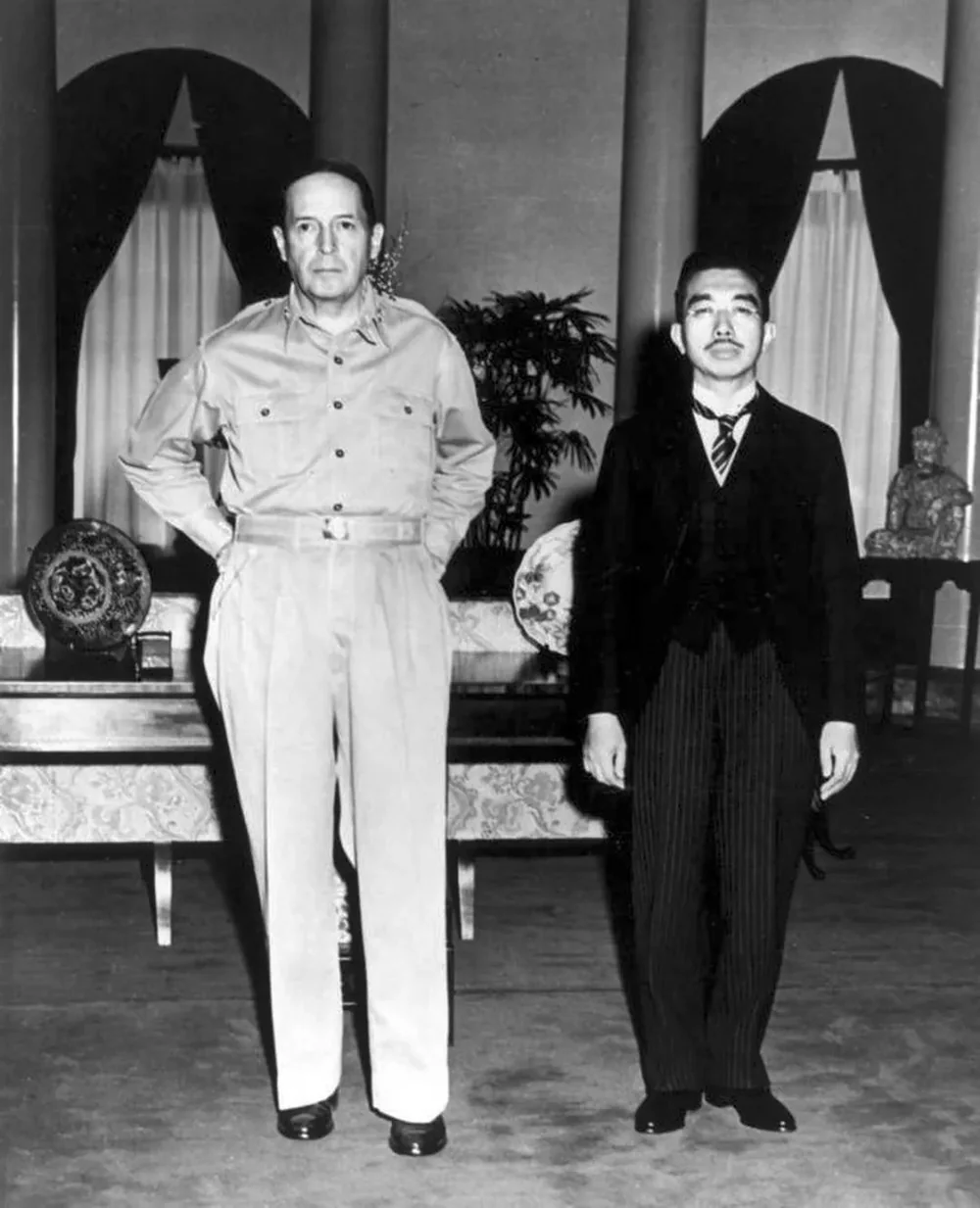
Figure 1: On September 27, 1945, General of the Army Douglas MacArthur met with Emperor Hirohito in Tokyo. This historic meeting symbolized the dismantling of militarist divine rule and marked the beginning of the Allied demilitarization and constitutional reconstruction of Japan. (Source: U.S. Army / Gaetano Faillace / Public Domain)
I. The Fundamental Misalignment of the Original Conflict: Aggressor vs. Victim
To dissect the true nature of any international “reconciliation,” one must look past diplomatic rhetoric and trace the causal chain back to its origin: In the initial conflict, which sovereign entity was the aggressor, and which was the victim?
1. The US-Japan Dynamic: The Defeat and Disarming of a Fascist Aggressor
In the Pacific War, Japanese militarism was the undisputed instigator of aggression. From the Mukden Incident and the full-scale invasion of China to the Rape of Nanking and the surprise attack on Pearl Harbor, Imperial Japan unleashed catastrophic devastation across the Asia-Pacific.
The U.S. deployment of atomic bombs on Hiroshima and Nagasaki in August 1945—while causing immense civilian casualties and prompting enduring humanitarian and nuclear-ethical debates—was, in terms of military and geopolitical logic, an extreme measure designed to break the fanatical “one hundred million honorable deaths” (ichigo gyokushai) doctrine, force an unconditional surrender, and halt a total war. In this confrontation, the Allied forces acted as the defenders of international law and justice, while Japan was the thoroughly defeated aggressor facing systemic reckoning.
2. The Sino-Russian Dynamic: Imperialist Predation of a Weakened Neighbor
The historical territorial disputes between China and Russia present a completely inverted dynamic. Through the Treaty of Aigun (1858), the Treaty of Peking (1860), and the subsequent Treaty of Tarbagatai, Tsarist Russia did not act in self-defense. Instead, it exploited the extreme vulnerability of the Qing Empire—then besieged by the Second Opium War and the Taiping Rebellion—using military intimidation and diplomatic deceit to annex over 1.5 million square kilometers of Chinese territory north of the Amur River, east of the Ussuri River, and in the northwest.
This geopolitical encroachment was punctuated by atrocities, such as the 1900 Blagoveshchensk massacre, where Tsarist troops systematically drove thousands of peaceful Chinese residents into the Amur River to drown. Throughout this century-long history of territorial erosion, China was exclusively the victim of imperialist plunder, having never launched an offensive invasion against Russian soil.
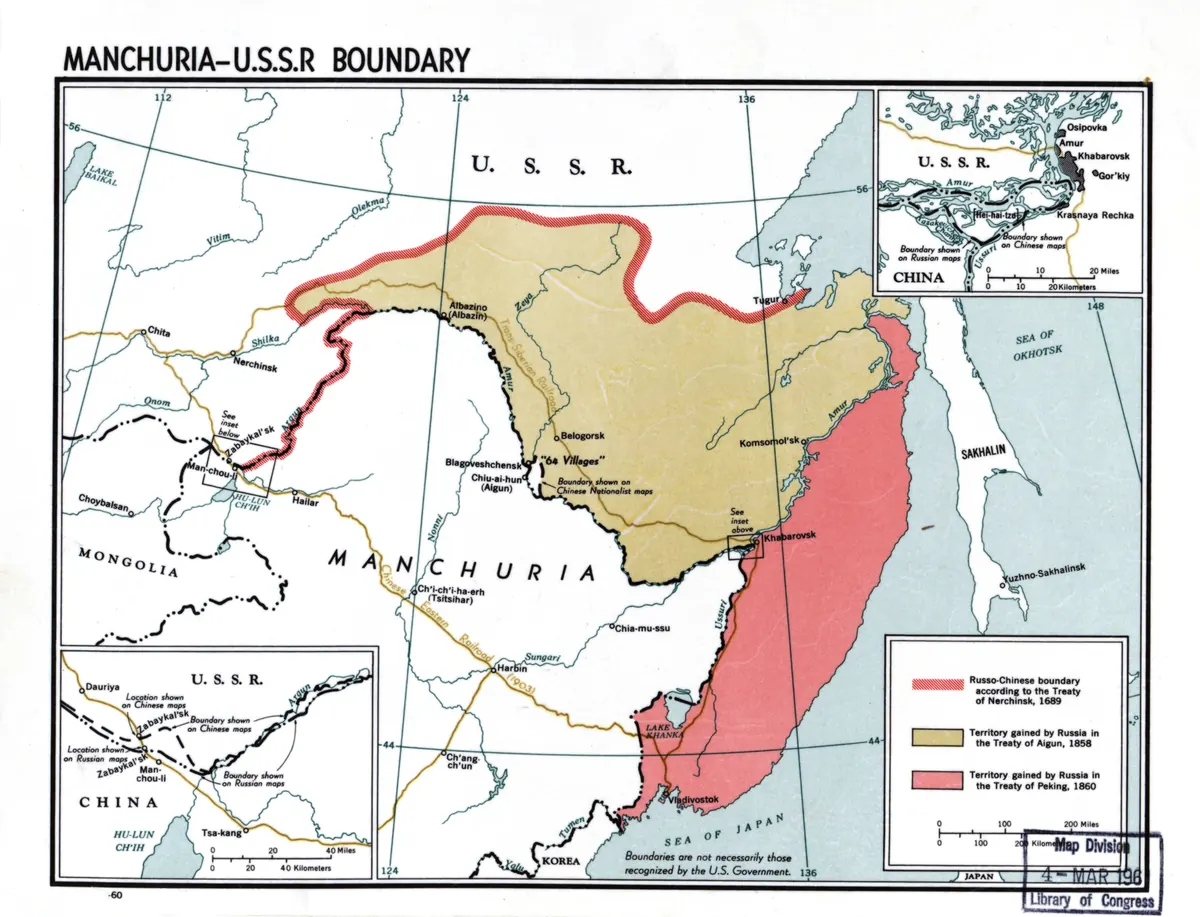
Figure 2: This historical map illustrates the vast territories in Outer Manchuria, north of the Amur and east of the Ussuri, annexed by Tsarist Russia through the unequal treaties of Aigun (tan) and Peking (pink), which stripped China of its access to the Sea of Japan. (Source: Library of Congress / Public Domain)
One scenario represents a victorious coalition disarming and restructuring a brutal aggressor; the other represents a victimized nation navigating a century of territorial predation by a predatory neighbor. Equating the two fundamentally distorts the moral and causal realities of history.
II. The Sovereign Ledger: A Victor That Annexed Nothing vs. a Plunderer That Legalized Its Conquests
The durability of any international order is written in the ledger of territorial and sovereign settlements. The stark contrast in how territory was handled in these two cases illustrates the difference between systemic reconstruction and raw power politics.
1. The Post-War US-Japan Settlement: Zero Territorial Annexation
Following WWII, the United States, as the sole occupying power of Japan, demonstrated remarkable restraint under modern international law:
- Renunciation of Annexation: The Supreme Commander for the Allied Powers (SCAP) did not annex a single inch of Japan’s home islands (Honshu, Hokkaido, Kyushu, Shikoku). Instead, adhering to the Cairo Declaration and Potsdam Proclamation, it stripped Japan only of the colonial territories acquired through imperialist expansion (such as Taiwan and the Korean Peninsula).
- Restoration of Administrative Control: Even amidst the Cold War, the U.S. ended its military occupation via the 1951 San Francisco Peace Treaty and subsequently returned administrative control of Okinawa (the Ryukyu Islands) to the Japanese government in 1972.
- Sovereign Integrity: Japan’s core sovereignty and territorial borders remained intact and protected under international law, entirely spared from partition by foreign powers.
2. The Sino-Russian Border Agreements: Ratifying the Fait Accompli
In sharp contrast, Russia has never yielded an inch of the 1.5 million square kilometers of annexed Chinese territory, nor has it ever offered moral contrition or material compensation. On the contrary, Vladivostok (historically Haishenwai)—the strategic crown jewel of the annexed Outer Manchuria—is celebrated annually by Moscow to commemorate its founding, its Russian name literally translating to “Ruler of the East.”
While the Sino-Russian Boundary Agreement of the 1990s and the 2004 Supplementary Agreement finalized the demarcation of the border, the geopolitical reality is clear:
- Pragmatic Damage Control: This settlement was not a restoration of historical justice or a return of plundered land. It was a pragmatic concession by China to avoid a two-front strategic dilemma and secure its northern border during a period of intense post-Cold War geopolitical pressure. In doing so, China permanently renounced its legal claims to these historical territories.
- Consolidation of Hegemonic Gains: The plunderer secured the permanent, cost-free legalization of territories seized through unequal treaties, legally locking down the historical dispute forever.
This is not the healing of a historical wound; it is the heavy price a victim pays when forced to accept the fait accompli of raw power politics.
III. The Quid Pro Quo of Reconciliation: Systemic Reconstruction vs. Realpolitik Alignment
Any strategic relationship that survives generations relies on a rigorous quid pro quo. Does this exchange catalyze a qualitative evolution in governance, or does it merely amount to a tactical alignment under external geopolitical pressure?
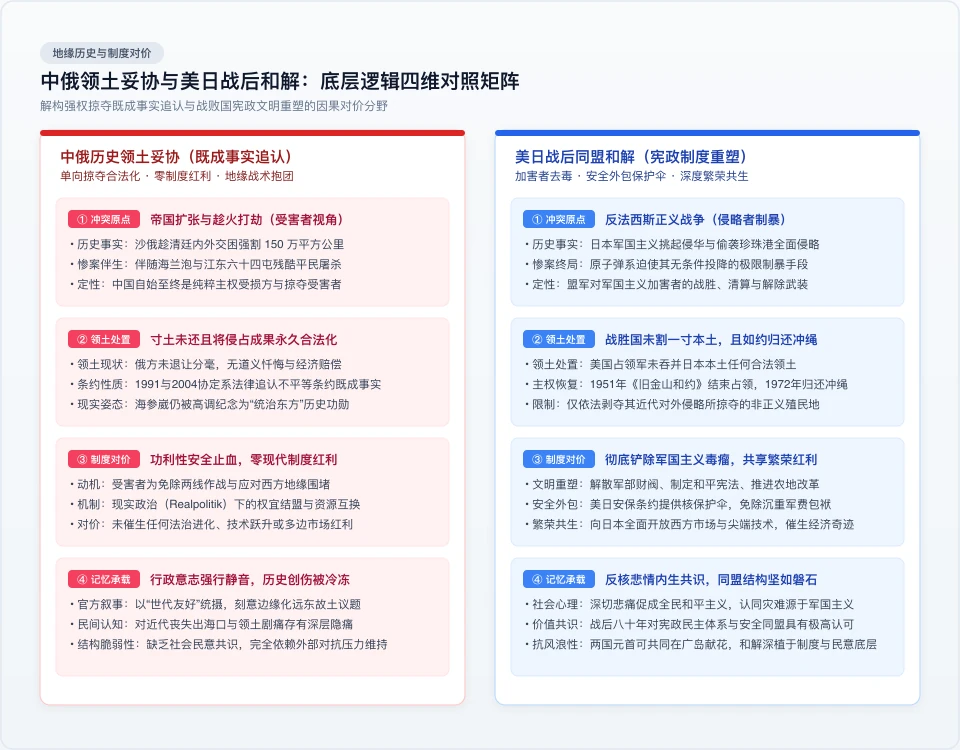
Figure 3: A comparative matrix of the underlying logics of Sino-Russian territorial compromise and the US-Japan post-war alliance.
| Dimension | US-Japan Post-War Alliance | Sino-Russian Border Settlement |
|---|---|---|
| Conflict Origin | Justice-driven disarmament of a fascist aggressor | Unilateral imperialist plunder of a weakened neighbor |
| Territorial Ledger | Zero annexation of home islands; return of administrative rights (Okinawa) | Permanent legalization of 1.5M+ sq km of annexed land |
| Institutional Quid Pro Quo | Constitutional democracy, security umbrella, market integration | Tactical security alignment, resource trade, no institutional integration |
| Social Memory | Deep societal consensus on peace and democratic transition | Top-down administrative suppression of historical grievances |
1. The US-Japan Alliance: Systemic Reconstruction and Shared Prosperity
The post-war U.S. administration of Japan represents one of the rarest instances of systemic detoxification and institutional rebuilding in modern history:
- Eradicating Militarism: The occupation forces oversaw the International Military Tribunal for the Far East, dismantled the militarist-aligned zaibatsu conglomerates (such as Mitsui and Mitsubishi), stripped Shinto of its state-sponsored fanaticism, enacted land reforms to eliminate tenant-landlord exploitation, and drafted the pacifist Post-War Constitution (specifically Article 9, which renounces the sovereign right to wage war). This transformed a fanatical militarist state into a stable constitutional democracy, granting Japanese citizens unprecedented civil liberties and universal suffrage.
- Externalizing Security Costs: Through the 1951 US-Japan Security Treaty, Japan was integrated into the U.S. nuclear umbrella. By relinquishing its offensive military capabilities, Japan avoided the ruinous fiscal burden of a Cold War arms race, allowing it to channel its national resources entirely into economic reconstruction.
- Access to Western Markets and Technology: During the Korean War and the broader Cold War, the U.S. opened its multilateral trade networks to Japan, provided massive procurement contracts, and facilitated the transfer of advanced industrial technologies. This directly catalyzed Japan’s post-war economic miracle, propelling it to become the world’s second-largest economy for decades.
Japan traded its offensive military ambitions for the foundations of a modern democratic state, geopolitical protection, and immense economic prosperity. This reconciliation was built on deep institutional trust and a shared civilizational contract.
2. The Sino-Russian Compromise: Tactical Transactionalism and Realpolitik
In contrast, the “enduring friendship” established by the Sino-Russian border treaties is rooted entirely in classical Realpolitik:
- Avoiding Two-Front Attrition: Much like the iron law of marginal exhaustion observed in continental chessboards and the geopolitics of Afghanistan as the graveyard of empires, no continental power can afford a perpetual military standoff along a massive land border. The demarcation of the Sino-Russian border eliminated the risk of direct military friction across thousands of kilometers, allowing both nations to redirect their strategic focus toward more pressing external threats.
- No Internal Institutional Evolution: This alignment, driven by immediate strategic interests, has yielded no modernization of legal frameworks, no optimization of governance structures, and no shared civilizational values.
- Tactical Transactionalism: Cooperation is largely confined to strategic coordination at the UN, upstream energy trade (oil and gas), and tactical defense against Western encirclement. This partnership mirrors the regional power dynamics between Azerbaijan and Iran, where cooperation is driven by shared external pressures rather than internal systemic integration.
The plunderer retains the spoils, while the victim secures temporary strategic breathing room. This is a cold calculation of geopolitics, entirely devoid of civilizational or institutional value.
IV. Historical Memory and Social Resilience: Organic Consensus vs. Administrative Freezing
The ultimate resilience of any strategic relationship depends on how deeply it takes root in the collective memory and social fabric of both nations.
1. The US-Japan Alliance: Organic Consensus and Open Reflection
While Japanese society harbors deep grief over the atomic devastation of Hiroshima and Nagasaki, the post-war decades have fostered a clear, modern consensus:
- The public widely recognizes that the atomic bombings were the tragic consequence of their own militarist leaders’ aggressive expansionism and domestic totalitarian control.
- There is overwhelming public support for the post-war pacifist constitution, civil liberties, and the prosperity secured by the US-Japan alliance.
- Leaders from both nations can stand together at the Hiroshima Peace Memorial Park to pay respects to the victims, reaffirming their commitment to the post-war international order and nuclear non-proliferation. This reconciliation is not just a legal text; it is woven into the shared values of both societies.
2. The Sino-Russian Relationship: Top-Down Administrative Suppression of Grievance
Conversely, the Sino-Russian “reconciliation” relies entirely on top-down administrative decree—a classic case of the “administrative freezing of historical memory”:
- Systemic Desensitization of Official Narratives: In official diplomatic discourse, the loss of 1.5 million square kilometers of ancestral land, the horrors of the Blagoveshchensk massacre, and the geopolitical suffocation of losing access to the Sea of Japan are systematically downplayed, marginalized, and sanitized.
- Deep Societal Fractures: Within civil society and intellectual circles, the memory of lost territories has never truly faded. Whenever Moscow displays historical arrogance in the Russian Far East, these historical wounds immediately resurface in the public consciousness.
- Vulnerability to Geopolitical Shifts: Lacking organic societal empathy or shared institutional values, this relationship is highly dependent on the existence of a common external adversary. Should the global geopolitical landscape undergo a structural realignment, this tactical alliance—held together solely by administrative will—will face severe historical strain.
V. Conclusion: The Healing of a Reconstructed Order vs. a Forced Suture Under Geopolitical Pressure
To equate the Sino-Russian border settlements with the post-WWII US-Japan alliance is to conflate two fundamentally different geopolitical phenomena:
- The US-Japan reconciliation represents the defeat, transformation, and integration of a militarist regime into a modern international system. Anchored by institutional evolution, demilitarization, and a shared security alliance, it granted a defeated nation long-term prosperity and a place in the global order.
- The Sino-Russian compromise is a pragmatic concession by a historically victimized nation facing contemporary geopolitical encirclement. The plunderer sits comfortably with its spoils, while the victim permanently surrenders its historical claims in exchange for immediate strategic relief.
The former is an organic healing process following systemic surgery and detoxification; the latter is a historical wound forcibly sutured under the heavy anesthesia of realpolitik. In the volatile storms of global geopolitics, history has already made clear which arrangement possesses true structural resilience, and which will fracture when the external pressures shift.
Related Research & Topics
Tello Mobile eSIM
SafetyWing Nomad Insurance
* Disclosure: This post contains affiliate links. If you make a purchase through these links, V-G Journal may earn a small commission at no additional cost to you. We only recommend services we independently evaluate and trust.
FIRE and Golf:自由旅居之路
专注于为追求 FIRE 与品质生活的人群提供特惠打球权益与候鸟微度假。不持一砖一瓦,运营品质生活。