The Factory Floor Reckoning: Why China’s Automotive Slump Is a Cash-Flow Crisis, Not a Balance-Sheet Shock
While China's property implosion destroyed household balance sheets and paralyzed bank credit creation, a stalling automotive sector triggers immediate industrial asphyxiation. An anatomical breakdown of supply-chain triangular debt, local state-equity write-offs, and the structural limits of subsidizing demand.

Executive Thesis: Labeling the automobile as a household’s “second-largest expenditure” invites a seductive yet dangerous linear extrapolation: if the collapse of the property engine triggered a multi-year macroeconomic downshift, will a post-subsidy cliff in automotive sales inevitably drag the Chinese economy into a second systemic financial abyss? The short answer: the physical shock to the real economy is equally brutal, but the pathology and transmission vectors are fundamentally different. The real estate crisis was a balance-sheet crisis that gutted aggregate household wealth and paralyzed the fractional-reserve money-creation apparatus—it left citizens feeling broke. A collapse in auto sales is a cash-flow and capacity-clearance crisis that severs current industrial operating liquidity, snarls supply-chain working capital, and strands local-government equity bets. It does not freeze the banking system; it leaves factories and industrial workers without an income overnight.
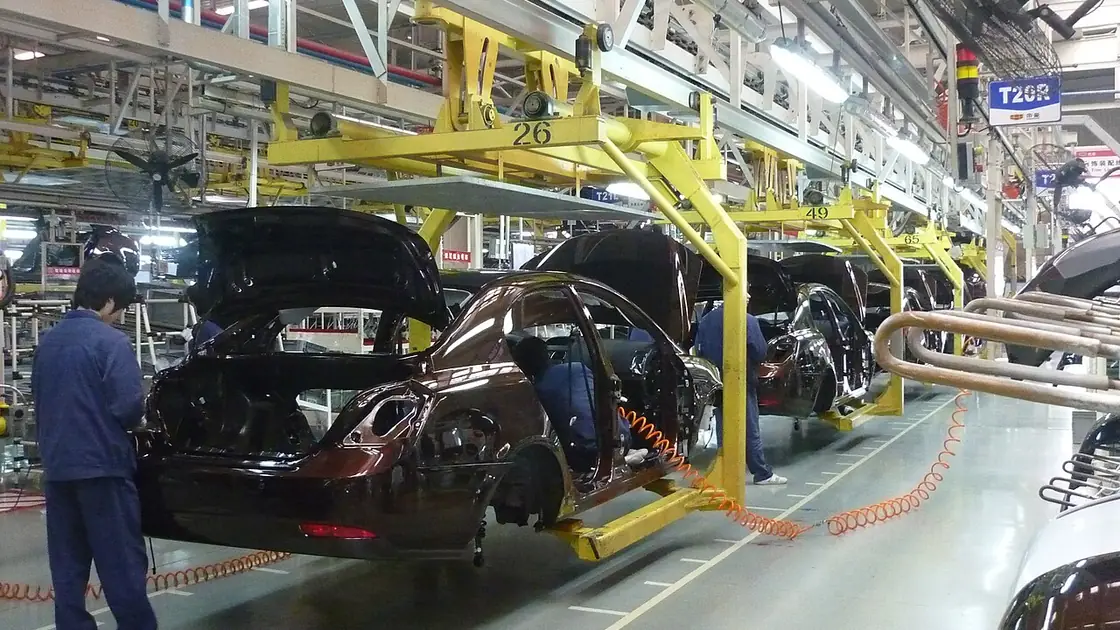
Figure 1: The broader automotive value chain contributes nearly 10% of China’s national GDP. As the most aggressive cash-flow pump in the industrial economy, any sudden terminal deceleration transmits directly onto assembly lines and cascades across tens of thousands of upstream component suppliers (Source: Wikimedia Commons).
I. Why an Automotive Slump Cannot Replicate the Financial Contagion of Real Estate
Real estate hijacked China’s macroeconomic apparatus not merely through the sheer physical length of its supply chains, but because institutional design assigned it two structural financial roles: quasi-money loan collateral and the de facto secondary treasury of local governments. In contrast, the moment a vehicle rolls off the final assembly line, it is a depreciating industrial consumer durable. Crucially, it is also a globally tradable good with an export valve to modulate domestic inventory pressure.
Although a passenger car ranks second only to a home in household ticket size, structural differences across financial attributes, fiscal integration, and inventory absorption demonstrate why an automotive sales slump constitutes an industrial clearing cycle, rather than a systemic banking credit collapse:
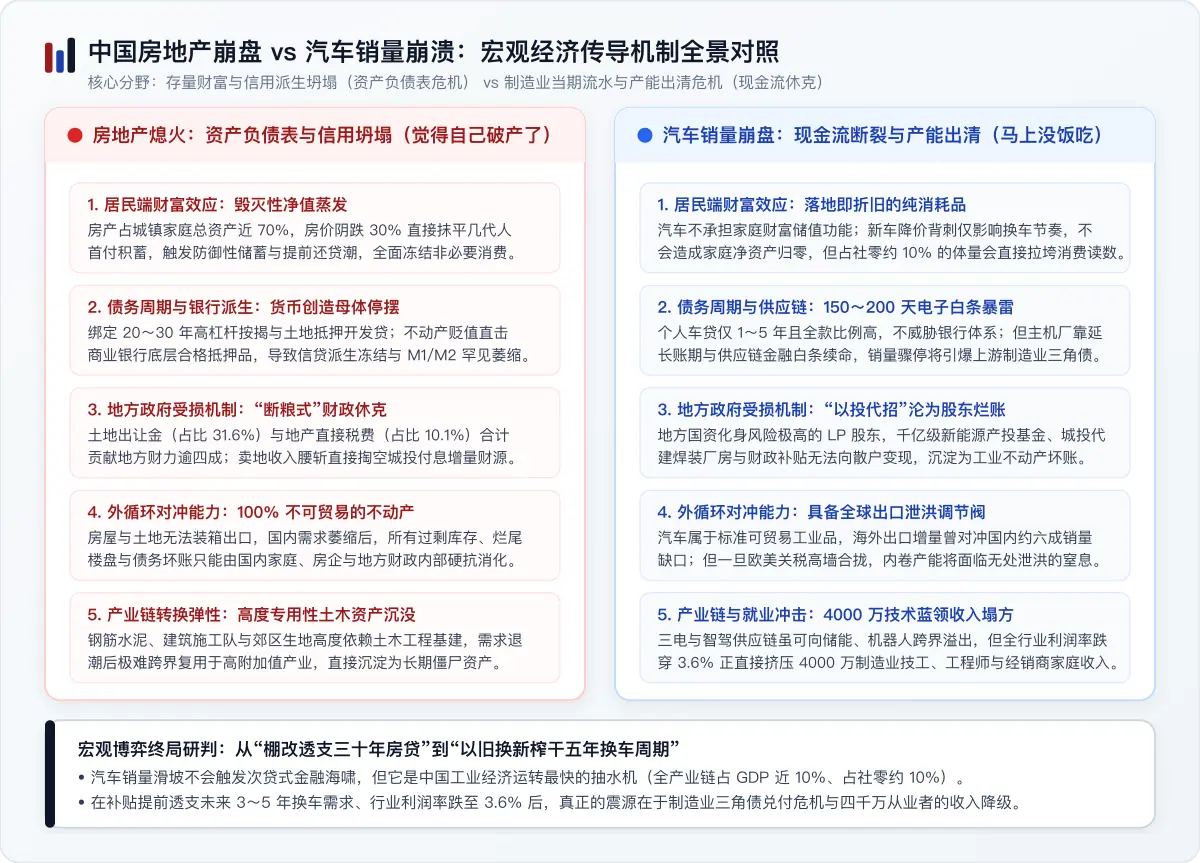
Figure 2: Comparative transmission matrix: China’s property collapse (balance-sheet wealth destruction and credit freezing) vs. automotive slump (current operating cash-flow thrombosis and capacity clearance).
| Transmission Vector | The Property Collapse (Stock Wealth Destruction & Credit Paralysis) | The Automotive Slump (Flow Thrombosis & Capacity Clearance) |
|---|---|---|
| Household Wealth Effect | Destructive Net-Worth Evaporation: As detailed in our analysis of China’s Household Wealth Structure and Asset Stratification, residential real estate constitutes nearly 70% of urban household assets. A 30% secular decline in home prices wipes out the down-payment equity of multiple generations, triggering defensive balance-sheet repair, accelerated mortgage prepayments, and a systemic freeze on discretionary consumption. | Zero Wealth-Storage Function: Cars do not serve as stores of household value. A sharp price cut on new models draws consumer ire over rapid depreciation, which delays trade-in cycles, but it never leads an owner to believe their family net worth has been wiped out. |
| Household Leverage Structure | Ultra-Long-Duration High Leverage (20–30 Year Mortgages): When asset prices drop below outstanding loan balances, homeowners enter negative equity. Default cascades directly jeopardize the Tier-1 capital and core collateral quality of commercial banks. | Short-Duration Low Leverage (1–5 Year Auto Loans): Principal balances average tens of thousands to low hundreds of thousands of yuan, accompanied by a historically high cash-purchase ratio. Rising delinquencies produce localized credit pain, not a systemic banking crisis. |
| Bank Credit Creation Engine | Seizure of the Primary Collateral Engine: Land and housing were the prime eligible collateral underwriting commercial loan creation. Freezing the property market paralyzed broad money multiplication, driving multi-decade contractions in transactional money aggregates. | Industrial Working Capital & Trade Acceptance Notes: Assembly equipment and dealer inventories depreciate too fast to serve as primary collateral in institutional risk models. An auto slump causes operational pain, but it does not paralyze commercial bank money printing. |
| Local Government Fiscal Fallout | Immediate Fiscal Shock via Budget Starvation: Land-use rights sales (constituting 31.6% of local receipts) combined with direct property-related taxes (10.1%) traditionally funded over 40% of local public budgets. The collapse in land transactions eliminated the primary marginal revenue stream servicing local government financing vehicles (LGFVs). | Stranded Equity & Bad Capital Allocations: Vehicle purchase taxes flow to the central government, shielding municipal operating accounts from immediate collapse. Instead, local governments bleed via state-backed venture bets: hundreds of billions deployed through municipal guidance funds, custom-built industrial parks, and unrecoverable industrial subsidies. |
| Trade Elasticity & Capital Conversion | Non-Tradable Specific Real Assets: Concrete and structural engineering cannot be loaded onto container vessels. When domestic demand dries up, unsold housing stock and stranded construction projects must be digested entirely within the domestic perimeter. | Globally Tradable Manufactured Goods: Vehicles are standard tradable goods; offshore exports act as an escape valve to absorb domestic overcapacity. Upstream capabilities in batteries, lidar, and autonomous compute can be repurposed into stationary energy storage, robotics, and low-altitude aviation. |
Put simply: cars possess no monetary storage capacity; they cannot detonate a subprime mortgage crisis. However, the automotive sector functions as the fastest-spinning cash-flow turbine across Chinese industry. When it stalls, the physical sense of asphyxiation on the factory floor is faster and more visceral than any real estate slowdown.
II. The Epicenter: Where the Real Macroeconomic Shockwaves Hit
Between 2023 and 2025, while real estate investment contracted at double-digit annual rates, China’s reported industrial output and headline retail sales stayed in positive territory largely because the automotive industry served as the macro ballast. The sector’s comprehensive supply chain accounts for nearly 10% of total GDP, while automotive sales at or above designated scale consistently generate 9.7% to 10% of total retail sales of consumer goods.
Entering 2026, the fuel feeding this engine is running thin. Years of aggressive trade-in subsidies, scrappage incentives, and purchase-tax exemptions effectively cannibalized three to five years of organic replacement demand to generate short-term volume. National industrial monitoring data indicates that amid relentless price wars and traditional internal combustion engine (ICE) decay, the operating profit margin for automotive manufacturing has compressed to 3.6%—well below the baseline for large-scale industrial enterprises. The sector is trapped in profitless volume expansion.
While automotive exports have surged to absorb domestic surpluses, mounting Western tariffs and localized manufacturing mandates mean offshore shipments can no longer offset domestic decelerations indefinitely. If domestic sales roll over post-subsidy, the shock will transmit along four distinct industrial fault lines:
1. Total Retail Sales Loses Its Foundational Anchor
Within the consumer basket, no discretionary product matches the ticket size of a passenger vehicle. Consumer electronics, dining out, and entertainment cannot compensate for drops in auto purchases; thousands of café visits do not equal the purchase price of an electric sedan.
Representing 10% of all consumer retail sales, an annualized decline of 15% to 20% in domestic auto transactions strips 1.5 to 2.8 percentage points off national retail growth. When broader discretionary spending is already sluggish, an auto stall turns aggregate consumer metrics negative, removing the headline statistical insulation that has obscured domestic demand weakness.
2. The Scale Game Unravels: The Supply-Chain Triangular Debt Cascade
The open secret behind how domestic original equipment manufacturers (OEMs) survived margin compression below 4%—or sustained outright per-vehicle cash losses—was the relentless financial squeeze applied to upstream component suppliers.
As documented in our analysis of Tesla vs. BYD: Compensation Models and Financial Architecture, domestic OEMs systematically stretched days payable outstanding (DPO) to 150 to over 200 days. Rather than settling balances in fiat cash, OEMs issued private digital acceptance notes—unsecured supply-chain commercial IOUs—via proprietary supply-chain finance platforms. This dynamic functions only so long as terminal sales volumes expand monotonically, enabling OEMs to use new consumer cash flows and fresh credit lines to honor paper issued half a year prior.
The moment top-line retail sales contract, that incoming cash stream dries up, straining the web of commercial credit. For thousands of Tier-1 and Tier-2 suppliers specializing in metal stamping, plastic molding, die-casting, automotive-grade semiconductors, and wiring harnesses, these digital credit certificates risk becoming illiquid paper. The consequence is a circular cascade of triangular debt and SME bankruptcies that cuts far deeper into technical manufacturing networks than developer defaults ever did.
3. The Second Hemorrhage of Local State Capital: Stranded Industrial Real Estate
Following the depletion of land-sale revenues, municipal governments channeled the debt-fueled expansion model pioneered by LGFVs and Local Infrastructure Platforms directly into new energy vehicles (NEVs) and lithium-ion manufacturing clusters. Municipal state-owned assets were committed as equity in industrial guidance funds, local development platforms constructed bespoke industrial plants on credit, and regional commercial banks provided subsidized project financing.
As the market enters a brutal zero-sum shakeout, sub-scale EV startups and regional legacy joint ventures face liquidation. The capital-intensive stamping, welding, and battery plants built across third- and fourth-tier suburbs cannot be liquidated like suburban residential plots, nor can they be easily repurposed for generic manufacturing. They represent local government balance sheets’ next frontier of structural non-performing assets: stranded industrial real estate.
4. Direct Earnings Contraction for 40 Million Industrial Workers
The automotive supply chain directly and indirectly supports more than 40 million domestic jobs, capturing approximately one-tenth of total urban employment.
While the real estate collapse disproportionately hit construction laborers and real-estate financial intermediaries, an automotive industrial contraction bears down squarely on China’s skilled technical middle class: plant floor technicians, systems engineers, software developers, and the tens of thousands of dealership personnel already strained by inverted wholesale-to-retail vehicle margins. With industry margins sitting near 3.6% and widespread operating losses, OEM and supplier cost reduction—slashing overtime, withholding bonuses, and dealer closures—translates directly into household income contraction across 40 million families.
III. The Cycle’s End: From Pulling Forward Demand to Having Nowhere Left to Borrow
Placing the real estate and automotive cycles on the same macro axis reveals an identical institutional reflex:
When structural aggregate demand softens and private balance sheets weaken, policymakers often resist transferring direct fiscal windfalls to households. Rather than systematically cutting regressive indirect taxes or expanding social safety nets to organically rebuild disposable income, the institutional impulse remains fixed on leveraging supply-side production capacity while using small-scale purchase subsidies to induce outsized household capital expenditure.
Past cycles utilized monetary-driven shantytown redevelopments and rising property prices to borrow against thirty years of household mortgage capacity. Recent years used trade-in vouchers and localized subsidies to consume the next three to five years of vehicle replacement demand. When an urban family depletes its liquid savings to secure a modest scrappage subsidy on a new EV, it extracts itself entirely from the durable goods market for the rest of the decade.
Definitive Analytical Takeaways
- Empirical Industrial Reality: The automotive ecosystem accounts for nearly 10% of both Chinese GDP and retail sales, while supporting over 40 million jobs. Following years of demand cannibalization and margin erosion down to 3.6%, an automotive sales stall directly depresses headline consumption, threatens default cycles across 150- to 200-day supplier payment notes, and crystallizes bad debt across municipal state-capital vehicle funds.
- Analytical Misconception: Equating an automotive slowdown with a second property-style financial collapse is an analytical error. Automobiles are rapidly depreciating consumer durables funded through short-term, low-leverage credit lines, backed by global export capacity and technology repurposing pipelines. They do not constitute 70% of household wealth, nor do they serve as the foundational collateral underpinning commercial bank credit creation. They cannot detonate a systemic banking run.
- Macro and Micro Strategy: The core vulnerability for the automotive complex is a structural pincer movement: domestic demand saturation coupled with closing Western trade borders. Once excess export volumes are trapped, overcapacity accelerates industrial deflation. For the individual household, recognizing that consumer durables are pure operational depreciation rather than wealth storage—and refusing to deplete liquid reserves for marginal trade-in subsidies—remains essential for preserving Household Cash-Flow Defense Lines and Emergency Reserves through an industrial clearing cycle.
Related Research & Topics
Tello Mobile eSIM
SafetyWing Nomad Insurance
* Disclosure: This post contains affiliate links. If you make a purchase through these links, V-G Journal may earn a small commission at no additional cost to you. We only recommend services we independently evaluate and trust.
FIRE and Golf:自由旅居之路
专注于为追求 FIRE 与品质生活的人群提供特惠打球权益与候鸟微度假。不持一砖一瓦,运营品质生活。