Taming the Surge: The Mechanics of PBOC’s FX Reserve Hike and the New Doctrine of Export Hedging
As the onshore RMB surged past 6.65, sparking a panic rush to convert foreign exchange receivables, the PBOC raised the FX reserve requirement ratio for the first time in nearly five years. By freezing $24 billion in bank liquidity, Beijing aims to suppress self-fulfilling overshoot while forcing exporters to adopt currency risk neutrality.


Figure 1: The People’s Bank of China deploys foreign exchange reserve requirements and counter-cyclical factors to flatten unilateral market expectations.
On the morning of November 3, 2026, the People’s Bank of China (PBOC) issued an official announcement: effective November 15, 2026, the foreign exchange reserve requirement ratio (FX RRR) for financial institutions would be raised by 2 percentage points, moving from 4% to 6%. This marks the central bank’s first hike of the FX RRR in nearly five years, following a similar intervention in December 2021. Just twenty-four hours prior, both onshore (CNY) and offshore (CNH) spot rates broke cleanly below the 6.65 mark, reaching their strongest levels since June 2022. By deploying this macroprudential tool, the PBOC directly immobilizes approximately $24 billion in foreign currency liquidity within the banking system—cutting short a self-reinforcing herd movement of pro-cyclical FX settlement and shielding real-sector manufacturers from the irreversible squeeze of an overshooting currency.
Balance Sheet Transmission: From Squeezing Dollar Liquidity to Managing Pro-Cyclical Expectations
In the central bank’s macroprudential toolkit, the FX RRR and the daily fixing counter-cyclical factor (CCF) serve distinct yet complementary functions. The CCF is embedded directly into the daily USD/CNY central parity pricing model; by introducing an adjustment coefficient alongside the “closing price + basket currency movement” formula, it offsets irrational pro-cyclical deviations driven by market momentum. The FX RRR, by contrast, is a direct, quantitative constraint applied straight to the foreign currency balance sheets of commercial banks.
To understand the physics of liquidity withdrawal: when commercial banks absorb foreign currency deposits from domestic enterprises and residents, they retain a portion as daily liquid reserves while using the rest for domestic interbank lending or market-making activities. As of late September 2026, total foreign currency deposits across Chinese financial institutions stood at approximately $1.2 trillion. Raising the FX reserve ratio from 4% to 6% mandates that, by mid-November, banks must transfer an additional slice of their cash deposits into frozen, non-usable reserve accounts at the PBOC. On a static balance of $1.2 trillion, this 2-percentage-point hike directly freezes roughly $24 billion in foreign currency liquidity.
In the domestic FX market, draining $24 billion in dollar spot liquidity means the inventory of greenbacks available for sale against the yuan in the interbank market shrinks instantly, elevating USD interbank lending rates and funding costs. This structural shift abruptly counteracts the supply imbalance—excess domestic dollars and deepening USD/CNY forward discounts—previously caused by an accumulating trade surplus.
More importantly, the intervention disrupts a dangerous feedback loop in market psychology. In preceding months, fueled by massive current account surpluses, export manufacturers succumbed to a wave of panic FX conversion. Anticipating further yuan appreciation, exporters rushed to unload their dollar receivables; this massive influx of net selling volume in the interbank market pushed onshore spot rates relentlessly past 6.65. As highlighted in our previous analysis on China’s macroeconomic imbalances and current account dynamics, once pro-cyclical expectations become self-fulfilling, market pricing decouples from fundamentals and triggers severe overshooting. By reviving the FX RRR hike for the first time in nearly five years, the central bank dispatched an unequivocal macroprudential signal, draining liquidity fuel from speculative momentum before prices could run entirely off the rails.
Micro-Level Profit Penetration: How Unhedged Appreciation Consumes Manufacturing Margins
For small-to-medium export manufacturers at the downstream end of the supply chain, exchange rates are never abstract figures on a Bloomberg terminal—they are sharp instruments that can slice through balance sheets in real time. Within the current profit distribution of Chinese manufacturing, original equipment manufacturers (OEMs) operating in precision hardware, textiles, and standard components typically operate within a narrow net profit margin corridor of 3% to 5%.
When the spot rate rallies rapidly within a few short months to break 6.65, the magnitude of appreciation quickly exceeds the average profit cushion of contract manufacturing. Physical execution in international trade features an unavoidable lag: the cycle spanning commercial negotiations, contract signing, sample testing, raw material procurement, customs clearance, and final bill of lading wire transfer spans anywhere from 90 to 180 days. If an exporter quotes an order based on current forward rates without securing financial hedges, a multi-month settlement delay turns lethal. As the yuan strengthens, the local currency proceeds realized from the same dollar payment shrink dramatically, obliterating processing margins and pushing the business into a surreal trap where “more orders yield heavier operational hemorrhaging.”
Faced with the realities of compressed margins under an export-reliant engine, many traditional factory owners retain a high-risk path dependency in currency management. During appreciation phases, they frequently leave their foreign exchange positions naked, or leave export proceeds sitting in offshore accounts, harboring the illusion that the rate will reverse, allowing them to “sell dollars at a high.” Yet modern FX markets are continuously rattled by major central bank policy divergences, geopolitical trade friction, and global supply chain realignments. The duration and depth of currency overshooting routinely outlast the cash flow endurance of mid-sized firms. Gambling on direction is, in essence, taking hard-earned, razor-thin manufacturing fees and placing them entirely on an unmanageable macroeconomic roulette wheel.
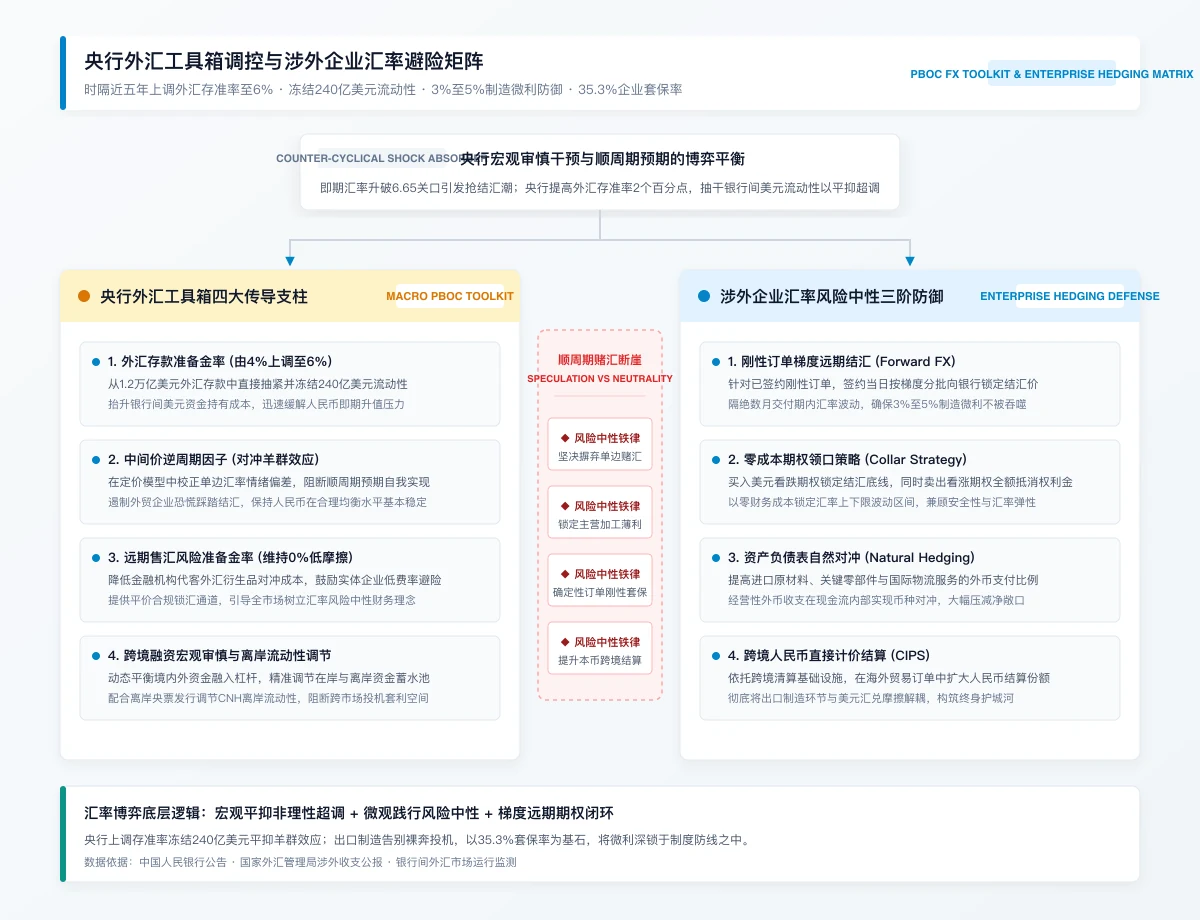
Figure 2: Transmission channels of central bank macroprudential tools and the three-tier currency risk neutrality matrix for cross-border enterprises.
Strategic Hedging Reconfigured: From Directional Bets to a Three-Tier Risk Neutral Matrix
Eliminating the random erosion of operational profit by currency swings requires a fundamental shift: abandoning directional speculation and instilling “currency risk neutrality” into corporate governance. The essence of hedging is to lock in operational certainty—its objective is capital preservation, not speculative yield generation. Data from the State Administration of Foreign Exchange (SAFE) indicates that as cross-border financial literacy matures, the foreign exchange hedging ratio among Chinese enterprises has risen steadily to 35.3%.
To build a resilient defense, cross-border enterprises should deploy a structured, three-tier architecture:
Tier 1: Staggered Forward FX Contracts for Fixed Orders (Forward FX)
For firm orders with confirmed delivery schedules and contract amounts, corporate treasury departments must execute staggered forward exchange contracts with commercial banks on the day of signing or confirmation, adhering strictly to cost-plus baseline margin targets. With the PBOC maintaining the FX risk reserve ratio for forward sales at zero, financial institutions face reduced compliance friction and transaction overhead. By locking in future settlement prices via forward contracts, the company insulates its operating profit entirely from market volatility, regardless of whether the yuan continues to surge.
Tier 2: Zero-Cost or Low-Cost Collar Strategies (Collar Strategy)
For growing enterprises facing payment schedule uncertainty or seeking to preserve favorable upside while capping downside exposure, foreign exchange option combinations offer a more dynamic toolkit. A well-established strategy is the zero-cost or low-cost “collar option”: the enterprise purchases a USD put option (establishing a minimum FX conversion floor) while simultaneously selling a USD call option with a higher strike price. The premium earned from selling the call fully offsets the premium paid for purchasing the put. This structure secures a firm floor against catastrophic tail risk caused by rapid yuan appreciation without incurring rigid cash outlays for options premiums.
Tier 3: Natural Balance Sheet Hedging and Local Currency Settlement
Beyond derivative contracts, the most sustainable defense lies in the structural redesign of internal operations and currency balance sheets. On the procurement side, enterprises should systematically increase the share of foreign currency payments for imported raw materials, auxiliary components, and international logistics. Matching foreign currency cash inflows with operational outflows over the cash cycle creates a natural hedge, reducing the net exposure that requires commercial bank settlement at the source.
Furthermore, as outlined in our study on cross-border RMB settlement and de-dollarization dynamics, promoting RMB as the invoicing and settlement currency with international partners serves as the ultimate buffer against cross-border exchange friction. Supported by the expansion of the Cross-Border Interbank Payment System (CIPS) and local currency settlement agreements, stripping currency risk out of manufacturing exports is becoming essential infrastructure for resilient global enterprises.
Under the dual lens of macroeconomic counter-cyclical management and micro-level profit protection, two-way exchange rate elasticity is now a permanent feature of globalized business. The PBOC’s foreign exchange reserve hike aims to neutralize irrational overshooting that strays from macroeconomic fundamentals; for export enterprises, enforcing strict currency risk neutrality safeguards the microscopic vitality of real-sector industry amid global economic turbulence.
Related Research & Topics
Tello Mobile eSIM
SafetyWing Nomad Insurance
* Disclosure: This post contains affiliate links. If you make a purchase through these links, V-G Journal may earn a small commission at no additional cost to you. We only recommend services we independently evaluate and trust.
FIRE and Golf:自由旅居之路
专注于为追求 FIRE 与品质生活的人群提供特惠打球权益与候鸟微度假。不持一砖一瓦,运营品质生活。