The Phuket Fallacy: Air Quality Migration, Revenue Order Paw 161, and the Arbitrage Ledger of Thailand's Nomadic Class
Seasonal agricultural burning in Chiang Mai forces digital nomads south to Phuket, where localized monopolies and soaring rents erode cost arbitrage. Meanwhile, Thailand's Paw 161 rule subjects 180-day tax residents to worldwide income taxation—leaving DTV holders vulnerable and reserving statutory immunity for the $80,000 LTR visa.


Figure 1: The seasonal migration from Chiang Mai’s smog basin to Phuket’s high-premium resort economy.
Every year between February and April, the valley of Chiang Mai is overwhelmed by crop residue burning and severe atmospheric inversion layers. For thousands of digital nomads, fleeing south to Phuket feels like an intuitive, stress-free move. Yet this seasonal migration is increasingly turning into a fiscal double bind. Rather than preserving low-cost geographic arbitrage, Phuket subjects nomads to a 60% to 100% price premium driven by local transport cartels and high-end rental demand. More critically, Revenue Department Order No. Paw 161/2566—enforced since early 2024—tightens the tax net around anyone staying 180 days or more. While the marketed Destination Thailand Visa (DTV) offers zero tax protection, only the Long-Term Resident (LTR) visa—with its $80,000 income baseline—provides statutory tax immunity under Royal Decree No. 743. Unplanned extended stays now expose location-independent workers to skyrocketing expenses and unexpected tax liabilities.
I. The Smog Migration Ledger: From Chiang Mai’s Valley Basin to Phuket’s Inflation Trap
In the narrative of Southeast Asian digital nomadism, Chiang Mai long held legendary status. Offering monthly living costs between $800 and $1,200, alongside dense networks of co-working spaces and specialty cafes, the city served as a primary hub for global remote workers. However, this mountain-ringed valley hits an unavoidable environmental boundary every spring: the burning season, lasting from mid-February to late April.
Intense agricultural burning across regional sugarcane and rice fields, combined with dry weather and high-altitude thermal inversion, traps fine particulate matter directly over the city. According to data from the official Air4Thai monitoring platform, PM2.5 levels and AQI readings in metropolitan Chiang Mai frequently spike into the 200 to 300 range during this period, routinely placing the city atop global air pollution rankings. For remote workers attempting to settle long-term, chronic respiratory issues and the constant hum of indoor air purifiers eventually force a seasonal exit.
The obvious move is to head south toward tropical islands, making Phuket the most popular destination. Yet upon arrival along the Andaman coast, the economic reality quickly shatters any lingering low-cost assumptions:
- Mobility Friction and Transport Cartels: Chiang Mai benefits from an accessible, low-cost network of Grab bikes and songthaews, with typical urban trips costing between 40 and 80 THB. In Phuket, entrenched taxi and tuk-tuk cartels maintain strict price floors. Even when using ride-hailing apps, single rides across beaches or into Phuket Town routinely run between 400 and 800 THB, causing local transit budgets to multiply overnight.
- Resort-Driven Rental Inflation: A modern single-bedroom condominium near Nimman or Suthep in Chiang Mai commands a stable long-term monthly rent of 10,000 to 15,000 THB. In Phuket areas like Rawai, Karon, or Bang Tao—heavily populated by affluent European vacationers and long-stay wintering tourists—median monthly rents for comparable, work-friendly condos range from 35,000 to 60,000 THB.
- Island Supply Chain Premiums: High freight costs and a luxury resort orientation drive up prices for healthy dining, specialty coffee, and daily groceries by 45% to 80% compared to northern Thailand.
Data tracked by cost-of-living aggregator Numbeo indicates that overall consumer spending in Phuket is approximately 45% higher than in Chiang Mai, while median rents are 80% to 120% higher. A hasty seasonal escape frequently drops remote workers directly into a high-cost resort market without the appropriate budget cushion.
II. The Tax Enforcement Shift: Revenue Department Order Paw 161/2566 and the 180-Day Rule
While doubled living expenses represent an immediate cash-flow burden, the gradual tightening of international tax rules poses a far more consequential threat to long-term wealth preservation.
For decades, an informal tax consensus circulated among location-independent workers in Thailand: under historical interpretations of Section 41, Paragraph 2 of the Thai Revenue Code, foreign-sourced income was exempt from Thai Personal Income Tax (PIT) as long as it was brought into the country in a subsequent calendar year after it was earned. This rule effectively created an offshore tax loop that stood untouched for generations.
That mechanism was dismantled in 2024:
- Revenue Department Order Paw 161/2566: Issued by the Thai Revenue Department and effective January 1, 2024, this order dictates that any individual residing in Thailand for 180 days or more in a calendar year becomes a Thai tax resident. Any foreign assessable income—including remote employment salary, freelance fees, offshore dividends, and capital gains—remitted into Thailand is subject to Thai Personal Income Tax at progressive rates ranging from 5% to 35%, regardless of when that income was originally earned.
- Administrative Guidance Paw 162/2566: A follow-up directive clarified a grandfather clause: capital earned and held offshore prior to January 1, 2024, remains tax-exempt upon remittance. However, all new foreign income generated after January 1, 2024, loses cross-year remittance protection entirely.
This shift—where physical presence triggers broad sovereign tax jurisdiction—mirrors the regulatory dynamics detailed in our analysis of France’s 2026 Luxury Wealth Tax Audits: Tax Residency and Compliance Traps for the FIRE Class.
Many remote workers spend four months in Chiang Mai and another three months in Phuket to escape the smog, crossing the 180-day physical threshold within a single calendar year without realizing it. The moment they draw living funds from an offshore account via local ATMs or direct wire transfers, they trigger formal tax filing obligations under Thai law.
III. Comparing Visa Options: DTV Marketing vs. LTR Royal Decree No. 743
Faced with stricter tax enforcement, many nomads assume that the Destination Thailand Visa (DTV)—launched with significant public promotion in 2024—offers a tax-sheltered solution. This assumption is one of the most widespread misconceptions currently circulating in remote-work communities.
| Metric / Dimension | Destination Thailand Visa (DTV) | Long-Term Resident Visa (LTR - Work-from-Thailand) | Traditional Tourist Visa / Exemption |
|---|---|---|---|
| Visa Validity | 5 years valid; maximum 180 days per entry | 10 years long-term residence | 30–60 days per entry; maximum 90 days with extension |
| Eligibility Thresholds | Proof of 500,000 THB (~$14,000 USD) in liquid assets | Annual personal income ≥ $80,000 USD over past 2 years; employer must be publicly listed or have $150M revenue over 3 years | Zero asset threshold; standard return flight proof |
| Statutory Tax Status | No statutory tax exemptions granted under Thai law | Statutory foreign-income tax exemption under Royal Decree No. 743 | Non-resident tax status (if stay remains under 180 days) |
| 180-Day Residency Impact | Remitted income subject to progressive 5%–35% PIT | Remitted foreign income receives statutory 0% tax exemption | Interrupted upon exit; cannot establish official long-term tax residency |
| Work Rights | Remote work for foreign entities permitted; no local work permit | Includes Digital Work Permit | Strictly prohibited from earning income in Thailand |
Official regulatory documentation for the DTV contains no special exemptions from standard Thai Revenue Code residency provisions. The DTV simplifies entry conditions and legalizes remote work within the country, but any holder spending 180 days or more in Thailand during a calendar year becomes a standard tax resident. Wiring foreign-sourced income into local accounts at Bangkok Bank or Kasikornbank to cover living costs creates a clear, reportable tax exposure.
By contrast, the Long-Term Resident (LTR) Visa—managed jointly by the Thailand Board of Investment (BOI) and the Revenue Department—provides real legal protection for high earners.
Under Royal Decree No. 743, LTR holders under the Work-from-Thailand Professionals, Wealthy Global Citizens, and Wealthy Pensioners tracks receive an explicit statutory exemption (0% tax) on remitted foreign-sourced income.
However, this protection comes with strict qualifying thresholds:
- Income Requirements: Minimum verifiable personal income of $80,000 USD per year over the past two years (reducible to $40,000 USD for master’s degree holders or intellectual property owners);
- Employer Criteria: The applicant’s employer must be a publicly traded company or a private entity with consolidated revenue of at least $150 million USD over the preceding three years.
For a broader evaluation of Asian residency frameworks and their cost evolution, see our comparative study on Asia Digital Nomad Visas: Comparative Cost and Residency Thresholds. The principle of building strong legal barriers around residency is similarly analyzed in our report on Portugal’s Golden Visa: CRS Audits and Dual-Residency Defenses.
IV. A Practical Framework for Cross-Border Nomads
To navigate the combination of seasonal air pollution in the north and rising prices in the south, cross-border remote workers and FIRE practitioners need a disciplined approach to managing both physical presence and capital flows.
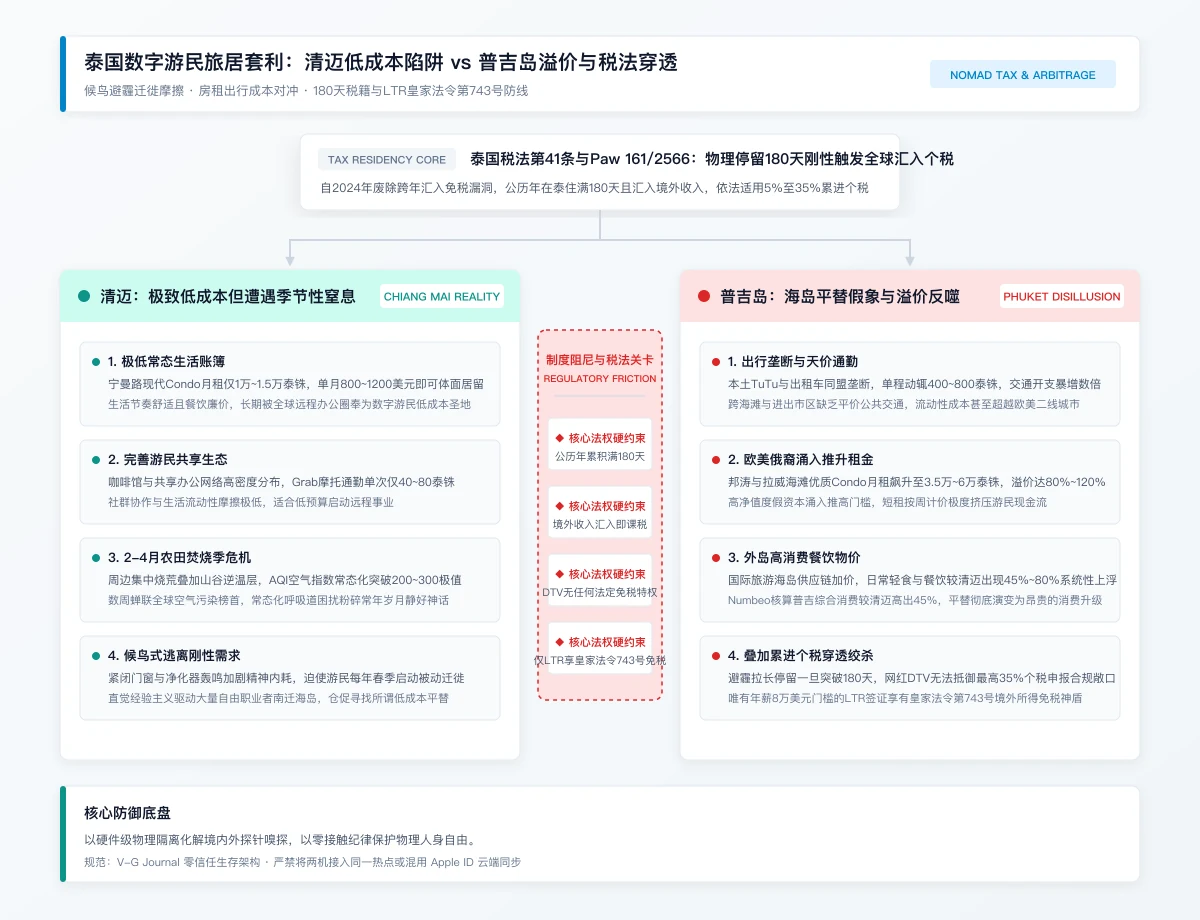
Figure 2: Strategic decision matrix for managing stay duration, location costs, and tax compliance in Thailand.
1. Managing Physical Stay: The “179-Day Ceiling”
For nomads who do not meet LTR requirements and rely on standard tourist visas or the DTV, capping physical presence in Thailand at 179 cumulative days within any single calendar year remains the most effective way to avoid triggering tax residency.
- A sustainable schedule involves staying three months during Chiang Mai’s cool season (November through January), leaving during the burning season to destinations like Penang, Da Nang, or Bali, and making a brief return late in the year;
- Unplanned, continuous stays across multiple seasons should be avoided.
2. Separating Living Expenses from Foreign Earnings
Under Order Paw 161/2566, tax events are triggered specifically by the act of remitting funds into Thailand:
- Living expenses should be covered primarily using foreign credit or debit cards for direct merchant transactions, minimizing large transfers into local Thai bank accounts;
- Clear records of offshore capital reserves accumulated prior to January 1, 2024 (such as monthly bank statements or brokerage records) should be preserved to substantiate tax-exempt claims under Paw 162 if significant transfers are made for larger purchases.
3. Factoring in Microeconomic Costs
As outlined in our research on Ecuador’s Geographic Arbitrage: Dollarized Costs and Microeconomic Frictions, relocating without considering localized commercial structures and informal monopolies can quickly eliminate expected savings through elevated transit, housing, and service costs. Phuket is not an inexpensive alternative to Chiang Mai; it is an established international resort market priced for high-net-worth travelers.
True geographic arbitrage relies on clear planning rather than trend-driven moves. It requires matching lifestyle decisions with real climate cycles, local price structures, and cross-border tax compliance.
Related Research & Topics
Tello Mobile eSIM
SafetyWing Nomad Insurance
* Disclosure: This post contains affiliate links. If you make a purchase through these links, V-G Journal may earn a small commission at no additional cost to you. We only recommend services we independently evaluate and trust.
FIRE and Golf:自由旅居之路
专注于为追求 FIRE 与品质生活的人群提供特惠打球权益与候鸟微度假。不持一砖一瓦,运营品质生活。