Geographic Arbitrage at 31: The True Cost and Hidden Frictions of Ecuador's Dollarized Economy
A 31-year-old former Amazon finance manager moved his family to Cuenca, Ecuador, with $350,000, slashing monthly rent to $600 and childcare expenses to fractions of US costs. Yet while full dollarization erases FX risk, a 15% VAT, a 5% capital exit tax, and rolling blackouts expose the heavy hidden tolls of cross-border arbitrage on asset isolation and safety redundancy.


Figure 1: A panoramic view of the New Cathedral and colonial streetscape in Cuenca, Ecuador’s Andean highland city, serving as a primary hub for low-cost living and expatriate retirees.
In early 2026, Johnston Osagie, a 31-year-old former senior financial analyst at Amazon, packed up $350,000 in investment capital from Nashville, Tennessee, relocated his family to the Andean mountain city of Cuenca, Ecuador, and welcomed a newborn child. Monthly rent plummeted from $1,720 to $600; nighttime infant care cost as little as $44 a night; and a premature Caesarean section at a private hospital tallied just $2,790. This cross-border geographic arbitrage case exploded across the internet.
Yet, Ecuador’s official dollarization—adopted in 2000—completely eliminates sudden currency devaluation risks while leaving the central bank without a lender-of-resort function, revealing profound macroeconomic vulnerability. Coupled with a national VAT permanently raised to 15% in April 2024, a 5% capital exit tax (ISD), and rolling blackouts lasting 8 to 14 hours amid extreme drought, these realities construct a harsh ledger of systemic frictions behind the pastoral narrative.
I. The Mathematics of Geographic Arbitrage: Purchasing Power Leap on a $350,000 Principal
In classic Financial Independence, Retire Early (FIRE) models, the gap between asset scale and local cost of living drives “geographic arbitrage.” For mid-career tech and finance professionals trapped in high-stress corporate environments, their early thirties often trigger a collision between career promotion ceilings and the inflexible time demands of starting a family.
Consider the financial model in this case: in Nashville, a monthly mortgage payment of about $1,720, combined with commercial health insurance premiums of roughly $300 each for the couple, pushed basic fixed overhead beyond $2,300 per month. After accumulating $350,000 in investment assets by 2022, staying in a Tier-1 or Tier-2 North American metro area and applying a strict 4% safe withdrawal rate would yield only about $14,000 annually (roughly $1,166 monthly) in passive cash flow—clearly insufficient to cover everyday living expenses and medical insurance for a family with a newborn.
Relocating to Cuenca, Ecuador structurally reorganized their cost ledger:
- Housing Dimensional Reduction: A comfortable three-bedroom apartment in downtown Cuenca costs only about $600 a month, immediately freeing up $1,120 in monthly housing cash outflow.
- Healthcare De-escalation: Abandoning the high-deductible North American insurance model for a cash-pay-per-service structure. His wife’s premature C-section three weeks early, followed by days of specialized neonatal observation at a private hospital, totaled just $2,790. Routine pediatric follow-ups cost roughly $50 a month.
- Labor Arbitrage: Hiring a professional night nurse five nights a week to assist with the newborn costs $44 per night (under $900 monthly). Equivalent night-nursing services in North America routinely exceed $6,000 monthly.
This cost differential relies fundamentally on exchanging “capital accumulated” in a developed economy for “cheap surplus service labor” in a developing one. Yet many discussions stop right there, packaging the move as a frictionless myth where $350,000 allows a family to completely coast—ignoring the legal and macroeconomic foundations upon which the entire arbitrage model rests.
II. The Double-Edged Sword of Dollarization: Eliminating FX Risk vs. Losing Monetary Defenses
Ecuador holds a unique ecological niche among Western digital nomads and retirees due to its monetary regime: official dollarization.
On January 9, 2000, following a catastrophic banking collapse and hyperinflation, Ecuador abandoned its domestic currency, the sucre, establishing the U.S. dollar as its sole legal tender. This framework provides cross-border arbitrageurs with an “FX-friction-free safety capsule” rarely found elsewhere in Latin America (such as Argentina, Brazil, or Colombia):
- Zero-Conversion Friction: Investors’ broad-market U.S. stock dividends, bond yields, or offshore cash accounts require no dual conversion through a weak local currency, completely avoiding wide bid-ask spreads and exchange controls.
- Elimination of Hyperinflation Premiums: Because monetary issuance is anchored to the Federal Reserve, Ecuador lost any domestic fiscal impulse to print money, keeping long-term price inflation relatively mild.
The flip side, however, is absolute macroeconomic passivity. Ecuador’s central bank lacks a “lender of last resort” rescue mechanism; national fiscal health relies entirely on oil export revenues and external debt issuance. When global dollar liquidity tightens or the Federal Reserve maintains a high-interest-rate cycle, Ecuador’s domestic financial system experiences liquidity contraction. Although local commercial banks once offered 8% to 9% annualized yields on dollar term deposits to attract capital, these are far from risk-free arbitrage—they price in low sovereign credit ratings and the lack of an external liquidity backstop for local bank balance sheets.
Examining the underlying logic of FIRE Kill-Line Defense and Liquidity Reserves reveals an immutable truth: any high-yield time deposit operating outside the protection of a sovereign central bank essentially trades principal security for spread risk.
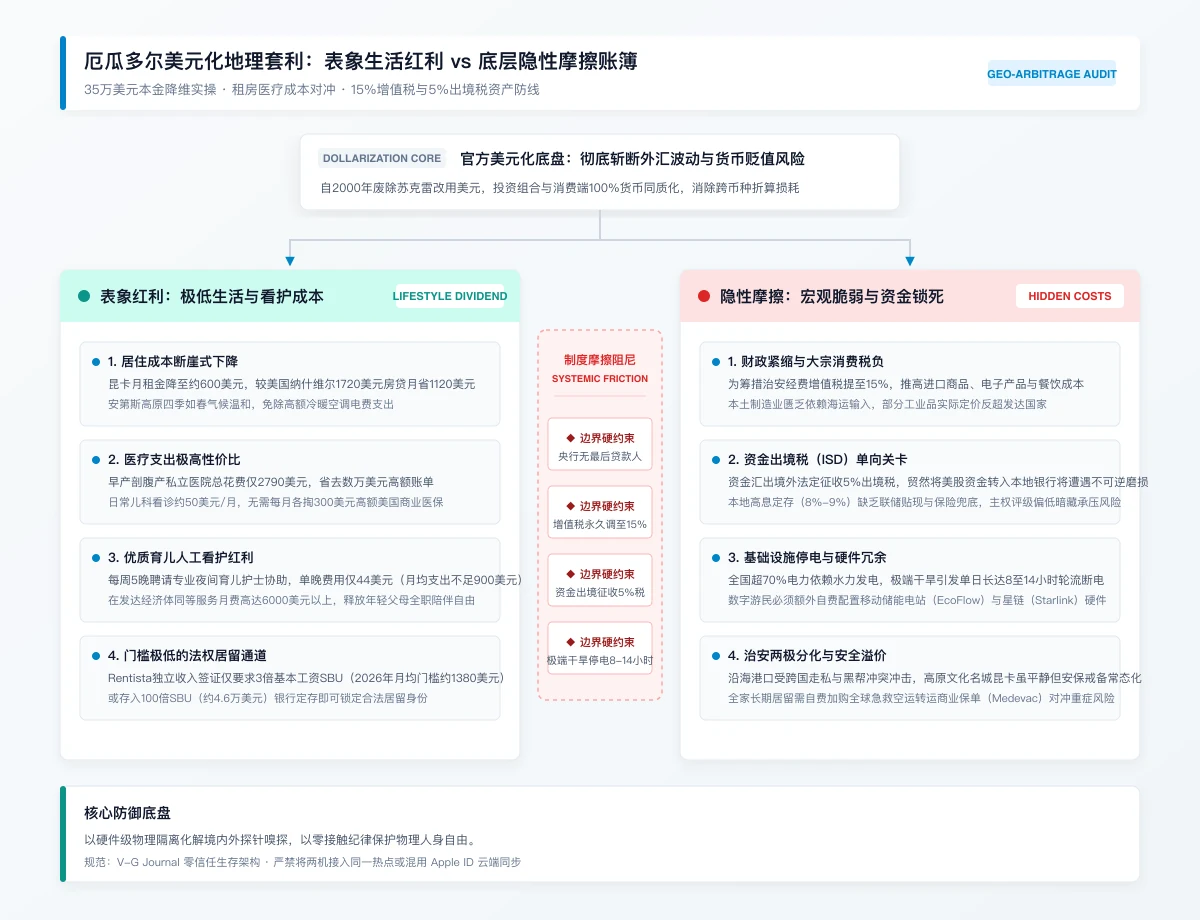
Figure 2: Ecuadorian Dollarized Geographic Arbitrage: Surface-level lifestyle dividends versus underlying systemic friction audit matrix.
III. The Hidden Friction Ledger: Tax Shocks, Power Grid Failures, and Safety Redundancy
True cross-border geographic arbitrage is never a one-way reduction in consumption costs; it is an actuarial hedge against multi-dimensional institutional frictions.
1. Fiscal Strain and the 15% VAT Blowback
Once a developing country loses its printing press, the only means to finance fiscal and security deficits is direct taxation. To fund security measures against organized crime, President Daniel Noboa signed a decree permanently raising the national standard Value-Added Tax (IVA) from 12% to 15% starting April 1, 2024.
This means all commercially distributed goods—from imported supermarket groceries and infant diapers to home appliances—carry a direct 15% tax surcharge. Combined with weak domestic industrial manufacturing and a heavy reliance on maritime imports for high-quality lifestyle goods and electronics, the terminal retail prices of many industrial benchmarks often significantly exceed those in the United States, diluting the service-sector arbitrage dividend.
2. The One-Way Trap of the 5% Capital Exit Tax (ISD)
Ecuadorian tax law imposes a strict Capital Exit Tax (Impuesto a la Salida de Divisas, ISD), currently set at a statutory rate of 5%.
This tax introduces a fatal one-way friction into cross-border financial planning: if an expatriate is unfamiliar with local tax rules and carelessly wires a large principal from overseas investments into a local Ecuadorian bank account, any subsequent repatriation of that capital back to an offshore account due to sudden emergencies (such as children’s education, political shifts, or severe illness) incurs a mandatory 5% government levy. This irreversible capital erosion dictates that sophisticated arbitrageurs must strictly maintain an “offshore asset, onshore consumption” firewall.
3. Hydropower Dependency and 8 to 14-Hour Rolling Blackouts
Infrastructure-wise, over 70% of Ecuador’s electricity generation relies on hydroelectric resources. Extreme drought conditions since 2024 have caused reservoir water levels to drop below critical thresholds, triggering national rolling blackouts (apagones) lasting anywhere from 8 to 14 hours a day in severe phases.
For families relying on internet connectivity to manage remote assets or handle professional workloads, blackouts bring immediate broadband failures and disruptions to refrigeration. This forces residents to self-fund large-capacity mobile storage power stations, diesel generators, and Starlink low-Earth-orbit satellite terminals, significantly increasing hardware depreciation and maintenance overhead.
4. Security Polarization and Cross-Border Medical Evacuation Policies
While the Andean highland city of Cuenca enjoys lower violent crime rates than coastal drug-trafficking hubs like Guayaquil—thanks to its traditional Catholic heritage, artisanal depth, and expatriate retiree community—the normalization of national states of emergency and curfews still raises the baseline security barrier.
More critically, even though private hospitals can handle routine C-sections for $2,790, local comprehensive medical resources for complex neonatal intensive care (NICU) or rare medical conditions remain limited. Expatriate residents must purchase specialized international health insurance featuring global emergency medical evacuation (Medevac) coverage, driving annual fixed policy expenses into the thousands of dollars.
IV. Compliant Residency and Cross-Border Defensive Architecture
For groups intending to optimize their family lifestyle through geographic arbitrage, Ecuador offers a clear statutory residency pathway—provided they strictly delineate between legal status and asset placement.
1. The Entry Threshold of the Rentista (Independent Income) Visa
Ecuadorian immigration regulations provide a “Rentista” (Independent Income) visa category for non-retired younger applicants. The legal obligation requires applicants to prove stable, lawful overseas passive income pegged to three times Ecuador’s Unified Basic Salary (SBU):
- In the 2025/2026 cycle, Ecuador’s SBU is approximately $460 per month, making the statutory triple-income requirement roughly $1,380 monthly.
- If foreign passive income cannot be verified via monthly bank statements, applicants can secure residency by placing a long-term certificate of deposit worth 100 times the SBU (roughly $46,000) inside a domestic Ecuadorian financial institution.
2. The Dual-Account Isolation Firewall
Just as established in the risk isolation consensus for Portugal’s Golden Visa and Cross-Border Tax Audits, cross-border geographic arbitrage must never “localize” asset allocation. A robust operational model requires:
- Layer 1 (The Offshore Wealth Reservoir): Core assets ($350,000 or more) remain anchored in U.S. brokerages (such as Schwab, Fidelity, or IBKR) and offshore bank accounts, maintaining high liquidity and low-cost broad-market index allocations.
- Layer 2 (The Monthly Consumption Pipeline): Avoid establishing large local deposit accounts. Instead, fund daily expenses via multi-currency global debit cards at ATMs or small monthly wire transfers, completely bypassing the potential 5% ISD capital exit drag.
- Layer 3 (The Lifestyle and Liquidity Buffer): As outlined in the structural framework of The Three Pension Ledgers and Nomad Defenses, maintain a cash buffer covering at least 12 to 24 months of living expenses to absorb sudden institutional frictions, such as backup power equipment purchases, visa legal fees, and cross-border plane tickets.
Choosing to leave a high-pressure career at 31 to relocate to an Andean mountain city, trading lower living costs for immediate parental presence during a child’s early years, is a courageous and rational choice in life-cycle time allocation. However, true geographic arbitrage is never a free lunch. Only by piercing through the hidden ledgers of dollarization-induced monetary tightness, 15% VATs, and power grid volatility—and constructing cross-jurisdictional asset firewalls—can this hard-won tranquility withstand unexpected systemic storms.
Related Research & Topics
Tello Mobile eSIM
SafetyWing Nomad Insurance
* Disclosure: This post contains affiliate links. If you make a purchase through these links, V-G Journal may earn a small commission at no additional cost to you. We only recommend services we independently evaluate and trust.
FIRE and Golf:自由旅居之路
专注于为追求 FIRE 与品质生活的人群提供特惠打球权益与候鸟微度假。不持一砖一瓦,运营品质生活。