Balance Sheet Rescue: The Ruthless Economics of Selling Your Home to Rent During a Downturn
When real estate enters a prolonged downward cycle, selling your home to rent isn't a lifestyle compromise—it's a ruthless balance sheet rescue and deleveraging strategy.

Curator’s Note: During unilateral bull markets, the belief that “buying a home is an asset, while renting is working for the landlord” became a societal cornerstone. This narrative thrived for two decades purely because a 5% to 10% annual capital gain easily masked all interest expenses, sunk costs, and physical depreciation of holding real estate. However, when asset prices enter a definitive downward trajectory, the underlying arithmetic completely flips. Cashing out of your primary residence to rent a property of equal quality is no longer a matter of face or a lifestyle compromise. Instead, it is a highly rational, ruthlessly calculated “balance sheet rescue” on a micro-financial level. Stripping away all emotional attachments and psychological inertia, this fundamentally boils down to three hardcore ledgers: the all-in holding cost, the rent-to-price ratio arbitrage, and the survival rate of a deleveraged life.
I. Calculating the “All-in Hidden Costs”: How Much Wealth Does This Heavy Asset Devour Daily?
When evaluating their primary residence, many people habitually fall into two financial illusions: “As long as I don’t sell, a price drop isn’t a real loss,” and “Since I live here rent-free, my holding cost is zero.”
This confuses “immediate cash flow expenditures” with “Economic Cost.”
Take a typical 5 million RMB primary residence in a tier-1 or strong tier-2 Chinese city as an example: assuming a 2 million RMB mortgage, the down payment and repaid principal (the family’s sunk net assets) amount to 3 million RMB. Breaking down its true hidden annual hemorrhage makes the ledger crystal clear:
1. Asset Net Worth Depreciation (Nominal Capital Loss)
In a prolonged cycle of price decline and slow bleeding, even with a highly conservative estimate of a 3% annual price correction:
5 million × 3% = 150,000 RMB/year
This 150,000 RMB is not a phantom paper loss; it directly deducts from and pierces through the family’s total net worth every year.
2. Opportunity Cost of Sunk Principal (Loss of Liquidity Premium)
The 3 million RMB of net capital trapped in concrete and bricks completely loses the yield premium brought by risk-free liquidity. If allocated to conservative ultra-long-term government bonds or low-risk fixed-income instruments from major commercial banks (conservatively estimated at a 2.2% annualized risk-free return):
3 million × 2.2% = 66,000 RMB/year
To “own” the nominal property rights of this house, the family actively forfeits 66,000 RMB in guaranteed risk-free cash returns annually.
3. Rigid Interest Outflows on Liabilities
For a 2 million RMB bank mortgage, even after multiple rounds of existing mortgage rate cuts, calculating at the current mortgage rate of around 3.1%, the pure interest paid to the bank annually is:
2 million × 3.1% ≈ 62,000 RMB/year
Repaying the principal is an internal savings substitution for family assets, but interest is an absolute, pure expense consumption. Every cent of interest that flows out of the account permanently slashes the family’s disposable liquidity.
4. Physical Depreciation and Maintenance Wear
Modern high-rise residential buildings are highly complex aggregates of physical facilities. Exterior wall waterproofing aging, elevator system maintenance, shared pipeline renewals, coupled with property management fees and indoor appliance replacements—the annual physical depreciation and rigid expenditures are conservatively estimated at 0.5%:
5 million × 0.5% = 25,000 RMB/year
Adding these four items together, the comprehensive annual economic cost of holding this 5 million RMB primary residence is:
15 + 6.6 + 6.2 + 2.5 = 303,000 RMB/year
Broken down monthly, this house silently devours about 25,000 RMB of the family’s economic value. When the capital side cannot provide a guaranteed annual appreciation of over 6%, continuing to hold a primary residence essentially means subsidizing this heavy negative cash-flow machine out of your own pocket.
II. Intertemporal Arbitrage Under a Distorted Rent-to-Price Ratio: Buying Usage Rights for 1.8%
The rent-to-price ratio in core domestic cities chronically hovers between 1.5% and 2.0%, forming a structural inversion ecosystem that is extremely rare globally: “asset prices are exorbitantly high, yet usage rents are astonishingly cheap.”
This very inversion provides an asymmetric arbitrage window for rational micro-entities.
Using the same 5 million RMB property:
- If you switch to renting a similar-quality unit in the same neighborhood, with the same floor plan, or even in the same building, the monthly rent generally ranges only from 6,500 to 8,000 RMB;
- The pure rental cash flow expenditure for a full year is about 78,000 to 96,000 RMB (calculated at the median, approximately 88,000 RMB/year);
- The bulk of property depreciation, major repair funds, public maintenance, natural wear and tear of appliances, and even high property management fees are all borne by the landlord according to market contracts.
Comparing the two ledgers:
- Holding for self-occupation: Annual consumption of comprehensive economic value is about 303,000 RMB;
- Renting to live: Annual pure rental cash flow payment is about 88,000 RMB.
Between the two, there is an absolute economic difference of over 215,000 RMB per year.
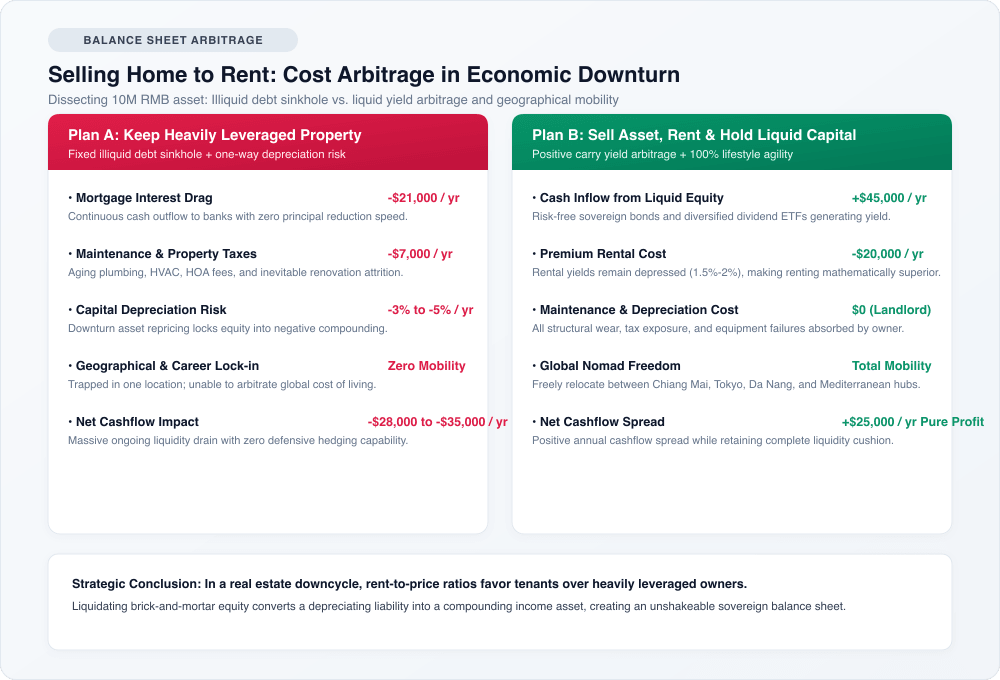
Selling to rent is, in its financial essence, precisely exploiting this institutional and cyclical gap of the “inverted rent-to-price ratio” to execute intertemporal arbitrage: You completely buy out the usage rights of high-quality living in that location using a meager rent equivalent to only 1.76% of the asset’s market value; simultaneously, you dump hundreds of thousands of RMB in annual asset depreciation risks, the heavy shackles of mortgage interest, and lengthy physical depreciation entirely onto the next buyer.
III. Balance Sheet Reconstruction and Defense: Total Deleveraging and Liquidity Premium
Beyond the annual profit and loss (P&L) statement savings, during the economic cycle clearing phase, what carries life-and-death significance is the survival rate of the family’s balance sheet:
1. Severing the Backlash of Debt Leverage
A primary residence is often accompanied by heavy debt. A 30% down payment ratio corresponds to 3.3 times financial leverage. During a unilateral asset appreciation phase, leverage is a catalyst for class mobility; but in a downward asset trajectory, leverage turns into a ruthless meat grinder:
- A 10% drop in property valuation directly shrinks the family’s net worth by over 33%;
- If the property valuation cumulatively corrects by 30%, the entire invested down payment has essentially gone to zero.
Selling the property and settling the bank loan means actively dropping the family’s debt-to-asset ratio to zero in one fell swoop. It completely eliminates the default risk of mortgage suspension when encountering income fluctuations, and more importantly, snuffs out the extreme tail risk of the asset turning into “negative equity” resulting in judicial freezing and foreclosure by the bank.
2. Trading for an Irreplaceable Liquidity Premium
Real estate is a heavy asset with extreme liquidity scarcity. During a downward clearing phase plagued by inventory pileup, the true transaction cycle for second-hand homes generally stretches to 6 to 18 months or more, and must be accompanied by deep price compromises.
Exchanging brick walls, which are highly difficult to liquidate, for highly liquid monetary assets means that in today’s climate—where external employment expectations are murky and corporate cost-cutting is the norm—the family possesses an “airbag” loaded with ammunition, ready to deploy at any time.
3. Holding a Bullish Call Option for the Future
The eternal law of financial markets is that “prices are determined by abundant liquidity.” Families holding ample cash flow and high-grade, low-risk assets will always retain the strategic option to calmly enter the market and pick up core scarce assets after societal asset valuations undergo a deep clearing and pessimistic sentiment bottoms out. Conversely, those fully invested or even heavily leveraged in the quagmire of heavy assets lose any strategic qualification to proactively position themselves, left only to passively endure the long cycle.
IV. Strategy Boundaries and Frictional Costs: Three Reality Checks You Must Face
From the perspective of micro-finance and financial accounting, the logic of selling a primary residence to rent is flawless. However, in actual real life, this decision must endure three non-financial frictional costs that cannot be ignored:
1. Transaction Friction Loss in Liquidation
Liquidating a second-hand home in a buyer’s market means enduring the buyer’s extreme probing and deep price suppression, accompanied by intermediary brokerage fees, deed taxes, and various transfer costs (usually accounting for 3% to 6% of the property’s total transaction value). If housing prices are merely experiencing a short-term shallow fluctuation, one-time transaction frictions might offset part of the arbitrage returns; only when there is certainty that the market is in a medium-to-long-term (3 to 5 years or more) structural clearing phase does this asset reconstruction possess a solid mathematical expectation.
2. Friction in Life Order and Psychological Security
The certainty of premium school district enrollment, household registration anchoring, the traditional psychological panic of elder family members over “having no fixed abode,” and forced relocations due to landlords breaching the lease mid-term—these constitute intangible “costs of life order.” They cannot be simply converted into percentages in a financial model, yet they tangibly drain the mental energy of family members and must be built upon a robust family consensus.
3. Capital Reinvestment and Disciplinary Constraints (The Fatal Achilles’ Heel)
This is the biggest hidden danger of the “sell to rent” strategy.
The millions of RMB cashed out from selling the house only validate all the aforementioned economic equations if they are strictly and absolutely parked in safe assets (such as ultra-long-term government bonds, large-denomination certificates of deposit from major state-owned banks, and high-credit-rating fixed-income cash management tools).
If a family, unable to tolerate a low-interest environment after cashing out, develops anxiety over idle funds and blindly wades into high-risk equity speculation, recklessly participates in brick-and-mortar venture capital, or falls into various private high-interest fundraising traps resulting in principal loss, the destructive power will be multiples times worse than the mild slow bleed of the real estate itself.
V. Conclusion: Reorganizing the Family’s Defensive Formation
During a downward cycle of asset prices, the essence of selling a primary residence to rent boils down to a single sentence:
Abandoning a downward put option that is “overvalued, asset-heavy, carrying 3.3x leverage, with annualized comprehensive frictional costs exceeding 6%”, in exchange for a usage rights contract that “costs only 1.8% of the house price, carries zero risk of mortgage default, and allows you to leave at will.”
At the ebb of a grand cycle, true wealth security no longer depends on how many cumbersome physical bricks you own on paper, but on how healthy your balance sheet is and how free your liquidity is. Withdrawing family assets from the fragile, exposed front lines of heavy assets and orderly retreating into a highly elastic defensive formation is the clearest self-salvation for micro-individuals directly facing the cyclical storm.
Related Research & Topics
Tello Mobile eSIM
SafetyWing Nomad Insurance
* Disclosure: This post contains affiliate links. If you make a purchase through these links, V-G Journal may earn a small commission at no additional cost to you. We only recommend services we independently evaluate and trust.
FIRE and Golf:自由旅居之路
专注于为追求 FIRE 与品质生活的人群提供特惠打球权益与候鸟微度假。不持一砖一瓦,运营品质生活。