The Industrial Fallacy of Modern Slavery: Why Forced Labor Cannot Build a World Factory
A deep-dive into the financial and engineering myths of the 'low human rights advantage.' Analyzing why forced labor is economically inefficient for precision manufacturing and how systemic coercion creates an intergenerational overdraft that collapses under modern trade law.

Executive Summary: In the discourse of industrial economics and geopolitical competition, the notion that “slavery offers the lowest labor cost” or that “extreme exploitation creates ultimate manufacturing competitiveness” is a persistent but financially illiterate delusion. By examining corporate balance sheets, micro-engineering tolerances, and multilateral trade jurisprudence, it becomes clear that forced labor is not only prohibitively expensive and inefficient in a modern context but also fundamentally incapable of sustaining complex precision manufacturing. The so-called “low human rights advantage” is not a sustainable institutional dividend; it is a systemic intergenerational overdraft that externalizes production costs onto society.
In macroeconomic sandbox simulations and supply chain forecasting, a radical hypothesis often emerges: If a regime were to implement modern slavery—exercising absolute physical control over workers with zero nominal wages—could it use this “human rights dividend” to undercut all competitors and replace established hubs as the new “World Factory”?
To answer this, we must strip away moral rhetoric and emotional bias. We must look directly at the balance sheets of modern enterprises, step onto the floors of high-precision workshops, and scrutinize the underlying rules of global trade.
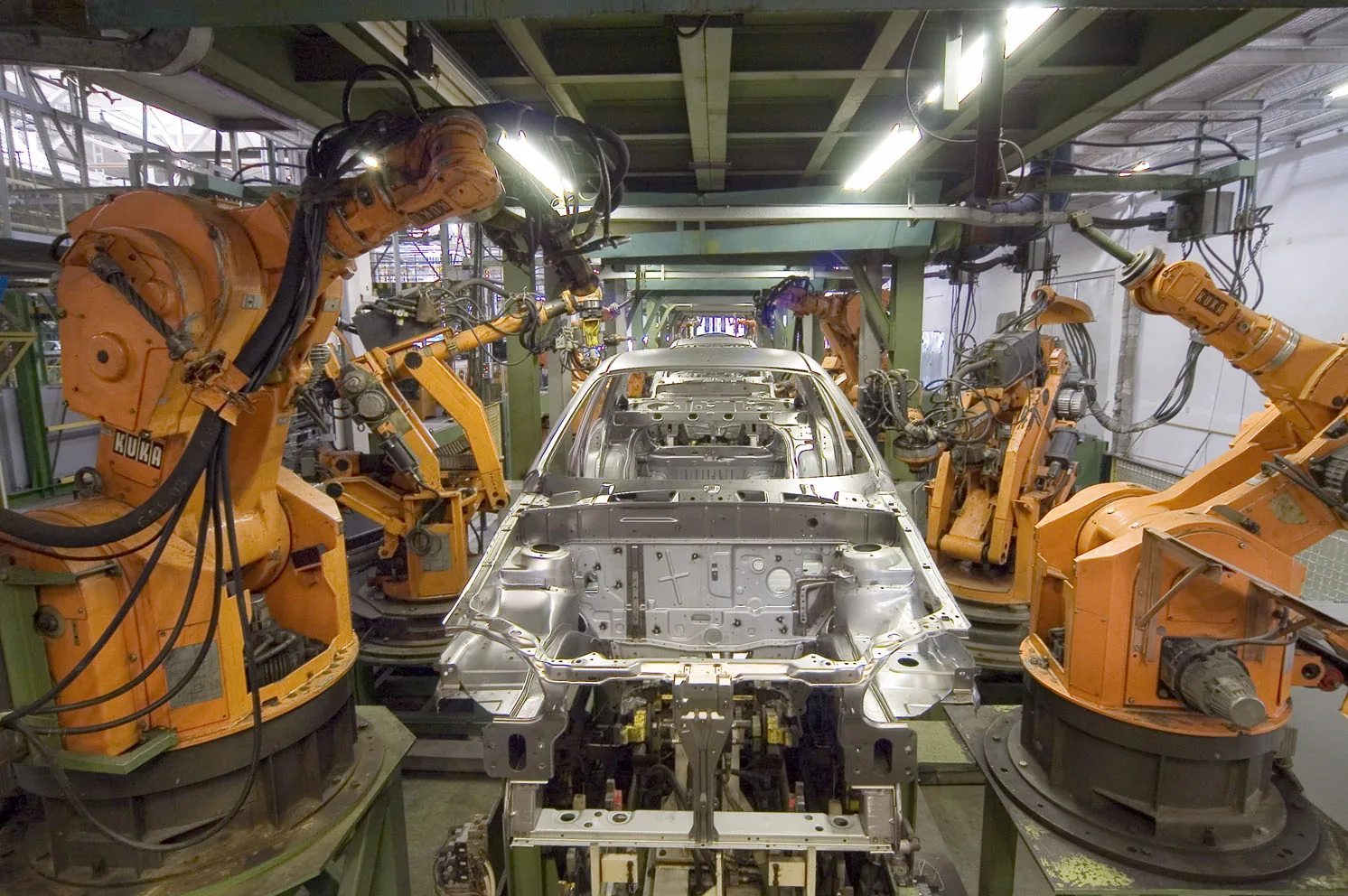
Figure 1: High-density industrial robot clusters in modern automotive manufacturing demonstrate the rigid dependence of precision production on expensive fixed assets and strict process synergy.
I. The Micro-Financial Ledger: The Exorbitant Total Cost of Slave Labor
The argument that “slaves have no wages, therefore costs are the lowest in the world” confuses nominal cash wages with Total Factor Labor Costs. Adam Smith, the father of classical economics, asserted in The Wealth of Nations: “The wear and tear of a slave, it has been said, is at the expense of his master; but that of a free servant is at his own expense… the work done by slaves, though it appears to cost only their maintenance, is in the end the dearest of any.” Institutional economics later confirmed this through the lens of transaction costs and property rights.
1. Asset Misclassification: Opex vs. Capex
Modern employment and slavery represent two fundamentally different positions on a corporate balance sheet:
| Dimension | Modern Free Employment | Traditional Slavery / Forced Labor |
|---|---|---|
| Accounting Category | Operating Expense (Opex) | Capital Expenditure (Capex) |
| Acquisition Cost | Negligible (Recruitment, hourly/monthly settlement) | Extremely High (One-time buyout, capture, or surveillance infrastructure) |
| Downside Risk | Elastic; firms can reduce hours, pause lines, or lay off staff | Rigid liability; rations, guards, and depreciation accrue even with zero orders |
| Labor Reproduction | Shared by the worker’s family and public infrastructure | Fully internalized as a rigid corporate cost (healthcare, aging, and death are total asset losses) |
Under a free employment system, a company purchases the use of labor for a specific duration. During economic downturns or technological shifts, the firm can shed labor costs quickly, transferring the risk of idle assets and human maintenance to the broader social and market system.
In a slave system, the laborer is a “fixed asset.” The enterprise faces high upfront sunk costs. Regardless of market demand or factory uptime, the slave’s basic survival (food, clothing, shelter, basic medical care) remains a rigid fixed cost. More critically, the injury or death of a slave is a direct destruction of corporate capital. This total lock-in of liquidity deprives the enterprise of financial elasticity during industry volatility.
2. The Unbearable Cost of Supervision and Internal Friction
Free contracts establish incentive compatibility: a worker’s effort is positively correlated with their personal welfare. In slavery, the fruits of labor have zero correlation with the slave’s benefit; in fact, exceeding quotas often results in higher future benchmarks. Consequently, slaves have the strongest possible motivation for “shirking” (the economic concept of moral hazard).
- Why did traditional slavery only persist in low-end agriculture?
Cotton plantations or Roman quarries functioned because the labor was easily observable. A supervisor on horseback with a whip could monitor picking; tools were crude hoes and sacks; output was weighed directly. The technical difficulty of supervision was low. - Modern precision manufacturing shatters this logic.
Modern production is a highly fragmented and precisely coupled engineering network. A slave worker harboring resentment and despair does not need to launch an open revolt:- They can drop a handful of quartz sand into the ball screw of a million-euro CNC machine.
- They can subtly tweak two degrees of temperature or pressure on a precision injection molder.
- They can leave a cold solder joint on a hidden layer of a vehicle braking system’s circuit board—virtually undetectable to the naked eye.
The process chains of modern manufacturing are incredibly long; the cost of troubleshooting and reworking “latent defects” scales exponentially. To prevent sabotage and maintain quality tolerances in a hostile environment, a firm would need a dedicated supervisor, a technical quality inspector, and a security guard for every single operator. Ultimately, the cost of “guarding the guards,” repairing equipment, and scrapping entire batches far exceeds the wages paid to a free, motivated worker.
II. The Moat of the “World Factory”: Labor Cost is No Longer the Deciding Factor
The belief that “whoever has the cheapest labor wins the World Factory title” is a fundamental misjudgment of the modern industrial ecosystem.
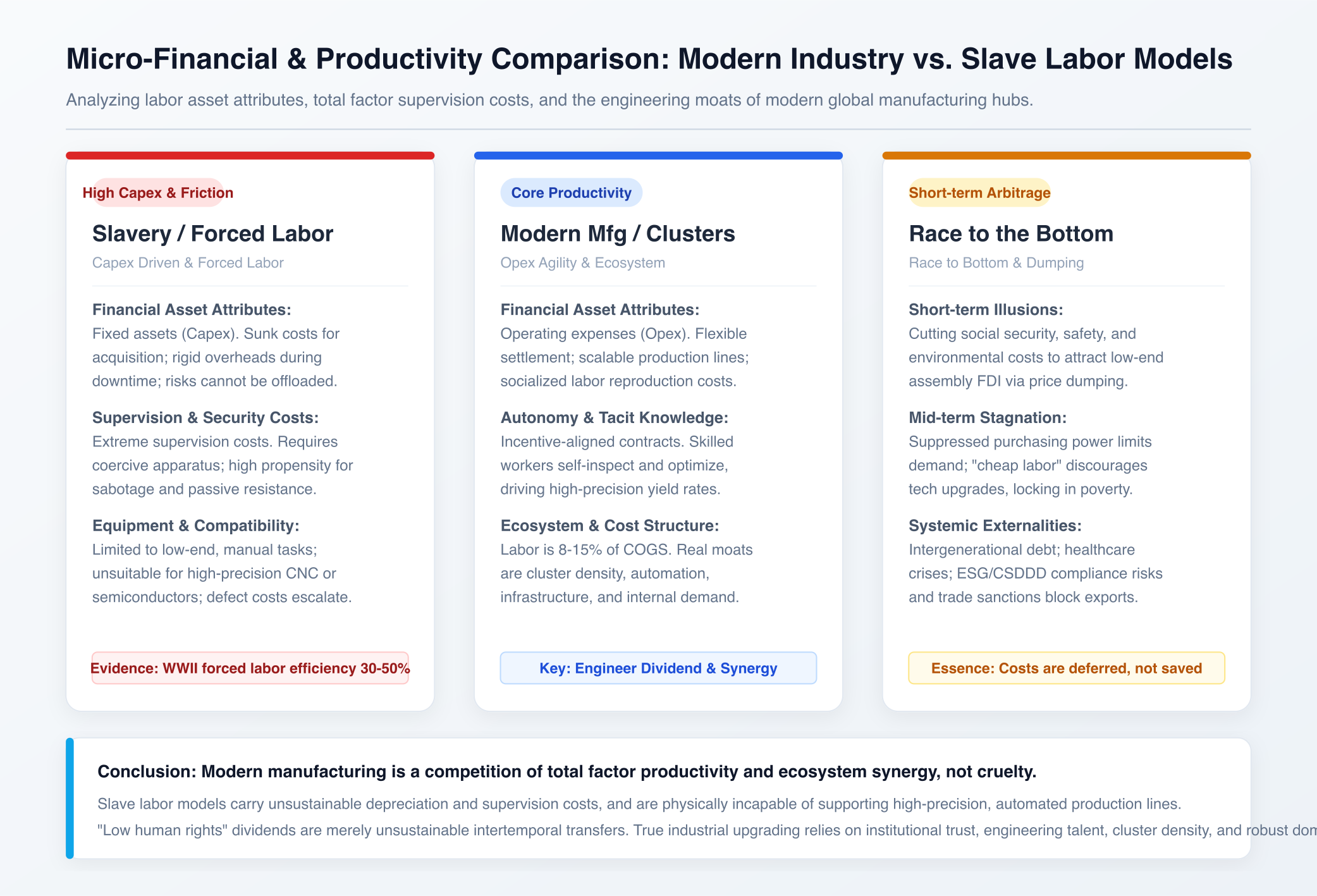
Figure 2: Comparison matrix of labor asset attributes, Total Factor Productivity (TFP), and the micro-mechanisms of the "low human rights advantage" intergenerational overdraft.
1. Labor as a Fraction of COGS
If nominal wages were the core competency, Bangladesh, Ethiopia, or Cambodia—where wages were a fraction of China’s coastal rates a decade ago—would have already become the world’s industrial hubs. Instead, they remain limited to low-value garment assembly. They cannot sustain a full-spectrum modern manufacturing base.
In consumer electronics, automotive, and high-end electrical engineering:
- Direct labor costs typically account for only 8% to 15% of the Total Cost of Goods Sold (COGS). In highly automated “dark factories,” this drops below 5%.
- The remaining 85%+ of competitiveness is determined by: the procurement radius of raw materials and components, the stability of industrial power and steam grids, the “flexible response” capability to retool high-precision molds within two weeks, and the throughput of efficient deep-water container ports.
The core barrier of a true “World Factory” is not labor price, but Agglomeration Economies—the ability to source thousands of structural parts, injection-molded components, and chips within a two-hour radius. As discussed in our analysis of China’s Macroeconomic Distortions, long-term resilience comes from the density of micro-collaboration networks and Total Factor Productivity (TFP), not the raw squeeze of labor. A slave state lacks the legal and contractual soil required to grow such a complex collaborative network.
2. The Rigid Dependence on “Tacit Knowledge” and Autonomy
Modern high-precision workshops rely on millions of skilled technicians and engineers who possess basic literacy, rigorous engineering discipline, and a sense of “process self-check.”
Automated lines frequently encounter minor mechanical vibrations, tolerance drifts, or material batch variances. A responsible, skilled worker will proactively pause a machine to recalibrate based on feel, sound, or instrument readings. They may even suggest micro-innovations (Kaizen). This is Tacit Knowledge—the most critical asset in modern industry.
Slavery can use a whip to force a man to swing a hammer at a rock, but it cannot use a whip to force focus, the delicate “touch” of precision operation, or creative problem-solving. High pressure and fear produce only crude, low-quality output. They cannot sustain a yield rate of 99.9% required by modern industry.
III. Historical Evidence: The Industrial Ledger of Nazi Wartime Factories
History has already tested the combination of “modern totalitarian industry + slave labor.”
During WWII, Nazi Germany forcibly conscripted over 7 million foreign forced laborers (Zwangsarbeiter) and concentration camp prisoners for companies like I.G. Farben, Krupp, Siemens, and the Mittelwerk underground rocket factory.
Declassified production records provide a chillingly objective conclusion:
- Productivity Collapse: According to the German Ministry of Armaments, the average productivity of forced laborers was only 30% to 50% of that of a free German industrial worker.
- Devastating Sabotage: In the Mittelwerk factory producing V2 ballistic missiles, prisoners sabotaged valves, mixed debris into turbo-pumps, or intentionally weakened seals. This led to a staggering number of V2 rockets exploding on the launchpad, failing mid-flight, or crashing far from their targets.
- Security Friction: The SS and factory security consumed massive amounts of manpower, weaponry, and logistics just to monitor a workforce with nothing to lose. Forced labor did not save the wartime economy; it crippled the quality and delivery cycles of high-tech weaponry.
IV. International Law and Trade Barriers: Compliance Execution
Even if a state could logically build a low-end slave industry, it would exist as a dead island, isolated from modern multilateral trade and global finance.
1. Zero Tolerance in Multilateral Trade Frameworks
Global trade is not a lawless jungle. Article XX(e) of the General Agreement on Tariffs and Trade (GATT), a core WTO pillar, states:
GATT Article XX(e): Subject to the requirement that such measures are not applied in a manner which would constitute a means of arbitrary or unjustifiable discrimination… nothing in this Agreement shall be construed to prevent the adoption or enforcement by any contracting party of measures… relating to the products of prison labour.
The International Labour Organization (ILO) Conventions (No. 29 and No. 105) on the abolition of forced labor constitute a “hard floor” for the international community. Any product backed by systemic forced labor loses its legal right to enter mainstream markets the moment it leaves its home port.
2. ESG and Supply Chain Transparency
In major consumer markets, the regulation of forced labor has evolved from moral appeal to punitive “long-arm jurisdiction” (e.g., the U.S. Uyghur Forced Labor Prevention Act, UFLPA, and the EU’s Corporate Sustainability Due Diligence Directive, CSDDD).
Whether it is Apple, Volkswagen, Boeing, or Nike, if a Tier 3 or Tier 4 supplier is suspected of using slave labor, the final product faces seizure and forfeiture at customs. The company itself faces crippling fines and divestment from global pension funds and institutional investors. No multinational giant will risk being expelled from the global market to source cheap parts from a slave state.
3. Physical and Financial Decoupling
A regime that openly establishes slavery would trigger comprehensive economic and arms embargos under Chapter VII of the UN Charter. Its banking system would be severed from the SWIFT network. Simultaneously, the International Group of P&I Clubs would refuse to insure any vessel docking at its ports. Without cross-border settlement, without shipping insurance, and without customs clearance, the products of such a state are physically and financially blocked from global participation.
V. The Essence of the “Low Human Rights Advantage”: Short-term Arbitrage vs. Long-term Overdraft
While the “slave state” is an extreme hypothesis, the more relevant discussion is the “Low Human Rights Advantage” (as coined by scholar Qin Hui) or “Social Dumping.” This involves suppressing social security, relaxing labor protections, and ignoring environmental standards to gain a nominal cost edge.
In the early stages of industrialization, this can manifest as a short-term dividend, attracting labor-intensive foreign investment. However, from a systemic perspective, it is not a dividend but a classic intergenerational overdraft.
1. The Trap of Deficient Effective Demand
In a modern macroeconomy, workers are both “factors of production” and “terminal buyers.”
If a society suppresses labor compensation and guts social safety nets to stay “competitive,” residents must convert all limited income into precautionary savings to guard against illness, aging, and unemployment. This suppresses domestic consumption. As explored in our piece on Ancient Minben and Modern Human Rights, when a system lacks a mechanism for labor to share in the gains, it becomes path-dependently reliant on external demand. Once it hits trade barriers or geopolitical shifts, the fragile domestic market cannot absorb the overcapacity, leading to devastating industrial depressions.
2. The Obstruction of Human Capital and the Middle-Income Trap
The core of high-value manufacturing is a steady supply of engineers and precision technicians.
When a policy treats “cheap heads” as its moat, the industrial system loses the internal drive for automation (“Why buy a robot when a human is cheaper?”). Simultaneously, families cannot afford to invest in their children’s high-quality engineering education or vocational training. The country fails to produce the engineer class required for high-end manufacturing, leaving it permanently locked in low-value assembly. As soon as a younger, cheaper market emerges, the “advantage” vanishes instantly.
3. Costs Never Vanish; They Are Externalized
The corporate profits squeezed from suppressed labor protections are essentially costs transferred to the public system:
- Health Overdraft: Workers who are disabled or exhausted by extreme overtime exit the labor force early, causing public health expenditures and aging pressures to explode prematurely.
- Ecological Overdraft: Lowering the bar for pollution creates short-term profit but leaves behind heavy metal contamination and acidified soil, the remediation of which often costs multiples of the original industrial gain.
- Governance Costs: The lack of labor mediation mechanisms eventually centralizes micro-conflicts into macro-social instability, forcing the government to spend massive budgets on “stability maintenance,” which ultimately poisons the business environment.
VI. Conclusion
The competition for the “World Factory” is not a race to see who can be the most cruel to labor. It is a comprehensive test of institutional transaction costs, supply chain topology, engineering infrastructure, and the autonomy of a high-quality workforce.
- Financially, slavery locks in rigid Capex, creates astronomical supervision costs, and invites equipment sabotage. It is far more expensive than free employment.
- Technically, modern manufacturing and micron-level tolerances depend on the responsibility and tacit knowledge of the worker—things no whip can extract.
- Systemically, the “race to the bottom” is an intergenerational overdraft of health, ecology, and demand. It leads to a dead end of international sanctions and the middle-income trap.
The true moat of manufacturing is built on the continuous leap of Total Factor Productivity, the rule of law protecting property and contracts, and a soil where the creative autonomy of the worker is fully unleashed. Any regressive production relationship that violates these laws is merely a bankrupt fantasy in the face of modern industrial logic.
Related Research & Topics
Tello Mobile eSIM
SafetyWing Nomad Insurance
* Disclosure: This post contains affiliate links. If you make a purchase through these links, V-G Journal may earn a small commission at no additional cost to you. We only recommend services we independently evaluate and trust.
FIRE and Golf:自由旅居之路
专注于为追求 FIRE 与品质生活的人群提供特惠打球权益与候鸟微度假。不持一砖一瓦,运营品质生活。