Ancient 'Minben' and the Evolution of Modern Human Rights: Deconstructing the Institutional Ledger Behind Individual Instrumentalization
Objectively deconstructs the core divergence between ancient Chinese 'minben' and modern human rights. From Shang Yang's mobilization of 'bianhu qimin' for tax bases and the patriarchal hierarchical structure to the Malthusian struggle for survival, this analysis dissects the institutional ledger behind individual instrumentalization, clarifying the profound collision between the awakening of modern rights and the realities of the environment.

Core Insight: In contemporary public discourse, sharp discussions frequently arise concerning the existence of a “Chinese concept of human rights” and the “self-instrumentalization of individuals.” Setting aside emotional online venting, a clear narrative emerges when examining the evolution of thought and law, the costs of institutional extraction, and the actual ledger of micro-social structures. Ancient China possessed a profound tradition of valuing life and the populace (‘minben’), but its institutional framework consistently lacked the legal architecture, rooted in the Western constitutional tradition, for “legal rights to counter public power.” The public’s lament of “not treating people as people” is not an inescapable cultural destiny but rather a behavioral inertia selected by a unified mobilization system, a patriarchal hierarchical structure, and a long-term Malthusian struggle against scarcity.
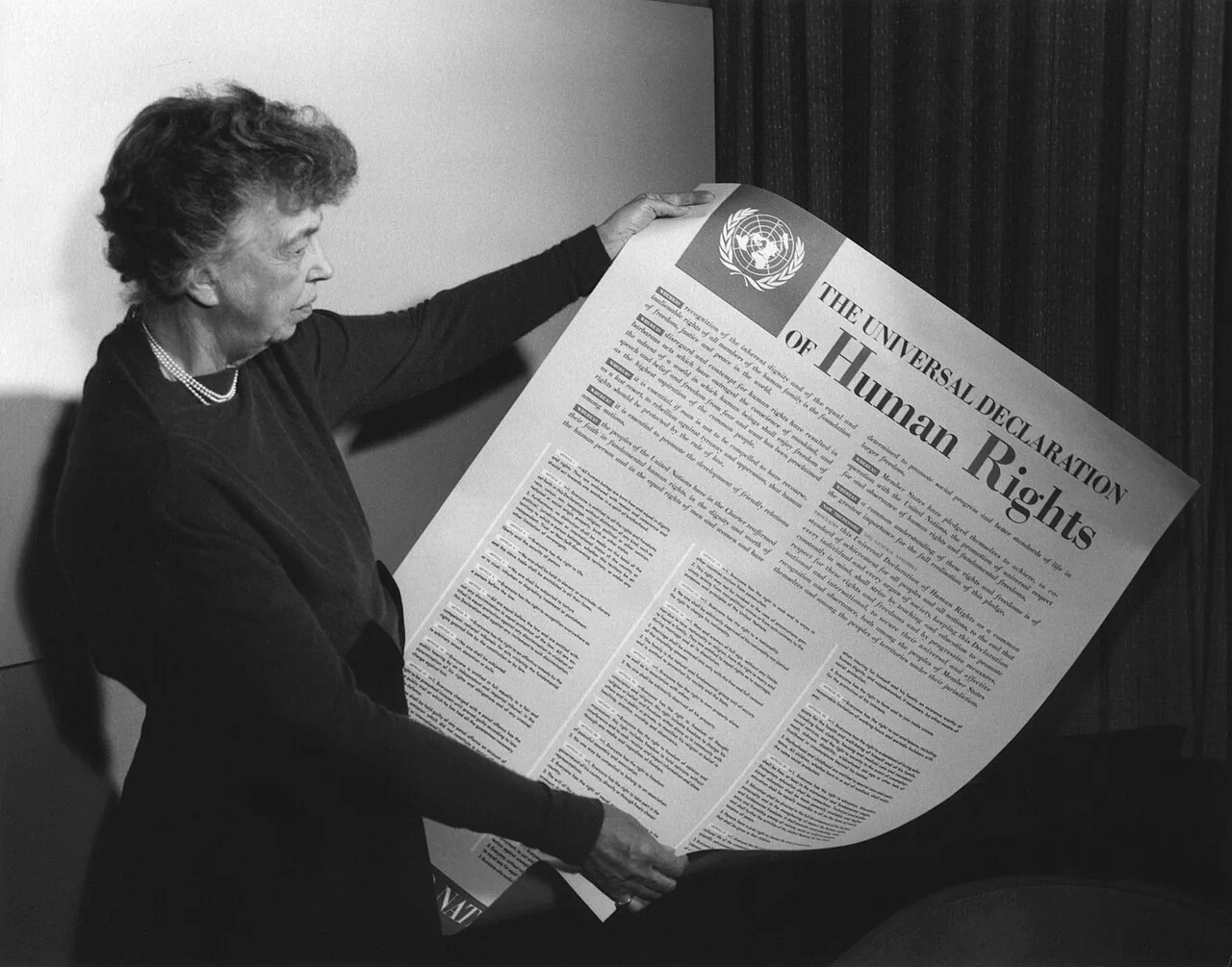
Figure 1: Eleanor Roosevelt, Chair of the UN Human Rights Commission in 1949, displaying the Universal Declaration of Human Rights.
I. Conceptual Origins: Did China Have a Concept of “Human Rights” Since Antiquity?
The objective reality is unequivocal: ancient China not only lacked the modern concept of “human rights” but, prior to the modern era, so did the West.
The modern concept of “human rights” (Human Rights / Natural Rights) is a legal and political philosophical construct born from the specific historical context of early modern Europe:
- Genesis: It emerged from the Enlightenment, the natural law school (Grotius, Locke, Rousseau) of the 17th and 18th centuries, and the bourgeois revolutions in England and America. It was solidified as a cornerstone of the post-war international legal order in the 1948 UN Universal Declaration of Human Rights.
- Core Essence: Its fundamental principle is “constitutional rights based on the independent legal subject, used to limit and counter state public power.” Rights such as life, property, and liberty are posited as inherent and inalienable to the individual, with governmental legitimacy entirely predicated on their protection.
In ancient human civilizations:
- Ancient Greece and Rome: Political rights in Athenian democracy were limited to a very small number of adult male citizens. Slaves, women, and foreigners, who constituted the vast majority of the population, were entirely excluded from legal personhood. Roman law was vast and intricate, but its economic and legal foundations also included the brutal institution of slavery.
- Traditional Chinese Lexicon: The character “权” (quán) in ancient Chinese primarily referred to power, strategy, or a weighing instrument (like a steelyard). The term “权利” (quánlì), denoting legal entitlements in the modern sense, was coined by Japanese scholars in the mid-to-late 19th century (like Nishi Amane and Kato Hiroyuki) to translate Western concepts using Chinese characters. It was later introduced back into China by figures like Yan Fu and Liang Qichao.
While ancient China lacked a Western-style legal framework of “rights,” it was not devoid of concern for the value of “human beings.” As analyzed in The Logical Texture of Pre-Qin Philosophical Models, Chinese philosophy engaged in profound contemplation of human value during the Axial Age. Confucianism speaks of “Heaven’s nature, man is most noble” and “the benevolent love others.” Mencius advocated, “The people are the most important element in a state; the altars of soil and grain come next; the ruler is the least important.” Mohism championed “universal love and mutual benefit” and non-aggression. Daoism emphasized “valuing life” and “honoring the self.”
The fundamental divergence lies in the entirely different underpinnings of their governance structures:
1. Rights-based Logic vs. Duty-based Logic
- Western Modern Legal Frameworks Begin with “Individual Rights”: They assume individuals possess inherent, inviolable boundaries of rights. Any transgression by public power constitutes illegality, and individuals possess legal recourse, procedural remedies, and even the right to resistance.
- Ancient Chinese Politics Begins with “Moral Duty”: It emphasizes ethical responsibilities and self-discipline from top to bottom, such as those between ruler and minister, father and son, husband and wife. The Book of Documents states, “The people are the root of the state; when the root is firm, the state is tranquil.” Dong Zhongshu argued, “Heaven establishes the ruler for the sake of the people.”
- The Essence of Paternalistic Nurturing: The “minben” (people as root) and “love for the people” in ancient times were fundamentally about the ruler’s moral consciousness and reverence for the Mandate of Heaven. The populace were “subjects” and “infants” to be protected, nurtured, and governed, rather than independent legal subjects possessing equal bargaining chips and procedural channels for appeal against officialdom.
2. “Minben” Does Not Equal “Minquan” (People’s Rights)
The most fundamental logic of ancient “minben” thought was highly practical political realism and the calculus of imperial rule:
- “Water can carry a boat, but it can also capsize it.” Water is a powerful force, but it possesses no independent constitutional seat or legal voting rights.
- The court’s love for the people, compassion, and tax reductions were because the number of households directly corresponded to the state’s tax base, corvée labor, and frontier defense manpower. The populace were core assets for the survival of the state, and excessive exploitation had to be prevented. However, the ultimate interpretive and discretionary power within this ethical system always rested with Heaven’s will and imperial authority.
- When rulers became decadent and tyrannical, and the people suffered immensely, the system lacked regular, low-cost, procedural legal channels for rights protection. The only corrective mechanism within the system was the extremely costly recourse of violent uprising and dynastic change.
II. The Institutional Ledger: “Self-Instrumentalization” and the Underlying Mechanisms of Empathy Deficit
The public’s frequent lament of “not treating oneself as a person (extreme self-suffering, self-instrumentalization) and not treating others as a person (empathy deficit, indifference, even mutual harm)” is not an inexplicable cultural destiny but rather a behavioral inertia selected by specific geopolitical survival environments, high-mobilization systems, and long-term extreme survival competition.
Opening the micro-ledger of history and society, this phenomenon is driven by the interlocking of three deep institutional gears:
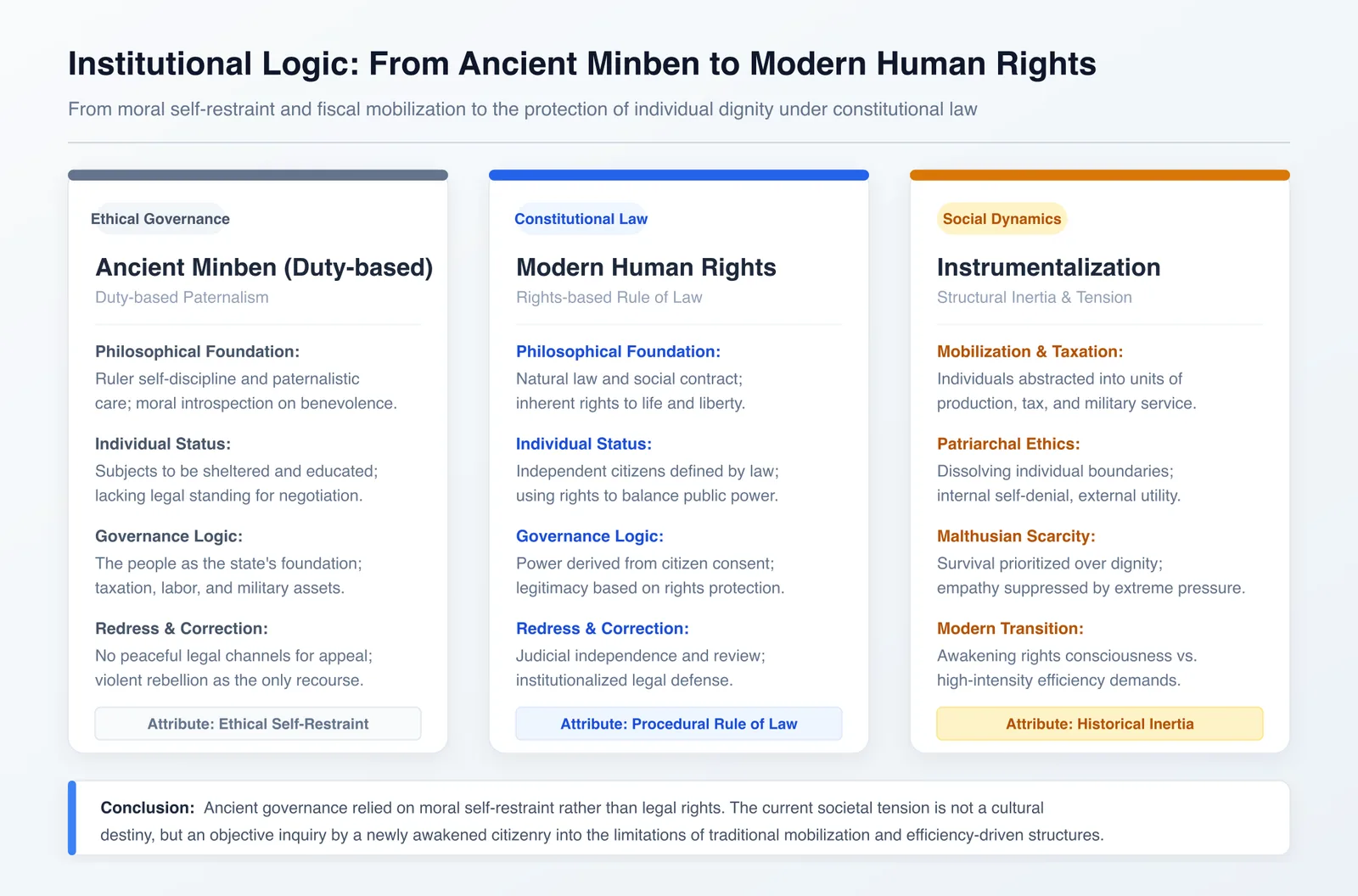
Figure 2: A comparative matrix of institutional logic between ancient ‘minben’ thought and the evolution of modern human rights.
1. “Bianhu Qimin” and the “Instrumentalization” of the State’s Tax Base
From Shang Yang’s reforms, which abolished the well-field system and opened up boundaries, to the establishment of a unified bureaucratic county system in the Qin and Han dynasties, Chinese society developed one of the most rigorous and efficient “bianhu qimin” (registering households and standardizing the populace) mobilization systems in early human history:
- Facing the need for large-scale water conservancy projects in the Yellow and Huai River basins, defense against northern nomadic cavalry along vast frontiers, and administrative integration of an enormous territory, the empire required an extremely high capacity for resource extraction and unified mobilization efficiency.
- On the bureaucratic machine’s household registers, the primary attribute of an individual was precisely defined as a “tax unit, labor hour, and conscription head.”
- The institutional structure of “single-source benefit” systematically blocked independent survival paths outside the system. For the state’s overarching goals (agriculture and warfare, canal construction, border defense), individual will, comfort, and physical boundaries had to yield to collective production output. Long-term institutional adaptation subtly fostered a behavioral creed: a person’s value lies primarily in their instrumental utility and contribution to the collective. Once productive capacity is lost, survival faces immense existential anxiety.
2. Hierarchical Differentiation (“Chaxu Geju”) and the Dissolution of Individual Boundaries
Sociologist Fei Xiaotong astutely pointed out in Earthbound China that traditional Chinese society was not a “group structure” based on equal individuals, as in the West, but a “hierarchical differentiation” structure based on kinship ethics:
- Individuals were not independent rights-bearing atoms but responsibility nodes within kinship and family networks.
- In this patriarchal ethical network, strict hierarchies of status and seniority prevailed, lacking clear and equal personal boundaries. For the continuation of family lineage, the prosperity of clan land, and collective interests, an individual’s marriage, health, and even life could be demanded to serve the greater good.
- Towards the Self: Enduring hardship and suppressing physiological and psychological instincts were elevated to the highest virtues. “Self-cultivation” ultimately served “regulating the family” and “governing the state,” leading to an infinite compression of the self into a functional role.
- Towards Others: Moral responsibility and empathy diminished rapidly with increasing kinship distance. While warmth and ethics prevailed within the clan, towards strangers outside the kinship network, it often devolved into utilitarian calculation, defensive indifference, and a lack of trust.
3. The Malthusian Trap and the Survival Memory of Scarcity Trauma
Throughout China’s two millennia of economic history, land scarcity and frequent floods, droughts, and locust plagues meant that population and resources were constantly in a precarious struggle at the edge of the “Malthusian Trap”:
- In an environment of low productivity and complete absence of social welfare, “survival” was the highest rigid constraint.
- Facing the ever-present risk of famine, people were forced to push themselves into overexertion and, in extreme circumstances, make agonizing family sacrifices.
- In a highly homogeneous, zero-sum survival environment, others’ survival space often directly encroached upon one’s own resources. Empathy was an extremely scarce commodity amidst extreme famine and chaotic warfare. Numbness, endurance, and profound self-instrumentalization, conversely, were the most effective survival strategies against risk. This “scarcity panic” imprinted in the collective subconscious often evolved into unrestrained physical overexertion and unconscious disregard for others’ boundaries during industrialization.
III. Modern Evolution and the Profound Collision with Reality
Since the late Qing dynasty, modern concepts of “human rights” and “citizenship” have been introduced, and the pursuit of individual rights by Chinese intellectuals and the public has never ceased:
- In the late 19th century, Yan Fu translated John Stuart Mill’s On Liberty, systematically defining the legitimate boundaries between public power and individual freedom for the first time.
- Liang Qichao published The New Citizen, urging the shedding of subservient subject consciousness and the cultivation of modern citizens with independent personalities and public virtue.
- During the May Fourth Movement, thinkers like Lu Xun, through works like A Madman’s Diary, deeply reflected on the mechanisms by which traditional etiquette devoured individuality, calling for the “discovery of man” and the spiritual liberation of the individual.
- When the Universal Declaration of Human Rights was drafted in 1948, Chinese scholar P. C. Chang served as Vice-Chairman of the drafting committee. He deeply integrated the Chinese philosophical understanding of “Ren” (benevolence) and “Conscience” into the first article of the declaration, imbuing the charter with a cultural inclusiveness that transcended a singular Western-centric perspective.
Entering the phase of modern state-building, China’s current constitution explicitly enshrines “The state respects and protects human rights” in Chapter Two. Legal systems such as the Labor Law and the Civil Code have also constructed modern legal frameworks for individual civil rights and labor protections.
So, why, even amidst material abundance today, does such intense public outcry over “not treating people as people” erupt so frequently?
Essentially, this is a structural tearing between rapidly advancing industrial modernity and traditional survival inertia:
- Rights Consciousness Outpaces Institutional Guarantees: New generations educated in a complete modern system naturally possess a clear expectation of “personal boundaries,” “legal rights,” and “quality of life.”
- Path Dependency in Micro-Level Operations: However, in micro-level workplace competition, the granularity of labor rights enforcement, and high-intensity mobilization models, a pragmatic inertia focused solely on efficiency and output remains.
- A Violent Collision of Two Value Systems: When modern individuals’ “expectations of rights” collide with the deeply ingrained traditional “worship of hardship” and the reality of “efficiency supremacy,” the gap manifests in public discourse as sharp individual suffering and backlash.
IV. Conclusion: From Practical Instrumentalization to Legal Dignity
An objective examination of historical trajectories leads to two fundamental conclusions:
- First, ancient China possessed a profound tradition of humanistic concern and care for the populace, but it lacked the legal framework, rooted in the soil of modern Western constitutionalism, for “legal rights to defend against public power.”
- Second, the sharp criticisms circulating online about “not treating oneself as a person and not treating others as a person” are by no means groundless complaints or an unchangeable genetic destiny. They represent an objective inquiry posed by an ancient society undergoing ultra-high-speed industrial transformation, as its individual rights consciousness fully awakens, directed at its micro-level reality and institutional guarantees.
The transition from “tax base heads” on imperial ledgers and “functional gears” within family networks to modern subjects possessing independent will, personal dignity, and channels for legal recourse is, in itself, a process of modern legal evolution that requires continuous deepening.
Related Research & Topics
The Anatomy of Digital Predation: Inside the Syndicate Targeting the Elderly via Livestream Appraisal Scams
Starlink V4 and the Low-Earth Orbit Satellite Arms Race: How a 100,000-Node Optical Mesh Pierces the Submarine Cable Monopoly
Tello Mobile eSIM
SafetyWing Nomad Insurance
* Disclosure: This post contains affiliate links. If you make a purchase through these links, V-G Journal may earn a small commission at no additional cost to you. We only recommend services we independently evaluate and trust.
FIRE and Golf:自由旅居之路
专注于为追求 FIRE 与品质生活的人群提供特惠打球权益与候鸟微度假。不持一砖一瓦,运营品质生活。