The Architecture of Reason: Why Formal Logic Governs Knowledge, and Where Classical Chinese Thought Diverges
Logic is not rhetorical theater; it is the compiled runtime protocol of human cognition and cumulative science. This essay dissects formal logic's irreplaceable role in identifying fallacies, driving scientific inference, and enabling cross-party rational dialogue — then audits Confucianism, Daoism, and Mohism on their actual logical rigor.

Curator’s Note: In an era of information saturation and emotionally driven public discourse, the faculty most easily lost is not the ability to consume information, but the mental discipline to distinguish valid reasoning from sophisticated sophistry. Logic is not the debater’s parlor trick — it is the compiled runtime protocol underpinning human rational inference and knowledge production. When we apply the lens of formal logic to classical Chinese intellectual history, the divergence among Confucianism, Daoism, and Mohism in their thinking paradigms snaps into sharp relief.
I. The Runtime Protocol of Thought: Why Logic Is Non-Negotiable
The human brain’s evolutionary architecture prioritizes survival adaptation, not the pursuit of absolute truth. This biological default hands the wheel to intuition, emotional resonance, and narrative — leaving cognition perpetually vulnerable to confirmation bias, equivocation, and appeals to feeling. The core contribution of Logic as a discipline is to establish a depersonalized system of error correction.
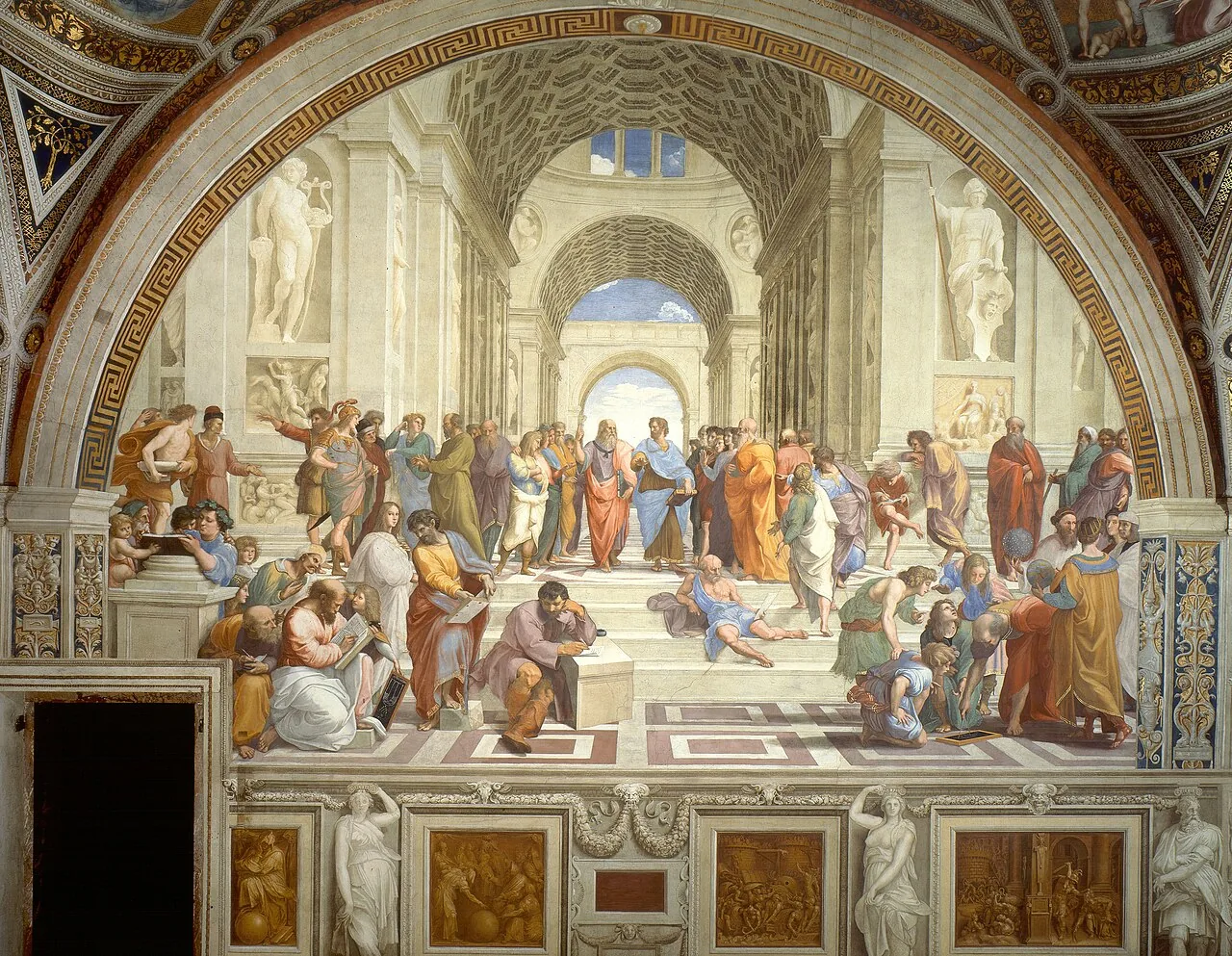
Figure 1: Raphael’s fresco The School of Athens (Stanza della Segnatura, Vatican) — the defining image of classical rational inquiry and axiomatic formal reasoning.
1. The Cognitive Firewall: Defining Truth and Detecting Broken Inferences
In everyday discourse, most arguments collapse not because the factual premises clash, but because the inferential chain breaks (Non Sequitur).
The foundational axioms that logic establishes — the Law of Identity (a concept retains its meaning), the Law of Non-Contradiction (two mutually contradictory propositions cannot both be true), and the Law of the Excluded Middle (between two contradictory propositions, one must be true) — form the bedrock of rational scrutiny. Mastery of this grammar allows a thinker to strip away rhetorical packaging and moral coercion, puncture False Dilemmas, Straw Man fallacies, and circular reasoning, and erect a robust intellectual firewall.
2. The Engine of Knowledge Production: From Empirical Notes to Verified Science
The rise of modern scientific civilization rests on two irreducible pillars: rigorous formal deduction + controlled empirical verification.
- Deductive logic (general to specific): Exemplified by Aristotle’s syllogism and Euclid’s Elements, deduction guarantees that when axioms and major premises hold, derived conclusions carry truth-preserving necessity.
- Induction and hypothetico-deduction: Allow scientists to abstract regularities from discrete observations and construct falsifiable theoretical hypotheses.
Without a tight formal logical system, even millennia of empirical trial-and-error and metaphysical insight remain stranded as scattered practical notes — unable to evolve into the cumulative, reproducible, transgenerational edifice of precision science.
3. The Universal Rational Compact for Cross-Party Cooperation
In today’s hyper-specialized society, participants arrive with divergent interests, cultural backgrounds, and value preferences. Without a mechanism for public dialogue that transcends private positions, any argument will eventually degenerate into power suppression or personal attack.
Logic provides a neutral “grammar parser.” As long as both parties honor logical consistency, the conversation converges on two objective anchors: “Does the major premise accord with objective fact?” and “Does the inferential process comply with the rules?” This dramatically lowers the transaction costs of collaboration between strangers and the governance of complex systems.
4. The Maternal Code of Computer Science and Machine Intelligence
From Leibniz’s vision of a universal calculus, through Boolean algebra and Frege’s first-order predicate logic, to the Turing machine and von Neumann architecture — the entire history of computing is essentially the engineering embodiment of formal logic. Every large language model, compiler, and agent interaction protocol today remains rooted in the bedrock of deterministic formal systems.
II. The Logical Texture of Pre-Qin Thinkers: Which School Is More Logical — Confucianism or Daoism?
Before placing either school on the logical scale, one historiographical fact must be established: among all the Hundred Schools of the pre-Qin era, the most rigorous and complete formal logic system belonged neither to Confucianism nor to Daoism, but to the Mohists and the School of Names.
The later Mohists, in the Mozi Canon (Mojing), independently constructed an inferential framework captured in the formula “names to raise reality, propositions to express ideas, explanations to draw out reasons” — and drew a remarkably precise distinction between xiao gu (necessary conditions) and da gu (necessary and sufficient conditions). The School of Names thinkers Hui Shi and Gongsun Long pursued highly speculative explorations of symbolic reference and semantic extension.

Figure 2: Warring States Chu bamboo slips — precious material relics of the Hundred Schools contention, the School of Names debates, and early rational inquiry.
Both Confucianism and Daoism were founded with purposes other than formal deduction or pure analytic philosophy. If we dissect them objectively along two distinct axes — “formal deductive rigor” and “systemic dialectical meta-critique” — their logical textures reveal dramatically different profiles.
1. Confucianism: Strong on Practical Norms and Semantic Order; Constrained by Moral Axioms and False Analogies
- Structurally logical features:
- Conceptual definition and classificatory norms (the zhengming principle): Confucius insisted “If names are not correct, speech will not accord with truth; if speech does not accord with truth, affairs cannot be accomplished.” Xunzi’s essay Zhengming (On Rectifying Names) provides a deep analysis of conventional naming, distinctions of sameness and difference, and logical fallacies such as “using a name to disorder another name” — displaying sophisticated pragmatic-normative awareness.
- Teleological causal chains: Confucian thought exhibits a clear behavioral deductive logic, as in The Great Learning’s sequence “investigate things → extend knowledge → make the will sincere → rectify the mind → cultivate the self → regulate the family → govern the state → bring peace under Heaven” — a coherent recursive loop of teleological and political-ethical reasoning.
- Inherent logical deficiencies:
- Conclusion-first and pervasive circular moral reasoning: Confucian core axioms — “benevolence” (ren), “Heaven’s mandate” (tianming), “the Way of the sage-kings” — are all aprioristic moral presuppositions. The argumentation relies heavily on appeals to the authority of the sage-kings, not on empirical induction or formal deduction.
- Systematic abuse of False Analogy: Confucian discourse, especially Mencius, excels at literary rhetoric and affective analogy. When arguing for innate human goodness, Mencius compares the tendency of human nature toward goodness to water flowing downward, and the spread of benevolent governance to the growth of plants. In logic, analogies carry only heuristic rhetorical value — they carry no truth-preserving inferential force — and slide easily into equivocation.
2. Daoism: Deconstructs Formal Fixity and Conceptual Boundaries; Exhibits Deep Dialectical Coherence
- Dimensions aligned with logic (especially dialectical and meta-logic):
- Mutual dependence of opposites and dynamic transformation: The Laozi’s “When all under Heaven know beauty as beauty, ugliness already exists; when all know good as good, not-good already exists” and “Disaster is what fortune depends upon; fortune is what disaster hides beneath” — these precisely reveal the mutual dependence and dynamic transformation between binary opposites, exhibiting high internal coherence within a dialectical system.
- Meta-logical reflection and incompleteness of formal systems: Laozi perceived the inherent limitations of linguistic symbols and logical tools. “The Dao that can be told is not the eternal Dao; the name that can be named is not the eternal name,” and Zhuangzi’s dissection in Qiwulun (Equalizing Assessments of Things) — “From over there it is this; from over here it is that” — point to something fundamental: any closed system built from finite concepts and formal symbols cannot fully exhaust or delineate an undivided reality. This meta-critique resonates in spirit with Gödel’s Incompleteness Theorems.
- Dimensions diverging from logic (especially formal logic):
- Dissolving the Laws of Identity and Non-Contradiction: Zhuangzi moves toward relativism and skepticism — “equalizing the ten thousand things,” “erasing the distinction of right and wrong” — actively dismantling the deterministic boundaries between concepts. When “right and wrong, this and that” are all nullified, formal logical deduction premised on clear either-or distinctions loses its anchor entirely.
- Appeals to transcendent intuition: Daoist ultimate epistemology often breaks free from rational analytic steps, moving toward “fasting of the mind” (xinzhai), “sitting in forgetfulness” (zuowang), and supra-linguistic intuitive experience — explicitly rejecting formalizable, reproducible rational derivation.
III. The Comparison Matrix and Rational Audit
To present each school’s standing across different cognitive dimensions with clarity, we place Confucianism, Daoism, and the Mohists — who represent the apex of classical Chinese formal logic — side by side:
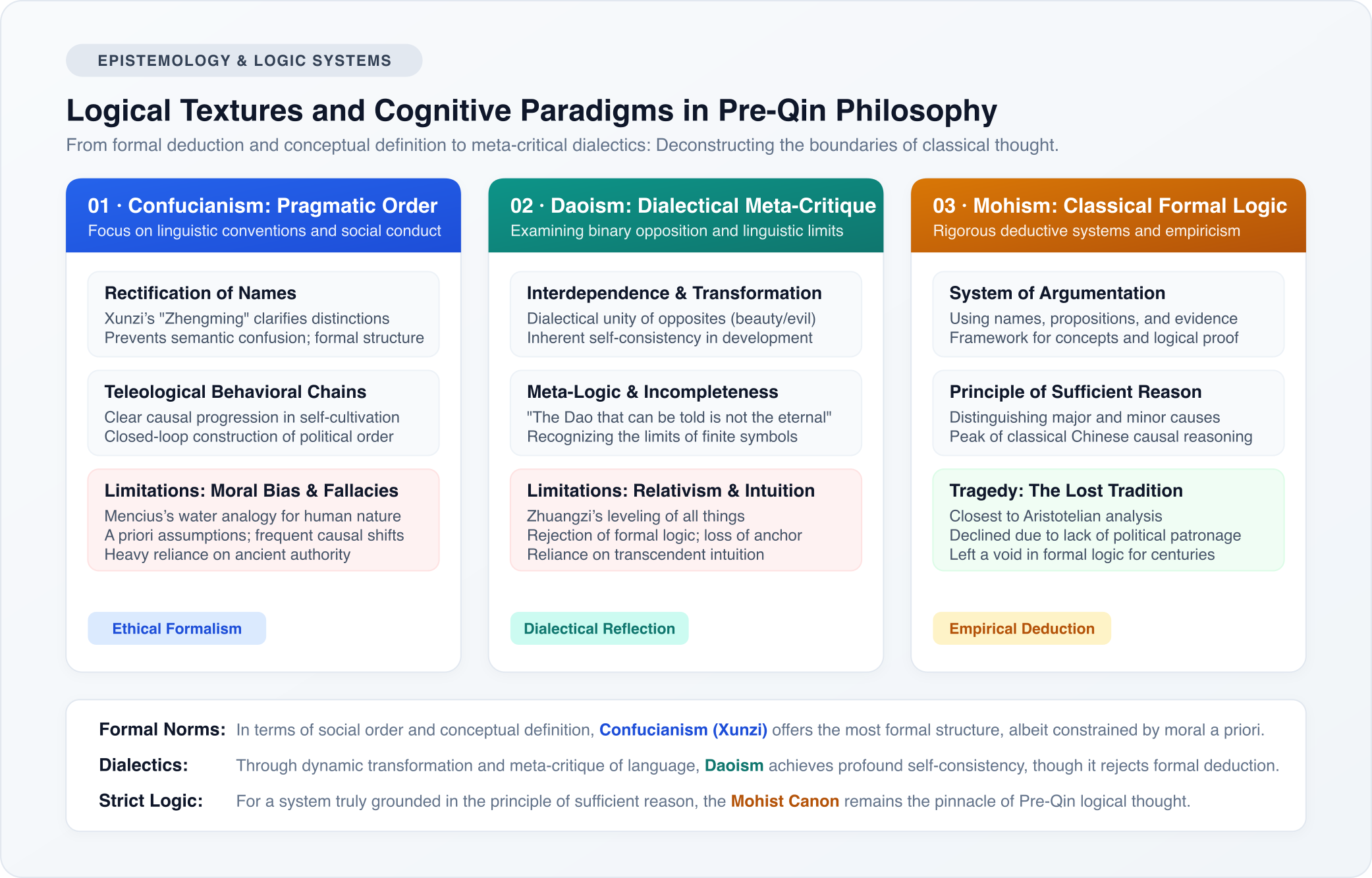
Figure 3: Logical Texture Comparison Matrix of Pre-Qin Schools of Thought
Core Findings:
- Measured by formal norms and surface-level inferential coherence: Confucianism (especially the Xunzi lineage) presents a closer resemblance to formal logic in outline — but its thinking is firmly tethered to aprioristic moral presuppositions and false analogies, making it prone to circular reasoning.
- Measured by dynamic dialectical coherence and meta-level tool reflection: Daoism achieves deeper internal coherence within its metaphysical system, acutely identifying the limits of formal symbolic systems — but its tendency to dissolve conceptual boundaries strips formal deduction of the foothold it needs.
- Measured by strict formal logic and scientific empiricism: The standout among pre-Qin schools is Mohism. The Mozi Canon’s rigorous treatment of concepts, propositions, and the principle of sufficient reason comes closest to Aristotle’s analytical system. The historical decline and fragmentation of Mohist thought is a pivotal turning point that left classical Chinese knowledge systems without a robust tradition of formal deductive reasoning for centuries.
Whether auditing classical philosophy or navigating decision-making in complex modern systems, the true foundation of lucid cognition lies in an uncompromising insistence on conceptual precision, rigorous verification of causal inference chains, and a humble respect for the limits of any formal system itself.
Related Research & Topics
The Anatomy of Digital Predation: Inside the Syndicate Targeting the Elderly via Livestream Appraisal Scams
Starlink V4 and the Low-Earth Orbit Satellite Arms Race: How a 100,000-Node Optical Mesh Pierces the Submarine Cable Monopoly
Tello Mobile eSIM
SafetyWing Nomad Insurance
* Disclosure: This post contains affiliate links. If you make a purchase through these links, V-G Journal may earn a small commission at no additional cost to you. We only recommend services we independently evaluate and trust.
FIRE and Golf:自由旅居之路
专注于为追求 FIRE 与品质生活的人群提供特惠打球权益与候鸟微度假。不持一砖一瓦,运营品质生活。