The Architecture of Offshore Sovereignty: Why US Infrastructure Defines the Transnational Individual
Global mobility does not equate to true freedom. In an era of geopolitical friction and algorithmic gatekeeping, a native US phone number, a compliant physical address, a domestic bank account, and a ten-year visa form the 'root trust' required to access the world’s premier productivity and asset networks.

Executive Summary:
Many entering the world of global nomadism or cross-border asset allocation fall for a common delusion: that a VPN and a different messaging app constitute “going offshore.” In reality, the global internet has been fractured into a hierarchy of digital concessions governed by compliance, telecom whitelists, and anti-money laundering (AML) models.Under this order, those relying on low-quality virtual numbers and offshore proxies are essentially “digital refugees,” liable to be purged by the system at any moment. To build a truly anti-fragile foundation for wealth and survival, one must secure four specific pins of root trust within the core system: a native US phone number, a compliant physical address, a domestic bank account, and a ten-year US visa.
While these span the disparate dimensions of communication, logistics, finance, and immigration, they function as an indivisible “offshore digital sovereignty loop.” This essay deconstructs their underlying logic, operational mechanics, and the reality of their acquisition.
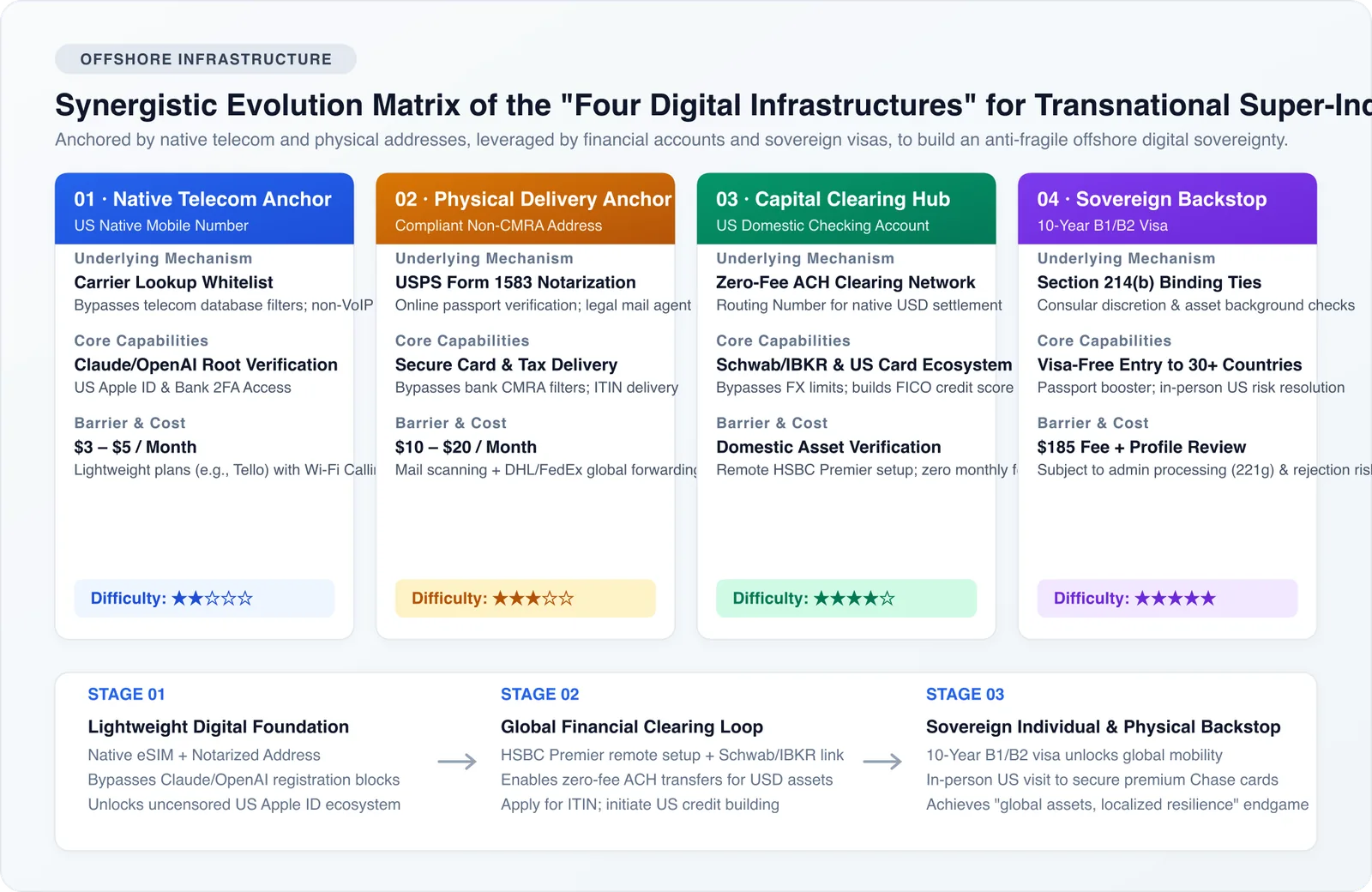
I. Defining the “Digital Infrastructure”
“Infrastructure” implies a foundational layer upon which all high-level activity is built, rather than an optional accessory.
When we discuss deploying cutting-edge AI (Claude, OpenAI), curating a native Apple ID ecosystem, allocating US Treasuries and index funds, or planning global movement, the primary friction is rarely cost. It is “black-box risk management.”
The walls erected by Silicon Valley labs and Wall Street institutions rely on a chain of local trust. These four elements serve as irreplaceable anchors within that system:
| Infrastructure | Core Essence | Systemic Role | Strategic Value |
|---|---|---|---|
| Native US Number | Communication Anchor | Neural endpoint of digital identity | Penetrates Carrier Lookup databases to serve as root trust for AI authentication and banking 2FA. |
| Compliant US Address | Physical & Legal Anchor | Tangible footprint in the legal world | Supports AML and non-resident identity audits; ensures delivery of physical cards, IRS tax documents, and official credentials. |
| US Bank Account | Capital Clearing Hub | Circulatory system for capital | Accesses the ACH network via Routing Numbers for zero-loss dollar movement and high-yield credit ecosystems. |
| 10-Year US Visa | Sovereign Credit Leverage | Ultimate pass & physical hedge | A mobility multiplier for 30+ countries; provides the “break-glass” ability to resolve financial freezes in person. |
These four pillars are nested. Without any single link, a transnational individual’s digital architecture develops a fatal vulnerability, risking account bans, asset freezes, or physical entrapment.
II. The Communication Anchor: Native Numbers and Telecom Risk Models
In any digital gatekeeping mechanism, the phone number is the first and most invisible threshold.
1. Penetrating the Whitelist: Carrier Lookup
Many assume a phone number is merely a pipe for SMS codes, leading them to rely on Google Voice or TextNow. However, in the eyes of fraud models used by tech giants and financial institutions, there is a strict “credit class” for numbers.
Telecom lookup services (e.g., Twilio, Telesign, Neustar) return metadata in milliseconds:
- VoIP (Virtual Numbers): Often flagged as tools for automated scripts and botnets. Tier-1 platforms (like Anthropic’s Claude) and commercial banks frequently block these at the gateway level.
- Non-Core Jurisdictions: Due to export controls and anti-fraud compliance, many non-Western numbers are downgraded in risk models, leading to endless CAPTCHA loops.
- Native US Mobile: Numbers assigned directly to T-Mobile, AT&T, or Verizon physical base stations. These carry the highest initial trust score and bypass rigorous audits.
2. Strategic Utility
- Unlocking Tier-1 AI Productivity: Anthropic’s scrutiny is legendary. A native mobile number is the prerequisite for activating Claude’s full suite, including “Computer Use” capabilities.
- Native Apple ID Ecosystem: Binding a native number as a Trusted Phone for 2FA cleanses the account of “bulk registration” suspicion, granting it the same status as a domestic US device.
- Financial 2FA Continuity: Traditional US banks (Chase, Citi) often refuse to send high-risk transaction codes to VoIP numbers. A native line is the only lifeline to prevent being locked out of overseas funds.
3. Acquisition Strategy
- Difficulty: ★★☆☆☆ (Low barrier, high information asymmetry)
- Cost: $3–$5 USD per month.
- Path: Utilize a legitimate US MVNO (Mobile Virtual Network Operator) like Tello or Ultra Mobile. With eSIM functionality on non-Chinese hardware, one can activate a native T-Mobile network line globally. Combined with Wi-Fi Calling, this allows for 24/7 SMS and calls without international roaming fees.
III. The Physical Anchor: Compliant Addresses and Anti-Audit Space
The internet appears to have eliminated distance, but before the law and financial regulators, physical space remains the bedrock of trust.
1. The Dependency of Digital Assets on Physical Mail
Regulated by the Bank Secrecy Act and the PATRIOT Act, financial institutions require addresses that withstand cross-verification. Furthermore, the delivery of core assets remains tethered to the postal system:
- Premium Financial Cards: Metal debit and credit cards from HSBC, Amex, or Chase must be shipped to a legitimate physical address.
- Government Tax Originals: The IRS issues ITIN confirmation letters (Form CP565) exclusively via physical mail.
- Compliance Inquiries: If a bank questions a transaction, they often send a physical letter. Failure to receive or respond can trigger immediate account closure.
2. The USPS Hierarchy and the CMRA Trap
The US Postal Service (USPS) maintains a massive database categorizing addresses as:
Residential(True personal dwellings)Commercial(Office buildings)CMRA(Commercial Mail Receiving Agency)
Many nomads rent cheap forwarding addresses already flagged as CMRA. When these are entered into applications for Chase or top-tier brokerages, the system may instantly reject the application or demand a “Utility Bill” from the last 90 days—a dead end for non-residents.
3. Acquisition Strategy
- Difficulty: ★★★☆☆ (Moderate; requires vetting and legal notarization)
- Cost: $10–$20 USD/month plus forwarding fees.
- Path:
- Complete USPS Form 1583 (Legal Authorization for Mail Receipt). This can be done via remote online notarization (Notarize, NotaryCam) using a passport.
- Prioritize providers that are not over-saturated by “black-grey” industries or those that offer residential-coded addresses.
- Use a “consolidate and ship” strategy via DHL/FedEx to ensure high-value documents reach your actual location safely.
IV. The Clearing Hub: US Banking and the Dollar Loop
If assets cannot circulate within a high-liquidity, anti-censorship fiat system, an individual remains exposed to the exchange rate volatility and capital controls of a single sovereign entity.
1. The Fintech Fallacy
Novices often park funds in Wise or similar tools. These are Fintech companies with payment licenses, not commercial banks with FDIC insurance:
- Fragile Risk Tolerance: Fintech accounts are notoriously sensitive to login location shifts or sudden inflows, often leading to long-term freezes.
- Feature Limitations: They lack the full functionality of a domestic account and do not report to the three major credit bureaus (Experian, Equifax, TransUnion), making them useless for building a US credit profile.
2. The ACH Network and Capital Arbitrage
A domestic US account with a Routing Number and Checking Account is the world’s clearing hub:
- Frictionless Capital Markets: Linking to tier-1 brokerages (Charles Schwab, IBKR) via ACH allows for zero-fee, near-instant transfers.
- Internal Circulation: Dividends, bond interest, and remote business income stay within the USD ecosystem, bypassing domestic capital controls.
- The Credit Engine: The US credit system offers the world’s highest rewards and cashback. A domestic checking account is the prerequisite for the “Amex/Chase Trifecta” of premium cards.
3. Acquisition Strategy
- Difficulty: ★★★★☆ (High; requires either capital or physical presence)
- Path A (Cross-Border Witnessing): For example, HSBC Premier. By maintaining a qualifying balance in one’s home country, a Relationship Manager can facilitate the opening of an HSBC US account remotely. No visa, no SSN, and no travel required.
- Path B (Physical Entry): Entering the US on a B1/B2 visa and visiting a branch (Bank of America, Chase) with a passport and proof of address. This requires travel costs and the ability to navigate a compliance interview in English.
V. Sovereign Credit Leverage: The 10-Year Visa as a Physical Hedge
If phone numbers and bank accounts solve “digital” survival, the 10-year B1/B2 visa is the ultimate “physical airbag.”
1. Institutional Game Theory: Section 214(b)
Under US law, every non-immigrant visa applicant is presumed to have immigrant intent. In a three-minute window, the applicant must use their history, assets, and composure to prove “strong ties” to their home country. This subjective discretion makes the US visa one of the hardest to obtain, especially in a volatile geopolitical climate.
2. Why It Is Essential Infrastructure
- The Visa-Free Multiplier: A standard passport is often limited. A US visa, however, grants entry or visa-on-arrival to nearly 30 additional countries (Mexico, Peru, Philippines, Albania, etc.). It turns a restrictive passport into a global mobility tool.
- Physical “Break-Glass” Capability: Digital channels have limits. If a bank locks an account and demands an in-person ID verification, or if you need to apply for a high-end JPMorgan card that requires a branch visit, the ability to board a flight to New York or San Francisco is the ultimate resolution to any “black-box” lockout.
- Supreme Credibility: In the eyes of international financial and regulatory bodies, an individual who holds a long-term US visa has already passed the world’s most stringent anti-terror and AML screenings. It is a default upgrade to one’s global reputation.
VI. The Roadmap: From Digital Refugee to Sovereign Individual
These infrastructures are not built in a day. The optimal strategy is phased:
Phase 1: The Digital Base (Months 1–2)
- Goal: Eliminate regional discrimination from tech platforms.
- Action: Activate a native US mobile line (e.g., Tello eSIM) and rent a USPS 1583 notarized address.
- Outcome: Access to Claude/OpenAI, a clean Apple ID ecosystem, and secure 2FA.
Phase 2: The Financial Loop (Months 3–6)
- Goal: Decouple from a single currency and build offshore wealth.
- Action: Open a US Checking account via cross-border witnessing (e.g., HSBC Premier). Link to brokerages for zero-fee USD investment. Apply for an ITIN to begin a US credit history.
- Outcome: Frictionless capital movement and the start of a FICO credit score.
Phase 3: Physical Sovereignty (Months 6–12)
- Goal: Global mobility and physical risk mitigation.
- Action: Secure a 10-year B1/B2 visa. Leverage it for visa-free travel. Use your established credit score to acquire high-end cards (Chase Sapphire, Amex Gold) for global insurance and travel benefits.
- Outcome: A closed loop where communication is unblocked, assets are offshore, spending is optimized via points, and physical movement is unrestricted.
VII. Conclusion: Building an Ark Within Centralized Rules
The freedom sought by the transnational individual is not built on hollow slogans, but on the sophisticated utilization of existing global rules.
Whether it is the telecom whitelist behind a phone number, the postal database behind an address, the ACH network behind a bank account, or the sovereign endorsement behind a visa—these are the “centralized trust protocols” of our age.
Recognizing these mechanisms and penetrating the information asymmetry to secure these four pins is not about worshipping a specific system. It is about building a personal ark for your digital life and family assets in an era of profound geopolitical uncertainty.
Related Research & Topics
Tello Mobile eSIM
SafetyWing Nomad Insurance
* Disclosure: This post contains affiliate links. If you make a purchase through these links, V-G Journal may earn a small commission at no additional cost to you. We only recommend services we independently evaluate and trust.
FIRE and Golf:自由旅居之路
专注于为追求 FIRE 与品质生活的人群提供特惠打球权益与候鸟微度假。不持一砖一瓦,运营品质生活。