Binance Security Breach and the $6.3B Liquidity Shock: Anatomy of an Exchange Crisis and Market Evolution
A deep forensic investigation into the $6.3B Binance security breach: debunking reserve misappropriation rumors and tracing the real vector—an APT-compromised DevOps terminal combined with EIP-7702 unauthorized sweeping. Assessing how a $3B freeze, SAFU fund backstop, and impending liquidity shocks are reshaping global asset pricing.

Executive Summary: In late October 2026, global financial communities were rocked by reports that Binance had suffered its largest-ever hack, losing $6.3 billion and resulting in a total suspension of deposits and withdrawals. Multi-source on-chain forensics and internal security briefings reveal this was neither an FTX-style internal asset misappropriation nor a systemic collapse. Instead, it was an Advanced Persistent Threat (APT)—attributed by intelligence assessments to the Lazarus Group—that compromised an internal DevOps terminal, leveraging the EIP-7702 authorization mechanism to rapidly sweep hot wallets. Although risk controls triggered immediate circuit breakers, cross-chain protocols like Tether and Circle froze roughly $3 billion, and Binance committed the SAFU fund to cover all losses, the remaining $3.3 billion in uncontrolled token overhang and the liquidity shock of the withdrawal reopening are fundamentally reshaping global crypto asset pricing.
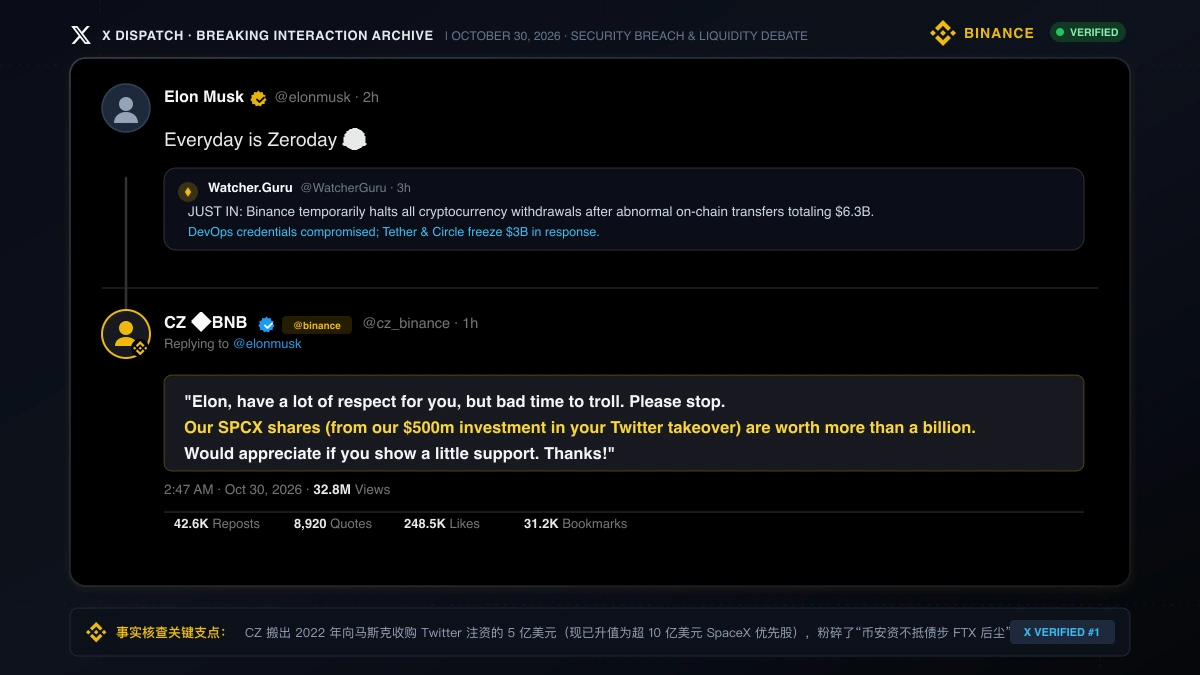
Figure 1: In the early hours of October 30, 2026, Elon Musk poked fun at Binance’s zero-day exploit on X. Binance co-founder CZ fired back, revealing a $500 million equity investment in the 2022 Twitter acquisition now valued at over $1 billion in SpaceX preferred stock—a critical turning point that crushed rumors of insolvency.
Evidence Matrix: Rumors vs. Real Underlying Risk Exposure
Before evaluating medium-term price trajectories, we must strip away panic and examine the actual asset exposure based on firsthand technical forensics and on-chain telemetry:
| Verification Dimension | Scenario A: Market Panic & Media Rumors | Scenario B: On-Chain Monitoring & Technical Reality | Risk Exposure & Fact-Capping |
|---|---|---|---|
| Total Stolen & Nature | Platform systems completely obliterated; $6.3B instantly erased | ~$6.3B moved across 10 chains in anomalous outflows, setting a historical security record | Single-Point Infrastructure Failure: Public chain consensus uncompromised; no reserve misappropriation |
| Asset Interception & Control | Massive funds entirely funneled into mixers; untraceable | Issuers like Tether and Circle executed emergency on-chain freezes of ~$3B | Partial Containment: ~$3.3B in unfrozen assets (non-controllable/native tokens) escaped |
| Attack Vector & Vulnerability | Smart contract logic bug or total private key compromise | DevOps terminal infiltration, privilege escalation via containers, and EIP-7702 sweeping | Privilege Isolation Blind Spot: Exposed flaws in zero-trust internal DevOps architectures at scale |
| Platform Backstop & Solvency | Platform insolvent, destined to follow FTX into bankruptcy | Official commitment to deploy SAFU emergency funds and treasury capital for full coverage | Capital Adequacy Pressure: Real capital shortfalls will directly draw down future operational reserves |
| Withdrawal & Trading Status | Total freeze of deposits/withdrawals, sparking permanent asset lockup panic | Cold wallet physical isolation post-circuit-breaker; phased restoration promised within 48 hours | Liquidity Stress Test Ahead: Reopening channels will trigger true bank-run stress tests |
I. Fog and Truth: The Offensive-Defensive Mechanics Behind the $6.3B Hack
The eye of the storm began with automated on-chain alert systems flashing red. In the early hours of October 30 (Beijing Time), unlabeled addresses initiated high-density authorization calls across Ethereum, BNB Chain, and multiple Layer2 networks, rapidly draining Binance hot wallets. Almost simultaneously, Binance’s front-end trading gateway timed out, and deposit/withdrawal channels were locked.
1. Attack Vector Reconstruction: Compromised DevOps Terminals and EIP-7702
Reverse-engineering by multiple on-chain security firms revealed that the attacker did not crack the exchange’s multi-sig cold storage, but instead targeted the weakest links—human and development environments:
- APT Phishing Breach: The attackers maintained a long-term presence, successfully breaching the personal terminal of a core DevOps engineer managing container clusters, thereby stealing internal production environment credentials and CI/CD pipeline access.
- EIP-7702 Authorization Abuse: Attackers exploited Ethereum’s newly activated account abstraction standard (EIP-7702), temporarily granting standard EOAs (Externally Owned Accounts) smart contract execution capabilities to execute automated, high-speed token sweeps across 10 chains within minutes.
2. On-Chain Interception and Cold Wallet Physical Circuit Breakers
Once abnormal volume breached risk thresholds, Binance’s automated circuit breakers triggered:
- Hot Wallet Drain for Self-Preservation: Risk control scripts executed protective flash-rollbacks within milliseconds, migrating the remaining multi-billion-dollar exposed assets to multi-sig cold wallets for offline physical isolation.
- Consortium Countermeasures: The Binance security team established real-time combat links with Tether, Circle, and major chain validators, leveraging centralized stablecoin blacklist functions to instantly freeze roughly $3 billion transferred to attacker addresses.
However, approximately $3.3 billion in native tokens (including BTC, ETH, and select public chain assets) lacked native centralization freeze mechanisms and fell into addresses controlled by the hacker. Binance subsequently announced it would deploy the SAFU (Secure Asset Fund for Users) and accumulated operating profits to bridge the deficit, ensuring a 100% payout while phasing in withdrawal restorations within 48 hours.
Amid spreading panic and doubts regarding potential FTX-style insolvency, Elon Musk posted on X joking that “Everyday is Zeroday.” Binance co-founder CZ fired back directly, highlighting the $500 million investment Binance made in the Twitter buyout—now worth over $1 billion in SpaceX preferred stock. Binance Co-CEO Yi He further confirmed that the platform’s annual operating profits alone could easily cover the uncontrolled exposure. This rare high-level public defense not only curbed malicious short-seller panic but also demonstrated Binance’s deep balance-sheet redundancy.
Though the platform averted immediate collapse, the deep wound transmitted straight into secondary markets, triggering a violent reconfiguration of crypto asset pricing logic.
II. Short-Term Trajectory (Next Few Weeks to 1 Month): Liquidity Shocks, Basis Distortion, and Secondary Bottoming
As the incident broke, Bitcoin (BTC) immediately crashed below the $77,000 psychological handle, bottoming out in the $76,300–$76,500 range, with total network liquidations exceeding billions. Over the coming weeks, price action will face relentless pressure from three core short-term headwinds:
1. The Withdrawal Restoration “Stress Test” and Market Maker Withdrawal
During the announced 48–72 hour withdrawal reopening window, the market will experience a massive defensive capital flight as retail and institutional investors alike rush to move assets into non-custodial cold storage or alternative compliant venues.
- Market Makers Pulling Liquidity: To mitigate counterparty and settlement risks, primary algorithmic market makers will dramatically thin out order book depth during the initial reopening.
- Slippage Spikes and Flash Crashes: In thinned-out liquidity environments, minor spot sell orders will induce violent price volatility and basis dislocations, easily triggering cascading leveraged liquidations.
2. The Damocles Sword of $3.3 Billion Unfrozen Assets
The roughly $3.3 billion in non-controlled tokens remaining in hacker wallets forms a persistent psychological overhang:
- Constrained by the throughput limitations of Tornado Cash and cross-chain bridges, attackers cannot liquidate everything at once. Nonetheless, any whale-address clustering, splitting, or exchange routing will trigger nervous sell-offs across secondary markets.
3. Short-Term Price Range Projections
- Trading Band: Bitcoin will likely undergo high-volatility oscillations and retest loops between $74,000 and $78,000.
- Floor Dynamics: If Binance’s subsequent Proof of Reserves (PoR) audit goes smoothly, withdrawals stabilize without liquidity bottlenecks, and $75,000 will establish a cyclical sentiment floor. Conversely, if secondary exploit rumors or withdrawal delays surface, a temporary wick down to the $70,000 strong psychological handle cannot be ruled out.
III. Medium-Term Trajectory (3 to 6 Months): Regulatory Hammers, Institutional Risk Gates, and Asset Divergence
Once short-term panic subsides, the event’s impact will fully permeate the “capital supply” and “institutional compliance” layers:
1. Wall Street Institutional Allocation Hits the Brakes
Intelligence agencies have strongly attributed this attack to a state-sponsored threat actor (Lazarus). With $6.3 billion involved, it directly touches the most sensitive nerves of global Anti-Money Laundering (AML) and Counter-Terrorist Financing (CFT) frameworks:
- Macro hedge funds, family offices, and pension committees currently building positions via ETFs and compliant custodians will face upwardly revised internal risk-compliance thresholds.
- Institutional capital inflows will slow noticeably, making unhindered, single-direction “mega bull runs” difficult over the next quarter as the market digests the news through time-based consolidation.
2. The Global Regulatory Storm: CEX “Custody Decoupling”
The U.S. Department of Justice (DOJ), SEC, and FATF will inevitably leverage this event to unleash harsher regulatory crackdowns on centralized exchanges:
- Mandatory Qualified Custodian Frameworks: Centralized pools of massive retail funds held directly by exchanges will face calls for elimination, replaced by hard constraints enforcing strict cold/hot wallet separation.
- Compliance friction costs across trading networks will soar, suppressing derivatives volume and leveraged speculative appetite in the near term.
3. Brutal Asset Divergence
- Platform Token (BNB) Valuation Pressure: Binance deploying massive proprietary cash reserves and capital to cover losses is, in essence, a direct draw-down on its future profit distribution and reinvestment capacity. BNB will bear noticeable valuation discounts and underperform the broader market in the medium term.
- The Stablecoin Credit Paradox: Tether and Circle’s lightning-fast freezes averted catastrophic losses, but they once again laid bare the technological reality that centralized stablecoins remain subject to censorship backdoors. Capital prioritizing censorship resistance will increasingly flow back into native BTC or decentralized overcollateralized stablecoins.
IV. Long-Term Trajectory (1+ Year Horizon): Detoxification of Centralized Faith and the Return of Antifragility
Zooming out to a macro horizon exceeding one year, this $6.3B exploit is not a terminal illness for the crypto ecosystem, but rather another violent cycle of detoxifying centralized faith:
1. Historical Crucible and Consensus Purification
From the 2014 Mt. Gox loss of 850k BTC to the 2016 Bitfinex hack and the 2022 FTX collapse, every centralized catastrophe has been greeted as an existential blow. Yet cycles prove:
- Damage is sustained by fragile centralized operating entities, not the blockchain network itself.
- In this incident, the underlying consensus algorithms of Bitcoin, SHA-256 hash security, and distributed ledgers did not fail by a single byte. The hackers breached an engineer’s terminal and internal DevOps containers—delivering a harsh lesson to global investors: “Not your keys, not your coins.”
2. The Infrastructure Baseline for Self-Custody and Account Abstraction
Idle capital perpetually parked in centralized hot wallets will accelerate its migration toward self-custody systems represented by hardware cold storage, Multi-Party Computation (MPC), and decentralized exchanges (DEXs). This security demand, forged in painful lessons, will permanently expand the structural market space for on-chain native security.
3. The Ultimate Anchor of the Macro Bull Thesis
The long-term historical destiny of crypto assets is dictated not by the rise and fall of any single exchange, but by global sovereign fiat over-issuance cycles, inflation hedging demand, and the depth of consensus around decentralized sovereign wealth. Provided this liquidity shock does not trigger a cascading bank run among top-tier market makers, once speculative foam is expelled and leveraged inventory is cleansed, the dispersed and resilient capital resting in distributed cold wallets will power crypto back into the primary macro bull run.
Core Takeaway: Rebuilding Your Antifragile Asset Fortress
When extreme storms hit, any defensive line dependent on a single institution or point of failure is fragile. Whether it is an exchange’s automated cold-storage circuit breakers or billions in mandatory capital backstops, recent events highlight the instantaneous vulnerability of liquidity within modern financial networks.
True financial resilience is never built on blind faith in a centralized monolith. It requires completing the structural leap from single-channel exposure to multi-dimensional offshore tooling, on-chain cold storage self-custody, and cross-cycle, all-weather asset allocation before crisis strikes.
🔗 Further Reading
Single-platform defensive circuit breakers and liquidity shocks serve as a risk warning for everyone. Explore the dedicated strategy guide:
👉 FIRE Safety Margins and Asset Resilience: Personal Wealth Hedging Guide Under Extreme Volatility
A systematic framework on constructing multi-dimensional offshore assets, self-custodial cold storage, and antifragile life safety margins through Monte Carlo stress testing during extreme macro volatility cycles.
Related Research & Topics
Geographic Arbitrage at 31: The True Cost and Hidden Frictions of Ecuador's Dollarized Economy
The Impending Monetization of UU Remote: The Inevitable Betrayal of Free SaaS and the Arbitrage of Self-Hosted Mesh VPNs
Tello Mobile eSIM
SafetyWing Nomad Insurance
* Disclosure: This post contains affiliate links. If you make a purchase through these links, V-G Journal may earn a small commission at no additional cost to you. We only recommend services we independently evaluate and trust.
FIRE and Golf:自由旅居之路
专注于为追求 FIRE 与品质生活的人群提供特惠打球权益与候鸟微度假。不持一砖一瓦,运营品质生活。