The Impending Monetization of UU Remote: The Inevitable Betrayal of Free SaaS and the Arbitrage of Self-Hosted Mesh VPNs
NetEase UU Remote's upcoming commercialization signals yet another cycle of SaaS exploitation, leaving digital nomads scrambling. This essay dissects the hidden costs of closed-source remote desktop tools and presents a definitive, low-cost self-hosted alternative using Tailscale and RustDesk.

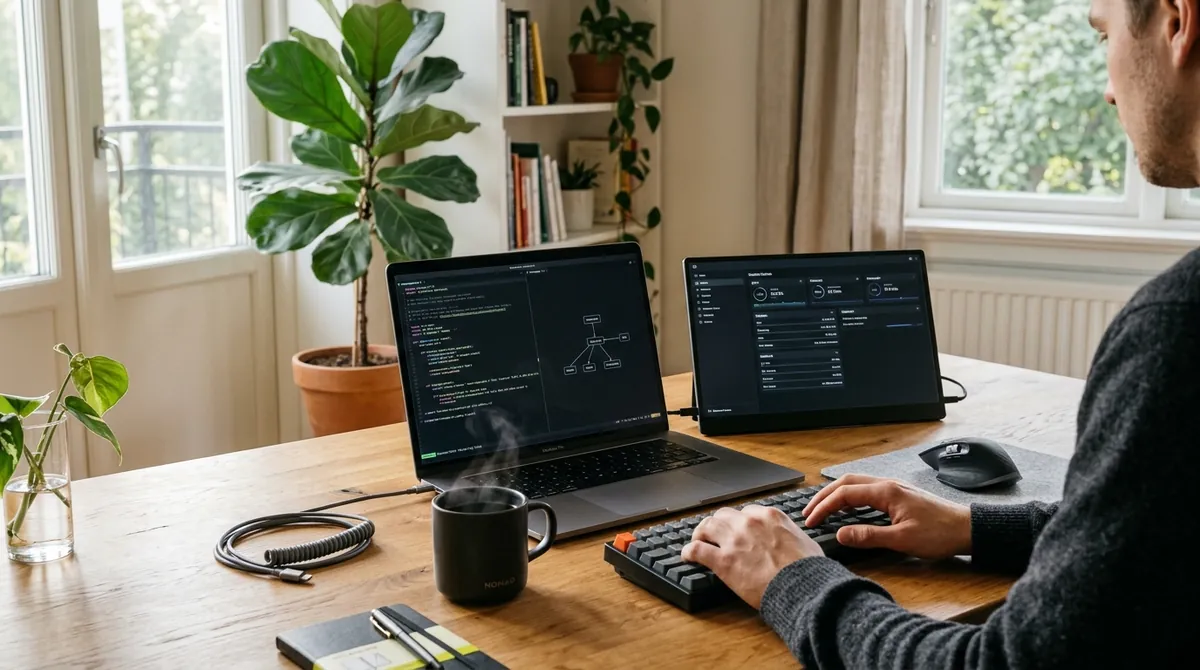
Figure 1: Multi-region collaboration and cross-device remote connections have become the lifeline of modern digital nomad productivity, yet underlying reliance on closed-source commercial networks introduces significant operational friction and disconnect risks.
On November 3, 2026, a discussion thread on the V2EX community titled “Will UU Remote start charging soon?” drew dozens of frantic replies from technical practitioners and digital nomads alike. Originally spun off from NetEase’s GameViewer, UU Remote had become a sanctuary for remote workers fleeing the speed caps of Sunflower (向日葵) and the steep annual subscriptions of ToDesk, prized for its 4K resolution, 144Hz ultra-high refresh rate, and completely free, ad-free experience. However, with the official team recently acknowledging that they are evaluating commercialization pathways aligned with the product’s long-term viability, this recurring cycle—where closed-source remote desktop providers offer free access to land-grab territory, only to build paywalls and harvest users later—has once again shattered technical professionals’ trust in commercial SaaS infrastructure.
I. A Brief History of Remote Desktop Migrations: No Philanthropic SaaS
In the evolution of remote desktops and cross-device workflows, everyday users and tech-savvy nomads are trapped in an exhausting, passive “digital nomad migration cycle.”
Looking back at the tool iterations of past years, nearly every runaway hit in the national remote-control market follows an identical commercial script:
- Sunflower’s Suffocating Rate Limits: As a legacy remote desktop giant, Sunflower tightened the screws on free users once it captured absolute market dominance. Free connection speeds were throttled to a sluggish 300kbps, compounded by rigid device-binding limits and relentless splash-screen ads that turned daily operations into a slide-show experience.
- ToDesk’s Gradual Betrayal: ToDesk surged into the market boasting a “completely free, unthrottled, ad-free” posture, quickly absorbing the massive workforce abandoned by Sunflower. Yet, as user growth plateaued, operators executed a sharp pivot: capping monthly connection durations, cutting off free multi-to-one connections, and packaging 4K resolution, 144Hz refresh rates, and 4:4:4 true-color support into exclusive paid tiers costing hundreds of yuan annually.
- NetEase UU Remote’s Repetition: Armed with gaming accelerator tech heritage, NetEase entered the fray. GameViewer (later rebranded as NetEase UU Remote) swept competitors aside with uncompromised, top-tier free parameters. Yet, as community users astutely observed: “No one runs server infrastructure for free.” As the compute and bandwidth bills for public cloud relay servers pile up, a commercial firm turning its blade on free users is merely a matter of time.
This is not a failure of moral character among individual software teams; it is the inescapable physical law of centralized remote desktop SaaS. As we noted in our analysis of macroeconomic system mechanics in Cost Conservation, Load Shedding, and Crisis Accounting, seemingly zero-cost experiences subsidized by venture capital are nothing more than temporary padding. Once external capital demands a return on investment, the accumulated system load is transferred in full to locked-in users via feature stripping, paywalls, and forced subscriptions.
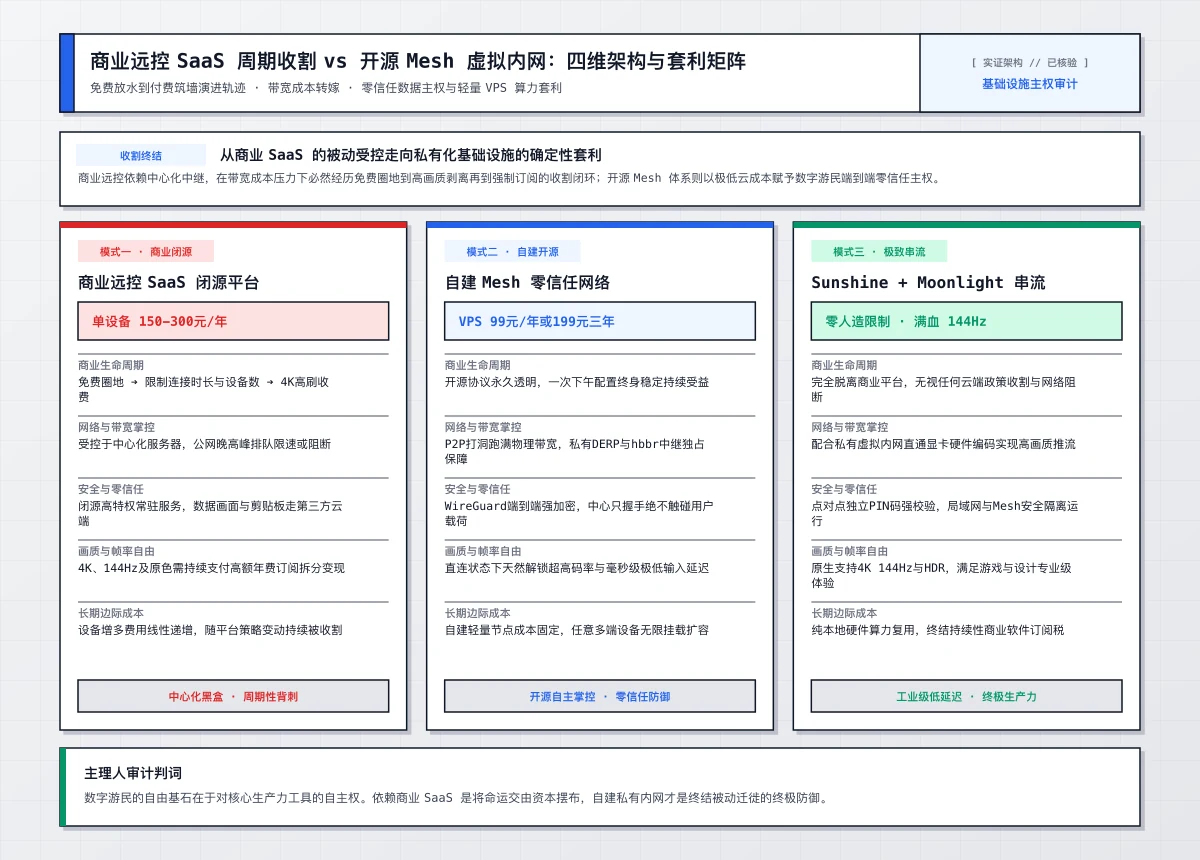
Figure 2: The three-stage harvesting cycle of commercial remote SaaS versus the four-dimensional hedging matrix of open-source, self-hosted networks across bandwidth, sovereignty, overhead, and stability.
II. The Dual Reefs of Closed-Source Centralized Remotes: Surrendered Sovereignty and Zero-Trust Collapse
For digital nomads pursuing geographic arbitrage and borderless mobility, commercial remote tools inflict damage that goes far deeper than drained wallets; their more insidious hazards strike at the heart of digital sovereignty and security isolation.
| Core Comparison Dimension | Commercial Closed-Source Remote SaaS (Sunflower / ToDesk / NetEase UU) | Open-Source Self-Hosted Mesh Network (Tailscale / Headscale + RustDesk / Sunshine) |
|---|---|---|
| Network Control | Entirely at the mercy of vendor cloud scheduling; speed caps or blocks applied at whim | Autonomous and controllable topology; peer-to-peer direct connections with zero bandwidth bottlenecks |
| Security & Encryption | Closed-source resident services run with elevated privileges; credentials and video feeds relayed via vendor central servers | End-to-end encryption based on WireGuard and Noise protocols; central servers handle handshakes only and never touch data flows |
| Marginal Cost | Scales linearly with device counts; continuous subscriptions run $20 to $50 per device annually | Requires only a lightweight self-hosted node (~$15 to $30 for a 3-year term); unlimited multi-device mesh integration |
| Visuals & Refresh Rate | 4K, 144Hz, and low-latency codecs are routinely stripped and sold as premium add-ons | Automatically unlocks full 4K and ultra-high refresh rates under LAN and P2P direct connections with zero artificial limits |
| Censorship & Ban Resistance | Subject to domestic single-point regulations and compliance audits; prone to sudden nationwide shutdowns | Private deployment protocols and custom ports remain insulated from commercial network policy shockwaves |
First lies the trust black box of high-privilege closed-source backdoors. Almost all commercial remote clients require resident, system-level, high-privilege services installed on the host machine. A user’s entire screen pixels, input device captures, bidirectional clipboard synchronization, and even local intranet file system mapping permissions are handed over to proprietary, closed-source vendor protocols that lack third-party security audits. Under the complex conditions of cross-border and mobile work, these resident processes easily become soft underbellies for expanded attack surfaces. This logic mirrors our warnings in Digital Nomad Anti-Phishing Defense and Hardware Insulation Boundaries: without absolute hardware and data-channel decoupling between public networks and unmanaged devices, any covert channel routed through a third party is inherently insecure.
Second is the unpredictability of the productivity lifeline. Parasitizing your productivity infrastructure on a commercial tool that can hike prices or alter user agreements at any moment means you must endlessly shoulder the costs of sudden shifts. A mid-meeting stutter or an overtime lockout during a critical file retrieval inflicts immeasurable reputational damage on cross-border arbitrageurs who rely on instant delivery.
III. Breaking Through via Self-Hosted Intranets: Mesh VPN Architecture and Private Compute Arbitrage
The definitive cure to this exhausting migration cycle is not waiting for the next NetEase or benevolent corporate savior, but engineering your own deterministic intranet infrastructure. Empowered by modern open-source ecosystems, setting up a private remote network that matches commercial user experiences with end-to-end strong encryption has never been easier.
A resilient, modern digital nomad self-hosted intranet is typically driven by a two-layer architectural synergy:
1. The Lower-Tier Virtual LAN: Tailscale / Headscale Zero-Trust Networking
Leveraging a mesh network built on the WireGuard kernel protocol, users establish an encrypted peer-to-peer network connecting laptops, home NAS units, workstations, and mobile devices scattered across the globe.
- P2P Hole-Punching Direct Connections: Devices establish direct peer-to-peer tunnels using NAT traversal technology. Under most network conditions, data flows directly between the two end devices at maximum physical bandwidth, entirely bypassing third-party relay servers while achieving millisecond-level, ultra-low end-to-end latency.
- Self-Hosted Private DERP Relays: When symmetric NATs or other severe network constraints block hole-punching, users simply host a private DERP relay node on an inexpensive, lightweight cloud instance (such as a lightweight application server priced around $15 to $30 for three years). Utilizing exclusive dedicated bandwidth entirely eliminates the queue limits and speed caps of commercial remote rush hours.
2. Application-Layer Streaming and Desktop Control: RustDesk and Sunshine/Moonlight
Atop this interconnected private virtual intranet, users can freely mix and match application-layer tools:
- General Desktop Operations (RustDesk): The de facto open-source standard for remote control. By spinning up
hbbs(signaling server) andhbbr(relay server) on a lightweight server with a single click, users secure a fully owned, private remote system. The client supports cross-platform environments with entirely transparent source code, eliminating hidden audit vulnerabilities. - Extreme-Quality Streaming (Sunshine + Moonlight): For heavy productivity demands requiring 4K resolution, 144Hz ultra-high refresh rates, and gaming-grade low-latency interactions, the open-source pairing of Sunshine (host) and Moonlight (client) delivers audio-visual fidelity that surpasses commercial SaaS. Because it runs within a successfully punched private mesh intranet, the video stream communicates directly with GPU hardware encoding—requiring zero “high-definition subscription surcharges.”
IV. The Awakening of the Digital Nomad: Reclaiming Infrastructure and Time Sovereignty
In building asset allocations and lifestyles, true autonomy is perpetually rooted in absolute control over your core production tools.
The core trap of the commercial SaaS model is utilizing a low initial barrier to entry to induce users into relinquishing their capacity for self-hosted underlying architecture. Once accustomed to out-of-the-box convenience, users quietly surrender their negotiating leverage against system volatility. From the illusions of real-estate rental yields to the periodic harvesting of remote-control tools, the underlying commercial mechanics remain identical.
With a lightweight server renting for just $15 to $30 for a three-year term, paired with robust open-source protocols, digital nomads can spend a single afternoon configuring a setup that permanently exempts them from the recurring $20 to $50 annual per-device fees demanded by commercial remote software. This is not merely a deterministic compute and financial arbitrage; it is a critical frontline defense for reclaiming personal time sovereignty and digital freedom amidst a high-uncertainty digital wave.
Related Research & Topics
Geographic Arbitrage at 31: The True Cost and Hidden Frictions of Ecuador's Dollarized Economy
Starlink V4 and the Low-Earth Orbit Satellite Arms Race: How a 100,000-Node Optical Mesh Pierces the Submarine Cable Monopoly
Tello Mobile eSIM
SafetyWing Nomad Insurance
* Disclosure: This post contains affiliate links. If you make a purchase through these links, V-G Journal may earn a small commission at no additional cost to you. We only recommend services we independently evaluate and trust.
FIRE and Golf:自由旅居之路
专注于为追求 FIRE 与品质生活的人群提供特惠打球权益与候鸟微度假。不持一砖一瓦,运营品质生活。