Desecration for Ransom: The Cold Economics Behind Celebrity Ash Theft
The theft of pop legend Anita Mui’s remains from Po Lin Monastery exposes a sinister extortion syndicate targeting Hong Kong’s deceased icons. By weaponizing filial piety and public sentiment, grave robbers have commodified post-mortem dignity into hostage capital.

Executive Summary: On October 10, 2026, the Anita Mui International Fan Club, acting with authorization from her family, revealed that the late pop icon’s ashes had been stolen from the Hoi Wai Pagoda at Lantau Island’s Po Lin Monastery as far back as mid-July. Despite nearly three months of covert investigation by the Hong Kong Police Force’s Regional Crime Unit, her remains remain unrecovered. While public commentary has reflexively framed this tragedy as an entertainment industry feud, a broader pattern of grave-robbing across Hong Kong reveals a far darker reality: an organized criminal syndicate weaponizing traditional filial piety to transform the remains of cultural figures into silent hostages for ransom.
October 10, 2026, marked what would have been the 63rd birthday of the legendary singer and actress Anita Mui. On a day meant for solemn commemoration, the Anita Mui International Fan Club issued an urgent public appeal: on July 18, 2026, during a routine visit to the Hoi Wai Pagoda at Po Lin Monastery, fans noticed that the screws securing her niche plaque were loose. Upon opening the compartment with monastery staff, they discovered that the urn containing Mui’s ashes was gone.
The news sent shockwaves through the region. Many observers instinctively remarked that “the entertainment industry is too dark—even the dead are not spared.” This emotional response stems from deep public sympathy for Mui’s troubled family history and posthumous estate litigation. Yet from a criminology and institutional perspective, reducing a severe criminal offense to “show business infighting” obscures a predatory, cross-border underworld that is actively commodifying human remains.
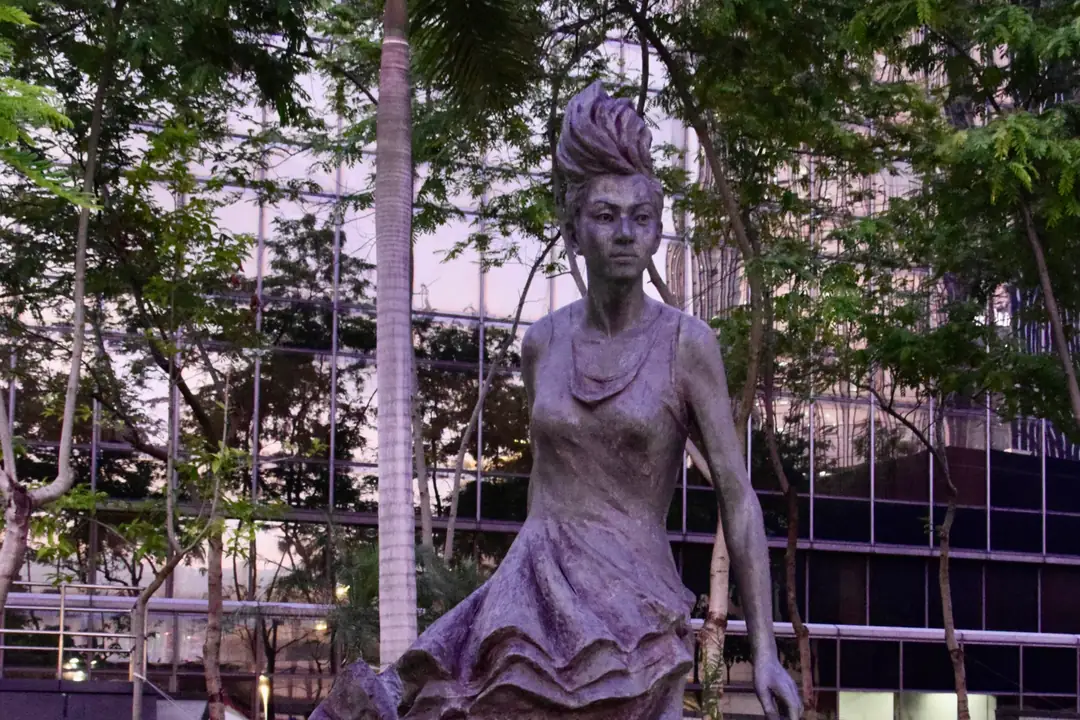
The bronze statue of Anita Mui, "Daughter of Hong Kong," on the Avenue of Stars, featuring calligraphy by Andy Lau—a tribute to her lasting cultural legacy.
I. The Hoi Wai Pagoda Heist: A Calculated Extraction
A timeline of the theft reveals a high degree of premeditation and professional camouflage:
| Milestone / Key Event | Operational Detail & Status |
|---|---|
| Posthumous Placement | Following her death in 2003, Mui’s family sought total privacy, placing her remains discreetly at Po Lin Monastery’s Hoi Wai Pagoda under her childhood nickname (“Guangdong Taishan Zhunü”) with no photograph or birth/death dates. |
| Discovery | On July 18, 2026, visiting fans noticed loose screws on the niche plaque. Monastery staff and fans opened the niche, confirming the urn was gone. |
| Police Action | Hong Kong Police opened a criminal investigation, with the Lantau District Regional Crime Unit taking charge of the case. |
| Public Appeal | After nearly three months of covert investigation yielded no recovery, the fan club made the incident public on her birthday, soliciting leads from the community. |
The discretion surrounding Mui’s niche registration is notable: a visitor standing before the columbarium wall could not easily identify her remains from the name “Zhunü” alone. Removing the specific mounting screws and extracting the urn required extensive prior reconnaissance, physical intelligence gathering, and target verification. This was not an impulsive act of vandalism; it was a targeted theft executed for financial extraction.
II. The Po Fook Hill Precedent: A Serial Syndicate Targeting Deceased Icons
The theft of Anita Mui’s ashes is not an isolated anomaly. Court records and police briefings from the past two years highlight a near-identical pattern that emerged at Shatin’s Po Fook Hill:
【Case File: The Shatin Po Fook Hill Serial Grave Robberies】
- Targets: In 2025, serial break-ins at Po Fook Hill resulted in the theft of the remains of martial arts master and director Lau Kar-leung, Win’s Entertainment founder Jimmy Heung (Xiang Huasheng), and Po Fook Hill founder Fung Shing.
- Modus Operandi: Perpetrators exploited security blind spots during open visiting hours to pry open niches, extracted the urns, and carefully restored the exterior plaques to delay detection. The remains were then buried in remote wooded areas.
- Extortion Demand: Lau Kar-leung’s widow, Mary Jean Reimer, was targeted with an extortion demand of 60 million HKD. Reimer refused to pay, cooperating fully with law enforcement. The Hong Kong Police successfully cracked the syndicate in February 2026, arresting key members.
From martial arts pioneers and film magnates to iconic pop stars, the victim profile spans Hong Kong’s cultural elite. This pattern confirms that the perpetrators are not personal enemies settling old scores, but organized criminals treating deceased public figures as high-yield ransom assets. They leverage the victim’s public stature and the family’s vulnerability to reputational pressure.
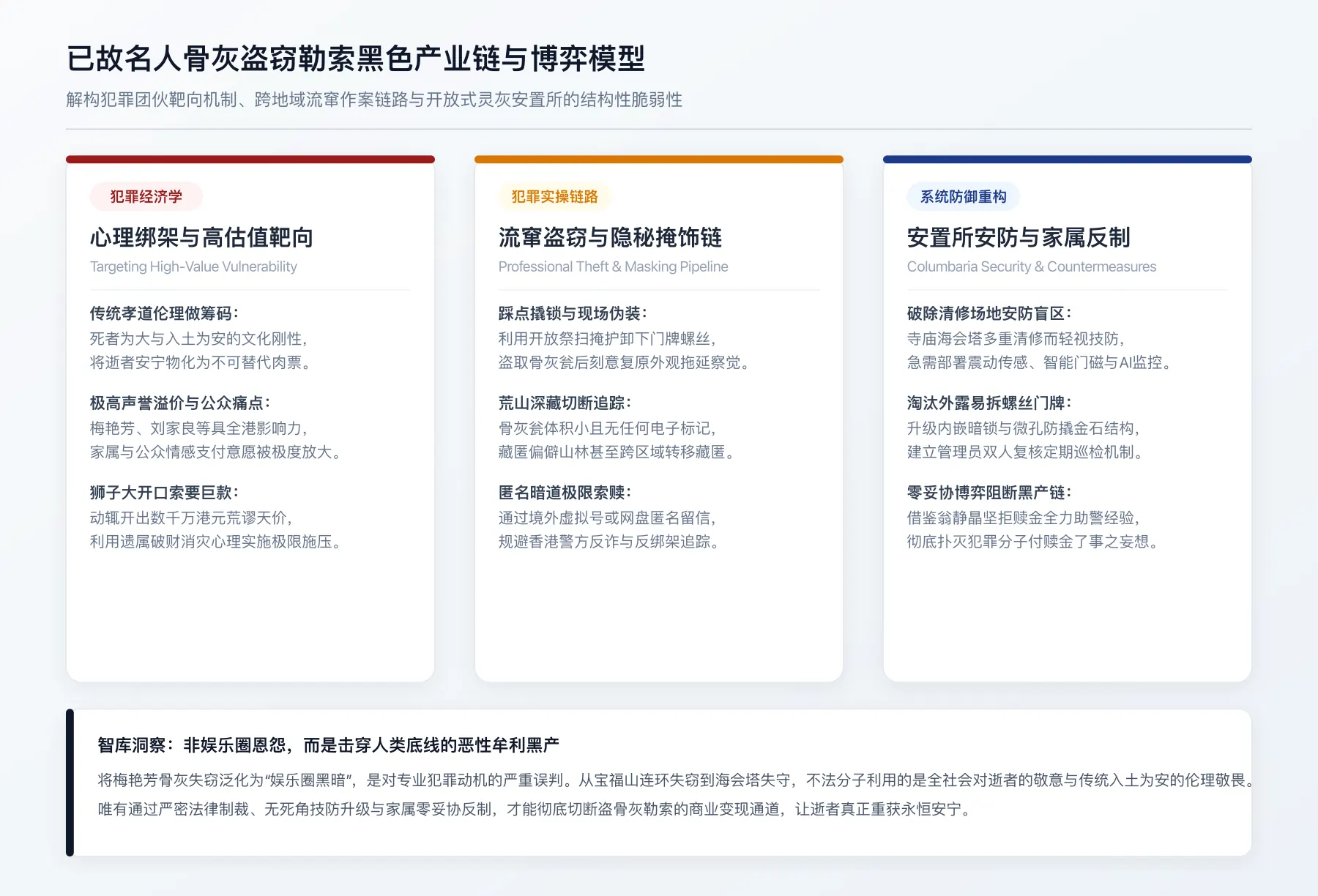
Operational mechanics, extortion loops, and security defense models for post-mortem ransom syndicates.
III. The Criminological Logic: Weaponizing Human Remains
In traditional kidnapping, criminals incur substantial maintenance and logistical costs: hostaging requires secure locations, constant guarding, sustenance, and carries a high risk of escape or medical emergency. In the case of post-mortem ash theft, the cost-benefit structure shifts dramatically:
| Operational Dimension | Traditional Kidnapping | Post-Mortem Ash Extortion |
|---|---|---|
| Maintenance & Custody Costs | Extremely High (Requires safe houses, guards, food, short window before exposure) | Near Zero (Inert material, compact, no biological needs, can be buried indefinitely) |
| Tracker Resistance | Low (Hostages possess biological signals and movement profiles easily tracked by law enforcement) | Exceptionally High (Urns lack electronic tags; physical tracking chains break upon extraction) |
| Psychological Leverage | Immediate Survival Risk (Urgency tied to hostage health and life) | Ethical & Cultural Vulnerability (Weaponizes deep-seated East Asian obligations regarding filial piety and ancestor reverence) |
| Ransom Conversion Incentive | Variable (Depends on immediate family liquidity) | Amplified Reputation Risk (Desecration creates intense social and media pressure on surviving family members) |
As explored in the myth of absolute equality in time and death, mortality is meant to be the ultimate equalizer—the definitive end to worldly disputes. Yet within the logic of criminal extraction, post-mortem peace is commodified based on a figure’s living fame. Syndicates exploit the high value placed on ancestral reverence in Chinese culture, using moral coercion to force families into private settlements.
The stability of modern society relies not only on legal enforcement, but on underlying contractual spirit and institutional trust. Treating ancestral remains as negotiable financial assets undermines these basic cultural norms.
IV. Structural Vulnerabilities and Institutional Countermeasures
The thefts at Po Lin Monastery and Po Fook Hill highlight persistent physical security vulnerabilities in traditional columbaria across the region:
- Conflict Between Monastic Design and Physical Security: Traditional sites like Po Lin Monastery prioritize open, tranquil spaces for reflection over defensive perimeter design. The open layout of the Hoi Wai Pagoda, surrounded by dense mountain foliage, creates security blind spots that facilitate undetected access;
- Inadequate Physical Lock Systems: Older columbarium niches often rely on simple exterior mounting screws or basic mechanical locks. These fasteners can be removed within minutes using standard hand tools;
- Passive Inspection Protocols: Columbaria typically experience high visitor traffic only during traditional festival periods (such as Qingming and Chung Yeung). Operational oversight often focuses on maintenance rather than physical auditing of individual niche covers. In Mui’s case, the theft went unnoticed from mid-July until observant fans spotted the loosened screws.
Addressing this form of extortion requires systemic changes in both physical security and response strategy:
- Hardware and Monitoring Upgrades: Columbaria must eliminate exposed mounting hardware in favor of internal locking mechanisms and reinforced interlocking stone facings. Integrating microwave vibration sensors and smart contact alerts can instantly trigger alarms if a niche is tampered with outside operating hours.
- Refusing Financial Negotiation: Breaking the economic incentive behind ash theft requires a firm refusal to negotiate. As demonstrated by Mary Jean Reimer, paying ransoms creates a dangerous market signal that encourages repeat offenses. Full cooperation with law enforcement and absolute refusal to pay are essential to dismantling the financial viability of these syndicates.
Anita Mui spent her life contributing to Chinese culture and supporting philanthropic causes. Ensuring dignity for the deceased remains a fundamental boundary for civil society. Restoring security to these sites and holding perpetrators accountable is necessary to preserve that standard.
Related Research & Topics
Tello Mobile eSIM
SafetyWing Nomad Insurance
* Disclosure: This post contains affiliate links. If you make a purchase through these links, V-G Journal may earn a small commission at no additional cost to you. We only recommend services we independently evaluate and trust.
FIRE and Golf:自由旅居之路
专注于为追求 FIRE 与品质生活的人群提供特惠打球权益与候鸟微度假。不持一砖一瓦,运营品质生活。