Cold War Echoes: The Spontaneous Disintegration of USA-32 and the Reality of Orbital Decay
Debunking viral rumors of a 'hostile attack' on US space assets, this analysis identifies the fragmented object as USA-32—a retired 1988 SIGINT satellite. The event underscores the 'ecological debt' of Cold War-era debris and the systemic risks facing the low-Earth orbit commons.

Executive Summary: In mid-September 2026, social media and fringe news outlets began circulating sensationalist claims regarding the “explosion of a cutting-edge US spy satellite” or a “hostile kinetic strike in orbit.” Cross-referencing catalog data from the US Space Force’s 18th Space Defense Squadron (Space-Track) with open-source monitoring records reveals a more mundane, yet sobering reality. The fragmented object is not a modern frontline asset, but USA-32—a signals intelligence (SIGINT) satellite launched in 1988 that has drifted derelict for nearly 30 years. This event is a textbook case of “spontaneous fragmentation” caused by internal energy failure in aging hardware, not an act of space warfare. However, occurring at a crowded 775km altitude, it serves as a stark reminder of the long-term risks to commercial space infrastructure.
I. Anatomy of a Rumor: The Anachronistic Conflation
Starting in mid-September 2026, reports of a “top-secret US reconnaissance satellite shattered in space” spread rapidly across digital platforms. Some commentators leveraged the event to suggest that a “state-of-the-art electro-optical satellite was neutralized by an anti-satellite (ASAT) missile or a high-energy laser,” framing it as the opening salvo of a kinetic space conflict.
By applying rigorous Open-Source Intelligence (OSINT) methodologies to the databases of the US Space Force (USSF) and Space Operations Command (S4S), these claims are revealed to be gross exaggerations rooted in three fundamental errors:
- Misidentification of Active Assets: Rumors conflated the fragmented object with the active KH-11 “Keyhole” series (the backbone of US high-resolution optical intelligence). In reality, the KH-11 constellation’s telemetry and orbital status are under constant, high-fidelity monitoring; no anomalies have been reported among active units.
- Absence of Kinetic Signatures: The Radar Cross Section (RCS) and the vector of the debris cloud indicate a uniform, discrete dispersion. This lacks the directional momentum characteristics typical of a high-velocity kinetic interceptor or the thermal scarring associated with directed-energy weapons.
- Ignoring the Lifecycle of “Space Relics”: The actual subject, USA-32, is a Cold War artifact launched in 1988. It completed its mission decades ago and has been a “zombie” satellite ever since.
Distinguishing signal from noise requires a deep dive into the technical history of the spacecraft in question.
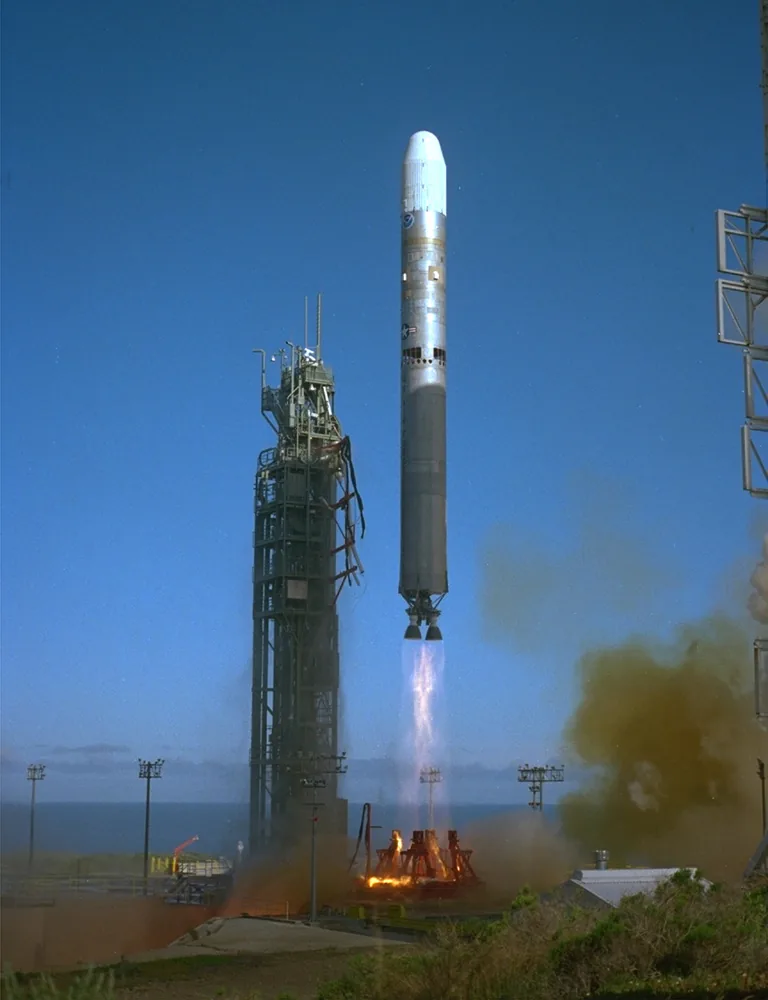
Figure 1: September 1988—A Titan 23G, refurbished from a retired ICBM, launches from Vandenberg Air Force Base, carrying USA-32 into a polar orbit.
II. Declassified Dossier: The Life and Times of USA-32
What was USA-32? Following the gradual declassification of late-Cold War space programs by the National Reconnaissance Office (NRO) in early 2026, the archives of this once-clandestine asset have finally become accessible to researchers.
USA-32 was part of the “Farrah” series of Signals Intelligence (SIGINT) satellites. Its primary mission was the interception and characterization of Soviet air defense radar signatures, surface-to-air missile fire-control frequencies, and high-frequency tactical radio communications.
| Technical Dimension | Verified Archive Data |
|---|---|
| Designation | USA-32 (Project Farrah III, COSPAR: 1988-078A, NORAD: 19460) |
| Lead Agency | National Reconnaissance Office (NRO) / US Air Force |
| Launch Date | September 5, 1988 (UTC) |
| Launch Vehicle | Titan 23G (A refurbished LGM-25C Titan II ICBM; this was its maiden flight) |
| Configuration | “Tuna Can” compact cylindrical bus; spin-stabilized for periodic antenna scanning |
| Operational Status | Active 1988–early 1990s; transponders deactivated; drifted derelict for ~30 years |
| Fragmentation Event | Circa 21:13 UTC, September 13, 2026 |
| Orbital Regime | Low Earth Orbit (LEO), ~775 km (480 miles), high-inclination polar orbit |
The “Farrah” codename was a nod to the era’s pop-culture icon, Farrah Fawcett—a common naming convention for clandestine projects at the time. Because the mission details were only declassified months before the explosion, the sudden announcement of its fragmentation was easily misinterpreted by the public as the loss of a “newly deployed” weapon system.
III. Physical Causality: Spontaneous Fragmentation in the Orbital Environment
Why does a satellite suddenly disintegrate after decades of silence?
Astrodynamics experts and orbital debris monitors note that “spontaneous fragmentation” is one of the most frequent accidents in LEO. Analysis from the 18th Space Defense Squadron points to two primary physical mechanisms for the USA-32 event:
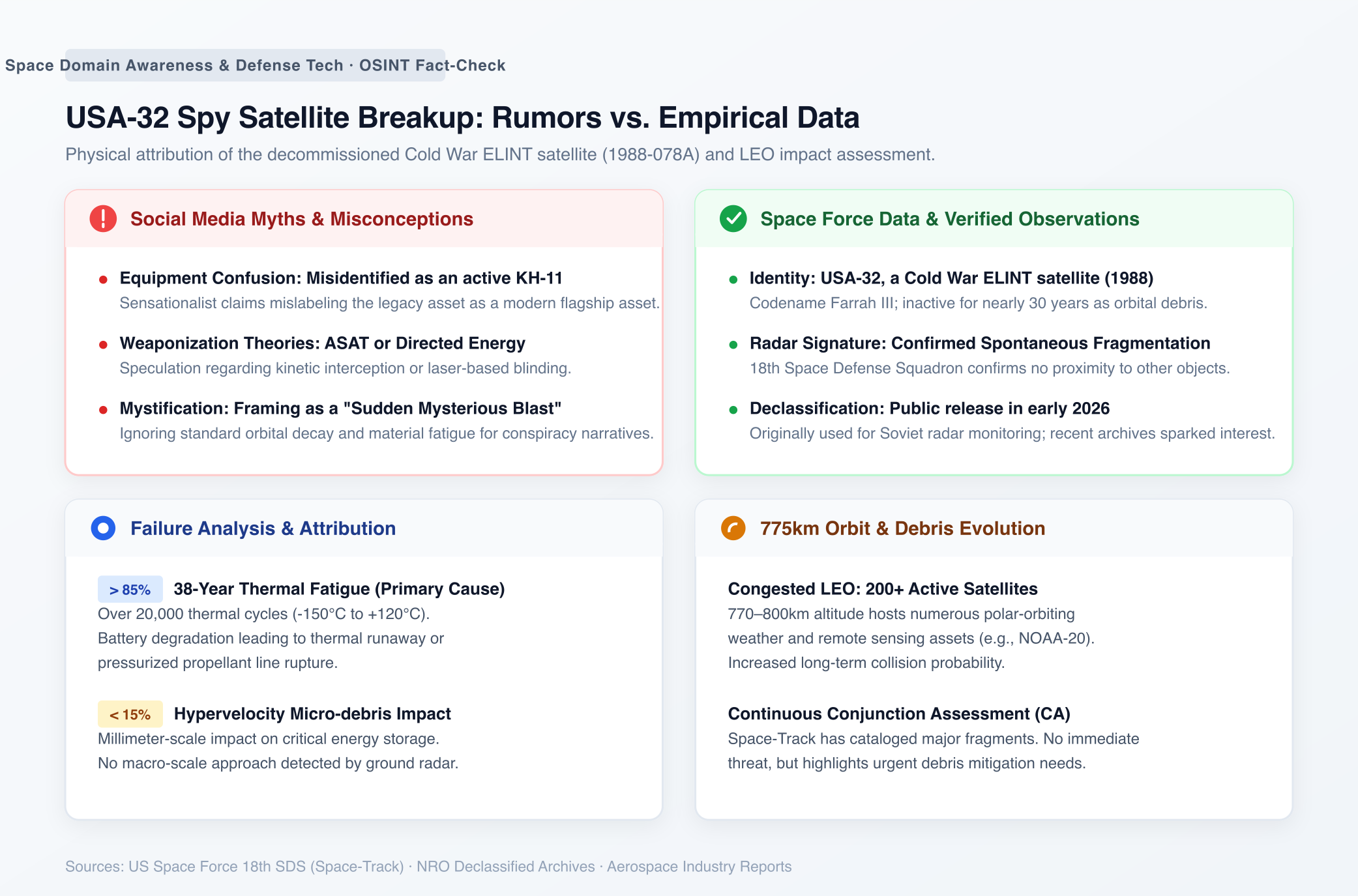
Figure 2: USA-32 Disintegration—A comparative matrix of social media rumors, empirical sensor data, and physical failure mechanisms.
1. Thermal Fatigue and Energy Storage Runaway (Probability > 85%)
This is the most likely culprit for a 38-year-old derelict:
- Cyclical Thermal Shock: At an altitude of 775km, the satellite completes an orbit every 100 minutes, transitioning from direct solar radiation (+120°C) to the Earth’s shadow (-150°C) 14 times a day. Over 38 years, USA-32 endured over 20,000 such cycles, leading to extreme material fatigue.
- Residual Propellant Rupture: Early satellites often bypassed “passivation”—the modern requirement to vent all remaining fuel and pressure. Residual hydrazine or high-pressure helium in USA-32’s tanks likely reached a critical failure point due to intergranular corrosion and thermal expansion, resulting in a structural burst.
- Battery Degradation: Aging nickel-cadmium or silver-zinc batteries suffer from separator degradation under constant cosmic radiation. An internal short circuit can trigger a rapid exothermic reaction, releasing high-pressure gases that shatter the satellite’s chassis.
2. Hypervelocity Micro-Debris Impact (Probability < 15%)
A secondary possibility is a kinetic strike from an untrackable piece of space junk:
- In LEO, relative velocities reach 7–14 km/s. A fragment just a few millimeters wide possesses enough kinetic energy to penetrate the satellite’s aluminum skin.
- If such a fragment struck a pressurized tank or a battery bank, it could trigger a secondary explosion. Since ground-based radar struggles to track objects smaller than 5–10 cm, such impacts occur without warning.
Based on the debris cloud’s morphology, US Space Command has categorized this as an internal physical failure, effectively ruling out external ASAT intervention.
IV. Orbital Situational Awareness: The 775km Risk Corridor
While USA-32 had zero tactical value, its disintegration creates a significant environmental hazard. In the context of Space Defense Hierarchies, the 770–800 km band is a high-sensitivity zone:
- High-Density Asset Corridor: This altitude is the “main street” for Sun-Synchronous Orbits (SSO) used by polar-orbiting weather and Earth-observation satellites. Over 200 high-value assets, including NOAA-20 and various European meteorological satellites, operate in this vicinity.
- The Persistence of Debris: At 775km, the atmosphere is too thin to provide meaningful drag. The hundreds of trackable fragments from USA-32 will remain in orbit for decades, if not centuries, before naturally decaying.
- Increased Conjunction Frequency: The 18th Space Defense Squadron has already cataloged the largest fragments for inclusion in daily Conjunction Assessment (CA) screenings. While no immediate collisions have occurred, active satellites will now be forced to perform more frequent “collision avoidance maneuvers,” consuming precious onboard fuel.
This event brings the Kessler Syndrome back into focus: the thousands of unpassivated Cold War-era satellites are essentially “ticking time bombs.” Without active debris removal (ADR) and stricter end-of-life protocols, these spontaneous explosions will continue to raise the “tax” on commercial space operations.
V. Conclusion: The Sunset of Cold War Legacies
The “spy satellite explosion” narrative, when stripped of its sensationalist veneer, reveals a clear logical path:
- The Bottom Line: This was not the start of a space war, nor the loss of a modern asset. It was the environmental collapse of a 40-year-old relic, USA-32, succumbing to the harsh reality of orbital physics.
- Information Governance: Defense-related topics are prone to conspiracy theories when keywords like “spy,” “explosion,” and “declassified” are combined. Relying on authoritative situational awareness data and cross-verified OSINT is the only way to pierce the information cocoon.
- The Hard Truth: The fragmentation of USA-32 represents an “ecological debt” from the era of unconstrained space exploration. As the commercial space sector grows exponentially, the challenge of cleaning up the “sleeping giants” of the Cold War remains a critical, unresolved mandate for global space traffic management.
Related Research & Topics
Tello Mobile eSIM
SafetyWing Nomad Insurance
* Disclosure: This post contains affiliate links. If you make a purchase through these links, V-G Journal may earn a small commission at no additional cost to you. We only recommend services we independently evaluate and trust.
FIRE and Golf:自由旅居之路
专注于为追求 FIRE 与品质生活的人群提供特惠打球权益与候鸟微度假。不持一砖一瓦,运营品质生活。