The Tehran Anomaly and the Logic of Planetary SEAD: Why Geopolitics Dissolves in Orbital Warfare
An analysis of the 2026 Tehran sightings through the lens of military operations research, deconstructing why strategic targeting priorities favor the destruction of global C4ISR hubs over regional tactical nodes.

Executive Summary: In late September 2026, footage of multi-colored luminous objects over Tehran’s Azadegan airspace ignited a digital firestorm, coinciding precisely with the 50th anniversary of the 1976 F-4 intercept incident. Beyond the fringe speculation lies a rigorous exercise in military operations research: If an interstellar force were to initiate hostilities against Earth, who constitutes the “First Strike” priority—Tehran or Washington? By stripping away geopolitical sentiment and applying the cold calculus of Suppression of Enemy Air Defenses (SEAD), C4ISR node weighting, and strategic retaliation thresholds, the answer is binary. Orbital warfare does not recognize political symbolism; it targets the planetary nervous system.
On the night of September 20, 2026, several short clips captured over the Tehran skyline achieved viral velocity. The footage depicted a cluster of luminous points—pulsating with RGB (Red, Green, Blue) transitions—drifting at low speeds and executing smooth, inertialess maneuvers over the Azadegan district.
The intensity of the public reaction was driven by more than just the chronic state of high alert in the Middle East. It was fueled by a profound historical synchronicity: exactly half a century ago, on the night of September 19, 1976, Tehran was the site of the Cold War’s most documented “UFO vs. Jet Fighter” encounter.
At this 50-year juncture, any routine nocturnal flight test or low-altitude exercise is inevitably shrouded in the surreal. This has prompted a fascinating, if seemingly absurd, hypothetical in military-intellectual circles: If a civilization capable of interstellar transit and orbital bombardment decided to wage war on Earth, who would be the primary target of the opening salvo—Tehran or Washington?
When we strip away the sensationalism of social media and the filters of geopolitical ideology, and instead view the question through the lens of military operations research and strategic SEAD (Suppression of Enemy Air Defenses) models, the logic becomes crystalline.
I. Dissecting Reality: The 2026 Luminous Objects vs. The 1976 Archives
Before engaging in strategic extrapolation, we must ground the Tehran phenomena in physical reality. Both contemporary sightings and declassified military records yield to cold engineering explanations.
1. Three Hard Facts Regarding the September 2026 Event
By cross-referencing military and meteorological data against the grainy zoom-lens footage, we can eliminate most extraterrestrial hypotheses:
- Zero Response from the Integrated Air Defense System (IADS):
Tehran is among the most heavily fortified airspaces in the region, ringed by Russian-made S-300 batteries and indigenous Bavar-373 and Khordad-15 long-range systems. On the night in question, no sirens were sounded, no anti-aircraft artillery (AAA) was tested, and the Revolutionary Guard’s radar networks remained in a non-kinetic state. If a physical entity capable of penetrating sovereign airspace were present, the ground-based defense architecture would not remain dormant. - Physical Signatures Consistent with Consumer-Grade Platforms:
The footage lacks fixed ground references and radar metadata, making it susceptible to the smoothing algorithms of modern smartphone night-mode sensors. The dynamics—low-speed hovering and shifting RGB LED patterns—are perfectly consistent with high-intensity LED kites or consumer-grade multi-rotor drone swarms, both common in the peri-urban areas of Middle Eastern metropolises. - Psychological Projection of the Anniversary Window:
The 24-hour delta between September 19, 1976, and September 20, 2026, is significant. In an environment of sustained geopolitical pressure, the public’s sensitivity to aerial anomalies is magnified, transforming a mundane civilian light source into a global trending topic.
2. Engineering Post-Mortem of the 1976 Incident
The 1976 Tehran incident, often cited as a “gold standard” by enthusiasts, does indeed possess a robust military paper trail.
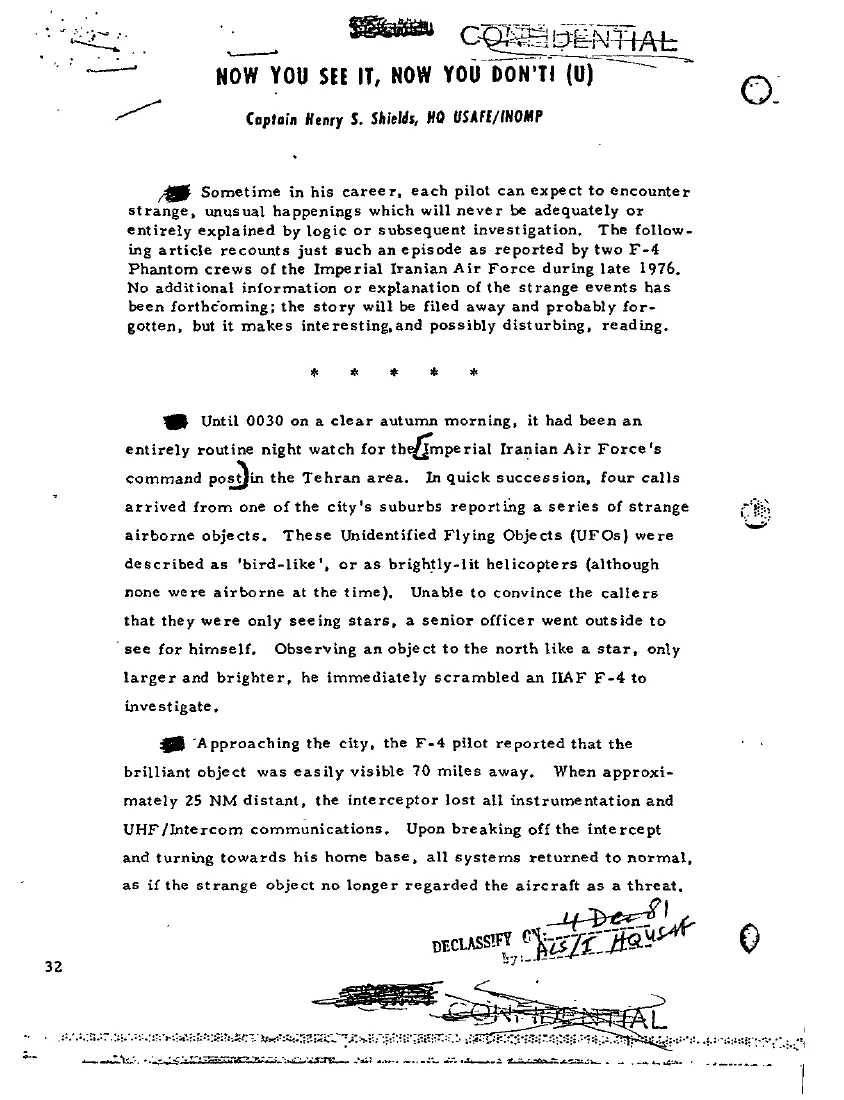
Figure 1: The first page of the declassified Defense Intelligence Agency (DIA) memo regarding the 1976 Tehran incident, documenting the avionics failure and fire-control lockouts experienced by Imperial Iranian Air Force F-4s.
During that event, the Imperial Iranian Air Force scrambled two US-made F-4 Phantom IIs:
- The first aircraft experienced a total failure of cockpit instrumentation, radio, and radar navigation at a range of 45 kilometers from the target, with systems recovering only after breaking contact.
- The second aircraft, piloted by Major Jafari, acquired a radar return equivalent to a Boeing 707. When attempting to fire an AIM-9 Sidewinder, the fire-control system suffered an instantaneous power failure.
While the Defense Intelligence Agency (DIA) drafted a classified memo for the White House and the Joint Chiefs of Staff, subsequent aerospace engineering reviews suggest a more terrestrial explanation. The Westinghouse APQ-120 radar and the F-4E’s early electrical bus were known to have vulnerabilities in high-static or high-electromagnetic load environments. Given the intense testing of high-power Electronic Countermeasures (ECM) by both superpowers in the region during the Cold War, the modern consensus leans toward high-altitude electromagnetic interference combined with avionics reliability flaws and pilot stress, rather than a display of extraterrestrial force.
II. Hypothetical Interstellar Conflict: Why the US is the Only Logical Target
If we push the scenario to its extreme—assuming a civilization with interstellar transit capabilities arrives in the solar system with hostile intent—who is the priority target?
In military science, there is no ambiguity: The United States is the undisputed Tier-1 priority, while Iran fails to even enter the initial strategic targeting sequence.
This has nothing to do with political bias or Hollywood tropes; it is a matter of the physical laws governing Suppression of Enemy Air Defenses (SEAD/DEAD).
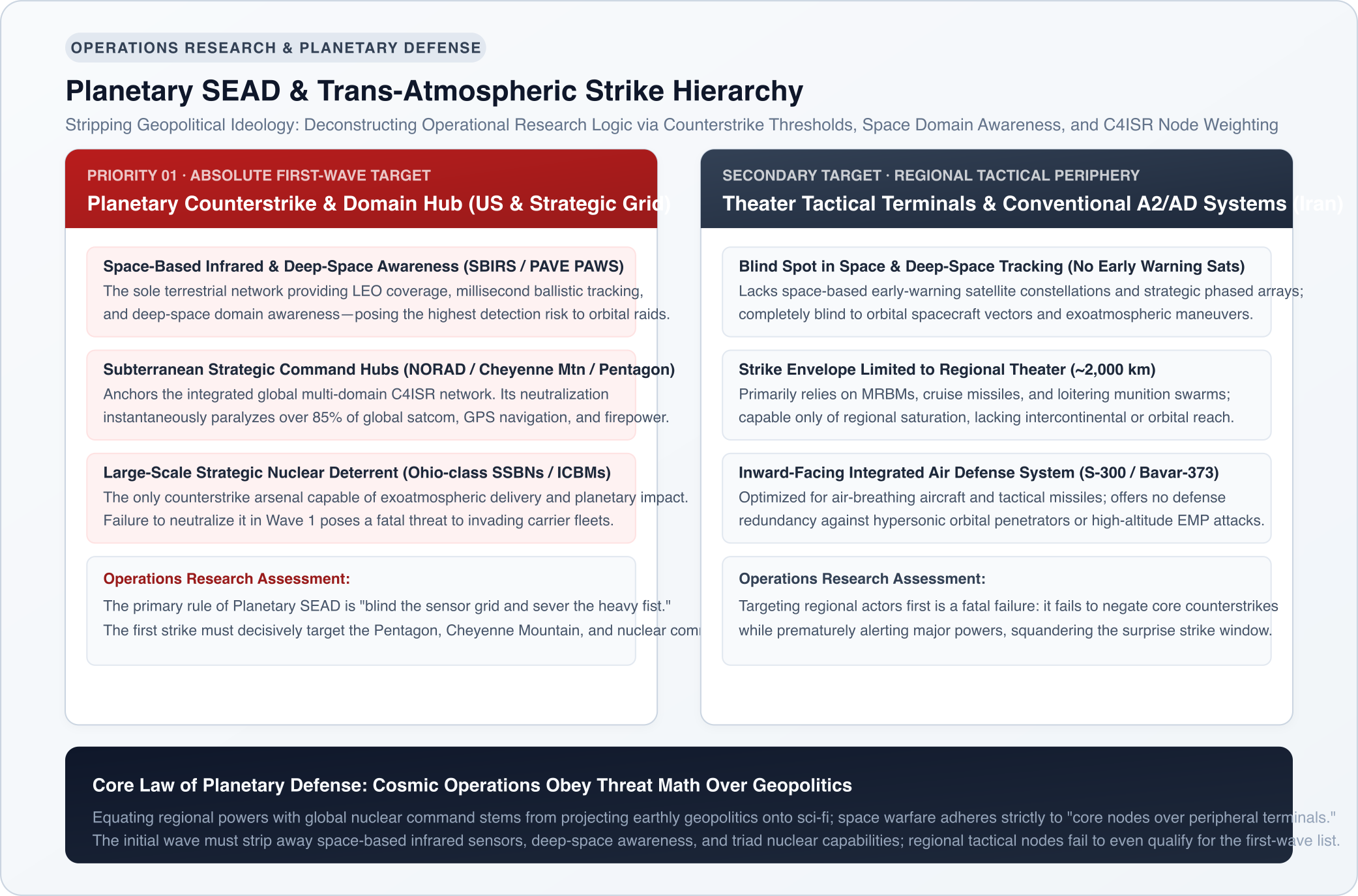
Figure 2: Strategic sequence model for planetary-scale military operations. Operations research dictates two iron laws: "Suppression of Retaliation Thresholds" and "Severing the C4ISR Backbone." The first wave must blind the planetary infrared "eyes" and neutralize nuclear counter-strike assets.
1. The Tactical Rigidity of the “Retaliation Threshold”
Any rational command system initiating a surprise assault on a foreign planet follows a singular principle: Allocate maximum fire density to neutralize any means the adversary has to threaten the mothership or orbital positions, while simultaneously stripping them of strategic situational awareness.
- The US Defensive and Deterrence Layer:
The United States maintains the world’s most sophisticated Space-Based Infrared System (SBIRS / Next-Gen OPIR) constellation, the PAVE PAWS long-range phased-array radar network, the NORAD deep-underground complex at Cheyenne Mountain, and a continuous-at-sea deterrent of Ohio-class ballistic missile submarines.
This is currently the only physical system on Earth capable of persistent Low Earth Orbit (LEO) surveillance, deep-space situational awareness, and the execution of a scaled, trans-atmospheric nuclear counter-strike. - The Iranian Defensive and Denial Layer:
Iran’s military strengths are concentrated in short-to-medium range tactical ballistic missiles, cruise missiles, and loitering munitions. Its effective strike radius is strictly regional (within 2,000 km). Its air defenses are designed for territorial sovereignty (S-300, Bavar-373); it lacks a space-based early warning constellation, deep-space tracking radars, and the anti-satellite (ASAT) or anti-ballistic missile (ABM) capacity to strike targets in orbit.
For an invading orbital fleet, bombing Tehran first would be a catastrophic failure in operations research: Destroying Iranian missile sites does nothing to degrade the planet’s actual nuclear retaliatory assets, but it would immediately trigger the global strategic warning network, granting the Pentagon and other major powers a window of several minutes to hours for total mobilization.
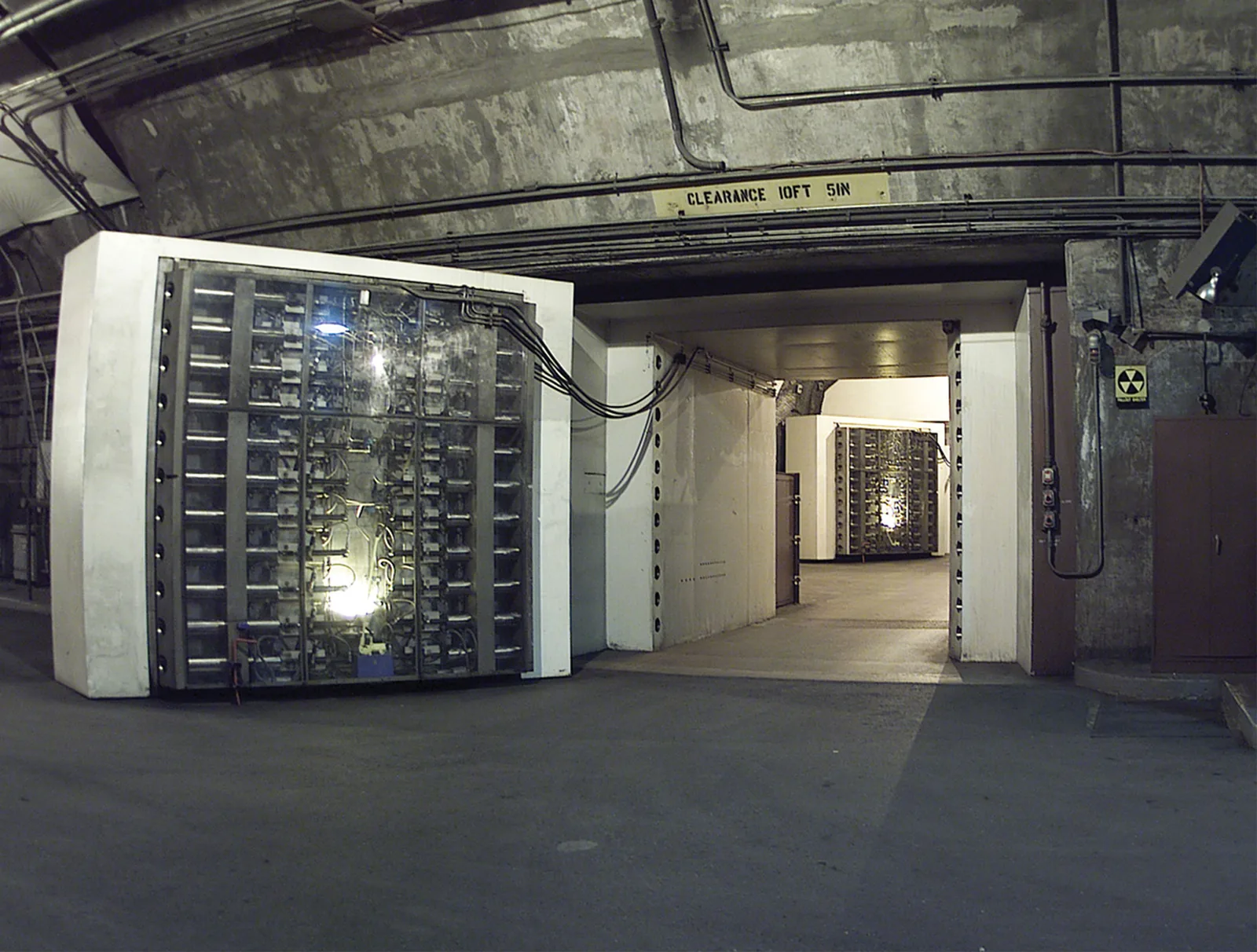
Figure 3: The 25-ton blast doors of the NORAD Cheyenne Mountain Complex. As the nerve center for planetary aerospace awareness and nuclear command, this is the primary physical target for any hypothetical planetary-scale strike.
2. The Node-Exclusion Principle of “Anti-Network Centric Warfare”
From a systems engineering perspective, paralyzing a multi-node planetary defense network requires severing the trunk, not pruning the branches:
- A first wave of kinetic weapons or High-Altitude Electromagnetic Pulses (HEMP) directed at the Pentagon, Cheyenne Mountain, Offutt Air Force Base (STRATCOM), and the command chains of major nuclear powers would cause an instantaneous collapse of GPS, military satellite communications, and theater-level missile defense coordination. The planet would be reduced to isolated, blind sectors.
- Conversely, even if every underground bunker and drone base in Iran were leveled, the global deep-space surveillance network would continue to function at full capacity, and the launch authorization chains for strategic nuclear submarines would remain intact.
In the cost-benefit model of battlefield operations, expending first-wave munitions on peripheral theater assets is a waste of the surprise window.
III. Cognitive Deconstruction: Why Does the Public Conflate Tehran and Washington?
If the military logic is so lopsided, why does public discourse frequently place these two nations on the same “first contact” plane?
This reveals a deep-seated cognitive projection: Humans tend to map secular geopolitical symbols onto sci-fi narratives without scrutiny.
In contemporary international political semiotics:
- The United States represents the apex of Western technological standards, conventional military hegemony, and the space-industrial alliance.
- Iran serves as a potent symbol of anti-hegemonic ideology, a central pivot of the Middle Eastern “powder keg,” and a repository of Persian mysticism—further amplified by the 1976 mystery.
When the public debates “who the aliens would hit first,” they are not calculating the detection range of phased-array radars or the re-entry trajectories of ICBMs. They are projecting a psychological desire for a cosmic deus ex machina to adjudicate Earth’s internal ideological conflicts.
However, once the perspective shifts to the interstellar dimension: At the cosmic scale, there are no ideological camps—only cold physical laws, energy gradients, and threat weights.
IV. Conclusion: Physics and Logic are the Only Universal Languages
The flickering lights over Tehran, lacking radar engagement or defensive response, remain routine civilian physical entities, amplified by the gravity of a historical anniversary and the thirst for digital engagement.
As for the “hard” hypothetical of an interstellar strike, the answer from operations research is as blunt as it is cold:
In the face of planetary-scale SEAD, what invites destruction is not the volume of one’s ideological rhetoric, but the sophistication of one’s information “eyes” and the weight of one’s strategic “fist.”
Related Research & Topics
Tello Mobile eSIM
SafetyWing Nomad Insurance
* Disclosure: This post contains affiliate links. If you make a purchase through these links, V-G Journal may earn a small commission at no additional cost to you. We only recommend services we independently evaluate and trust.
FIRE and Golf:自由旅居之路
专注于为追求 FIRE 与品质生活的人群提供特惠打球权益与候鸟微度假。不持一砖一瓦,运营品质生活。