The Friction Fallacy: Why 'Premium Pricing' Cannot Solve the Economics of Telecom Fraud
An analysis of the paradox of using high-cost calling to deter telecom fraud: from the dark history of revenue-sharing SP models to the reality of cost-evasion through compromised infrastructure and 'human consumables.'

Executive Summary:
In public discourse regarding the fight against telecommunications fraud, a seemingly “disruptive” proposal often resurfaces: “fighting fire with fire.”If the fundamental tenet of criminal economics is that the most effective way to prevent crime is to increase its cost, and if the business model of telecom fraud relies on massive outbound volume with low conversion rates, why not strike at the root? Why not reconfigure the entire network to function like the high-cost “premium-rate” lines of the 1990s? If every minute cost dozens of dollars, would the sheer overhead not force scammers into insolvency?
While the logic feels satisfyingly punitive, a cold-eyed simulation—grounded in telecommunications engineering, the dark history of regulatory failure, and the actual ledgers of cross-border syndicates—suggests a counter-intuitive reality: This would not end fraud. Instead, it would resurrect predatory “legal” billing models and effectively paralyze the neural pathways of modern communication.
I. The Boomerang of History: Premium Lines as the Original Breeding Ground
Those who suggest returning to high-cost “audio-text” hotlines often remember the astronomical bills for the caller, but forget the underlying commercial engine: The Revenue-Sharing Mechanism (SP Value-Added Service Settlement).
The bedrock of premium-rate calling was a split-fee agreement between the telecom carrier and the Service Provider (SP). For every minute a user spent on the line, a massive fee was generated; the carrier deducted a small access fee, and the lion’s share was settled directly into the SP’s coffers.
A look back at the late 1990s and early 2000s reveals that the most rampant and lucrative “gray-market” activities were parasitic on exactly this high-cost model:

Figure 1: Historical record of 20th-century manual switchboards and audio-text centers. The high-cost model of early premium lines relied on revenue sharing between carriers and SPs. Far from deterring crime, it birthed the “one-ring” callback scam and the unauthorized tapping of public lines.
1. The “One-Ring” Callback: The Ancestor of Modern Fraud
Criminals used automated dialers to blast millions of numbers, hanging up after a single ring. When unsuspecting victims called back out of curiosity, they were instantly connected to a premium-rate line.
The system would play simulated busy signals or fake greetings to stall for time. By the time the victim realized the ruse, the telecom system had already “legally” deducted hundreds of dollars, which the syndicate and the money-laundering channel then split 80/20 in the background.
2. Tapping Public Lines and Internal Theft
In the era of PBX (Private Branch Exchange) systems, the phone lines of government agencies, schools, and research institutes were frequently hijacked at night. Security guards, maintenance contractors, or external intruders would bridge external lines to these systems.
They would run automated dialers all night, calling premium-rate lines they owned. By the time the organization received its monthly bill—showing tens of thousands in losses—the syndicate had already cashed out and vanished.
If we were to re-implement high-cost calling today as a “defense,” we would essentially be handing organized crime a “license to rob.” Scammers wouldn’t need complex scripts about “police investigations” or “insurance premiums.” They would only need to keep you on the line for five minutes of idle chatter to legally drain your account through the carrier’s own billing rules.
II. The Fatal Blind Spot: Scammers Never Pay Their Own Bills
The argument that “massive call volume leads to prohibitive costs” contains a fatal microeconomic error: It assumes that criminal syndicates are law-abiding consumers using real-name accounts and paying the carrier’s public list price per minute.
In the actual trenches of cybersecurity and cross-border crime, no professional syndicate operates this way. Their access to communication resources is achieved through defensive penetration and “cost dumping”:
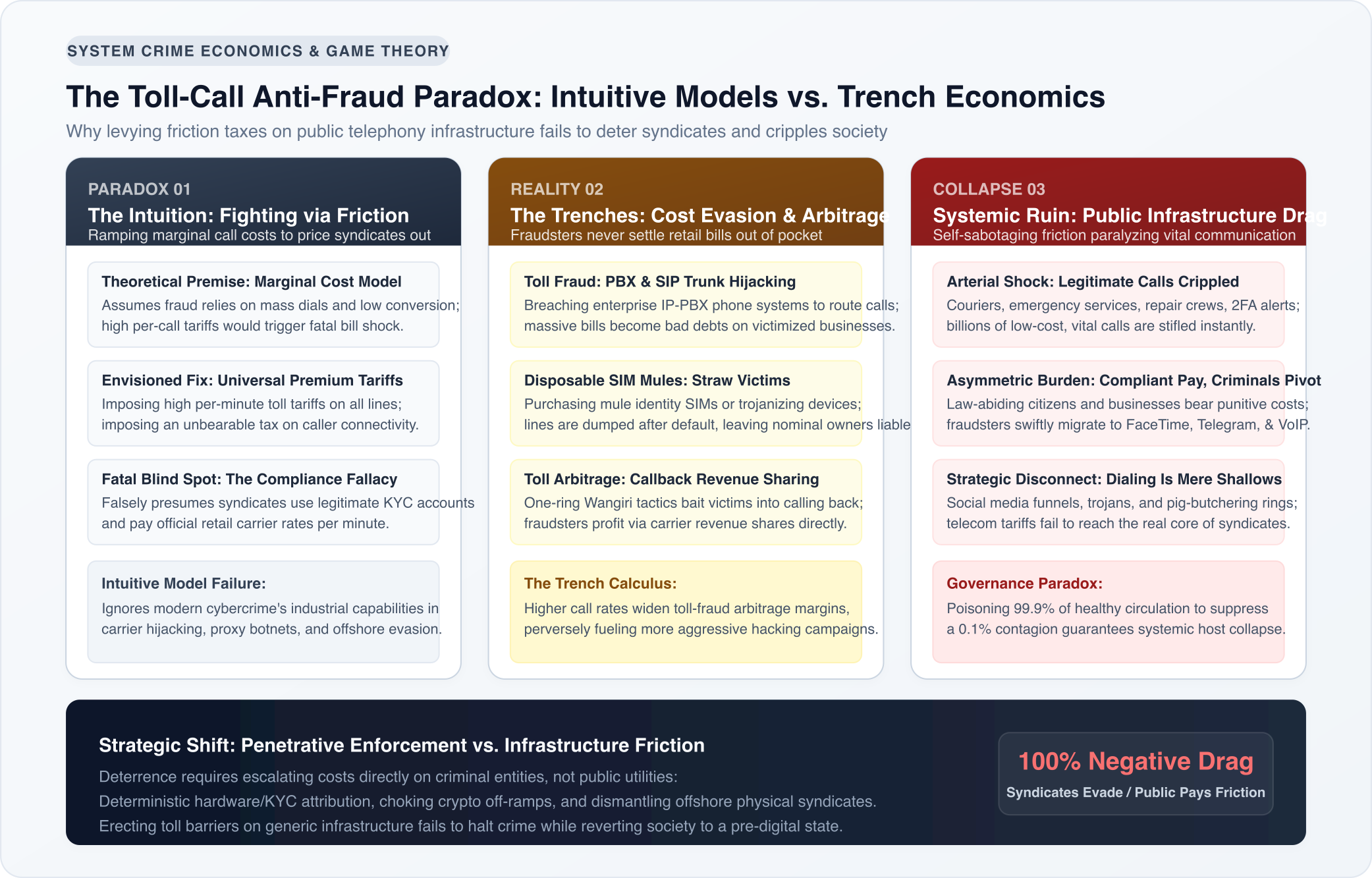
Figure 2: The logical paradox of “High-Cost Calls as Deterrence.” The intuitive model wrongly assumes criminals pay list price. In reality, costs are offloaded through SIP trunking exploits, “human consumables” (mules), and dark-web credit card fraud. High tariffs merely become a heavy friction tax on society.
1. SIP Trunk Penetration (PBX Hijacking)
Hackers use automated scripts to scan for open ports and weak passwords on IP-PBX systems used by small businesses, trading companies, and cloud call centers. Once breached, the hacker routes malicious outbound traffic through the legitimate company’s high-speed channels.
Over a single weekend, thousands of international calls are made. The resulting astronomical bill becomes the bankruptcy-inducing debt of the victimized company or a bad-debt dispute for the carrier.
2. “Human Consumables” and the Mule Economy
At the bottom of the black-market chain, syndicates harvest real-name SIM cards from students, elderly rural residents, or those with poor credit through “daily-pay” job postings or fake promotions. Alternatively, they use malware to turn a victim’s phone into a silent outbound relay.
To the syndicate, these cards are “disposable biological consumables.” Once the card incurs massive debt or is flagged by anti-fraud systems, it is discarded. The legal and financial consequences—the debt and the credit ruin—are borne entirely by the nominal cardholder.
3. Dark Web Carding and VoIP Funding
The funds used to top up VoIP (Voice over IP) channels often come from stolen credit cards bought in bulk on the dark web or from “black money” that needs to be laundered.
The Reality of the Ledger:
For a criminal syndicate, the cost of communication is not the “price per minute” on a billboard; it is the “attrition rate of the flow.” The higher the official tariff, the faster the hijacked businesses die and the heavier the debt on the “mules,” but it never stops the criminal who is playing with someone else’s chips.
III. The Infrastructure Catastrophe: A Toll on the Social Circulatory System
Modern telecommunications networks, like water, electricity, and roads, are “universal service” public infrastructures. Their core economic mission is to reduce the marginal cost of information flow and social collaboration to near zero.
If, to catch a thief, you installed high-priced toll booths on every street and alleyway, you wouldn’t eliminate theft; you would induce systemic shock in the city’s biology:
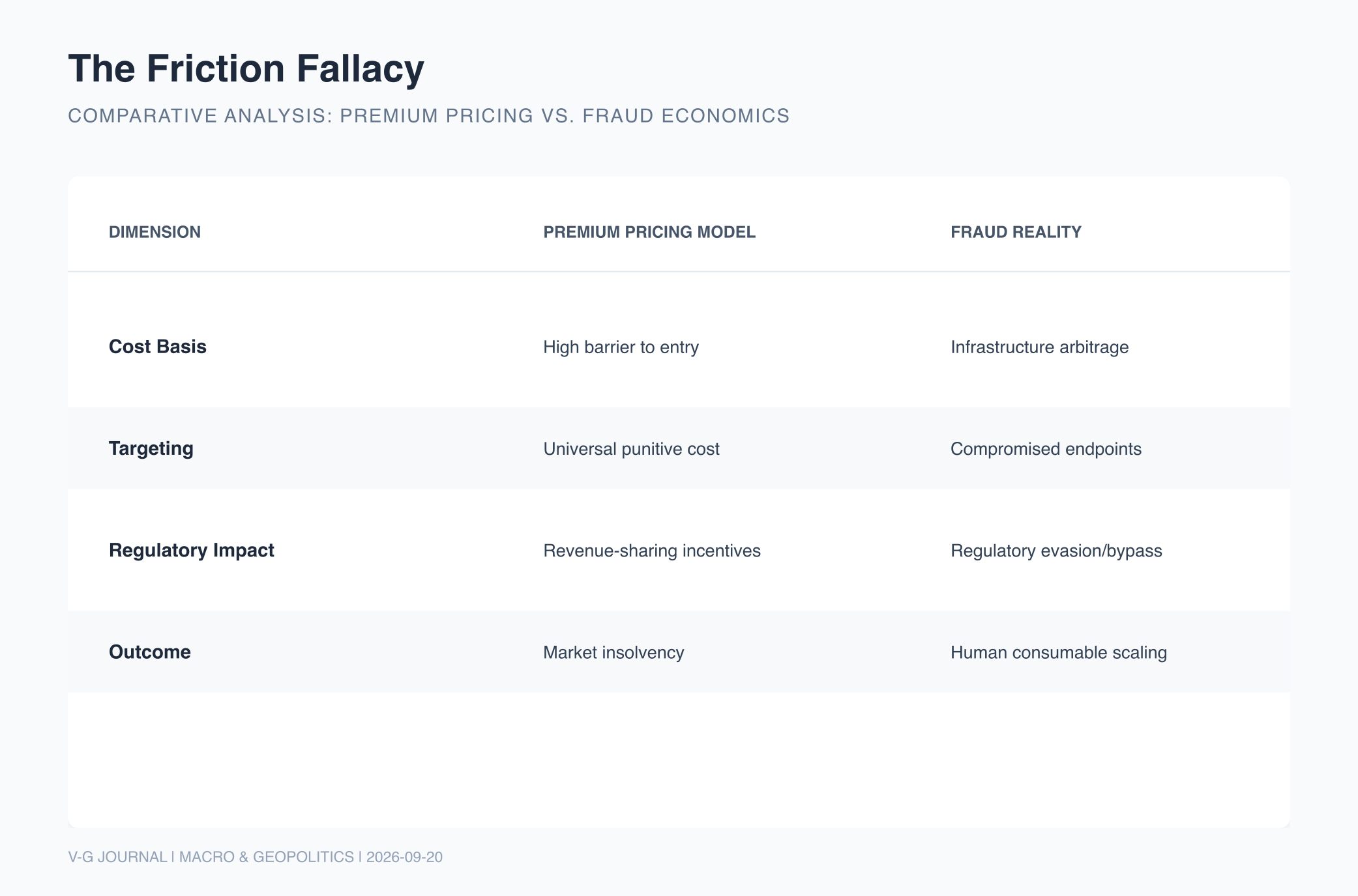
Figure 3: Modern telecom data center and fiber optic trunking. Public networks are zero-marginal-cost infrastructure. Attempting to build high-tariff walls to stop crime is akin to taxing the city’s main arteries to catch a mouse.
1. The Paralysis of Healthy Communication
Logistics notifications, food delivery coordination, bank fraud alerts, emergency utility repairs, hospital triage, fire and accident reporting—the billions of point-to-point interactions that keep modern society functioning rely on a low-cost foundation.
Once calling becomes expensive, this massive volume of daily, healthy communication is strangled by institutional friction. The efficiency of modern commercial collaboration would regress by decades.
2. The Tax on the Law-Abiding
Law-abiding citizens and compliant businesses are tethered to real-name registration and regulatory compliance; they must pay the high tariffs. Meanwhile, professional syndicates have already migrated their infrastructure.
They have long since moved to data-driven channels: end-to-end encrypted tools (Telegram, Signal, WhatsApp), Apple FaceTime exploits, or proprietary encrypted VoIP nodes hosted offshore.
Punishing 99.9% of the healthy circulatory system to stop the 0.1% of drug-resistant bacteria is a textbook case of failed governance through negative externalities.
IV. Temporal Dislocation: Traditional Dialing is Now the “Shallows” of Fraud
Focusing all defensive energy on the physical act of “making a phone call” reflects a profound misunderstanding of the industrial evolution of modern fraud.
As national anti-fraud platforms, hardware crackdowns on “GoIP” devices, and carrier-level AI monitoring have intensified, the share of fraud relying on traditional “blind calling” has shrunk significantly.

Figure 4: Offshore call center and network voice stations. Modern fraud is no longer a simple PSTN game; it is a composite digital industry relying on VoIP penetration, fake traffic, and endpoint poisoning.
The real attack funnel has evolved toward multi-channel, high-fidelity, and endpoint-permission penetration:
- Public-to-Private Conversion: Using short-video algorithms, fake job ads, or “Pig Butchering” (romance scams) to build long-term trust before moving the victim to encrypted apps for the final “harvest.”
- Endpoint Poisoning: Using fake government documents or phishing SMS to install malware that silently intercepts bank SMS codes, bypassing the call entirely to drain funds.
- Protocol Bypassing: Avoiding carrier networks altogether by using screen-sharing features in video conferencing software, built-in customer service chats on crypto exchanges, or spoofed internal channels within banking apps.
In these highly digitized trenches, the cost of a traditional phone call is irrelevant to the syndicate’s bottom line.
V. The Path Forward: Structural Penetration Costs vs. Infrastructure Friction
The effective way to prevent crime is indeed to increase the cost, but that cost must not be an indiscriminate “friction tax” levied on society. It must be a “Structural Penetration Cost” targeted specifically at the offender:
| Dimension | Wrong Direction: Infrastructure Friction (High-Cost Calls) | Right Direction: Structural Penetration Cost (Targeted Strike) |
|---|---|---|
| Who Bears the Cost? | Law-abiding citizens and businesses bear 99% of the friction. | Criminals, gray-market intermediaries, and money launderers bear the full cost of enforcement. |
| Technical Focus | Carrier billing rules and list prices. | Physical device tracing (targeting GoIP/SIM-bank supply chains). |
| Financial Strike | Encourages “legal” cash-outs via SP revenue sharing. | Cracking down on cross-border “money mules,” underground banks, and crypto-exit ramps. |
| Physical Space | Cannot reach offshore compounds. | International joint operations and physical border enforcement to break “safe havens.” |
| Social Efficiency | Destroys universal communication and trust. | Protects low-cost information flow while increasing digital security literacy. |
Attempting to build a high-priced wall at the end of the public network not only underestimates the escapability of modern crime but threatens to drive modern civilization back into the isolated, high-friction silos of the pre-internet era.
True security does not lie in shackling everyone; it lies in ensuring that no matter which dimension a criminal flees to, they face a certain and crushing cost for every attempt to reach out.
Related Research & Topics
Tello Mobile eSIM
SafetyWing Nomad Insurance
* Disclosure: This post contains affiliate links. If you make a purchase through these links, V-G Journal may earn a small commission at no additional cost to you. We only recommend services we independently evaluate and trust.
FIRE and Golf:自由旅居之路
专注于为追求 FIRE 与品质生活的人群提供特惠打球权益与候鸟微度假。不持一砖一瓦,运营品质生活。