The Tokyo Exodus Myth: Visa Tightening, Rate Hikes, and the Reality of Japan's Property Market
A fact-check dissecting claims that a Chinese speculator exit crashed Tokyo real estate in late 2026. Analyzing the 30 million JPY visa overhaul, central Tokyo's 170M JPY ceiling, and BOJ interest rate normalization.

Executive Brief: In the autumn of 2026, a sensationalist narrative swept cross-border real estate circles: “A mass exit and panic-selling by Chinese property speculators has ended Tokyo’s real estate bull run, triggering a market crash.” Data from the Real Estate Economic Institute (REEI), Tokyo Kantei’s monthly market index, and official policy directives from Japan’s Immigration Services Agency reveal that this narrative conflates two entirely separate phenomena. First, Japan’s decision to raise the minimum capital threshold for the Business Manager Visa sixfold—from 5 million to 30 million JPY in October 2025—forced a wave of low-tier speculators operating shell-company vacation rentals (minpaku) in Tokyo’s outer sub-markets and Osaka to liquidate at a discount. Second, existing 70-square-meter condominium prices across Central Tokyo’s 6 Wards entered a minor month-on-month consolidation of 0.3% to 1.2% after reaching a record high of 170 million JPY. However, average prices for newly built apartments across Tokyo’s 23 Wards continued to notch historic highs, exceeding 142 million JPY. The true drivers behind central Tokyo’s volume slowdown are the Bank of Japan’s policy rate hike to 1.0% and an affordability ceiling hit by local buyers, not a dramatic collapse driven by foreign capital flight.
I. Three Real-World Triggers: Why Liquidation and Stagnation Coincided in 2026
Viral financial rumors rarely emerge in a vacuum; they usually feed on misattributed local market friction. Between late 2025 and October 2026, three distinct events converged to fuel the “Chinese exodus” narrative:
1. The 30 Million JPY Visa Overhaul Triggers Peripheral Distressed Sales
Over the past decade, cross-border agencies built a low-cost pipeline for individuals seeking residency in Japan: establish a shell corporation with 5 million JPY (~$33,000 USD) in capital, purchase a dilapidated single-family home (akiya) or micro-apartment in outer Tokyo (e.g., Adachi, Katsushika, or Itabashi Wards) or Osaka for 20 to 40 million JPY, convert it into a vacation rental, and apply for a Business Manager Visa.
In October 2025, the Immigration Services Agency of Japan revised its ministerial ordinance. The minimum capital requirement jumped sixfold to 30 million JPY, accompanied by mandatory requirements to hire at least one full-time Japanese citizen or permanent resident, demonstrate JLPT N2-equivalent Japanese language proficiency, and submit a CPA-certified business plan.
By mid-2026, sub-tier visa holders unable to inject an additional 25 million JPY in paid-in capital or absorb annual local salaries and corporate taxes faced non-renewal. Forced to exit, many began dumping their peripheral residential assets and low-yield minpaku units at steep discounts. The sudden flood of distressed listings across Chinese brokerage channels provided the visual fodder for claims of a “speculator mass exit.”
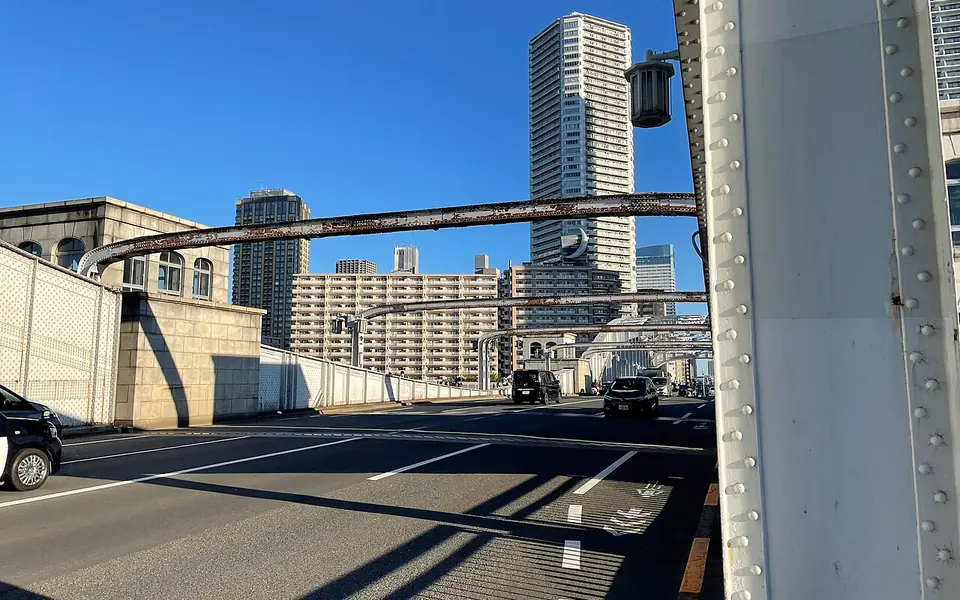
Figure 1: High-rise apartment towers in Kachidoki and the Tokyo Bay area. High-net-worth capital deployed fully into ultra-prime assets exists in an entirely different financial ecosystem than peripheral 5-million-JPY visa properties.
2. The Tokyo Kantei Existing Condo Index Pauses Its Historic Rally
Coinciding with this visa-driven liquidation was a shift in monthly reporting from Tokyo Kantei, Japan’s premier real estate analytics firm, during the summer and autumn of 2026:
- The average asking price for an existing 70-square-meter unit across Greater Tokyo registered its first month-on-month contraction (0.3% to 0.8%) after more than 20 consecutive months of gains.
- In Central Tokyo’s 6 Wards (Chiyoda, Chuo, Minato, Shinjuku, Bunkyo, Shibuya)—which had previously led the national bull run—the 70-square-meter resale benchmark plateaued at 172 million JPY. Active listing inventory rose roughly 15% year-on-year, prompting select buyers who had bought off-plan on leverage to trim asking prices by 3% to 5% to lock in liquidity.
3. Anti-Speculation Rules and Chiyoda Ward’s 5-Year Flip Restriction
To prevent residential real estate from drifting completely out of reach for local residents, municipal authorities in Chiyoda Ward issued formal guidelines to the Real Estate Association of Japan between 2025 and 2026. Developers were encouraged to implement strict 5-year anti-resale clauses (tenbai kisai) on new condominium lotteries and cap the number of units bought under a single entity.
This regulatory maneuver dismantled the short-term arbitrage model popular in the Tokyo Bay area and central districts—where investors would buy off-plan options via lottery and flip the contract upon construction completion for immediate multi-million-yen returns. As a result, short-term speculative capital quietly stepped aside.
II. Dissecting the Data: Did Tokyo Real Estate Actually Crash?
Concluding that Tokyo real estate crashed because Chinese buyers exited involves two fundamental analytical errors: mistaking high-level volume consolidation for a collapse, and drastically overestimating the weight of foreign retail investors in the overall market.
Data from the Real Estate Economic Institute (REEI), the Real Estate Information Network System (REINS), and Tokyo Kantei clarify the market reality:
| Market Segment | 2023 Baseline Benchmark | 2026 Observed Price | Late 2026 Price Trajectory | Foreign/Chinese Investor Share & Dynamics |
|---|---|---|---|---|
| New Condos: Tokyo 23 Wards (REEI) | ~105M JPY | Surpassed 142M JPY (Greater Tokyo >101M JPY) | Continues reaching all-time highs (+12% YoY) | Foreign buyers hold 15%–25% in select prime towers (Minato, Harumi); Taiwanese capital replacing mainland flippers. |
| Existing Condos: Central 6 Wards (70m²) | ~115M JPY | ~170M JPY (Chiyoda >200M JPY) | Sideways consolidation at historic peak (MoM dip < 1.2%) | Held primarily by cash-rich HNWIs and safe-haven capital; high holding conviction, no panic selling. |
| Peripheral Tokyo Old Homes / Micro-Units | 25M–45M JPY | 21M–38M JPY | Inventory surge; distressed sales at 8%–15% discounts | Highly concentrated among shell-company minpaku operators impacted by the 30M JPY visa policy change. |
Two underlying dynamics emerge from these metrics:
- New Supply Constraints Keep Prices High: Driven by strict labor hour caps enforced under Japan’s revised Labor Standards Act (the ongoing structural impact of the “2024 Problem” in construction and logistics) alongside elevated steel and material costs, new apartment supply across Tokyo’s 23 Wards remains constrained. Supply-side cost baselines have anchored average new unit prices firmly above 142 million JPY.
- Structural Polarization, Not General Decline: Price cuts and liquidations are concentrated in low-tier, peripheral assets—suburban single-family homes, outdated units, and unlicensed micro-rentals tethered to the old 5-million-JPY visa threshold. These low-tier assets have never served as pricing anchors for Tokyo’s prime core. As detailed in Japan’s Deflationary Wealth Mirage and Asset Polarization, Japanese real estate has entered a pronounced K-shaped divergence: core prime assets inflate alongside global capital, while peripheral, lower-quality stock depreciates over time.
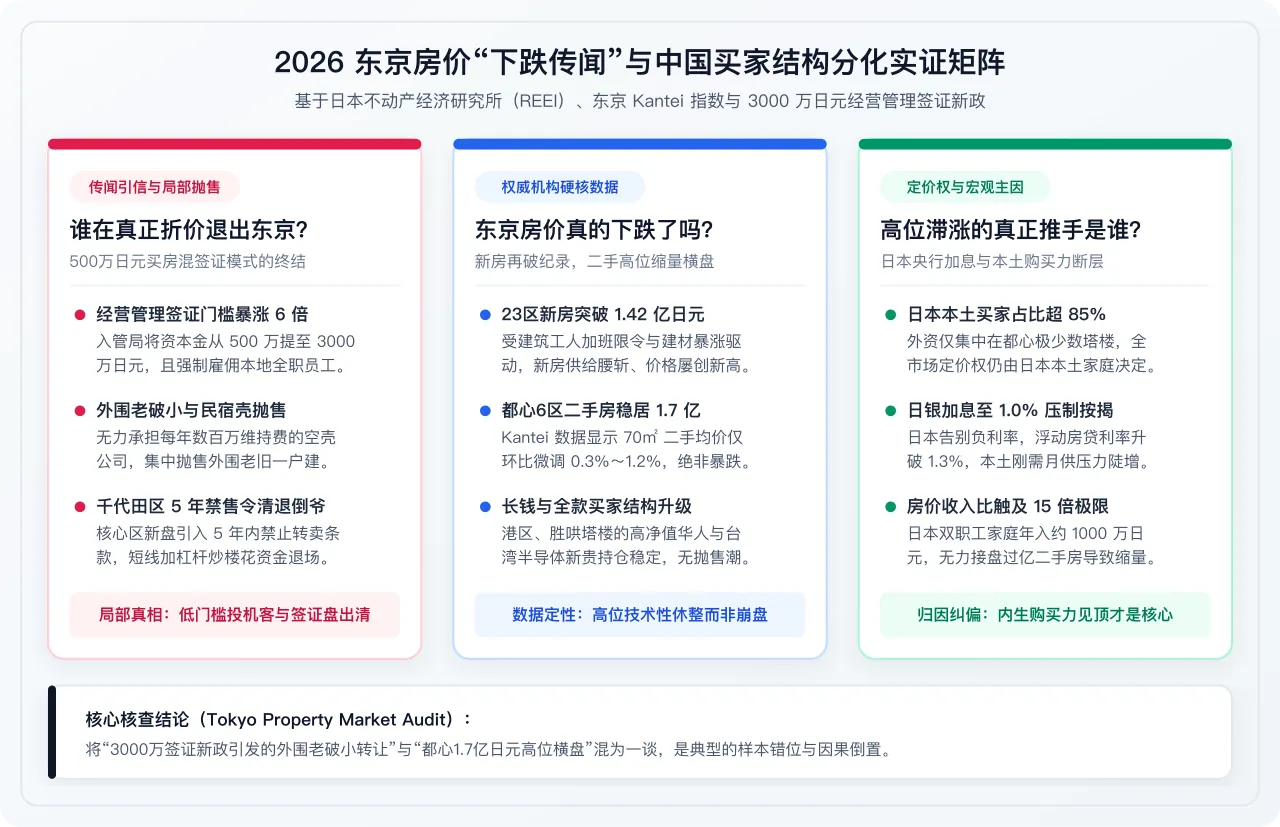
Figure 2: Empirical framework showing the separation between peripheral visa-linked liquidations, core asset resilience, and macroeconomic rate hikes in 2026 Tokyo real estate.
III. The True Drivers Pressuring Tokyo Real Estate in 2026
If the exit of low-end visa buyers does not dictate prime central prices, what caused central Tokyo resale prices to slow down in late 2026?
The actual drivers stem from domestic monetary policy and the balance sheets of local buyers.
1. The Bank of Japan’s Rate Hike to 1.0% Shifts Floating Mortgages
Tokyo’s decade-long residential bull run was underwritten by ultra-loose monetary policy. Local buyers relied on ultra-low variable mortgage rates (0.3% to 0.4%) with zero down payments and 35-year terms.
Between 2025 and 2026, the Bank of Japan advanced its policy normalization, bringing benchmark policy rates to 1.0%. In response, major commercial banks adjusted their prime lending rates, moving standard floating mortgage rates into the 1.3% to 1.6% range. For local buyers carrying 80 million JPY or more in debt, the jump in monthly service costs placed immediate pressure on disposable income.
2. The Local Household Price-to-Income Threshold
Local Japanese buyers account for over 85% of existing apartment transactions across Tokyo, led by dual-income professional households (“Power Couples”) earning 10 to 15 million JPY combined.
With average 70-square-meter resale apartments in the Central 6 Wards holding at 170 million JPY and secondary rings exceeding 110 million JPY, prices have reached 14 to 17 times average dual-income earnings. Given that commercial mortgage underwriting typically caps borrowing at 7 to 8 times gross annual income, local buyers face a hard ceiling on leverage for central properties.
The reduction in domestic purchasing capacity due to higher rates and high absolute prices is the primary driver of lower transaction volumes and slight price consolidation in Central Tokyo.
3. A Shift in Foreign Investor Demographics
Within the foreign buyer segment—which accounts for 15% to 20% of prime central tower sales—2026 brought a shift in buyer profile rather than a net capital outflow:
- Highly leveraged mainland Chinese buyers chasing short-term gains, alongside low-capital visa seekers, have exited the market.
- They have been replaced by two distinct capital pools: all-cash mainland high-net-worth buyers focused on yen asset preservation and rental yields, and Taiwanese tech executives and business owners benefiting from global semiconductor expansion (who, according to major Japanese brokerages, became the leading foreign buyer group in prime Tokyo launches in 2026).
For global investors navigating cross-border real estate allocation, reacting to media reports of a “Tokyo crash” misses the broader picture. Comparing regional value models—such as those analyzed in Japan Prefectures Wellness & Golf Rating—shows that capital is increasingly moving away from central towers with compressed gross rental yields under 2.8%, favoring high-utility lifestyle assets in regions like Karuizawa, Chiba, or central Fukuoka.
IV. Summary Findings
【Fact Check Verdicts】
- Verdict 1 (Visa Overhaul and Peripheral Liquidations: Confirmed): The Immigration Services Agency’s policy shift in October 2025—raising capital requirements from 5M to 30M JPY and introducing mandatory local hiring—forced low-capital operators of shell-company minpaku assets in Tokyo’s outer districts to liquidate at a discount throughout 2026.
- Verdict 2 (Claims of a Foreign-Driven Price Collapse: False): According to REEI and Tokyo Kantei data, average new apartment prices across Tokyo’s 23 Wards reached record highs above 142 million JPY in 2026, while central resale prices underwent minor consolidation (0.3%–1.2%) near historic peaks of 170 million JPY. Conflating peripheral liquidations with a central market crash misinterprets fundamental market data.
- Verdict 3 (Primary Market Drivers in 2026): The moderation in Tokyo’s price momentum is driven primarily by the Bank of Japan’s policy rate hike to 1.0%—which raised floating mortgage rates—and local household income limits among domestic buyers, who represent over 85% of overall market demand.
Related Research & Topics
Tello Mobile eSIM
SafetyWing Nomad Insurance
* Disclosure: This post contains affiliate links. If you make a purchase through these links, V-G Journal may earn a small commission at no additional cost to you. We only recommend services we independently evaluate and trust.
FIRE and Golf:自由旅居之路
专注于为追求 FIRE 与品质生活的人群提供特惠打球权益与候鸟微度假。不持一砖一瓦,运营品质生活。