The Strategic Guide to Round-the-World Business Class Tickets: Navigating Oneworld and Star Alliance
A comprehensive analysis of the underlying mechanics of RTW business class tickets. From continental vs. mileage-based algorithms to arbitrage strategies and itinerary optimization, this guide provides the tactical framework for high-frequency travelers and digital nomads.

Executive Summary: Following the discontinuation of traditional SkyTeam RTW passes in 2023, the global Round-the-World (RTW) business class market has consolidated into a duopoly: Oneworld (continental-based) and Star Alliance (mileage-based). For digital nomads, gap-year explorers, and frequent international professionals practicing Time Sovereignty, a well-architected 16-segment RTW ticket is more than a travel hack—it is a strategic asset. It can compress long-haul flat-bed costs to 40–60% of point-to-point pricing while serving as a high-leverage vehicle for securing elite airline status. This guide deconstructs the pricing algorithms, topological constraints, and arbitrage opportunities inherent in these alliances.
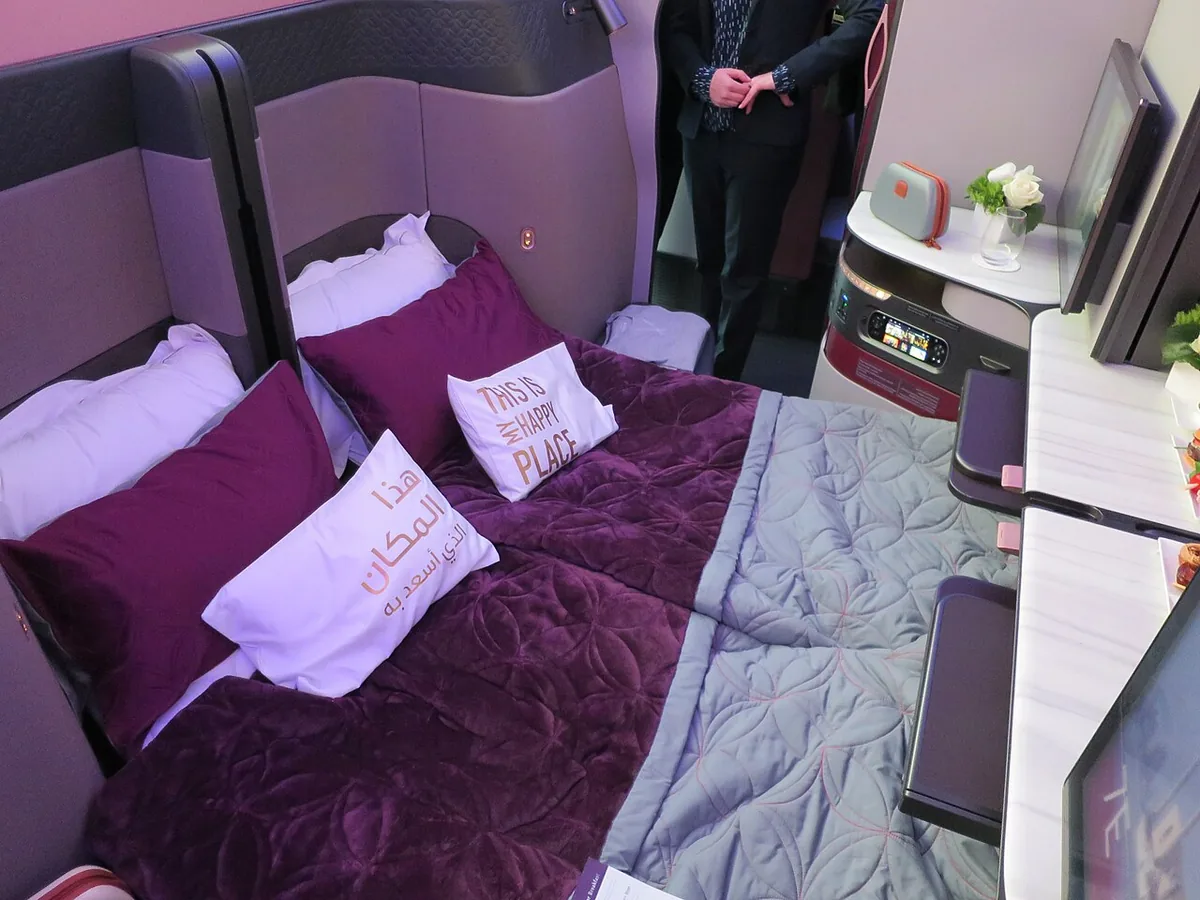
Figure 1: Qatar Airways Qsuite—the gold standard for long-haul Oneworld business class.
I. Pricing Models: The Continental vs. Mileage Divide
RTW tickets are not standard multi-city itineraries; they are standardized alliance passes governed by Special Prorate Agreements. The two major alliances operate on fundamentally different logic: Star Alliance utilizes a “Mileage-Based” system tied to Great Circle Distance (GCD), while Oneworld relies on a “Continental-Based” structure.
1. Core Parameter Comparison
| Metric | Oneworld Explorer | Oneworld Global Explorer | Star Alliance RTW |
|---|---|---|---|
| Pricing Basis | Continental Count (3–6 continents) | Total Mileage | Great Circle Distance (26k–39k miles) |
| Class Codes | DONE3, DONE4, DONE5, DONE6 | IGLOB26, DGLOB34 | Special (≤26k), Standard (up to 39k) |
| Max Segments | 16 (including surface gaps) | 16 (including surface gaps) | 16 (max 5 surface gaps) |
| Stopover Limits | 2–15 stops | Varies by mileage | 2–15 stops |
| Business Class Cabin | Typically ‘D’ or ‘I’ class | ‘D’ or ‘I’ class | ‘D’ or ‘Z’ class |
| Voluntary Refund | 5% of base fare | 5% of base fare | $150 USD per transaction |
2. Oneworld Explorer: The Continental Advantage
The Oneworld Explorer is widely considered the superior value multiplier for long-haul travelers because it decouples cost from total mileage.
- Zero Marginal Cost for Long-Haul: Once you purchase a specific continental tier (e.g.,
DONE4covering Asia, Europe, North America, and Oceania), the distance flown within those continents is irrelevant. Flying New York–Miami–Honolulu–Alaska costs the same as a shorter route. - The Middle East/North Africa Loophole: Oneworld classifies the Middle East and six North African nations (Egypt, Algeria, Morocco, Tunisia, Libya, Sudan) within the “Europe/Middle East” continent. This allows you to traverse Doha, Dubai, or Cairo without consuming an additional “Africa” continental quota.
- Elite Status Acceleration: A 16-segment
DONE4ticket often generates enough Tier Points to secure Oneworld Emerald status, granting lifetime-style access to the world’s most exclusive first-class lounges.
3. Star Alliance RTW: Density and Reach
Star Alliance leverages its 26 member airlines to offer the densest network. Its pricing is strictly tied to the Great Circle Distance (GCD) of the segments:
- Mileage Tiers: The 26,000-mile “Special” tier is the sweet spot for compact global routes (e.g., Asia–Middle East/Europe–North America–Asia). If your itinerary involves significant deviations (e.g., New Zealand, South Africa, or Argentina), you must scale up to the 34k or 39k tiers.
- Regional Connectivity: The Lufthansa Group’s dominance in secondary European cities and Ethiopian Airlines’ reach in Africa make this the preferred choice for non-standard, complex itineraries.

Figure 2: Decision matrix for selecting between continental and mileage-based RTW structures.
II. Rigid Constraints and “Anti-Gaming” Rules
Airlines impose strict rules to prevent RTW tickets from cannibalizing their high-margin, point-to-point business class revenue.
- The Closed-Loop Requirement: The journey must start and end in the same country. While you can start in Boston and end in San Francisco, you cannot end in a different country than the one you started in.
- No Backtracking: You must maintain a consistent global vector—either moving consistently East or West. You must cross both the Pacific and Atlantic oceans exactly once. Zigzagging between regions (e.g., Europe ➔ North America ➔ Europe) is strictly prohibited.
- Surface Gaps: If you travel between two cities by train or car, this is a “surface gap.” It counts as one of your 16 segments and, in Star Alliance, the distance between those two points is still added to your total mileage calculation.
- The 10-Day Rule: Most RTW tickets require at least 10 days between the first and last international segment. This is a defensive mechanism against corporate travelers using these tickets as cheap substitutes for last-minute, full-fare business class tickets.
III. Ex-Point Arbitrage and Tax Optimization
The base fare of an RTW ticket is determined by the country of origin, regardless of your nationality.
- Arbitrage Opportunities: Starting your ticket in a “low-cost origin” market can save you 20–40% on the base fare. Historically, markets like Cairo (CAI), Johannesburg (JNB), and Oslo (OSL) offer significantly lower base pricing due to currency fluctuations and local market dynamics.
- Tax Control: Avoid high-departure-tax hubs like London Heathrow (LHR). By using the Eurostar to reach Paris or Amsterdam before departing on your long-haul segment, you can bypass hundreds of dollars in Air Passenger Duty (APD).
IV. Strategic Applications
| Scenario | Why RTW Business Class? |
|---|---|
| Digital Nomad Gap Year | Unlimited date changes allow for a fluid, “slow-travel” lifestyle. |
| Nested RTW | Split a 12-month ticket into 2–3 major trips, returning home via separate low-cost flights. |
| Remote Island Hopping | High-cost destinations (e.g., Fiji, Easter Island) are “flattened” into the continental cost. |
| Status Runs | 16 segments in one ticket can secure top-tier airline status in a single month. |
The Math: A
DONE4ticket from a low-cost origin can cost ~$4,500. With 16 segments, your cost per flat-bed flight is roughly $280—often cheaper than a full-fare economy ticket on domestic routes.
V. Conclusion: Reclaiming Time as an Asset
The RTW business class ticket is not merely a travel product; it is a logistical infrastructure. By mastering the rules of airline alliances, you transform the high-friction, high-cost experience of global movement into a predictable, flexible, and comfortable network. When flying becomes a space for rest and deep work rather than a physical ordeal, the physical boundaries of your professional and personal life effectively vanish. In the era of time-sovereignty, this is the ultimate high-leverage skill.
Related Research & Topics
Tello Mobile eSIM
SafetyWing Nomad Insurance
* Disclosure: This post contains affiliate links. If you make a purchase through these links, V-G Journal may earn a small commission at no additional cost to you. We only recommend services we independently evaluate and trust.
FIRE and Golf:自由旅居之路
专注于为追求 FIRE 与品质生活的人群提供特惠打球权益与候鸟微度假。不持一砖一瓦,运营品质生活。