The Shelf-E-commerce Logic of Fiverr: Productizing Intellectual Capital in the Global Gig Economy
A strategic deconstruction of Fiverr’s algorithmic marketplace and its shift from labor-bidding to SKU-based service delivery. This essay explores how solo enterprises can bypass low-cost attrition through service productization and geographic arbitrage.

Curator’s Note:
In the pursuit of remote work, geographic arbitrage, and independent cash flow, global freelance platforms are often viewed as the most accessible entry points for digital nomads. However, most entrants fall into two traps: they are either lured by low barriers to entry only to be drowned by low-cost labor from emerging economies, or they remain stuck in the traditional “bidding” mindset—wasting hours on custom proposals only to find themselves in a “linear hours for linear pay” trap.Fiverr, founded in 2010 and now a NYSE-listed entity, fundamentally disrupted this logic. It moved away from the friction-heavy bidding model and reconstructed intangible intellectual labor into highly standardized, fixed-price “Gigs”—essentially a shelf-based e-commerce model for services.
To navigate this global bilateral market, one must look beyond the 20% platform rent and the rigid fulfillment algorithms. The real game is not selling cheap labor; it is “productizing” services through niche specialization and standardized SOPs to compress marginal delivery costs, thereby capturing the spread between high-purchasing-power currencies and localized operational costs.
I. The Paradigm Shift: Why Fiverr is a “Service E-commerce” Platform
In the global market for digital labor, two distinct transactional paradigms have emerged:

Figure 1: Fiverr’s branding. As a representative of micro-tasks and digital services, it reframes professional skills as standardized online commodities.
1. Bidding Crowdsourcing (Upwork) vs. Shelf E-commerce (Fiverr)
In traditional models like Upwork or Freelancer, the core mechanism is demand-driven bidding. A buyer posts a project, and freelancers spend “Connects” (platform credits) to write bespoke proposals. This model carries high transactional friction: buyers spend hours interviewing, while sellers waste significant energy on proposals that never convert.
Fiverr inverts this relationship through supply-driven shelf placement:
- The Seller packages a specific skill into a “Gig”—a digital product with a defined deliverable, timeline, and revision count.
- Each Gig typically features tiered pricing: Basic, Standard, and Premium.
- The Buyer does not post a job; instead, they browse the marketplace like an Amazon shopper, comparing samples and reviews before “checking out.”
- Once an order is placed, the seller executes via a pre-defined SOP. Upon acceptance, funds are released.
2. The Divergence of Marginal Delivery Costs
The significance of the shelf-based model lies in the transformation of a freelancer’s core asset. It shifts from “non-accumulative linear hours” to “data assets with compounding weight.”
In a bidding model, every project is a custom build, making it difficult to reduce marginal time costs. On Fiverr, once a standardized Gig is optimized with templates, automated workflows, and asset libraries, the delivery time per unit can be drastically reduced. This allows the seller to achieve an effective hourly rate far exceeding the market baseline.
II. Platform Mechanics: Rent, Cash Flow, and the Seller Hierarchy
Any business built on a centralized platform must account for “platform rent” and the underlying rules of the ecosystem.
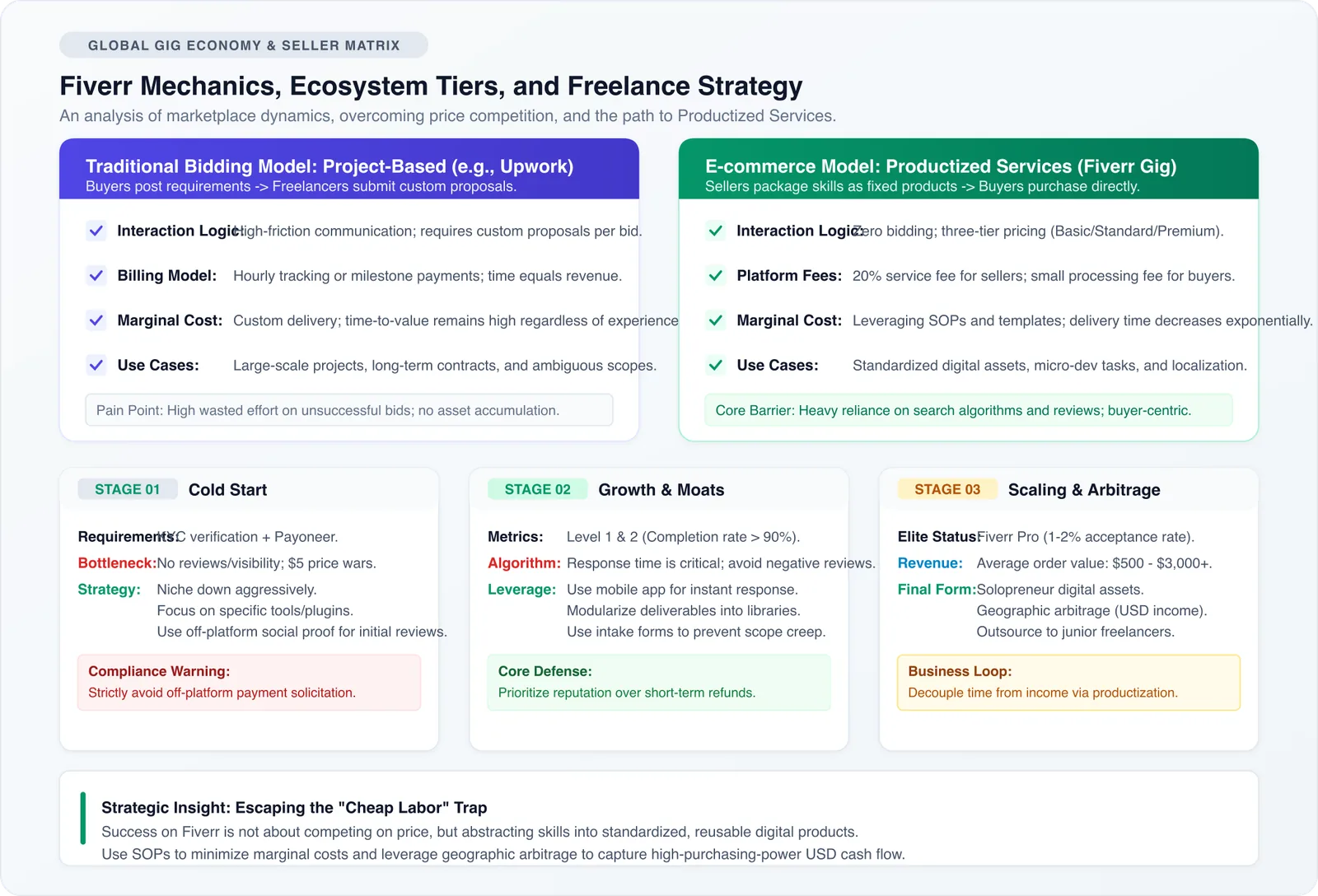
Figure 2: The operational logic of Fiverr, illustrating the transition from cold-start to productized scaling within the platform’s hierarchical matrix.
1. The 20% Commission and Escrow System
- Seller Commission: Fiverr deducts a flat 20% service fee from every order. A $100 order results in an $80 net credit to the seller.
- Buyer Fees: Buyers pay an additional service fee (roughly 5.5%) at checkout.
- Escrow and Clearing: Funds are held by the platform upon ordering. After delivery, the buyer has a 3-day review period. If no action is taken, the system auto-completes the order. Once completed, funds enter a 14-day safety clearing period (reduced to 7 days for Top Rated and Pro sellers) before they can be withdrawn.
2. The Seller Tier System
Fiverr’s search and recommendation algorithm is heavily weighted by a seller’s certification level:
| Seller Level | Key Advancement Metrics | Core Benefits & Visibility |
|---|---|---|
| New Seller | Basic registration and KYC verification | Up to 7 active Gigs; minimal organic exposure. |
| Level 1 | 60+ days active, 10+ orders, ≥ $400 earnings, 4.7+ rating, 90% response/completion rates | Up to 15 Gigs; ability to create custom offers and longer delivery add-ons. |
| Level 2 | 120+ days active, 50+ orders, ≥ $2,000 earnings, sustained performance metrics | Up to 20 Gigs; significant search weighting and “Handpicked” recommendations. |
| Top Rated Seller | 180+ days active, 100+ orders, ≥ $20,000 earnings, manual editorial review | VIP support; 7-day withdrawal clearing; high-ticket price premiums. |
| Fiverr Pro | Rigorous manual vetting of professional background and portfolio (1–2% pass rate) | Access to high-net-worth enterprise buyers; typical order values from $500 to $5,000+. |
III. Beyond the Low Barrier: The Invisible Moats
On paper, Fiverr has zero barriers to entry. In reality, building a sustainable, commercially significant cash flow requires surmounting several high-altitude “invisible mountains.”
1. The Baseline Requirements
Opening an account requires three fundamentals:
- KYC Compliance: A valid passport or ID and dynamic facial recognition.
- Cross-border Payment Channels: Integration with accounts like Payoneer or PayPal to facilitate fund repatriation.
- Professional Business English: While translation tools assist, the ability to parse complex requirements and manage client expectations in English is non-negotiable.
2. The Four “Deep Water” Zones
Barrier 1: The “Zero-Review” Wilderness
The Fiverr algorithm is a Matthew Effect amplifier. Search rankings favor established shops with hundreds of reviews. New sellers face a “cold start” problem where their Gigs may receive zero impressions for weeks without a specific breakthrough strategy.
Barrier 2: The Low-Cost Labor Attrition
General categories—basic logo design, simple bug fixes, or entry-level video editing—are saturated with providers from low-cost regions (India, Pakistan, Bangladesh). These sellers often price their labor at $5–$10. Without a distinct positioning strategy, sellers from higher-cost regions cannot compete on price alone.
Barrier 3: The Response Time Trap
Fiverr tracks “First Response Time” with extreme prejudice. The platform encourages replies within one hour. For those in different time zones, the peak inquiry hours for US/EU clients often fall in the middle of the night, creating a grueling demand for 24/7 availability.
Barrier 4: Extreme Buyer Protection
The platform’s rules lean heavily toward the buyer. In the early stages of a shop, a single 1-star or 2-star review—whether due to a misunderstanding or a “difficult” client—can tank a Gig’s average below the 4.7-star threshold, causing the algorithm to throttle search visibility almost instantly.
IV. The Red Lines: Non-Negotiable Risk Management
Operating a digital asset on Fiverr requires strict adherence to its “High-Voltage” policies:
- No Off-Platform Transactions: The internal messaging system uses sophisticated Natural Language Processing (NLP) to flag keywords like
PayPal,WhatsApp,Email, orSkype. Attempting to bypass the 20% fee by taking clients off-platform is the fastest way to a permanent ban. - No Multi-Accounting: Creating multiple shops in the same category or using the same IP/device for different identities is strictly prohibited.
- No Review Manipulation: Any attempt to “fake” five-star reviews through self-purchasing or coordinated groups will lead to account freezing and forfeiture of funds once detected by anti-fraud systems.
V. The Solopreneur’s Gambit: From Labor to “Productized Services”
If competing on price is a dead end, how does a solo enterprise build a defensive moat?
1. Strategy I: Niche Down to Avoid the Red Ocean
Do not offer “generalized skills for everyone.” Instead, cut deep into high-value, specific Western business scenarios.
- Bad Example: “I will write Python scripts” (Competing with 50,000 people at $5).
- Good Example: “I will build an automated synchronization middleware for Shopify stores connecting to specific ERPs” or “I will implement high-performance Pagefind search for Astro-based blogs.”
2. Strategy II: Productized Services and Delivery SOPs
The only way to escape the “time-for-money” trap is to treat services as standardized products:
- Deconstruct deliverables into modular components (code snippets, preset stylesheets, standardized audit checklists).
- Use the platform’s Requirements Questionnaire to force clients to provide exhaustive inputs upfront, locking the scope and preventing “scope creep.”
- Optimize the internal pipeline so that a task that takes 8 hours of custom work is compressed into 45 minutes of assembly. You charge for the value of the “product,” not the minutes spent.
3. Strategy III: Using the Platform as a Leverage Tool
For those building their own ventures (SaaS, digital media, or e-commerce), Fiverr is not just a place to earn; it is a distributed outsourcing engine:
- Hire native speakers for $15 to perform localized proofreading of landing pages.
- Outsource low-cognition, time-consuming tasks (competitor data scraping, icon slicing, or voiceovers).
- Focus your high-value energy on system architecture and core business logic while using global labor to handle the “last mile” of execution.
VI. Conclusion: Escaping the Prisoner’s Dilemma of Cheap Labor
Fiverr is ultimately a matching engine for global digital labor.
If you enter with a “gig worker” mindset—selling raw hours—you will be crushed by the 20% platform rent and the relentless competition from the world’s lowest-cost labor pools.
However, if you view it as a Productization Sandbox, using the shelf-based model as a lever to deliver high-value, standardized solutions to high-purchasing-power economies, the platform becomes a powerful springboard. It allows a solo enterprise to build automated cash flow and global credibility without the friction of traditional business development.
Related Research & Topics
Tello Mobile eSIM
SafetyWing Nomad Insurance
* Disclosure: This post contains affiliate links. If you make a purchase through these links, V-G Journal may earn a small commission at no additional cost to you. We only recommend services we independently evaluate and trust.
FIRE and Golf:自由旅居之路
专注于为追求 FIRE 与品质生活的人群提供特惠打球权益与候鸟微度假。不持一砖一瓦,运营品质生活。