The Physics of Exit: Chile's 1988 Plebiscite and the Structural Underpinnings of Authoritarian Transition
Dispelling the myth of dictators 'forgetting to rig elections,' this essay dissects Chile's 1988 plebiscite. It reveals how internal military divisions, parallel vote tabulation, and institutionalized safety nets transformed the electoral system from an authoritarian lubricant into a bulwark for democratic transition, grounded in the physics of power.

Core Insight: The anecdote that “Pinochet forgot to rig the election, leading to his downfall” is a pervasive myth among history enthusiasts. Yet, in the brutal calculus of realpolitik, no dictator ever “forgets to cheat” at a critical juncture concerning their life, limb, and absolute power. The military junta’s concession and exit in Chile’s October 5, 1988 plebiscite was a physical inevitability, squeezed by internal military fissures, the opposition’s penetrative parallel vote tabulation, the self-imposed constraints of a rule-of-law bureaucracy, tailor-made institutional safety nets, and the geopolitical red lines of the late Cold War. The ballot box is not a solitary guardian of democracy, but a scale. Absent the four physical struts of a neutral military apparatus, penetrable anti-fraud technology, pre-set secure exit pathways, and independent constitutional arbitration, mere elections often devolve into a legitimacy lubricant for authoritarian rule.
When discussing authoritarian transitions and democratization, a colorful historical narrative often circulates: in 1988, Chile’s military leader, Augusto Pinochet, supposedly “forgot to manipulate the votes” during a national plebiscite, either due to overconfidence or sheer oversight. Consequently, he swallowed the bitter pill of defeat and was forced to relinquish power.
Such narratives are catchy, easy to remember, and imbued with a cheap sense of predestined justice. Yet, they are entirely divorced from the brutal calculus of real political struggle.
The transfer of political power is never a parlor game. No dictator would ever “forget to cheat” at a crucial juncture concerning their absolute authority and personal survival. The true backdrop of Chile’s national plebiscite on October 5, 1988, was not a single individual’s oversight, but a predetermined outcome strictly embedded within a pre-existing institutional framework, meticulously squeezed and penetrated by multiple real-world forces.
Only by dissecting the micro-mechanics of this plebiscite can we truly answer: What role does the ballot box play in modern politics? Can electoral systems truly safeguard modern democracy on their own?
Deconstructing 1988: The Five-Fold Institutional Clamp That Locked Down Manipulation
The 1988 plebiscite was no spontaneous democratic largesse from the military government. It was a statutory process mandated by the transitional provisions of the 1980 Constitution, which Pinochet himself had largely orchestrated.
Under the institutional design of the time, the military government nominated a single presidential candidate (Pinochet himself), for whom the entire electorate would cast a “Yes” or “No” vote. If the “Yes” vote prevailed, he would continue as president for another eight years until 1997. If the “No” vote won, it would trigger a one-year constitutional transition period, culminating in fully open presidential and parliamentary elections in 1989.
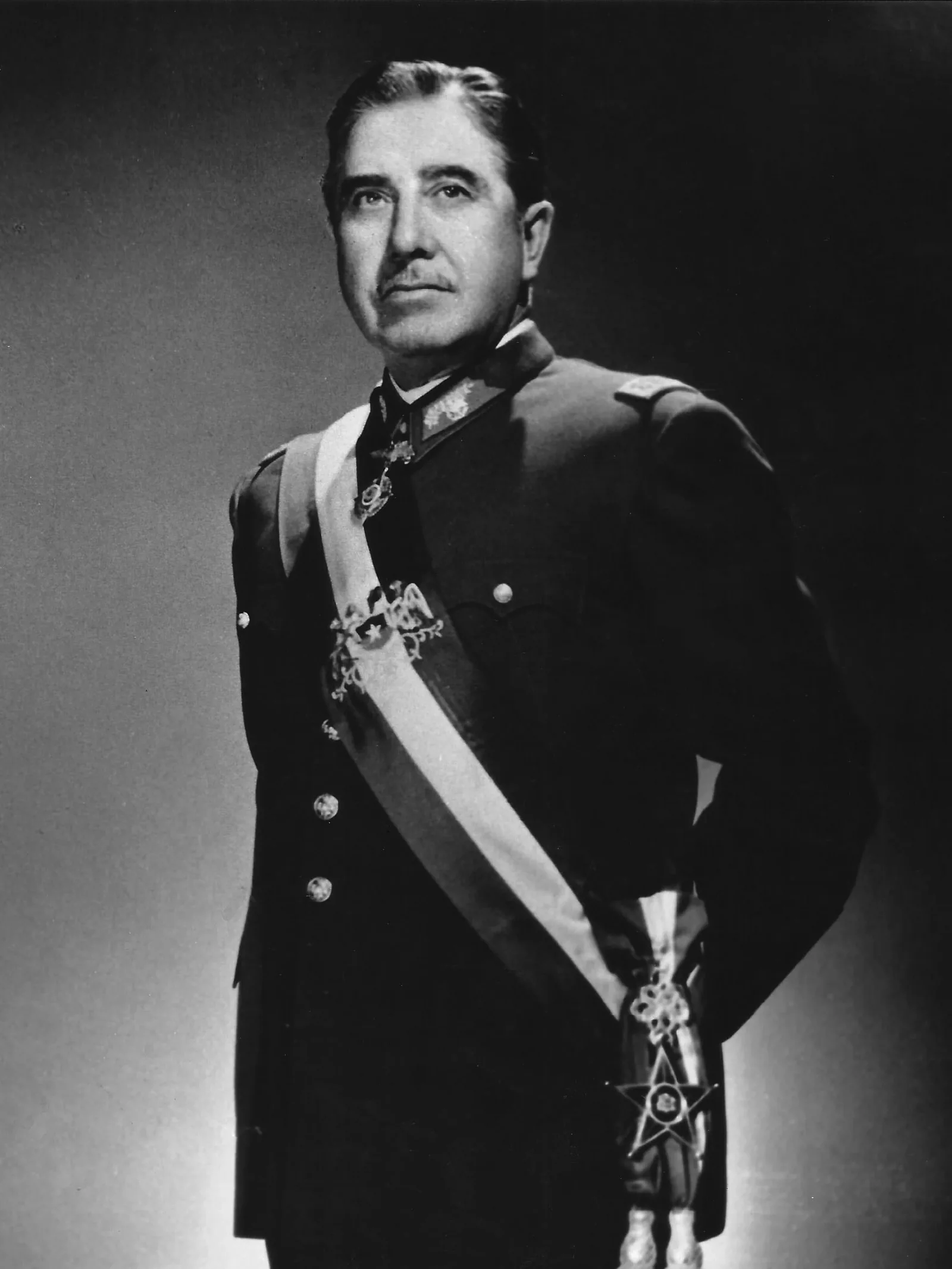
Figure 1: Augusto Pinochet, Chilean Army General and Chairman of the Military Junta. The 1980 Constitution established his authoritarian regime, while simultaneously embedding the statutory procedural track for the 1988 plebiscite.
The final vote count revealed: 55.99% for “No” and 44.01% for “Yes.” Pinochet ultimately swallowed defeat and signed the plebiscite concession, not because he lacked the will to reverse the outcome, but because a five-fold institutional clamp thoroughly locked down any physical space for him to overturn the results:
1. Internal Fissures and Inter-Service Dissent within the Military Apparatus
The military government was never Pinochet’s private fiefdom. The Governing Junta, established after the 1973 coup, was composed of the commanders-in-chief of the Army, Navy, Air Force, and the Carabineros (national police). Legislative drafts required unanimous consent from all four.
Around 10 PM on election night, as Interior Ministry statistics showed the “No” camp leading across major regions, the official vote count system abruptly stalled. Television screens went silent, replaying music for an extended period. Pinochet urgently convened the other three military chiefs at La Moneda Palace, attempting to declare a state of emergency, deploy the Army, and forcibly halt the plebiscite.
However, Air Force Commander Fernando Matthei, before even entering the palace, publicly declared to a scrum of international media: “It’s evident, to me, that the ‘No’ option won.”
Subsequently, Carabineros General Director Rodolfo Stange and Navy Commander José Merino likewise explicitly refused to sign an unconstitutional military decree during the closed-door meeting. When the instruments of state violence exhibit structural divisions, and the armed forces are not thoroughly “domesticated” by a single faction, any desperate military intervention would immediately escalate into armed conflict between the services. The marginal cost of military action became prohibitively high.
2. The Opposition’s Parallel Vote Tabulation Network and Micro-Penetration
Before the plebiscite, the “Command for the No Option” (Concertación de Partidos por el No), a coalition of 16 parties, learned from previous instances of electoral fraud across Latin America and organized an exceptionally sophisticated technical counter-measure.
The opposition trained and deployed hundreds of thousands of legally and statistically certified volunteer poll watchers nationwide, covering every single polling station (Mesa de votación) without blind spots. As soon as a ballot box was counted, poll watchers verified the stamped paper tallies on-site and transmitted the data from each polling station in real-time to the opposition’s technical command center via independent telephone and encrypted communication networks.
This decentralized, computer-based parallel vote tabulation system tabulated results nearly two hours faster than the official Interior Ministry. During the dangerous window of opportunity when the government attempted to exploit an information vacuum and delay official results, the opposition had already communicated its cross-verified, precise statistical results in real-time to international media, foreign embassies, observer missions, and the Catholic Church. The physical window for manipulation was completely sealed.
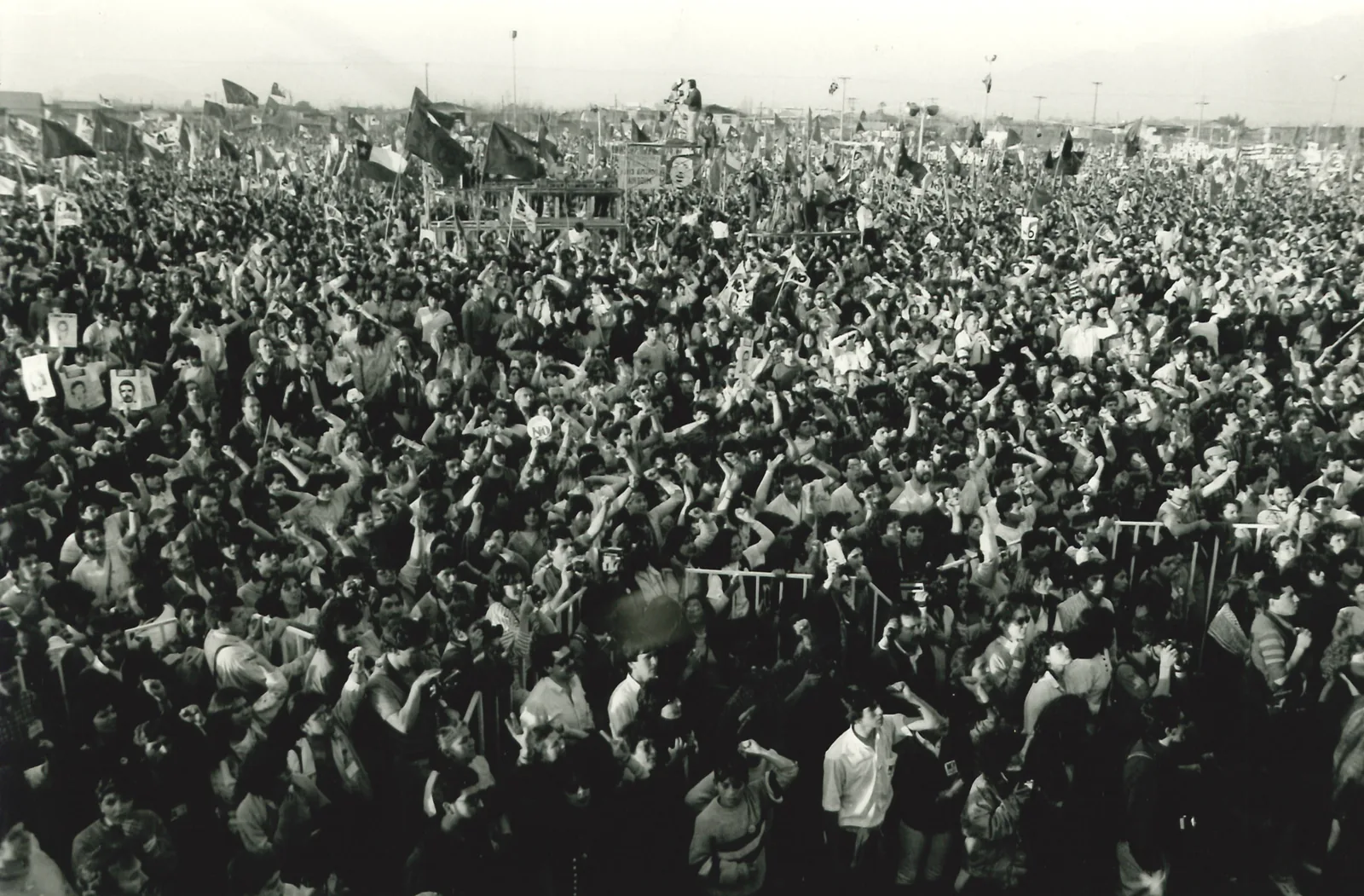
Figure 2: A mass rally for the opposition's "No" campaign in Santiago, Chile, on the eve of the 1988 plebiscite. A comprehensive civilian monitoring network and parallel vote tabulation technology completely locked down the time window for administrative manipulation.
3. Judicial-Bureaucratic Tradition and the Self-Imposed Institutional Constraint of the Electoral Court
The 1980 Constitution established the independently operating Electoral Qualifying Tribunal (TRICEL). Chile possessed a long-standing and deeply entrenched professional bureaucratic tradition of rule of law. Even during military rule, the technical neutrality of the judicial bureaucracy remained largely intact.
TRICEL formulated extremely stringent rules for voter registration verification and public display at each polling station, making it difficult for the executive to directly swap ballots under the joint scrutiny of judges, notaries, and multi-party representatives. The legal procedures, largely drafted under the military government’s purview, paradoxically became an institutional cage that the military government itself could not easily transgress.
4. Institutional “Safety Net” Lowered the Cost of Concession
The deepest physical driver behind an incumbent’s refusal to relinquish power in political struggles is the extreme fear of retribution, asset forfeiture, and physical elimination after losing power. If failure means utter ruin, any incumbent will choose to fight to the last bullet.
The 1980 Constitution tailor-made a robust institutional safety net for Pinochet and his military regime:
- Retention of Core Military Command: After stepping down as president, Pinochet retained his position as Commander-in-Chief of the Army until 1998.
- Judicial Immunity Shield: Upon stepping down, he automatically assumed a lifetime senatorial seat, granting him parliamentary immunity from prosecution.
- Rigid Military Funding Legislation: The Ley Reservada del Cobre (Secret Copper Law) mandated that 10% of total national copper export revenue be compulsorily allocated to the military budget, bypassing civilian parliamentary oversight.
This arrangement constituted a carefully calculated political quid pro quo: acknowledging plebiscite defeat meant losing only the head of state title; personal safety, property privileges, and the military’s fundamental power base remained intact. Concession thus became the rational choice of least resistance.
5. Cold War Geopolitical Red Lines
By 1988, the broader outcome of the US-Soviet Cold War was already determined. The Reagan administration in the United States had completely recalibrated its Latin American strategy, and the geopolitical imperative of propping up authoritarian military regimes to contain leftist expansion had completely vanished.
US Ambassador to Chile Harry G. Barnes Jr. and the Under Secretary of State repeatedly drew an unequivocal red line for the military government’s high command: in the event of widespread electoral fraud or violent military intervention, the US would immediately cut off multilateral credit, initiate comprehensive economic sanctions, and unite the international community in refusing to recognize the regime’s legitimacy. These external hard constraints completely severed any path for a risky reversal.
Is the Electoral System Truly a “Guardian” of Democratic Politics?
Having clarified the micro-mechanics of the 1988 struggle, we must now strip away the moral mystification of formal democracy and the ballot box.
The conclusion is clear: the mere “ballot box and electoral system” is by no means a solitary guardian deity of democratic politics. It is, in essence, simply an interface for settling the outcomes of political power struggles.
In global political practice, “electoral authoritarianism” is, in fact, one of the most prevalent tools of governance. Many non-democratic regimes regularly hold elections, which allows society and the opposition to vent public grievances within a controlled framework (acting as a low-cost safety valve), precisely identifies dissenters through vote patterns, and cheaply whitewashes the legitimacy of their rule with “over 90% of the vote.”
In such structures, elections are not guardians; they become a sophisticated lubricant for the authoritarian machine, dampening shocks and noise.
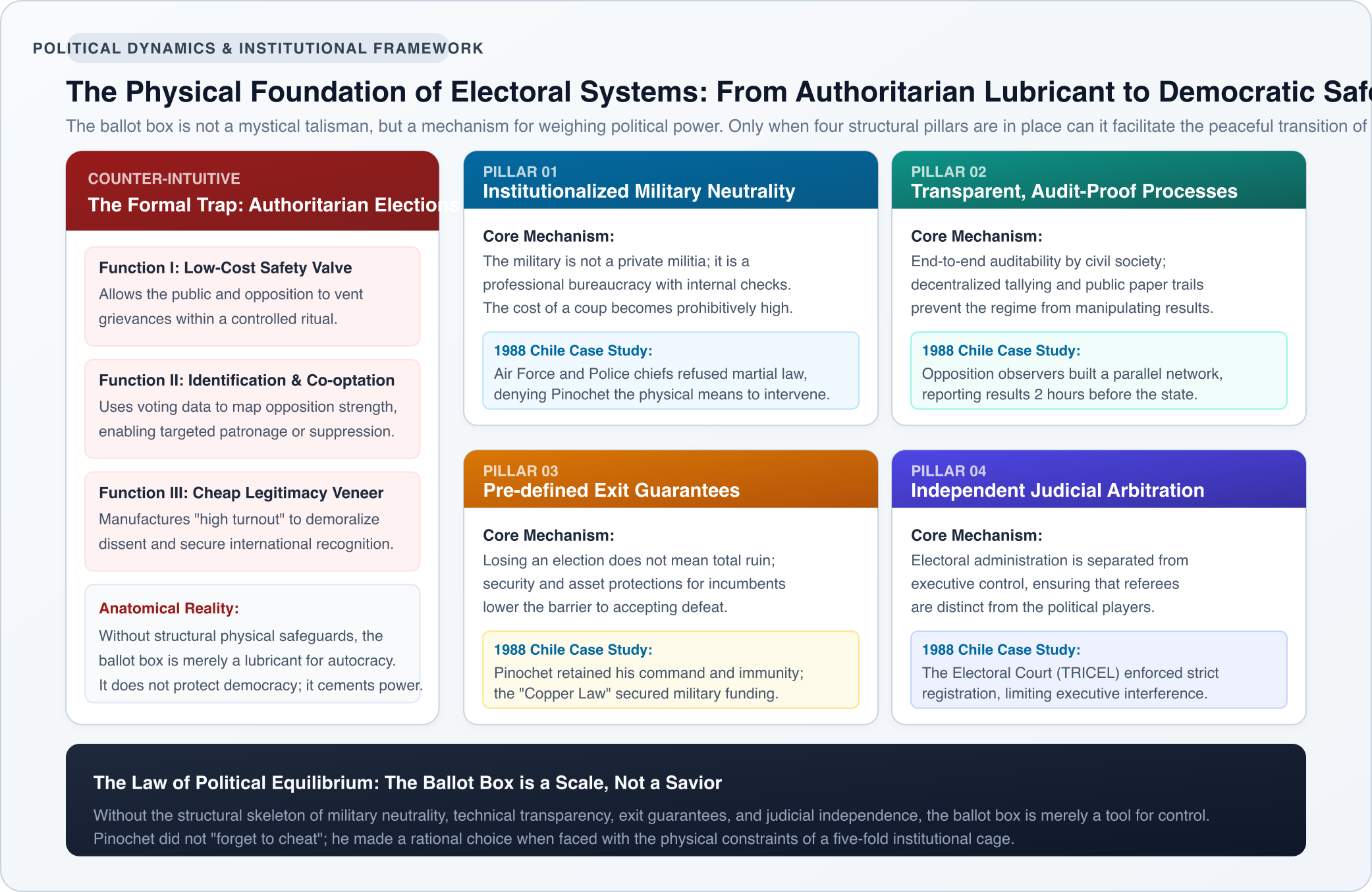
Figure 3: The physical pillars of electoral mechanisms. Only when the four pillars of neutral violence, technical penetrability, secure exit, and independent arbitration are simultaneously effective can the ballot box truly facilitate the peaceful transfer of power.
Electoral systems can only truly transform into a bulwark for democracy when the following four hard physical struts are simultaneously effective:
1. Neutralization and Division of the Military Apparatus
Whether the instruments of force obey constitutional order or the personal whims of the ruler is the primary physical determinant of whether an election possesses actual efficacy.
If the military and police are completely domesticated by the ruling faction, any unfavorable election outcome will be immediately labeled as “external subversion” or “illegal rebellion” and met with physical elimination. Only when the military and police systems exhibit professionalized bureaucratic characteristics, possess statutory checks and balances between services, and the cost of violent enforcement becomes prohibitively high, does the compact of peaceful transition gain real enforceability.
2. Micro-Penetrability and Immutability of Underlying Processes
Without rigorous monitoring and decentralized auditing, the ballot box is merely a magician’s prop.
For electoral systems to be effective, their processes must be micro-penetrable by the public and all competing parties: from voter registration to prevent impersonation, public on-site tallying, dual verification with physical paper records, to decentralized vote transmission networks. Elections lacking underlying technical audit capabilities are simply announcements of results, a unidirectional output of power.
3. Secure Exit Pathways and Re-Engagement Spaces Under Pre-Set Rules
Political struggles adhere to principles of utility maximization and risk aversion. If electoral defeat means total deprivation, imprisonment, or physical elimination, incumbents will inevitably destroy the rules at all costs.
For elections to function sustainably, those who lose must still retain property security, personal freedom, and the space to re-engage in the political game through legitimate competition in the future. Chile’s peaceful transition was, to a large extent, a “privilege for exit” compromise with the former military establishment.
4. Constitutional Arbitration Independent of the Executive
If the ultimate authority for electoral district demarcation, candidate qualification review, and fraud dispute investigation is entirely monopolized by the ruling party, the referee and the player become one. In such a scenario, the electoral system loses the fundamental baseline of procedural justice. There must exist a relatively neutral judicial system or independent electoral court as the final arbiter.
Conclusion: The Framework Determines the Reading, Physics Dictates the Outcome
Pinochet did not “forget to cheat.” He
Related Research & Topics
Tello Mobile eSIM
SafetyWing Nomad Insurance
* Disclosure: This post contains affiliate links. If you make a purchase through these links, V-G Journal may earn a small commission at no additional cost to you. We only recommend services we independently evaluate and trust.
FIRE and Golf:自由旅居之路
专注于为追求 FIRE 与品质生活的人群提供特惠打球权益与候鸟微度假。不持一砖一瓦,运营品质生活。