The Architecture of Deception: Decrypting OSINT-Driven Social Engineering
An exploration of how Open-Source Intelligence (OSINT) transforms social engineering from random phishing into surgical psychological warfare. We dissect the four-stage attack chain—from digital breadcrumbs to pretexting—and outline the defense-in-depth strategies required for the digital age.

Curator’s Note:
In the popular imagination, the hacker is a Hollywood trope: a technical savant watching green code cascade across a screen, breaching fortresses with zero-day exploits and esoteric algorithms. Yet, in the high-stakes theater of Red Teaming, state-sponsored APTs, and corporate espionage, over 90% of successful breaches begin with a method that is ancient, visceral, and notoriously difficult to patch: Social Engineering.Traditional social engineering relied on “spray and pray” tactics—bulk SMS scams or generic invoice spoofs—easily caught by basic filters and rudimentary awareness. Today, however, the synthesis of social engineering and OSINT (Open-Source Intelligence) has birthed a new, surgical paradigm: OSINT-driven Targeted Social Engineering.
Attackers no longer hammer at the hardened walls of encryption protocols; they target the most vulnerable neuron in the system: human trust, weaponized by the unconscious leakage of digital breadcrumbs. This essay deconstructs the core attack chain, the psychological mechanics of the “breakthrough,” and the necessary defense-in-depth for the modern professional.
I. The Core Logic: OSINT as the Armory
In the modern theater of cyber-warfare:
- OSINT (Open-Source Intelligence): The intelligence gathering phase. It is the art of mining, extracting, and correlating data from public, legal, and unprivileged sources.
- Social Engineering: The psychological execution phase. It exploits human heuristics—trust, greed, empathy, authority, and urgency—to induce actions that bypass security protocols.
When combined, social engineering evolves from a game of probability into a precision-guided munition. The attacker aggregates the victim’s digital debris into a “mosaic” that shatters the target’s psychological defenses.
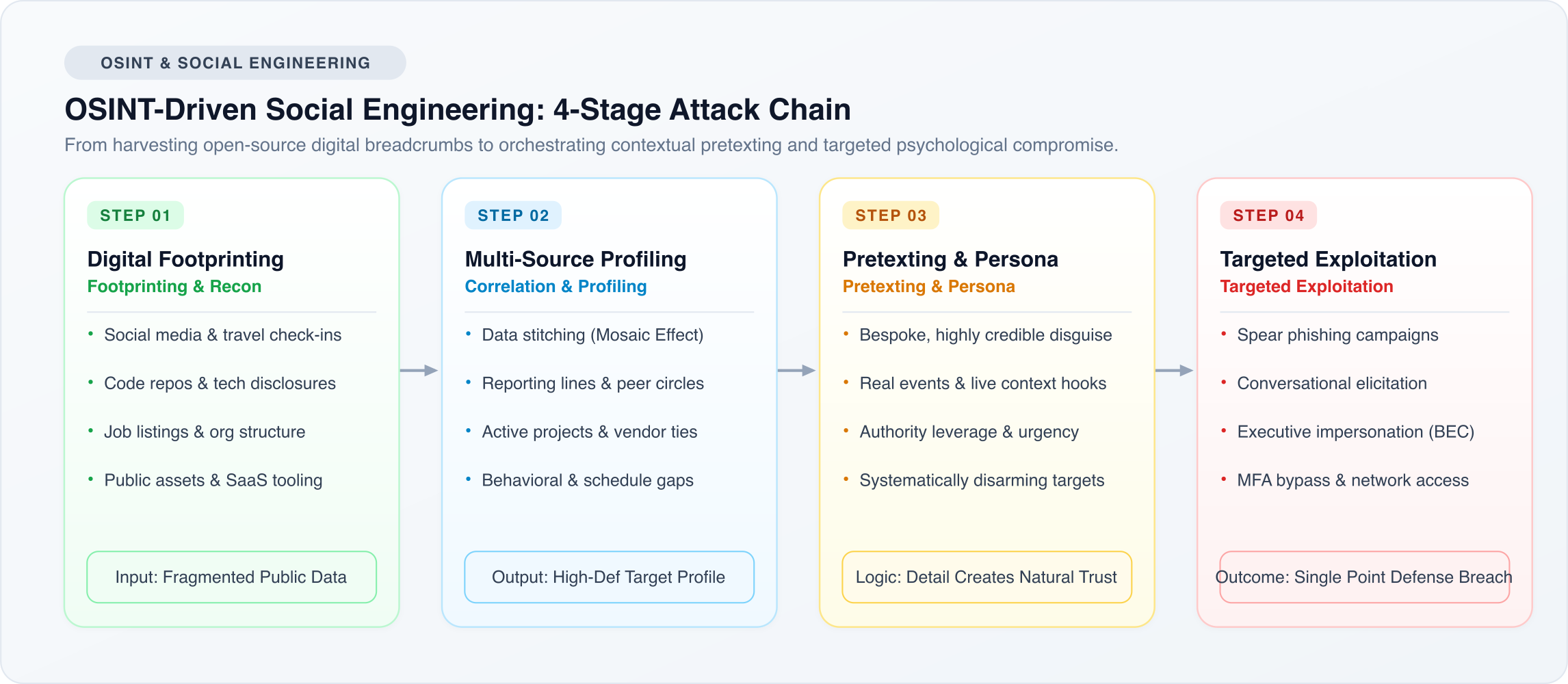
The Four-Stage Attack Chain
[The Evolution of the Targeted Strike]
- Stage 01: Digital Footprinting & Reconnaissance
➔ Sources: Social media check-ins, technical blogs, GitHub repositories, job board requirements, public domain assets.
➔ Input: Legal, public, but isolated “digital shards.”- Stage 02: Multi-Source Correlation & Profiling
➔ Logic: Applying The Mosaic Theory. Aligning shards across time, geography, and interpersonal graphs.
➔ Output: Identifying reporting lines, active projects, partners, and the victim’s “blind spots” (e.g., travel schedules).- Stage 03: Pretexting & Persona Crafting
➔ Engineering: Tailoring a fake identity that fits the victim’s current professional context.
➔ Psychological Anchor: Using “insider-only” details to bypass the victim’s suspicion.- Stage 04: Targeted Exploitation & Elicitation
➔ The Strike: Executing high-fidelity spear phishing, impersonation during network outages, or deep-fake voice fraud.
II. Four Modalities of the Modern Attack
OSINT-driven social engineering manifests in several highly covert forms, targeting everyone from multinational executives to independent digital nomads.
1. Spear Phishing and “Whaling”
Generic phishing is a net; spear phishing is a harpoon. When targeting C-suite executives, it becomes “Whaling.”
| Dimension | Generic Phishing | OSINT-Driven Spear Phishing / Whaling |
|---|---|---|
| Targeting | Massive, random, and blind. | Key developers, CFOs, or sysadmins. |
| Reconnaissance | None. | LinkedIn roles, GitHub commits, tech stack analysis, direct manager names. |
| The Hook | “Your account is locked; click here.” | “Internal VPN update for the [Project Spark Phase II] deployment next Wednesday.” |
| Difficulty to Detect | Low (caught by gateways and basic training). | Extreme (uses real project names, real manager signatures, and real internal software). |
An attacker only needs to scrape a team’s GitHub commit history or read a job posting for a “Kubernetes Expert” to understand a company’s internal architecture. A fake update notification from “IT Ops” regarding that specific architecture carries an inherent, dangerous legitimacy.
2. Pretexting and Vishing (Voice Phishing)
Pretexting is the soul of social engineering; OSINT is the foundation that makes the script airtight.
- The OSINT Capture:
A victim posts on social media: “3-hour delay at Daxing Airport. Might be late for the Shenzhen Tech Salon. Exhausted.” The photo shows a coffee cup with a blurred flight number in the background. - The Targeted Strike (Vishing):
Twenty minutes later, the victim receives a call from “Airline VIP Services.” The caller provides the victim’s full name, the last four digits of their ID, and the flight number.“We apologize for the delay on your way to your business event in Shenzhen. Due to the mechanical failure, we’ve opened a 800 RMB cash compensation channel for our premium passengers. Please provide the verification code we just sent to your mobile to process the claim…”
In a state of travel fatigue and anxiety, the victim’s brain defaults to the “familiarity heuristic.” Because the caller knows “everything” about their current reality, the request for a verification code (which is actually for a password reset) feels benign.
3. Business Email Compromise (BEC) & The “In-Flight” Blind Spot
BEC is one of the most financially devastating forms of social engineering, often involving high-value wire transfers.
- The OSINT Tactic:
Attackers monitor an executive’s public calendar, speaking engagements, and social media. They identify a 12-hour transoceanic flight. During this window, the executive is at 35,000 feet—unable to take calls or verify emails in real-time. - The Execution:
Using a look-alike domain or a compromised edge account, the attacker emails the CFO:“I’m on the flight to Frankfurt; Wi-Fi is spotty so I can’t call. Regarding the confidential acquisition, we need to wire a $800,000 earnest money deposit to the escrow account before the bank closes today. This is highly sensitive; don’t wait for the Monday briefing. I’ll sign the paperwork when I land.”
Faced with the authority of the CEO, a verifiable travel schedule, and the physical impossibility of a phone confirmation, the CFO is under immense situational pressure to comply.
4. Active OSINT & The “Sockpuppet” Elicitation
OSINT doesn’t just fuel social engineering; social engineering can be used to harvest high-level OSINT. This is known as Active OSINT.
- Building the Sockpuppet:
The attacker creates a high-credibility persona on LinkedIn or GitHub—perhaps a “Director of Deep Tech” at a major VC firm or a “Co-founder” of a top-tier security framework. The profile is aged and populated with curated industry insights. - The Elicitation:
The persona reaches out to a lead architect at a target firm for a “closed-door industry exchange” or “potential investment due diligence.” Through professional flattery and the victim’s desire for recognition, the attacker extracts sensitive details about internal topology, server loads, and product roadmaps—all without ever “hacking” a single server.
III. Why OSINT-Driven Attacks Succeed
The efficacy of these attacks lies in the biological limitations of cognitive psychology and the asymmetry of information.
[The Three Pillars of Psychological Breach]
- Mechanism 1: The Familiarity Heuristic
The human brain uses shortcuts. If a stranger knows your manager’s name, your morning schedule, and your project code, the brain subconsciously categorizes them as “trusted.”- Mechanism 2: The Mosaic Theory
Victims often think, “I only shared a photo of my desk,” or “I only updated my LinkedIn.” They don’t see the mosaic. To an intelligence analyst, every shard is a tile. When a thousand tiles are placed together, the company’s “war room” becomes visible.- Mechanism 3: The Fatigue Window
Defenders must be perfect 24/7. Attackers have the luxury of time. They can wait months for the perfect “fatigue window”—a victim’s illness, a stressful business trip, or a frantic project launch—to strike when cognitive load is highest and defenses are lowest.
IV. Defense-in-Depth for the Digital Sovereign
To counter OSINT-driven social engineering, antivirus software and firewalls are insufficient. Defense must be anchored in Operational Security (OpSec) and Zero Trust Processes.
1. Personal Level: The OpSec Mindset
- Practice Anti-Over-sharing:
Never post real-time photos of ID badges, unredacted boarding passes, or event lanyards with QR codes. Scrub photos for background details like Wi-Fi SSIDs, internal whiteboards, or employee IDs. - The T+1 Rule (Time-Delayed Posting):
Delay posting travel updates or event check-ins by at least 24 hours. This deprives attackers of the ability to use your current physical location to script an “emergency” pretext. - Identity Sandboxing:
Isolate your professional identity from your private social identity. Use unique aliases and “burner” emails for public forums and technical communities to prevent cross-platform correlation.
2. Organizational Level: Shattering the Illusion of Trust
| Defensive Strategy | Implementation & Action | Mitigated Attack |
|---|---|---|
| Out-of-Band Verification | For transfers or credential resets, never verify via the current channel. Use a secondary, pre-verified channel (internal directory, face-to-face, or a known phone number). | Spear Phishing, Impersonation. |
| Dual-Control / Separation | High-value approvals and key exports must require a multi-party digital signature, removing the risk of a single “fooled” decision-maker. | BEC / CEO Fraud. |
| OSINT Surface Mapping | Security teams should proactively “dox” their own organization from a Red Team perspective, identifying leaked credentials or sensitive docs on GitHub/social media. | Closes the intelligence gap at the source. |
V. Closing Thoughts: The Transparency Trap
In an era of deep digital penetration and LLM-powered data mining, total anonymity is a luxury of the past. However, understanding the logic of OSINT-driven social engineering allows us to maintain a baseline of “instinctive clarity.”
When someone approaches you with an uncanny level of detail and a sense of urgency, those details are not a “passport” proving their legitimacy. They are the “camouflage” of an attacker who has been watching from the shadows.
Breaking context-based trust and adhering to out-of-band verification is the only way to guard your assets in an increasingly transparent world.
Related Research & Topics
Binance Security Breach and the $6.3B Liquidity Shock: Anatomy of an Exchange Crisis and Market Evolution
Communication Compartmentalization: The Strategic Efficacy and Jurisdictional Limits of US-Based Fraud Defense
Tello Mobile eSIM
SafetyWing Nomad Insurance
* Disclosure: This post contains affiliate links. If you make a purchase through these links, V-G Journal may earn a small commission at no additional cost to you. We only recommend services we independently evaluate and trust.
FIRE and Golf:自由旅居之路
专注于为追求 FIRE 与品质生活的人群提供特惠打球权益与候鸟微度假。不持一砖一瓦,运营品质生活。