Look-Through Taxation and the $1.8 Billion Wahaha Estate Dispute: From Dynastic Warfare to Regulatory Settlement
China’s look-through individual income tax rules for offshore trusts mandate a 20% tax across the full asset lifecycle, fundamentally restructuring the strategic game theory behind the $1.8 billion Wahaha estate battle. Legitimizing the trust now triggers dual Sino-US tax liabilities and an annual 18.25% late penalty, forcing dynastic litigation toward a tax-driven settlement.

Executive Summary: Jointly issued by China’s Ministry of Finance and the State Taxation Administration, Announcements No. 21 and No. 15 of 2026 establish a comprehensive 20% look-through individual income tax regime covering the entire lifecycle of offshore trusts—funding, accumulated undistributed investment income, and final liquidation. The 90-day grace period for historical compliance filings expired on October 22, 2026. This regulatory shift decisively dispels the illusion that offshore trusts function as tax-exempt safe havens or asset-cloaking devices. For the high-stakes $1.8 billion estate dispute involving Wahaha’s BVI vehicle (Jian Hao Ventures Limited)—currently litigated across the High Court of Hong Kong and Mainland tribunals—the new tax regime is not merely an added cost. It fundamentally rewrites the bargaining power of both factions. What began as a battle over dynastic inheritance has transformed into a high-stakes survival exercise, squeezed between statutory look-through tax enforcement, civil debt-satisfaction mandates, dual Sino-US tax liabilities, compound interest penalties, and cross-border capital control audits.

Figure 1: The central figures in the $1.8B Wahaha offshore account dispute: Defendant Kelly Zong Fuli (left), current chair of Wahaha, and plaintiff representative Du Jianying (right).
A broader analysis of Chinese household wealth architecture and asset-allocation boundaries reveals that first-generation Chinese entrepreneurs relied heavily on a simplified legacy structure for cross-border wealth transfer: a Hong Kong bank account, a British Virgin Islands (BVI) shell company, and vague, unratified founder intent. While this blueprint operated smoothly during an era of fragmented global financial intelligence and ambiguous tax jurisdictions, it has proven fundamentally fragile. The convergence of Golden Tax Phase IV, automatic tax information exchange under CRS 2.0, and China’s new offshore trust tax regime has exposed those structural flaws.
The $1.8 billion disputed account at the center of the Wahaha litigation serves as a case study for this systemic transition. Held at HSBC Hong Kong under the name of BVI-registered Jian Hao Ventures Limited, the funds remain frozen under an injunction issued by the Hong Kong High Court. The enforcement of China’s new tax rules fundamentally alters the trajectory of this legal battle.
I. The Reversal of Strategic Posture: How Establishing the Trust Triggers a Dual Sino-US Tax Trap
The civil litigation over the $1.8 billion disputed account turns on a fundamental disagreement regarding the legal nature of Jian Hao Ventures Limited:
- The Plaintiffs’ Offensive Strategy (Three US-citizen non-marital children and their mother, Du Jianying): The plaintiffs aim to prove that the $1.8 billion represents an irrevocable family trust established and funded by the late founder, Zong Qinghou. They claim beneficiary rights of approximately $700 million each for Zong Jichang, Zong Jieli, and Zong Jisheng, seeking judicial confirmation and asset distribution.
- The Defendant’s Defensive Strategy (Kelly Zong Fuli’s Team): The defense contends that the trust agreement was never validly executed. They maintain the account serves as offshore corporate working capital for Wahaha’s international expansion. To dismantle the claim of an independent trust, Kelly Zong’s legal team presented evidence showing the disbursement of millions of dollars from the account for overseas operations, demonstrating the commingling of corporate and personal funds.
Before the new tax regime took effect, the calculus of civil litigation was straightforward: proving the formal existence of a trust would allow the plaintiffs to secure the assets, while blocking its establishment enabled the defense to maintain control. However, the new offshore trust tax rules—anchored by the principles of “substance over form” and “full-chain look-through”—introduce a severe economic paradox into the plaintiffs’ strategy.
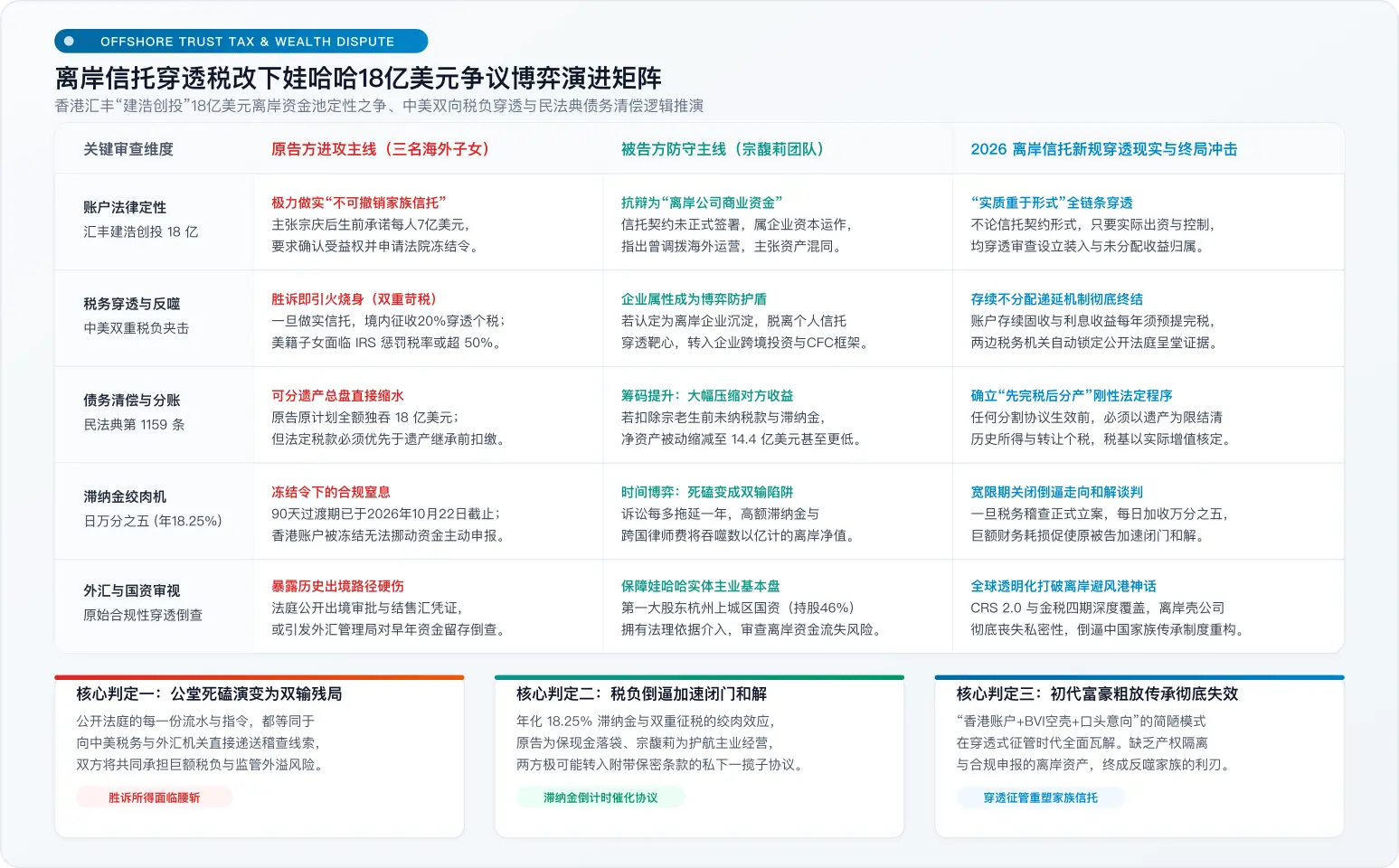
Figure 2: Strategic game theory matrix and tax liability evolution of the $1.8B Wahaha dispute under China’s look-through individual tax regime for offshore trusts.
1. The Plaintiffs’ “Pyrrhic Victory” Trap
If the Hong Kong High Court rules in favor of the plaintiffs—confirming the $1.8 billion account as a family trust established by Zong Qinghou during his lifetime—the plaintiffs will immediately trigger tax enforcement across two jurisdictions:
- China’s 20% Look-Through Tax: Under the new regulations, any offshore trust or “foreign legal arrangement serving a trust-like function” funded and controlled by a Mainland tax resident triggers a tax event upon asset transfer. Crucially, tax deferral for retained offshore income is eliminated. The hundreds of millions of dollars in accumulated interest and yield generated by the account’s fixed-income holdings are subject to a mandatory 20% individual income tax annually.
- The US IRS Throwback Tax: All three plaintiffs are US citizens and US tax residents. Under the Internal Revenue Code (IRC), distributions of accumulated income from a Foreign Non-Grantor Trust to US beneficiaries trigger the Throwback Tax, which imposes retroactive tax rates alongside compound interest penalties. Combined federal and state marginal tax liabilities can exceed 50%.
- Value Erosion: The more evidence the plaintiffs introduce to establish the existence of an irrevocable trust, the more capital is absorbed by mandatory tax enforcement in China and the United States before any distribution occurs.
2. The Defense’s Strategic Re-anchoring
Conversely, Kelly Zong’s defense argument—classifying the funds as corporate commercial capital—creates a partial tax buffer.
If the court determines that the funds represent accumulated commercial capital belonging to Wahaha’s offshore corporate entities, the account falls outside the scope of individual offshore trust look-through taxation. Instead, it enters the regulatory frameworks governing cross-border corporate investments and Controlled Foreign Corporations (CFCs). Under this structure, fund distributions and tax obligations remain governed by corporate governance resolutions and operational strategies, rather than an immediate tax assessment against an individual estate. This shift significantly reduces the plaintiffs’ financial incentive to pursue prolonged litigation.
II. The “Taxes First, Distribution Later” Mandate: Civil Code Article 1159 and the 18.25% Annual Penalty Engine
Discussions surrounding high-profile estate disputes often overlook a fundamental statutory requirement: tax claims and civil debts take legal precedence over estate division.
Article 1159 of the Civil Code of the People’s Republic of China explicitly states:
The division of an estate shall be subject to the clearance of taxes and debts lawfully payable by the decedent, provided that the payment of taxes and settlement of debts shall be limited to the actual value of the estate.
1. Look-Through Tax Liability and Mandatory Net Asset Reduction
Zong Qinghou was a Chinese tax resident. If tax authorities determine that the $1.8 billion in offshore assets constitutes a structure funded and established by him, all tax liabilities associated with the capital transfer and accumulated untaxed gains become legal tax debts of his estate.
Under statutory inheritance procedures, any civil distribution agreement—whether awarded to Kelly Zong, divided equally among four heirs, or distributed according to trust terms—requires the prior clearance of all unpaid tax debts from the asset pool.
As noted in our analysis of high-net-worth asset allocation and institutional credit risks, statutory regulatory obligations supersede commercial distribution arrangements. Even under a favorable tax base calculation that credits historically taxed principal, settling the accrued tax liabilities will substantially reduce the net remaining assets available for distribution.
2. The Financial Impact of the 18.25% Annual Late Penalty
The 90-day grace period for historical self-inspection and tax filing under the offshore trust tax regulations closed on October 22, 2026. Because the Hong Kong High Court placed a freezing order on the HSBC account held by Jian Hao Ventures Limited, neither party can access the funds to pay tax obligations prior to a final judgment.
Consequently, if tax authorities issue a formal assessment notice, unpaid taxes will accrue a statutory daily late penalty of 0.05%, which translates to an annual interest rate of 18.25%.
The annual 18.25% late fee creates a significant financial drag on extended litigation.
For every year the dispute remains unresolved in court, the frozen asset pool is reduced by tax penalties, litigation fees across multiple jurisdictions, and forensic audit costs. Under this mechanism, delay reduces the total net value available to all parties.
III. Forced Transparency and Systemic Contagion: Foreign Exchange and State Capital Audits
The underlying logic of offshore trust tax reform relies on complete capital transparency and look-through regulatory audits.
Multiple legal proceedings across Hong Kong and Mainland courts have exposed previously confidential offshore structures, banking records, powers of attorney, and founder directives. The network of capital transfers behind these shell companies is now subject to public and regulatory scrutiny.
| Audit Dimension | Historical Offshore Ambiguity | Post-2026 Look-Through Reality | Impact on the $1.8B Wahaha Dispute |
|---|---|---|---|
| Capital Exfiltration Path | Retained offshore through legacy joint venture structures (e.g., Danone era) or Red-Chip shells. | Tax filings require proof of original funding costs and approved foreign exchange registration receipts. | Triggers regulatory reviews by foreign exchange authorities into historical capital outflows and compliance records. |
| State-Owned Shareholder Rights | Offshore account transfers were treated as private family matters. | Retained earnings reclassified as corporate revenue fall under corporate income tax and dividend regulations. | The largest shareholder, Hangzhou Shangcheng District State-Owned Investment (holding 46%), gains legal standing to review whether offshore funds involve corporate asset diversion. |
| Sino-US Regulatory Information Exchange | Assets concealed across multi-layer offshore entities amid regulatory information gaps. | China’s Golden Tax Phase IV penetrates offshore structures, while US FATCA/FBAR enforces look-through reporting for US citizens. | Court filings and banking records provide direct evidence for tax authorities in both jurisdictions. |
When tax authorities review the asset base, both parties must document the original trade or capital channels used to transfer the $1.8 billion offshore. If the original foreign exchange approvals contain compliance irregularities, the civil litigation could expand into broader regulatory investigations regarding foreign exchange controls and state-asset preservation, creating operational risks for Wahaha’s core commercial enterprise.
IV. Endgame Under the Broken Window Effect: From Courtroom Standoff to Closed-Door Settlement
Under the combined pressure of look-through trust taxation, statutory tax-first estate rules, and an 18.25% annual penalty rate, the original litigation strategy behind the $1.8 billion Wahaha dispute is no longer viable.
Key Analytical Conclusions
- 1. Continued public litigation results in net value destruction Prolonged litigation in Hong Kong and Mainland courts produces evidence of global bank accounts and private instructions that tax, foreign exchange, and state-asset regulators can act upon. Beyond reducing the $1.8 billion asset pool through tax liabilities and penalties, continued litigation exposes Wahaha Group’s core operating business to broader regulatory and public scrutiny following its leadership transition.
- 2. Accruing penalties narrow the timeline for settlement With the October 22, 2026 grace period closed, accruing late penalties limit the viability of an extended legal battle. For the three US-citizen plaintiffs, continued litigation risks substantial tax exposure in both China and the US, even in the event of a favorable judgment. For Kelly Zong, resolving external legal uncertainties is critical to maintaining operational control over Mainland entities. These compounding tax dynamics incentivize both sides to move away from a public legal determination of trust status in favor of a confidential, negotiated settlement funded by discounted cash settlements.
- 3. The legacy model of offshore wealth transfer is obsolete As one of the first major cases tested under China’s new offshore trust tax framework, the Wahaha dispute marks a shift in cross-border wealth planning. The traditional model—relying on a Hong Kong bank account, a BVI shell company, and informal letters of wishes—no longer offers effective protection in an era of look-through regulatory enforcement and global tax transparency. Offshore structures that lack clear regulatory compliance, formal asset segregation, and transparent tax reporting risk becoming legal liabilities when family disputes arise.
Beyond the family conflict narrative, the $1.8 billion Wahaha dispute illustrates the structural evolution of global asset planning for Chinese high-net-worth families. As regulatory look-through frameworks and international tax transparency agreements expand, informal offshore wealth arrangements are increasingly subject to formal legal and tax reconciliation.
Related Research & Topics
Tello Mobile eSIM
SafetyWing Nomad Insurance
* Disclosure: This post contains affiliate links. If you make a purchase through these links, V-G Journal may earn a small commission at no additional cost to you. We only recommend services we independently evaluate and trust.
FIRE and Golf:自由旅居之路
专注于为追求 FIRE 与品质生活的人群提供特惠打球权益与候鸟微度假。不持一砖一瓦,运营品质生活。