The Next Financial Crisis: Made in the USA or Made in China?
The US and China are no longer separate workshops, but two ends of a single, deeply embedded global balance sheet. The coming reckoning will be a resonance between American 'acute cardiac arrest' and Chinese 'chronic rheumatism.'

Executive Summary: Attributing the next economic crisis simply to “Made in the USA” or “Made in China” is as futile as debating whether the left wing is too heavy or the right engine is out of fuel while the entire aircraft is in a dual-engine stall.
The world’s two largest economies are no longer independent entities; they are the mirrored ends of a single global balance sheet. To define the next crisis is to recognize a bilateral deadlock where the pathologies are shared, even if the modes of failure and lethal paths differ fundamentally.
I. The American Path: High-Altitude Acrobatics and “Acute Cardiac Arrest”
If the United States triggers the next global crisis, the script will follow the classic, high-intensity pattern of a sudden liquidity collapse and a violent reprisal of asset valuations.
1. The Core Pathology: Financial Empire vs. Real Returns
As the world’s ultimate printer of currency, the U.S. has long enjoyed the dividends of global seigniorage. However, the Achilles’ heel of this model is that the infinite expansion of financial capital on the liability side has severely overdrawn the real rate of return on the physical asset side.
Financial derivatives and sovereign debt can manufacture the illusion of prosperity, but they cannot conjure physical productivity out of thin air. When long-term interest rates are forced to remain elevated due to stubborn inflation, every financial structure fed on cheap capital must eventually face the law of gravity.
2. Critical Node: Interest Devouring Revenue
U.S. national debt has surged past the $35 trillion mark. In a high-interest-rate environment, the annual interest expense alone exceeds $1 trillion—surpassing the entire defense budget and eroding federal fiscal space at an exponential rate.
The system is currently performing a dangerous high-wire act: issuing more new debt simply to service the interest on the old. The fragility of this “Ponzi-style” rollover lies in its absolute dependence on marginal buyers. If global central banks reduce their allocations or Treasury auctions signal a lack of demand, the cost of rolling over the sovereign debt chain will hit a physical limit of endurance.
3. The AI Narrative and the “Narrow Gate” Effect
Current valuations for the S&P 500 and Nasdaq are tethered to a handful of tech giants. The market’s “bullish faith” is held aloft almost entirely by AI infrastructure and massive Capital Expenditure (CapEx).
This creates a liquidity bottleneck:
- Explosive CapEx: Investments in data centers and chips are measured in the hundreds of billions.
- Brutal Depreciation: Hardware faces generational obsolescence and balance-sheet impairment every 3 to 5 years.
- Lagging Monetization: If downstream applications fail to generate matching free cash flow in the short term, the investment loop snaps.
When a key liquidity node fails, we will see a repeat of the Silicon Valley Bank or Lehman moment: quantitative algorithms and passive index funds will stampede toward a “narrow gate” in a matter of milliseconds.
4. The Outbreak: High-Altitude Avalanche
Wall Street’s leverage is a perpetual bet that cheaper liquidity is coming tomorrow. If the liquidity gates remain shut, risk assets will drop vertically from 30,000 feet. This type of crisis is characterized by its suddenness and velocity, capable of flooding every offshore financial market with panic within a few trading weeks.
II. The Chinese Path: Hyper-Competitive Attrition and “Chronic Rheumatism”
If a crisis originates in China, it will not mirror the dramatic Wall Street “Lehman moment” of collapsing investment banks and bankruptcy filings.
1. The Core Pathology: Unmatched Supply vs. Weak Distribution
China possesses the most complete and massive industrial manufacturing cluster in human history. The flip side of this coin is a structural imbalance: the proportion of primary distribution and household disposable income relative to GDP has remained low for decades. Domestic consumption cannot independently absorb this level of industrial output.
This creates a deep, structural tension: extreme abundance in production capacity versus a relative lack of purchasing power and financial security at the household level.
2. Critical Node: Balance Sheet Defense and Liquidity Traps
The engine that powered credit expansion for twenty years—“Land Sales ➔ Local Government Financing ➔ Infrastructure and Real Estate”—has peaked irreversibly.
As real estate prices in core cities return to rationality and household wealth expectations shift, the most rational individual choice becomes “prepaying debt, cutting non-essential spending, and increasing precautionary savings.” Simultaneously, the corporate sector, facing weak downstream demand, hesitates to increase CapEx. The result is a “liquidity trap” where capital circulates within the banking system, leading to a classic balance sheet recession.
3. The Overflow: The Dam of Overcapacity Hits Trade Walls
As the ability of real estate to absorb credit wanes, financial resources and industrial policies have pivoted toward New Energy, high-end manufacturing, and semiconductors. This has built an unprecedented industrial plateau.
Unable to find sufficient domestic demand, companies must export their way out of the “involution,” dumping goods into overseas markets to maintain utilization rates and cash flow. This unilateral supply surge has not only triggered tariff barriers in the West under the guise of “national security” but has also met intense anti-dumping resistance in emerging markets like Southeast Asia and Latin America.
4. The Outbreak: Deflationary Decay and the Long De-leveraging
Under capital controls, the backing of state-owned banks, and a robust regulatory framework, the Chinese system is highly resilient to “sudden cardiac arrest.”
However, the cost of this resilience is a long, cold process of de-leveraging: stagnant asset prices, razor-thin corporate margins, and a “bleeding” form of hyper-competition. Like chronic rheumatism, it is not immediately fatal, but it causes persistent, systemic pain over a long cycle.
III. The Ultimate Deadlock: The Collapse of the “Offshore Marriage”
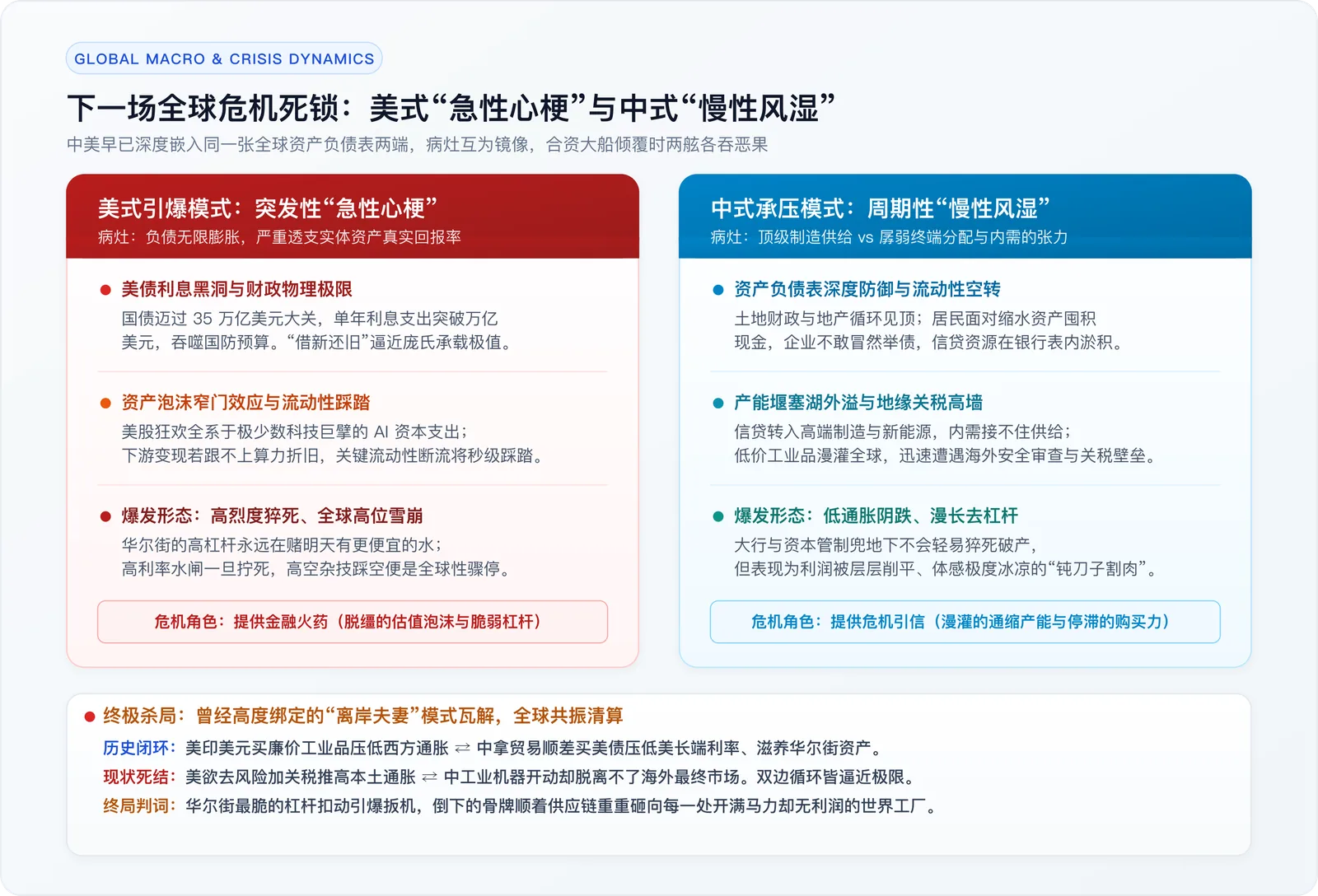
1. The Once-Perfect Loop
The underlying code for the last thirty years of global low inflation and prosperity was the “offshore marriage” between the US and China:
The Traditional Symbiotic Cycle
- Flow of Goods: China utilized its massive labor force and infrastructure to export high-value-for-money industrial goods to the US, helping the West suppress inflationary pressure.
- Flow of Capital: China took its massive trade surpluses and bought U.S. Treasuries, helping the US keep long-term interest rates low. Foreign reserves flowed back to New York, nourishing the expansion of Wall Street assets.
In this loop, the US exported paper (currency and financial assets) while China exported physical reality (goods and labor).
2. The Broken Gear
Today, both ends of this sophisticated machine have reached their limits, resulting in violent friction:
- The US Side: Attempting to “de-risk” and reshore manufacturing. However, a hollowed-out labor force and a mountain of national debt cannot build a low-inflation industrial base at home. The higher the tariffs, the stickier the domestic inflation, which in turn forces higher interest rates that cannibalize the federal budget.
- The Chinese Side: Focusing on “technological self-reliance” and “de-dollarization.” Yet, once the massive industrial machine starts humming, its scale dictates that it cannot physically survive without the absorption of overseas consumer markets.
| Dimension | American Crisis (Acute Cardiac Arrest) | Chinese Pressure (Chronic Rheumatism) |
|---|---|---|
| Root Cause | Liability expansion outstripping asset returns | Tension between industrial supply and domestic demand |
| Primary Carrier | Wall Street leverage, Treasury liquidity, AI valuations | Real estate credit, local debt, export capacity |
| Trigger Mechanism | Liquidity gap, asset bubble stampede | External trade barriers, corporate “bleeding” |
| Intensity | Sudden avalanche, measured in seconds | Long-term decay, measured in years |
| Underlying Role | Provides the Gunpowder (Unchecked valuations) | Provides the Fuse (Deflationary overflow) |
IV. Conclusion: The Individual’s Airbag
If we were to summarize the mechanism of the next global crisis in one sentence:
The United States provides the gunpowder (unhinged asset valuations and fragile debt leverage), while China provides the fuse (deflationary overcapacity and stagnant domestic demand).
The trigger will likely be pulled on Wall Street—because financial leverage has the lowest tolerance for error and the highest sensitivity to pricing. But when the first domino falls, it will travel through the fractured global supply chain and inevitably strike every factory floor that is running at full speed but earning zero profit.
This is not an “either/or” between Made in China or Made in the USA. It is the structural consequence of a globalized vessel attempting to split in two while both sides are still bolted to the same hull.
For the individual investor or those pursuing FIRE (Financial Independence, Retire Early), the lesson is to abandon the hope of a “one-sided” bet:
- Beware the High-Wire Act: Do not overestimate your reaction speed at the “narrow gate” of liquidity. Avoid fragile leverage that depends on cheap money to survive.
- Beware the Slow Bleed: Do not underestimate the length or the coldness of a de-leveraging cycle. Avoid heavy-asset sectors trapped in endless price wars.
- Build a Micro-Buffer: Owning assets with real, positive cash flow that can transcend cycles is the only functional airbag for the coming macro storm.
Related Research & Topics
Tello Mobile eSIM
SafetyWing Nomad Insurance
* Disclosure: This post contains affiliate links. If you make a purchase through these links, V-G Journal may earn a small commission at no additional cost to you. We only recommend services we independently evaluate and trust.
FIRE and Golf:自由旅居之路
专注于为追求 FIRE 与品质生活的人群提供特惠打球权益与候鸟微度假。不持一砖一瓦,运营品质生活。