The West Wing Collision: Musk, Bessent, and the Limits of Disruption
An anatomical breakdown of the April 2025 physical altercation between Elon Musk and Treasury Secretary Scott Bessent. Beyond the 'slap' rumors lies a fundamental clash between Silicon Valley’s First Principles and the immovable machinery of the American state.

Executive Summary: In mid-April 2025, a heated confrontation between Elon Musk and then-Treasury Secretary Scott Bessent erupted in the West Wing, later sensationalized on social media as a “White House slapping match.” The reality was less cinematic but more visceral: a verbal escalation that culminated in a “football-style” shoulder charge and physical shoving. The friction was fueled by a battle over IRS leadership and Bessent’s blunt dismissal of Musk’s DOGE budget cuts—specifically the promise to slash $2 trillion—as a mathematical impossibility, labeling the tech mogul a “fraud” to his face. This corridor clash marks the definitive moment where Silicon Valley’s radicalism met the systemic “immune response” of the Washington and Wall Street establishment.
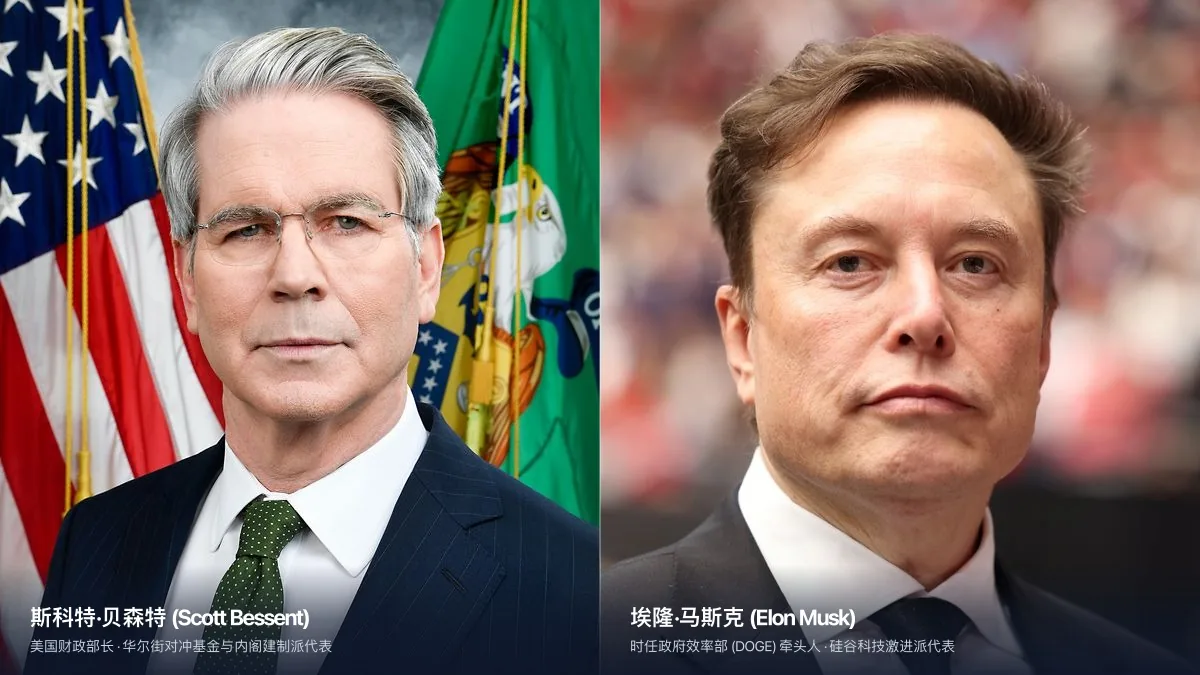
Figure 1: Treasury Secretary Scott Bessent and then-DOGE lead Elon Musk.
In the ecosystem of the modern White House, backroom maneuvering between advisors and cabinet members is the norm. Physical confrontation, however, is an anomaly. In mid-April 2025, rumors of a “slap heard ‘round the West Wing” involving Elon Musk and the Secretary of the Treasury flooded the digital sphere, pivoting public discourse from policy to high-stakes theater.
Stripping away the tabloid froth reveals a confrontation driven by a rigorous logic of power. This was not a mere lapse in temper; it was a head-on collision between Silicon Valley’s insurgent energy and the institutional guardrails of Wall Street and Washington. At stake were the boundaries of executive authority, fiscal jurisdiction, and the very legitimacy of the “First Principles” approach when applied to a nuclear-armed bureaucracy.
I. Anatomy of a Rumor: What Actually Happened in the Corridor
The “slap” narrative that dominated X (formerly Twitter) was a classic case of digital distortion—a theatrical simplification of a much more aggressive physical reality.
1. The Genesis of the “Slap” Myth
The rumor gained traction through a confluence of fragmented imagery and the public’s appetite for drama. Shortly after the incident, Musk appeared at a public event with a visible mark near his eye. Social media accounts immediately attributed the “shiner” to a palm-strike from the Treasury Secretary. However, it was later confirmed that the facial abrasion was the result of an accidental collision while playing with his young son.
While the “slap” served as a potent symbol of humiliation in the court of public opinion, it obscured the actual mechanics of the encounter.
2. The Physical Reality: The West Wing Charge
Cross-referenced reports from The Washington Post, Axios, and former strategist Steve Bannon suggest the confrontation in the narrow corridors of the West Wing was more akin to a sporting field collision than a duel:
- Verbal Escalation: After exiting the Oval Office, the two continued a high-decibel argument in the confined space of the West Wing hallway.
- The Shoulder Charge: As the stalemate reached a breaking point, Musk reportedly lunged forward, using his shoulder to “truck” Bessent in the chest and ribs—a move described by witnesses as “football-style” aggression.
- The Scuffle: A blindsided Bessent retaliated, leading to a brief but intense bout of shoving and grappling.
- Secret Service Intervention: Secret Service agents and senior aides intervened within seconds, physically separating the two men before the situation could spiral into a full-blown fistfight.
Donald Trump’s private reaction was reportedly blunt: “This is too much.” Publicly, Press Secretary Karoline Leavitt opted for containment, acknowledging “spirited disagreements” while flatly denying a “fistfight.” Bessent, maintaining a professional veneer, downplayed the event in subsequent interviews, attempting to seal the scandal within the West Wing’s walls.
II. The Catalysts: IRS Jurisdiction and the $2 Trillion Myth
The friction was not spontaneous. It was the result of months of structural tension regarding two core administrative pillars.
| Conflict Dimension | Musk / DOGE Position | Bessent / Treasury Position |
|---|---|---|
| IRS Authority | Direct control via DOGE-appointed “Acting Director” to bypass bureaucracy. | Statutory authority; IRS remains a sub-agency of Treasury under federal law. |
| Budget Strategy | “First Principles” disruption; cutting $1–2 trillion via radical automation. | Actuarial reality; mandatory spending (Social Security/Interest) is legally protected. |
| Operational Style | “Move fast and break things”; ignore Administrative Procedure Act. | Institutional stability; maintaining global confidence in U.S. debt markets. |
1. The Battle for the IRS
The first domino was the control of the Internal Revenue Service. As the Senate-confirmed Secretary, Bessent held statutory authority over the Treasury and its sub-agencies. Musk, leading the Department of Government Efficiency (DOGE), attempted to circumvent this vertical chain of command. He presented Trump with his own candidate for Acting IRS Commissioner, seeking to place the nation’s tax and financial data hub under DOGE’s direct purview.
In the Oval Office, Bessent defended the legal prerogatives of the Cabinet, arguing that personnel appointments in the financial sector were not subject to the whims of outside consultants. Musk, conversely, viewed these procedural safeguards as “bureaucratic friction” designed to protect inefficiency.
2. The “Fraud” Accusation
The argument spilled into the hallway over the feasibility of federal spending cuts. Musk had publicly promised to slash $1 trillion to $2 trillion from the federal budget through radical restructuring.
Bessent—a veteran macro hedge fund manager who understands the plumbing of the U.S. balance sheet—knew the math didn’t hold. With over two-thirds of the budget tied to mandatory spending (Social Security, Medicare, and interest on the national debt), “cutting trillions” without massive legislative overhauls is an accounting fantasy. In the heat of the corridor argument, Bessent reportedly looked Musk in the eye and called his DOGE projections a “fraud.”
For a man who built an empire on technical authority and “solving the impossible,” the label of “fraud” was a psychological breach that triggered the physical impulse.
III. The Deep Mechanics: When First Principles Hit the Deep State
The shoving match in the West Wing was a visceral rejection of one institutional culture by another.
1. Silicon Valley Disruption vs. Constitutional Law
Musk’s operating manual is the classic Silicon Valley “First Principles” approach: identify the inefficiency, flatten the hierarchy, and ignore the legacy code. At X, he fired 80% of the staff and kept the servers running. At SpaceX, he broke the aerospace supply chain.
But the federal government is not a corporation designed for “efficiency.” It is a system designed for “procedural legitimacy and the balance of power.” The Administrative Procedure Act (APA), federal employee protections, and Congressional “power of the purse” act as a massive institutional firewall. When Musk tried to “format” the federal ledger with the executive fiat of a CEO, he didn’t just hit Bessent—he hit the entire immune system of the modern state.
2. Wall Street Prudence and the “Read-Only” Redline
Bessent represents the macro-prudential wing of the establishment. Having navigated global markets at Soros Fund Management, he understood that the credit of the United States rests on stability and predictability.
Allowing an unconfirmed technical team to meddle with the Treasury’s underlying payment systems or threaten the servicing of U.S. Treasuries wouldn’t “save money”—it would trigger a catastrophic loss of confidence in the dollar. Bessent, in coordination with the Senate Finance Committee, effectively placed a “read-only” restriction on DOGE’s access to Treasury systems, using the rule of law to neutralize technological radicalism.
As we analyzed in the White House State Dinner and the Geopolitics of ‘Les Misérables’, the foundation of great power competition does not rely on theatrical gestures, but on the hard-coded reality of institutions and economics. On the White House chessboard, no matter how bright an individual’s star may shine, the system’s recoil is absolute once its core pillars are threatened.
IV. The Endgame: The Institutional Exit
The corridor clash served as the inflection point for Musk’s influence within the second Trump administration. It forced the White House to choose between the stability of the Cabinet and the experimentalism of the tech elite. The political ripples were immediate:
- Cabinet Primacy Restored: Following the incident, Bessent’s authority over tax reform, tariffs, and debt management was reinforced. The traditional Cabinet mechanism regained its grip on policy execution.
- DOGE’s Diminished Scope: Courts and Congressional leaders increased scrutiny on DOGE’s legality. The “advisors” were relegated to making suggestions, stripped of any pretense of executive or personnel authority.
- The Exit: The confrontation accelerated the end of Musk’s political experiment. On May 30, 2025, Musk officially stepped down from his DOGE role, citing the need to focus on Tesla and SpaceX.
The folk rumors of “slaps” will eventually fade into political trivia. However, the shoving match in the West Wing remains a landmark case study in modern political science: a record of the rigid resistance and institutional backlash that occurs when the Silicon Valley utopia attempts to forcibly re-engineer the machinery of the state.
Related Research & Topics
Tello Mobile eSIM
SafetyWing Nomad Insurance
* Disclosure: This post contains affiliate links. If you make a purchase through these links, V-G Journal may earn a small commission at no additional cost to you. We only recommend services we independently evaluate and trust.
FIRE and Golf:自由旅居之路
专注于为追求 FIRE 与品质生活的人群提供特惠打球权益与候鸟微度假。不持一砖一瓦,运营品质生活。