The Midlife Void: Sabbatical Reframing, Pension Countdowns, and the Reclamation of Time Sovereignty
Between mid-career corporate ejection and statutory pension eligibility lies a multi-year purgatory. Framing this interregnum as a sabbatical is neither purely defensive nor entirely candid—it is a cognitive battleground for personal sovereignty.

Executive Summary: Under traditional industrial employment systems, parting ways with a corporate employer in one’s forties carries an immediate, corrosive label: “midlife unemployment.” When this event occurs five, eight, or twelve years prior to statutory pension eligibility, how one defines the ensuing vacuum dictates whether life devolves into anxious stasis or evolves into deliberate redesign. Is framing this structural displacement as a sabbatical merely a respectable psychological shield, or does it represent high-order cognitive reconstruction? The distinction lies in internal psychological sovereignty, external social positioning, and the tactical phase-structuring of one’s remaining horizon.

Figure 1: Decoupling from institutional schedules requires an active reclamation of discretionary time.
In hyper-optimized labor markets, knowledge workers frequently face corporate obsolescence or voluntary exit around their fourth decade. This milestone opens up an excruciatingly awkward gap: a multi-year interregnum separating career termination from statutory pension payouts. Mainstream social scripts reduce this territory to a bleak holding pattern: “unemployed, waiting out retirement.”
Some choose to rewrite the script, announcing to their networks that they are “taking a sabbatical.” Whether the term is appropriate does not depend on semantic pedantry or traditional dictionary definitions. It depends entirely on whether the individual uses the term as an internal tool for cognitive restructuring, an external social interface, or a deceptive narcotic—and whether their balance sheet and psychological framework can support the weight of the pause.
1. The Semantic Friction: Privilege vs. Precarity
Applying the academic notion of a sabbatical to involuntary midlife separation or prolonged labor market withdrawal creates immediate cognitive dissonance. This friction originates in two structural misalignments:
1. Agency and Psychological Projection
- The Authentic Sabbatical: Rooted in academia and elite corporate covenants, a true sabbatical is an exercise in absolute agency. It carries a pre-allocated budget, explicit research or regenerative milestones (e.g., publishing a treatise, intensive residential study, somatic recovery), and an unshakeable grip on the steering wheel.
- The Midlife Ejection: Often triggered by corporate restructuring, sector-wide compression, or age-based labor depreciation. If an individual remains mentally tethered to institutional patron-client dynamics—consumed by resentment, drift, and passive panic—proclaiming a “sabbatical” carries the hollow ring of denial, both to the outside world and to their own bathroom mirror.
2. Temporal Boundaries and the Return Ticket
- A conventional sabbatical possesses rigorous boundary lines, typically spanning six to eighteen months, predicated on a guaranteed return: re-entry into the same academic institution or corporate treadmill.
- When the statutory pension horizon remains five to ten years away, return-to-track is rarely realistic or desirable given labor market depreciation curves. This extended gap is not a temporary “Pause.” It is an unalterable Exit or Pivot.
2. The Cognitive Upgrade: When the Label Becomes Strategy
Despite these contradictions, claiming the sabbatical label can serve as an exceptionally sophisticated, functional intervention during the opening chapters of a transition.
1. Inward-Facing: Neutralizing the Stigma of Displacement
Corporate societies program workers to equate the lack of an institutional labor contract with personal deficiency and social erasure. This conditioning produces acute, debilitating shame.
- Dismantling the External Scorecard: Adopting the sabbatical framework decouples personal self-worth from institutional performance evaluations. The internal dialogue shifts from “I have been discarded by the system” to: “I have redeemed my time sovereignty from a machine that extracts human capital as biological fuel.”
- Reclaiming Operational Agency: If an individual possesses the liquidity buffers and cash flow to underwrite foundational living expenses until pension activation, labeling the transition as a sabbatical halts the paralysis of counting down days. It shifts the primary query from defensive survival to generative enterprise: “Now that uninterrupted blocks of autonomous time are mine, what intellectual assets will I cultivate, and what deferred life experiences will I finally inhabit?”
2. Outward-Facing: A High-Fidelity Social Interface
During the initial 12 to 24 months post-exit, managing interactions with former peers, industry contacts, and extended family requires tactical boundary management. Bludgeoning the room with “I was laid off and cannot find comparable work” invites intrusive pity and awkward interrogations. Announcing “permanent retirement” at forty-three invites suspicion or perceived eccentricity.
Framing the period as a deliberate sabbatical—“I have set aside an intentional window to decompress, consolidate twenty years of market capital, and structure my next operational focus”—establishes a clean, professional perimeter. It conveys intentionality, preserves dignity, and buys discretionary breathing room without burning social equity.
3. Narrative Triangulation: Three Paradigms of the Transitional State
To evaluate how narrative frameworks govern psychological depletion and quality of life, the post-employment experience can be divided into three distinct operational models:
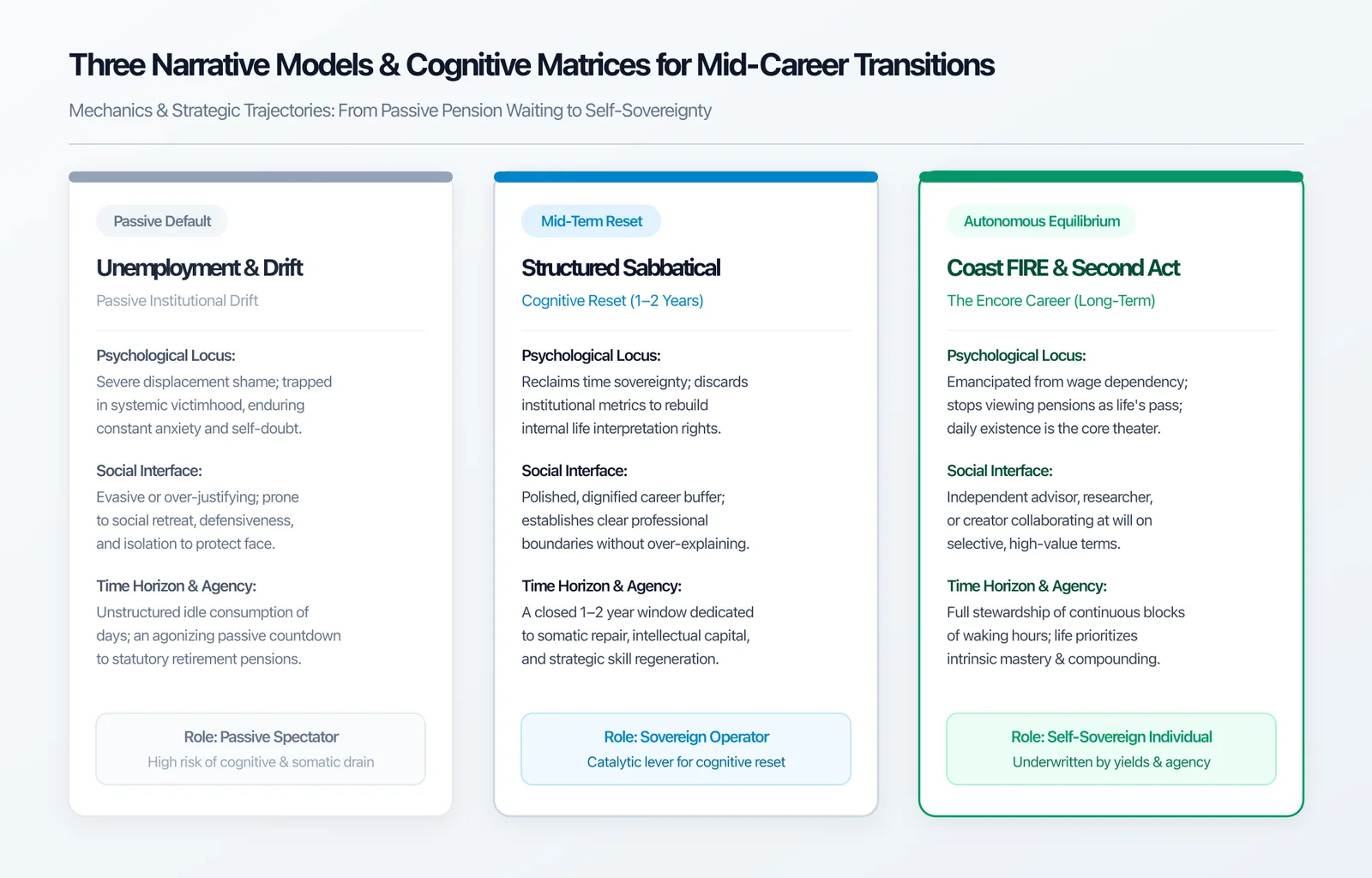
Figure 2: Mindset evolution across passive waiting, deliberate sabbatical reset, and the Encore Career.
| Analytical Dimension | Passive Waiting (Institutional Drift) | The Structured Sabbatical | Coast FIRE / The Encore Career |
|---|---|---|---|
| Psychological Locus | Externalized victimhood; pervasive status anxiety and precarity | High agency; space treated as an unscripted canvas for reset | Total structural autonomy; emancipation from corporate wage-dependence |
| Time Horizon | 5–10 years of open-ended, shapeless consumption of days | 12–24 months of bounded exploration with planned milestones | A permanent, sustainable equilibrium for the remainder of life |
| Outward Interface | Evasive, defensive; social withdrawal or aggressive over-justification | Polished professional pause; clear boundaries with industry networks | Independent operator, niche advisor, or practitioner of slow life |
| Financial Anchor | Raw capital burn; acute sensitivity to inflation and macro shocks | Ring-fenced sabbatical budget; targeted investment in intangible capital | Passive yields cover baseline burn; supplemented by high-agency micro-projects |
4. Scaling the Horizon: From Sabbatical to the Second Act
When the runway to legal pension distribution spans several years, the “sabbatical” label eventually exhausts its psychological utility. An indefinite vacation with no re-entry point breeds its own brand of existential vertigo. Navigating this demands long-range tactical scaffolding:
1. The Stage-Gated Sabbatical (Isolating Years 1 and 2)
Attempting to map an entire decade on the day of departure is an exercise in futility. The pragmatic approach requires declaring a closed 12- to 24-month Sabbatical Window.
- During this initial chapter, priorities must remain fiercely singular: remediating chronic somatic damage (sleep fragmentation, metabolic syndrome, nervous system burnout), rediscovering suppressed intellectual curiosities, restoring domestic relationships, or mastering complex skills formerly locked out by sixty-hour work weeks.
- At the close of year two, conduct a rigorous audit: determine whether to deploy capital into low-overhead advisory micro-enterprises, or step directly into an asset-underwritten lifestyle.
2. Normalizing Coast FIRE and Partial Exit
If invested capital and low-volatility yield instruments reliably service baseline survival expenses, shedding corporate anxiety requires dropping the semantic resistance to “retirement.”
Rather than straining to maintain the veneer of an academic sabbatical indefinitely, one can comfortably occupy the mechanics of Coast FIRE. This posture acknowledges that the individual no longer needs to sell bulk blocks of waking hours to amass primary capital. Modest consulting retainers, fractional advisory roles, or creative outputs are leveraged solely to cover marginal discretionary lifestyle costs.
3. Architecting the Encore Career
The corporate ladder is not an immutable law of human fulfillment; it is merely an organizational technology invented by industrial societies to coordinate labor.
- The focus of the second half of life shifts from competitive rent-seeking in organizational hierarchies toward personal enterprises that generate asymmetric compound dividends.
- Whether this manifests as multi-base nomadic dwelling, publishing long-form research, mastering endurance athletics, or cultivating technical mastery in a non-scalable craft, the individual ceases to be an displaced corporate functionary. They become the sovereign chief executive of their own waking hours.
5. Conclusion: Relinquishing the Pension as a Hall-Pass
Whether mid-career separation registers as a cataclysm or an emancipation is not determined by the labels imposed by peers or institutions.
Operational Principles:
- Cognitively: Seize the sabbatical framework without apology to neutralize social pathology and reclaim unilateral interpretative authority over your biography;
- Temporally: Refuse to let the years degenerate into a passive countdown toward state pension qualification; break the horizon into deliberate, milestone-driven phases;
- Existentially: Cease viewing statutory pension eligibility as the permission slip to begin living. Sovereign time, reclaimed today, is the primary theater of an autonomous existence.
Related Research & Topics
Tello Mobile eSIM
SafetyWing Nomad Insurance
* Disclosure: This post contains affiliate links. If you make a purchase through these links, V-G Journal may earn a small commission at no additional cost to you. We only recommend services we independently evaluate and trust.
FIRE and Golf:自由旅居之路
专注于为追求 FIRE 与品质生活的人群提供特惠打球权益与候鸟微度假。不持一砖一瓦,运营品质生活。