The Paradox of the Counter-Cyclical Buy: Cognitive Warfare, Capital Clearing, and Engineered Defense
When markets collapse, the mantra 'be greedy when others are fearful' often serves as a trap for retail investors. This essay deconstructs the neurobiology of market panic and proposes an engineered, emotion-free system for capital allocation during systemic liquidity events.

Core Thesis: “Be greedy when others are fearful” is perhaps the most widely circulated and destructive platitude in finance. Most who treat it as gospel fail to distinguish between rational, balance-sheet-driven contrarianism and the desperate gambling of a retail investor catching a falling knife. When Warren Buffett injected capital into Goldman Sachs and GE during the 2008 liquidity freeze, his “edge” wasn’t just courage; it was the tens of billions in low-cost insurance float and punitive preferred-stock dividend terms that made it impossible for him to be liquidated. Conversely, the average investor facing a market crash is dealing with evaporating wealth, professional instability, and a brain hijacked by its own neuroendocrine system. Sustainable “crisis embracing” is not about willpower; it is about replacing human impulse with an engineered system that strips away emotion entirely.

Figure 1: Trading floor activity at the NYSE. During systemic liquidity crunches, panic selling often decouples asset prices from their intrinsic value. (Source: Wikimedia Commons)
I. The Psychological Perspective: Why Instinct Forbids the “Buy”
The inability to buy during a crash is not a failure of financial literacy; it is a feature of human hardware. Our brains were not designed for secondary market speculation. Demanding that a biological organism remain “greedy” while its financial environment bleeds is a direct violation of evolutionary survival reflexes.
1. Loss Aversion and Amygdala Hijacking
Daniel Kahneman and Amos Tversky’s Prospect Theory confirmed that the psychological pain of a loss is 2 to 2.5 times more intense than the joy of an equivalent gain. When a portfolio retreats at breakneck speed, the body releases cortisol at levels identical to a prehistoric human encountering an apex predator. The prefrontal cortex—the seat of logic and long-term planning—is effectively bypassed by the amygdala. The neuroendocrine system issues only two commands: flee (sell) or freeze (stop looking at the account).
2. Recency Bias and Linear Extrapolation
The human brain relies heavily on recent memory to predict the future. In a bull market, we believe in “new paradigms.” In a crash, we linearly extrapolate the current downward trajectory into infinity. The decline itself becomes the primary argument for further decline. Any attempt to buy feels like hammering nails into one’s own coffin.
3. Cognitive Bandwidth Depletion
When an account evaporates years of labor in days, mental bandwidth is consumed by regret and self-reproach. This leads to “learned helplessness.” The individual loses not only the courage to buy but the capacity to even analyze a balance sheet. The brain’s defense mechanism forces physical avoidance—closing the trading app and refusing to discuss finances—to stop the mental agony.
4. The Keynesian Beauty Contest
As John Maynard Keynes noted, “Worldly wisdom teaches that it is better for reputation to fail conventionally than to succeed unconventionally.” As social animals, we are hardwired for consensus. When the market is in a panic-selling frenzy, buying against the grain is viewed not as foresight, but as madness. The fear of social isolation and moral judgment is a powerful deterrent that few can withstand.
II. The Economic Perspective: Crisis as Clearing and Repricing
From the lens of macro-cycles, a crash is not a failure of the system, but a necessary mechanism for the self-repair of capitalist credit cycles.
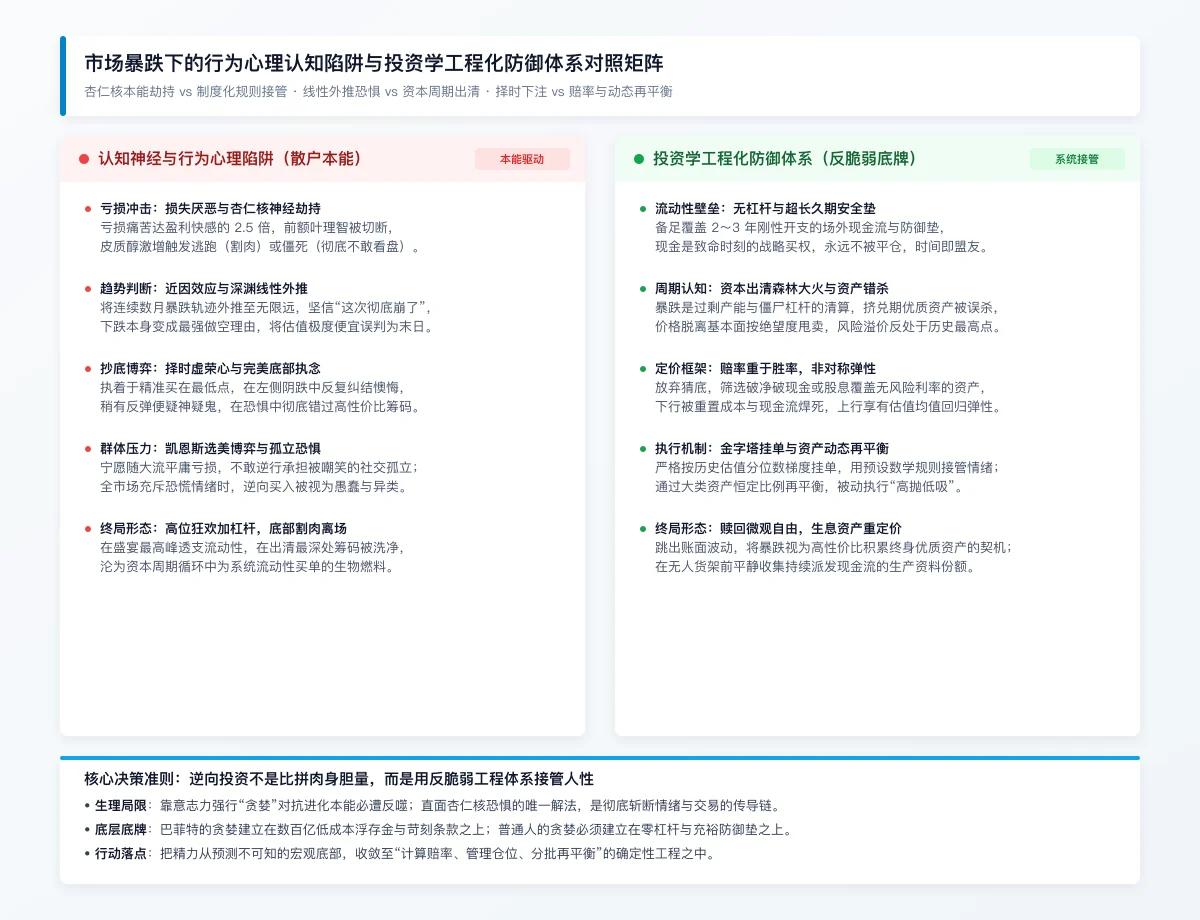
Figure 2: A comparative matrix of behavioral traps versus engineered investment defenses during market crashes.
1. The Forest Fire Law
Prosperity is the breeding ground for fragility. Long bull markets attract massive amounts of inefficient capital, fueling high-leverage, low-return zombie enterprises. A crash is a periodic “forest fire” that clears out the deadwood and speculative bubbles, allowing resources—land, labor, and capital—to migrate toward survivors with healthy balance sheets and genuine competitive moats.
2. Liquidity Black Holes
In the final stages of a crash, the market descends into a pure liquidity crunch (the “Minsky Moment”). When margin calls trigger and quantitative risk models force liquidations, institutions often cannot sell their illiquid, junk assets. Consequently, they are forced to dump their highest-quality, most liquid assets to meet margin requirements. This creates a temporary, extreme distortion where assets are priced not by future cash flows, but by the desperation of the liquidator.
III. The Engineering System: How to “Embrace the Crisis”
Treating contrarianism as a test of “guts” is a recipe for ruin. Sustainable investing requires a system that removes the human element from the decision-making loop.
| Dimension | The Fatal Flaw (Intuition) | The Engineering System (Rules) |
|---|---|---|
| Capital Source | Short-term funds or leverage | Long-duration capital (3+ years) |
| Defense | Fully invested, hoping for a bounce | Liquidity buffer as a strategic call option |
| Entry Timing | Trying to time the absolute bottom | Tiered, pyramid-style entry based on valuation |
| Pricing Anchor | Daily P&L and news narratives | Dividend yield, replacement cost, book value |
| Trigger | Emotional reaction to volatility | Mechanical rebalancing (e.g., 60/40 split) |
1. The Liquidity Moat
Cash is not a low-return asset during a crisis; it is oxygen. It is a strategic call option.
- Zero Leverage: Leverage turns long-term mean reversion into a short-term countdown to liquidation. Without leverage, time is your ally; with it, volatility is your noose.
- Redundancy: Maintain 2–3 years of living expenses in high-liquidity assets. Only when your survival is decoupled from the market can your prefrontal cortex function rationally.
2. Odds Over Accuracy
The quest to buy at the absolute bottom is a vanity project. Instead, focus on asymmetric assets:
- Look for companies where the dividend yield exceeds the risk-free rate and the market cap is near net cash. Here, the downside is “welded shut” by the balance sheet, while the upside remains open-ended.
3. The “Passive” System
- Tiered Entry: Set mechanical triggers based on historical valuation percentiles (e.g., buy 20% at 30th percentile, 30% at 15th, 50% at 5th). Let the math, not your heart rate, execute the trade.
- Dynamic Rebalancing: If your target is a 60/40 stock-to-bond split, a market crash will force you to sell bonds and buy stocks to maintain the ratio. The system forces you to “buy low” without you ever having to make a conscious, emotional decision.
Final Thought: The goal of investing is to reclaim personal sovereignty and peace of mind, not to prove one’s brilliance on a casino floor. A crash is merely the world putting high-quality, cash-generating assets on a discount rack. Embrace it not with greed, but with the cold, calculated discipline of an engineer.
Related Research & Topics
Tello Mobile eSIM
SafetyWing Nomad Insurance
* Disclosure: This post contains affiliate links. If you make a purchase through these links, V-G Journal may earn a small commission at no additional cost to you. We only recommend services we independently evaluate and trust.
FIRE and Golf:自由旅居之路
专注于为追求 FIRE 与品质生活的人群提供特惠打球权益与候鸟微度假。不持一砖一瓦,运营品质生活。