Kazakhstan's Golden Visa: Central Asia's Emerging Nexus for Capital and Compliance
Kazakhstan unveils a $300,000 Golden Visa and the AIFC zero-tax special zone, offering offshore income exemptions and universal declaration waivers. As visa thresholds tighten in Southeast Asia and Europe, Central Asia emerges as a new asset allocation springboard. However, legally shielding against home country tax penetration hinges on establishing a 183-day center of vital interests and ensuring compliant capital flows.

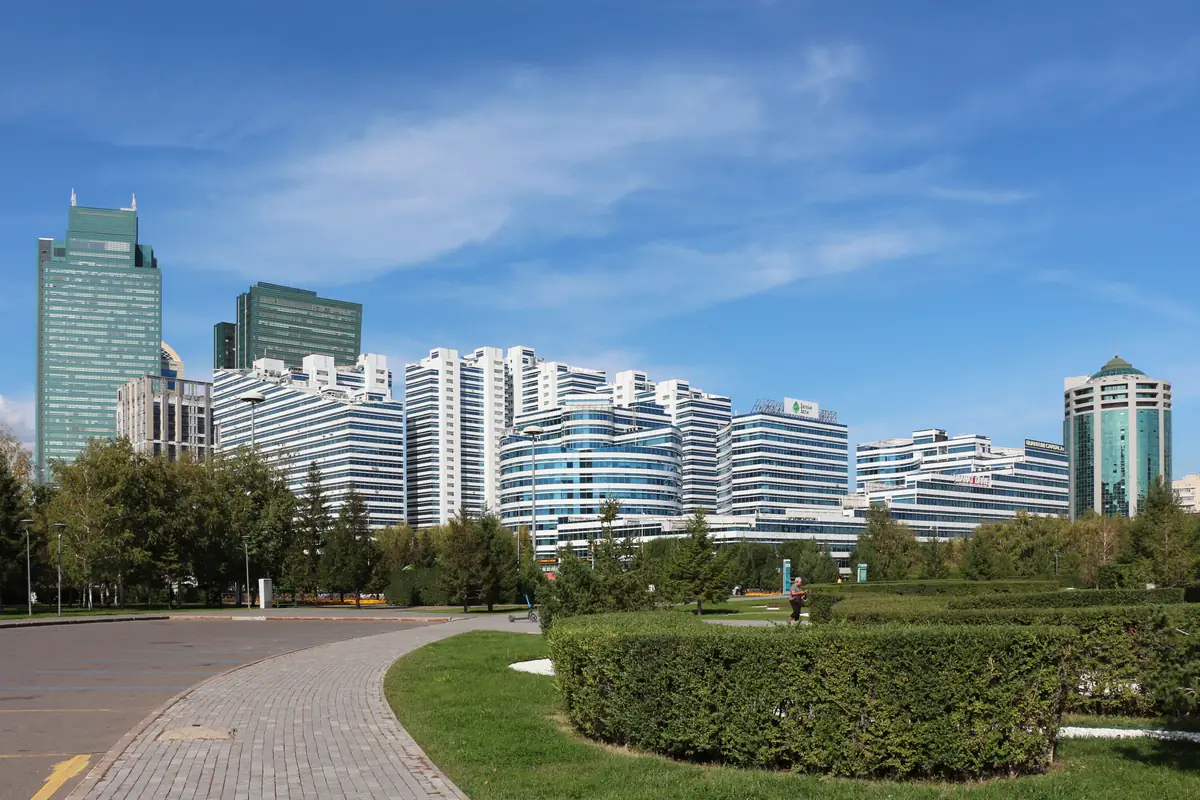
Figure 1: Astana’s modern financial skyline. This Eurasian land bridge is reshaping the transnational capital landscape through its independent common law special economic zone and new immigration policies.
The Kazakh government has officially established a long-term investor residency framework, code-named “Altyn Visa.” Foreign nationals investing a minimum of $300,000 into designated domestic commercial capital, investment funds, or securities listed on the AIX exchange can apply for a residency permit valid for up to 10 years. Accompanying this legislation is a remarkably potent suite of tax exemptions: Altyn Visa holders are not only exempt from personal income tax on foreign-sourced income, real estate property tax, and land tax, but are also explicitly and entirely waived from the universal asset and income declaration mandated across Kazakhstan. As traditional pathways for transnational nomads and offshore asset allocation continue to narrow, the institutional dividends emerging from the Eurasian interior are fundamentally reshaping the global landscape of safe havens for migratory capital.
Central Asia’s New Coordinates: As Southeast Asia Closes In and Europe Recedes
For years, global liquid capital and remote workers habitually cast their gaze towards the Mediterranean coastlines and Southeast Asian tropical islands. However, the relentless march of international tax transparency and the evolving internal political cycles within various nations have rapidly altered this established game theory landscape.
As systematically outlined in our Comparative Rating of Asian Digital Nomad Visas, Southeast Asia’s ecosystem as a low-barrier residency destination has undergone a profound reversal. Notably, the institutional pivot documented in our Thailand LTR Long-Term Residency Tax Penetration Report reveals that Thailand, effective 2024, has definitively closed the historical loophole of tax-exempt offshore income remitted across fiscal years. Any tax resident residing in Thailand for over 180 days now faces top-tier progressive tax rates on their foreign-sourced capital gains repatriated onshore. Malaysia’s My Second Home (MM2H) program has seen its thresholds significantly raised, coupled with stringent new property-binding requirements. Concurrently, in Europe, as the trend revealed in our Portugal Golden Visa CRS Cross-Border Tax Audit indicates, real estate investment immigration categories have been largely shuttered, and traditional offshore tax incentive schemes are progressively phasing out.
In response to this global compliance squeeze, Kazakhstan has adopted a pragmatic dual-track strategy for attracting capital:
- Light-Asset Remote Worker Pathway (Neo Nomad Visa, B12-1 Category): Requires applicants to demonstrate a minimum monthly foreign-sourced income of $3,000 (equivalent to $36,000 annually), provide 6 consecutive months of bank statements, and proof of tax compliance from their home country. This grants residency, with a strict prohibition against employment by Kazakh-based entities.
- High-Capital, High-Net-Worth Pathway (Altyn Visa, Golden Visa): Mandates an investment of no less than $300,000 into Kazakh tangible capital, qualified investment funds, or the securities market, in exchange for a 10-year legal residency status for the applicant and their immediate family.
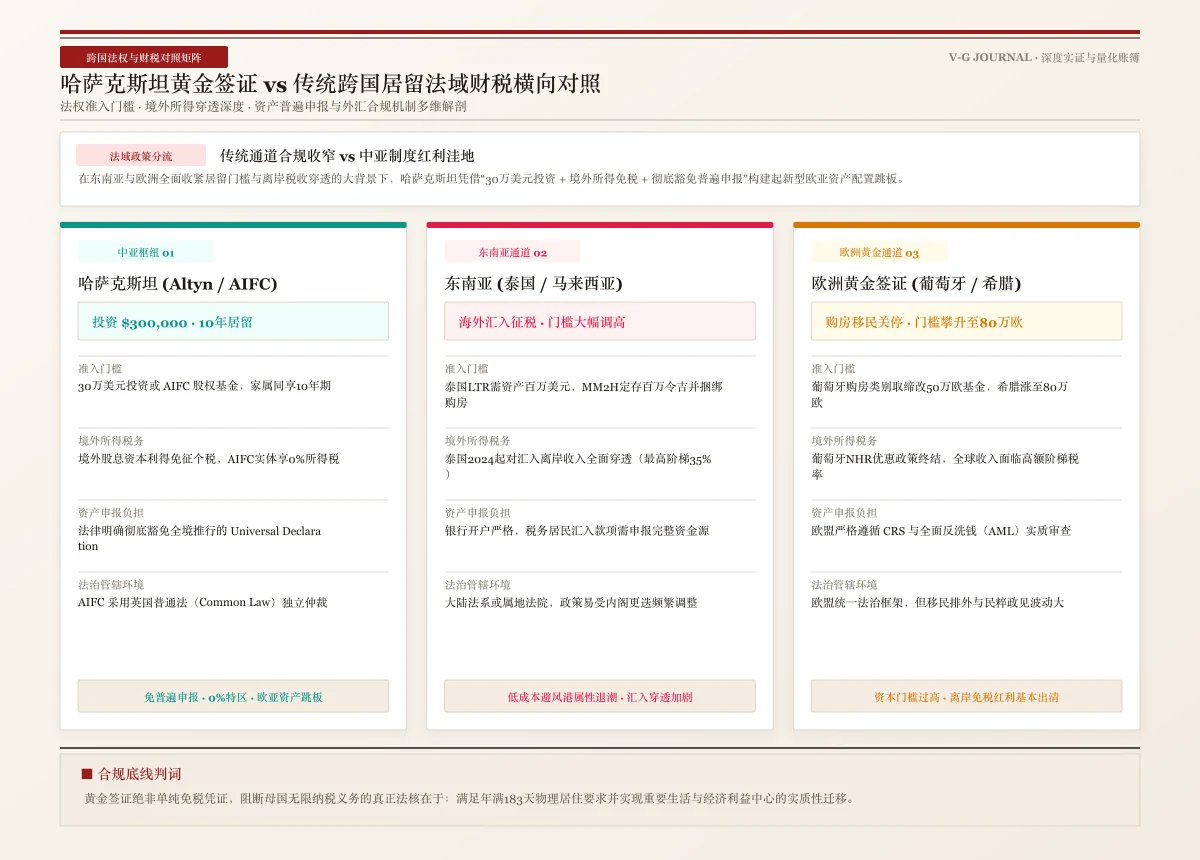
Figure 2: A comparative matrix of Kazakhstan’s Altyn Visa / AIFC against traditional residency jurisdictions across dimensions of tax penetration, entry thresholds, and asset declaration requirements.
Deconstructing Altyn Visa’s Core Fiscal Benefits: Declaration Waivers and Zero-Tax Special Zones
Unlike many immigration programs that merely issue a visa and then shunt applicants directly into a complex domestic tax labyrinth, Kazakhstan’s new policy stands out to the wealth management sector for the targeted exemptions enshrined in its accompanying legislation.
1. Complete Waiver of Universal Asset and Income Declaration
Kazakhstan is currently implementing a phased “Universal Declaration” nationwide, requiring both domestic residents and long-term foreign residents to periodically submit Forms 250.00 and 270.00, meticulously disclosing all onshore and offshore bank accounts, real estate, and equity in offshore entities. However, a specific amendment to the tax code carves out special provisions for foreign investors holding the Altyn Visa and their accompanying family members, explicitly and entirely exempting them from the legal obligation to submit universal asset and income declaration forms. This waiver significantly reduces the compliance friction costs associated with cross-border asset transparency for high-net-worth individuals.
2. Exemption for Foreign-Sourced Income and Real Estate Tax Reductions
Under the standard tax regime, ordinary residents in Kazakhstan face a personal income tax rate of 10%. Yet, Altyn Visa holders and their family members are not only fully exempt from personal real estate property tax and land tax during their long-term residency, but their foreign-sourced income—including dividends, interest, and capital gains originating outside Kazakhstan—also enjoys personal income tax exemption. This institutionally establishes a protective barrier akin to a territorial tax system.
3. The Common Law Framework of the AIFC Jurisdictional Special Zone
The Astana International Financial Centre (AIFC), located in the capital Astana, constitutes a unique legal oasis within Central Asia. The AIFC boasts an independent legal system, directly adopting English Common Law, and has established an international arbitration center staffed by independent foreign judges. On the fiscal front, qualified financial and investment entities registered within the AIFC benefit from a statutory 0% corporate income tax rate (explicitly guaranteed until 2066), with shareholders also enjoying 0% withholding tax on capital gains and dividends. Compared to Kazakhstan’s conventional domestic corporate income tax of 20% and VAT of 12%, the AIFC offers a remarkably high standard of institutional insulation for cross-border fund operations and family asset holdings.
Navigating the Compliance Reefs: 183-Day Center of Vital Interests and Capital Repatriation Loops
Every institutional dividend comes with explicit boundary conditions. When planning residency and offshore structures in Kazakhstan, investors must maintain a clear-eyed perspective, penetrating the following three unavoidable compliance reefs.
1. The “Center of Vital Interests” Under Double Taxation Agreements
Obtaining residency status in Kazakhstan does not automatically equate to a unilateral exemption from your home country’s tax jurisdiction. According to the OECD Model Convention and the Tie-breaker rules within international Double Taxation Agreements (DTAs), when two sovereign states dispute a taxpayer’s tax residency status, the priority for determination is not the visa category, but rather the location of the taxpayer’s permanent home, their center of vital interests (where family members reside, primary business investments are located), and the actual number of days spent in each jurisdiction.
If an investor merely injects capital into Kazakhstan to obtain a visa, yet their core family remains long-term in the home country and their personal economic lifeline is still anchored there, the home country’s tax laws can still pursue their global income based on the principle of personal nexus. To construct a truly robust offshore tax residency defense, one must satisfy the physical threshold of cumulative stay exceeding 183 days within
Related Research & Topics
Tello Mobile eSIM
SafetyWing Nomad Insurance
* Disclosure: This post contains affiliate links. If you make a purchase through these links, V-G Journal may earn a small commission at no additional cost to you. We only recommend services we independently evaluate and trust.
FIRE and Golf:自由旅居之路
专注于为追求 FIRE 与品质生活的人群提供特惠打球权益与候鸟微度假。不持一砖一瓦,运营品质生活。