The Anatomy of Stagnation: Mapping China’s Cycle Against Japan’s Lost Decades
Japan’s survival strategy during its 'Lost Decades' relied on the state absorbing private debt and leveraging massive overseas dividends. By analyzing asset drawdowns, momentum exhaustion, and the collapse of expectations, we find China entering a 'deep water' phase analogous to Japan’s 1993–1996 period.

Executive Summary: Domestic discourse regarding Japan’s “Lost Decades” is often polarized between dismissive mockery and the rigid application of balance sheet dogma. To understand the true historical ledger, we must recognize that while Japan lost its expansionist ambition, it preserved social dignity through state-led debt absorption and a robust social safety net.
In contrast, our current trajectory reveals a starker reality: an 8–10 year retreat in asset values, a 15–20 year exhaustion of growth momentum, and the disintegration of a generational belief that wealth will always outpace biological depreciation. We are currently navigating a transition period mirroring Japan’s 1993–1996 era—a stage where bad debt is rolled over and liquidity pools in stagnation. In the face of “getting old before getting rich” and geopolitical headwinds, identifying our precise coordinate in this cycle is the only viable starting point for individual defense.
I. Deconstructing the Myth: What Japan Lost vs. What It Preserved
Popular discourse often reduces Japan’s three lost decades to a narrative of total collapse—a fundamental misreading of the historical ledger.
What Japan truly lost was the collective ambition for aggressive balance sheet expansion. What it preserved, however, was the baseline dignity of its citizens and the functional stability of its social fabric.
1. Bad Debt Does Not Evaporate: The Seven-Year Delusion
Following the initial burst of the asset bubble, Japan’s political and business elite endured seven years of “hallucination and procrastination.”
Banks kept non-performing loans (NPLs) hidden in drawers, utilizing “evergreen loans” to dress up balance sheets and maintain a facade of solvency. They operated on the desperate hope that an economic miracle would spark a rebound.
Time, however, did not heal these wounds. By the 1997 Asian Financial Crisis, the collapse of Sanyo Securities, Hokkaido Takushoku Bank, and Yamaichi Securities forced a reckoning. The state was eventually compelled to inject tens of trillions of yen in taxpayer funds to facilitate a brutal, iron-fisted restructuring.
💡 The Lesson: In the face of a precipitous drop in asset prices, early liquidation is a painful surgery; delayed liquidation is a slow death in the ICU. Procrastination does not dissolve debt; it merely transforms localized liquidity pressure into systemic cardiac arrest.
2. The Strategic Masterstroke: The State as the Ultimate Shock Absorber
This was the core reason Japan’s social foundation remained intact.
In a classic “balance sheet recession,” corporations and households—crushed by collapsing assets and static liabilities—shift their behavior toward “debt minimization.” Everyone pays down debt; no one borrows to spend or invest. During this period, the Japanese government stepped in as the borrower of last resort, driving the central government’s debt-to-GDP ratio from 60% to over 260%.
Crucially, the Japanese government did not use administrative or financial levers to force ordinary families to “rescue” the property bubble. Nor did they slash healthcare or pension nets to balance the fiscal budget.
Household debt ratios declined steadily after the 1990s. The result was a society that avoided mass bankruptcy and extreme poverty, maintaining low crime rates and a “high-level stagnation.”
💡 The Lesson: If the debt burden is shifted onto the fragile individual through hidden taxes, delayed retirement, or increased social security premiums, the result is not a dignified “low-desire society,” but a high-pressure cooker prone to catastrophic failure.
3. The Chasm Between “Rich Before Old” and “Old Before Rich”
When Japan’s bubble burst in 1990, its per capita GDP was already $25,000, eventually peaking over $40,000 a few years later. Before hitting the wall, Japan had secured three massive strategic buffers:
- Overseas Asset Hegemony: The yen’s appreciation forced Japanese firms to globalize early. Japan essentially built “another Japan” abroad, sustaining itself on a massive flow of net investment income.
- Industrial Moats: Japan maintained a stranglehold on critical semiconductor materials, high-end precision instruments, and core components.
- Homogenized Public Welfare: The gap between urban and rural infrastructure was minimal, and universal healthcare and pension systems were already mature.
Japan’s predicament was that of a billionaire who goes bankrupt but retains enough principal to live a comfortable middle-class life on the interest. A society that hits the wall without that principal has no such cushion.
4. Demographic Gravity is Absolute
Once aging becomes a snowballing trend, any short-term policy intended to stimulate asset prices is essentially throwing mud at the law of gravity. Real estate is supported by young populations and sustained new demand. Without that base, the long-term revaluation of asset prices becomes an icy, inescapable law.
II. The Real Ledger: How Many Years Have We Lost?
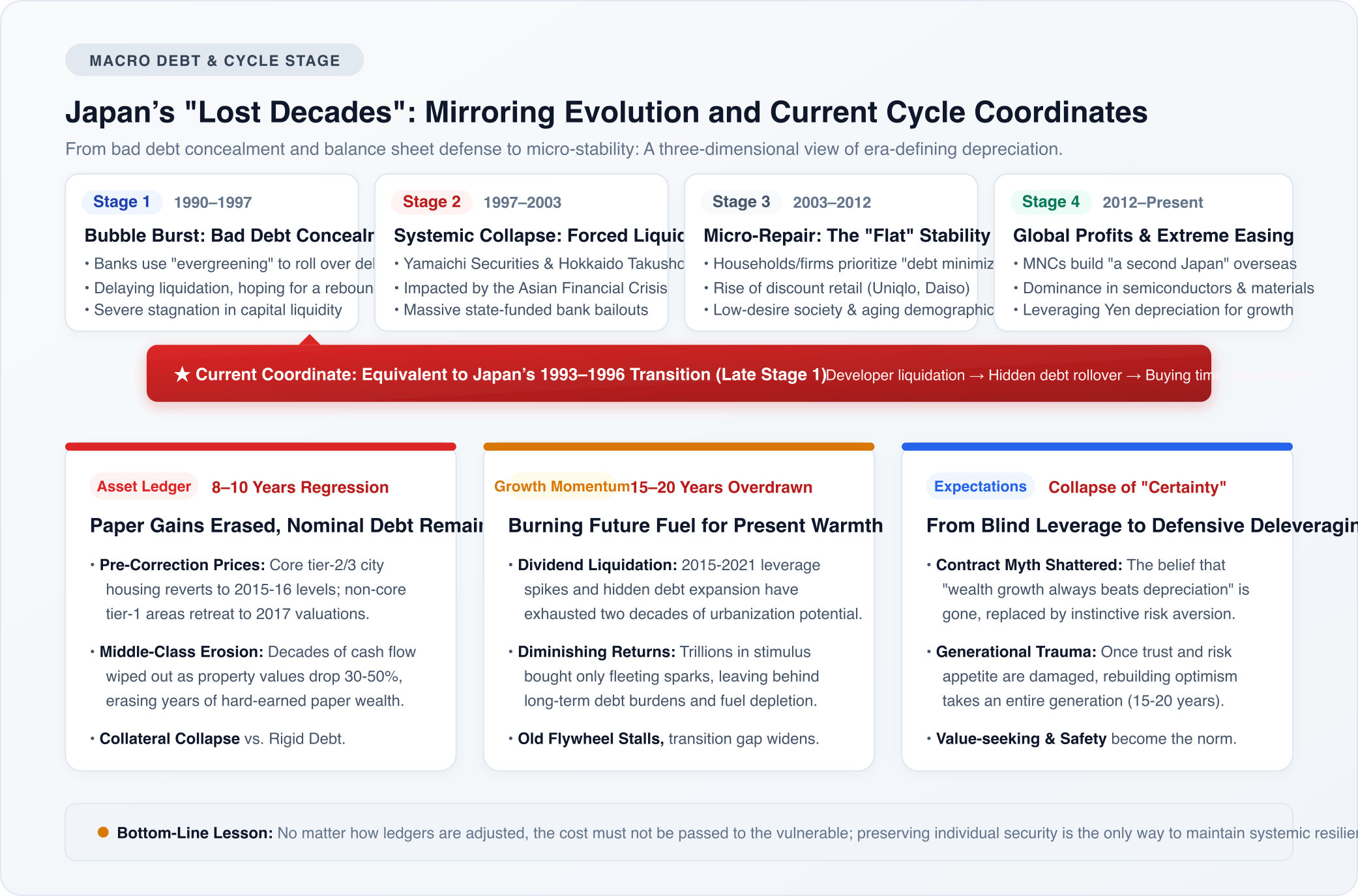
Measuring the depreciation of an era requires looking beyond GDP percentages. We must weigh the loss across three physical dimensions: asset values, growth momentum, and psychological expectations.
| Dimension of Loss | Scale of Retreat/Exhaustion | Micro-Manifestation | Core Impact & Cost |
|---|---|---|---|
| Asset Values | 8–10 Year Retreat | Core areas in Tier 2/3 cities back to 2015 levels; Tier 1 peripheries back to 2017. | Middle-class “Six-Pocket” families see 30-50% wealth erosion; nominal debt remains unchanged. |
| Growth Momentum | 15–20 Year Exhaustion | Aggressive expansion of household and local debt (2015-2021) pulled future demand into the present. | The “fireplace” burned all future wood at once; the system now faces a long period of fuel scarcity and debt servicing. |
| Psychological Expectations | Generational Collapse (15–20 Years) | The myth that “wealth outpaces biological aging” has shattered. | Traumatic memory requires a generational shift to reset. Low-desire and value-consumption become the new steady state. |
1. Asset Values: A Decade Erased
- Price Revaluation: Most core districts in Tier 2 and Tier 3 cities have surrendered all gains made since the 2015 “de-stocking” campaign. Peripheral areas of Tier 1 cities have retreated to 2017 levels.
- Balance Sheet Attrition: Millions of middle-class families who exhausted their “six pockets” to buy into the market now face a 30% to 50% drop in collateral value, while their bank debt remains fixed. The paper wealth accumulated through years of overtime and physical sacrifice has been neutralized.
2. Growth Momentum: Cannibalizing the Future
Between 2015 and 2021, through aggressive household leveraging and the expansion of hidden local government debt, we concentrated twenty years of urbanization dividends and infrastructure demand into a five-year window.
By throwing all the future’s wood into the fireplace at once, we achieved a brilliant, blinding glow—but we are now entering a long winter of fuel scarcity. As old engines stall, new ones are not yet large enough to fill the multi-trillion-dollar credit gap.
3. Expectations: The Death of “Certainty”
More lethal than the shrinking of assets is the dissolution of the social contract that “tomorrow will be better than today.”
For forty years, the mental model that sustained hyper-competition and high biological “wear and tear” was the belief that wealth would grow faster than the body would age. Once this certainty is broken, defensive saving, debt aversion, and delayed marriage/childbearing become instinctive. Rebuilding social optimism after such a trauma typically requires the passing of an entire generation.
III. Where Are We Now?
If we deconstruct Japan’s post-bubble evolution into four stages:
- Stage 1 (1990–1997): The initial burst, procrastination, and the era of hidden bad debt.
- Stage 2 (1997–2003): Systemic financial failures, external shocks, and iron-fisted liquidation/credit contraction.
- Stage 3 (2003–2012): Micro-repair of balance sheets; entry into a “low-desire, aging, value-consumption” steady state.
- Stage 4 (2012–Present): Structural breakthroughs via overseas income, extreme monetary easing, and currency revaluation.
Our Current Coordinate: Japan, circa 1993–1996
We are in the late phase of Stage 1, standing at the threshold of the “deep water” zone.
This is evident in three micro-behaviors:
- Debt Morphology: The most fragile links (high-leverage private developers) have already shattered. However, the associated local debt and bank NPLs are still in the “rollover and swap” phase—trading interest rate cuts for time. Systemic credit shock has not been fully exposed, but liquidity is already pooling in low-risk assets.
- Micro-Behavior: Corporations are shunning expansion to hoard cash. Households are aggressively prepaying mortgages and slashing discretionary spending. The shift from “luxury department stores” to “Uniqlo and value-brands” is mirroring the Japanese trajectory.
- The Critical Difference: During this stage, Japan benefited from a golden era of globalization where Western markets welcomed Japanese high-end manufacturing. We face a “Triple Resonance”: Domestic balance sheet defense + Geopolitical decoupling + Demographic cliff.
IV. The Final Lesson: The Individual’s Breakwater
Understanding the cycle is not an exercise in nihilism; it is a prerequisite for discarding speculative delusions and building a personal breakwater.
For the Macro-Ship: Japan’s most profound warning is that no matter how you shuffle the ledger, the cost must not be allowed to penetrate the bottom layer of society. Only by preserving the breathing room and basic security of the common citizen can the ship maintain the elasticity required to survive the storm.
For the Micro-Individual:
- Sever the Delusion of Leverage: The era of real estate as a high-yield engine is over. Do not pay for illusory asset premiums.
- Guard Deterministic Cash Flow: In a period of balance sheet defense, high-liquidity, stable cash flow is the only hard currency that survives the storm.
- Anchor Resources in Anti-Depreciative Assets: Invest limited energy and capital into irreplaceable skills, physical health, and the family’s foundational safety net. These are the only assets that do not depreciate in a long-cycle grind.
Related Research & Topics
Tello Mobile eSIM
SafetyWing Nomad Insurance
* Disclosure: This post contains affiliate links. If you make a purchase through these links, V-G Journal may earn a small commission at no additional cost to you. We only recommend services we independently evaluate and trust.
FIRE and Golf:自由旅居之路
专注于为追求 FIRE 与品质生活的人群提供特惠打球权益与候鸟微度假。不持一砖一瓦,运营品质生活。