China's Deflationary Pressures vs. Japan's Lost Decades: Balance Sheet Repair and Long-Term Trajectories
This essay deeply deconstructs the parallels and divergences between China's current macroeconomic adjustments and Japan's post-bubble 'lost decades.' We analyze the mechanisms of balance sheet contraction, demographic inflection points, and institutional backstops, dissecting the systemic financial crisis prevention floor and the critical long-term pivot from investment-driven to consumption-led growth.

Key Insights: Comparing China’s current macroeconomic adjustments (low-price environment, profound real estate re-shaping, local government debt resolution, and growth deceleration) with Japan’s “lost decades” following its early 1990s bubble burst is one of the most pervasive discussions in global macroeconomic and policy research today. Mechanistically, both share a macroeconomic pathology of “asset depreciation ➔ deleveraging ➔ weak demand.” However, fundamental divergences exist in per capita wealth, institutional command-and-control capabilities, industrial depth, and monetary sovereignty. The future trajectory is not a binary outcome: China possesses a more robust defensive floor against a cascading systemic financial crisis. Yet, it faces more intricate structural challenges than Japan did, particularly concerning social welfare resource constraints, comprehensive external geopolitical friction, and the transition of local fiscal momentum. The ultimate watershed depends on whether the ingrained habit of prioritizing investment over consumption can truly be broken.
I. Core Comparability: Shared Macroeconomic Pathologies and Structural Constraints
China’s current economic evolution shares four significant commonalities in macroeconomic mechanisms and underlying logic with Japan in the early 1990s:

Figure 1: Interplay of Macro Asset Price Adjustments and Credit Cycles
1. Balance Sheet Impairment and Micro-Level Deleveraging
In the classic macroeconomic transmission chain, a significant retreat in asset prices directly triggers what Richard Koo defines as a “balance sheet recession”:
- Japan (Early 1990s): Tokyo land prices and the Nikkei 225 index plummeted. The value of assets held by corporations and households shrank severalfold, while nominal liabilities remained unchanged. To avoid bankruptcy, corporate objectives shifted entirely from “profit maximization” to “debt minimization,” with all cash flow prioritized for debt repayment. Banks, even with zero interest rates, found no willing borrowers.
- China (Current Phase): The real estate market has entered a period of profound re-shaping. Household net worth (with approximately 60% tied to real estate) has seen a nominal contraction. Amidst weakened income and employment expectations, the household sector’s propensity to save has risen significantly, with a sustained high desire to prepay mortgages. The corporate sector has similarly reduced debt-driven expansion, exhibiting a defensive characteristic of micro-entities spontaneously contracting their balance sheets.
2. Accelerating Erosion of Demographic Dividend and Inflection Point of Low Birth Rate and Aging
Generational shifts in population structure directly constrain the upper limit of medium-to-long-term potential economic growth:
- Japan: The working-age population (15-64) peaked in 1995, followed by the national total population entering negative growth. The dependency ratio surged, marking a precipitous inflection point for rigid housing demand and total dependency costs.
- China: The working-age population peaked around 2011-2013, and the national total population entered negative growth in 2022. More critically, China’s trajectory from mild to deep aging is even steeper than Japan’s was. The erosion of the demographic dividend and the increasing burden of dependency are continuously suppressing the marginal propensity to consume.
3. Supply-Demand Imbalance-Driven Low Inflation and Deflationary Expectation Cycle
A structural disconnect between capacity and demand is the core issue behind persistently weak prices:
- Supply Side: Possesses the world’s most comprehensive manufacturing capacity, with highly elastic supply and abundant industrial production capability.
- Demand Side: Subject to triple pressures from real estate adjustments, local fiscal tightening, and household precautionary savings, resulting in relatively insufficient terminal effective demand.
- Outcome: Supply-side strength and demand-side weakness have kept CPI and PPI in a prolonged low range. Real interest rates are therefore passively maintained at high levels, further inhibiting micro-level borrowing and investment impulses, forming a reverse cycle of “low prices ➔ high real financing costs ➔ demand contraction.”
4. Long-Term Friction in External Economic and Trade Order and Geopolitical Competition
Both nations, as they transitioned through the middle-to-high-income stage, encountered significant headwinds in the global economic and trade landscape:
- Japan: Faced US-Japan trade wars, semiconductor agreement pressures, and exchange rate restructuring post-Plaza Accord.
- China: Is currently situated within a more intricate geopolitical great power game, confronting long-term external headwinds including high-tech export controls, tariff barriers, investment restrictions, and cross-border supply chain “de-risking.”
II. Core Incomparability: Deep-Seated Differences in Development Foundations and Institutional Tools
While macroeconomic pathologies exhibit similar symptoms, to simply extrapolate that China will perfectly replicate Japan’s trajectory overlooks fundamental differences in their development stages, financial architectures, and institutional depth.
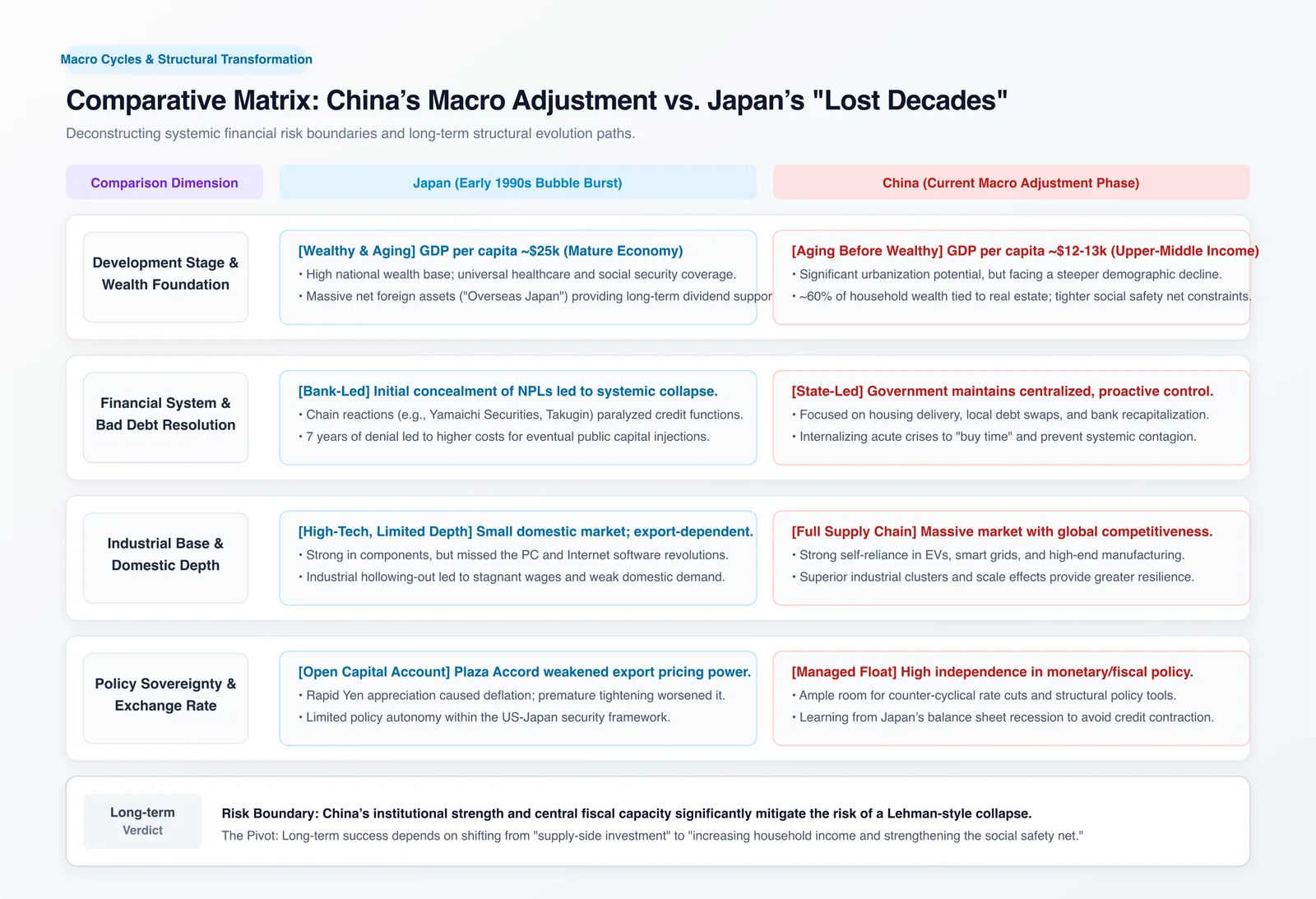
Figure 2: Core Mechanism Comparison Matrix: China’s Macro Adjustments vs. Japan’s ‘Lost Decades’
Detailed Comparison Matrix
| Key Comparison Dimension | Japan (Early 1990s Post-Bubble Burst) | China (Current Macro Adjustment Phase) | Divergence & Mechanistic Implications |
|---|---|---|---|
| Development Stage & Per Capita Wealth | Rich Before Old: Per capita GDP ~US$25,000, already a mature, developed economy. | Old Before Rich: Per capita GDP ~US$12,000-13,000, in the upper-middle-income bracket. | Japan had a high base of social security and national accumulated wealth; China has greater scope for industrial catch-up and new-type urbanization depth, but tighter rigid carrying capacity for public social security resources. |
| Financial System & Institutional Deleveraging | Dominance of Dispersed Commercial Banks: Initial cover-ups and delays eventually led to cascading failures of large institutions. | Pillar of Large State-Owned Commercial Banks: Government possesses penetrating control and coordinated oversight. | China has an extremely low probability of a stampede-like, Lehman-esque bank run crisis; non-performing asset disposal primarily relies on policy backstops and debt swaps/extensions. |
| Industrial Categories & Market Depth | Cutting-edge Manufacturing Tech but Limited Domestic Depth: Highly reliant on capital outflow and multinational investment. | Complete Industrial Categories & Super-Sized Single Market: Emerging manufacturing sectors possess full-chain competitiveness. | China’s industrial upgrading has stronger full-chain self-sufficiency and domestic trial-and-error scale, with more ample room for maneuver against supply chain disruptions and single-point shocks. |
| Policy Autonomy & Exchange Rate Mechanism | Open Capital Account: Yen’s sharp, passive appreciation post-Plaza Accord; severe policy lags in early stages. | Managed Floating Exchange Rate & Macroprudential Management: High autonomy in monetary and fiscal policy sovereignty. | China is less constrained by sudden shifts in overseas capital and passive, sharp exchange rate appreciation, with more autonomous counter-cyclical adjustment and structural tool space. |
III. Will the Outcome Be Better or Worse? Multi-Dimensional Trajectory Projections
The future trajectory is not unidirectionally linear, neither purely pessimistic nor optimistic, but exhibits distinctly asymmetrical characteristics:
1. In Which Dimensions is China Likely to Perform Better?
- Robust Floor Against Acute, Precipitous Financial Crises: Japan paid a heavy price: after a 7-year period of bad debt concealment, “Jusen” companies imploded, followed by the collapses of Sanyo Securities, Hokkaido Takushoku Bank, and Yamaichi Securities, instantly paralyzing financial intermediation. China, through penetrating oversight of its state-controlled financial system, has implemented a series of policy levers such as “ensuring housing project delivery,” long-term swaps of implicit debt, and capital injections into major state-owned banks. This has successfully “internalized” and “long-termized” localized acute credit default risks, firmly blocking systemic bank runs and the collapse of debt dominoes.
- Greater Resilience in Global Competitiveness of Emerging Real Sectors: Japan, after its bubble burst, missed the PC and consumer internet industry waves. While still dominant in precision instruments, materials, and core components, it lacked terminal ecosystem leverage. In contrast, China has established world-leading industrial clusters and a scale advantage in engineers across new-generation information technology, the entire new energy industrial chain (photovoltaics, energy storage, lithium batteries, electric vehicles), smart grids, and high-end equipment manufacturing. The global export competitiveness of its real manufacturing sector retains strong momentum.
- Policy Makers Possess Long-Term Pre-Emptive Lessons and Preparations: Chinese economists and policymakers have over two decades of in-depth tracking of Japan’s “lost thirty years” and Koo’s “balance sheet recession” theory. They possess a strong risk-aversion consciousness, particularly in preventing premature bubble bursting and avoiding hasty liquidity tightening in the early stages of recovery.
2. In Which Dimensions Does China Face More Severe Challenges?
- Social Security Safety Net and Livelihood Resource Constraints from ‘Old Before Rich’: When Japan hit the wall of aging, it had long been among the world’s wealthiest economies, with highly homogenized universal healthcare and pension systems. The private sector had accumulated vast overseas net assets (consistently enjoying dividends from overseas investments). China, however, faces accelerating aging before its per capita income has even reached the developed nation threshold. Household precautionary concerns about future healthcare, elder care, and children’s education directly lock in marginal propensity to consume, leading to “insufficient domestic demand” with stronger structural stickiness.
- Higher Tier of External Geopolitical Strategic Friction: While Japan was severely impacted by US-Japan trade friction, it remained within the Western bloc’s security and defense framework. Its external technological exchanges and integration into high-end industrial chains were not physically severed. China currently faces an all-encompassing blockade spanning technology transfer, high-end semiconductor manufacturing equipment, advanced processes, and critical investments. The marginal resistance to growth driven by external technology spillovers and unilateral exports has significantly increased.
- Post-Land Finance Retreat: Momentum Vacuum and Fiscal Friction at the Local Level: The “land sales ➔ urban investment financing ➔ infrastructure
Related Research & Topics
Tello Mobile eSIM
SafetyWing Nomad Insurance
* Disclosure: This post contains affiliate links. If you make a purchase through these links, V-G Journal may earn a small commission at no additional cost to you. We only recommend services we independently evaluate and trust.
FIRE and Golf:自由旅居之路
专注于为追求 FIRE 与品质生活的人群提供特惠打球权益与候鸟微度假。不持一砖一瓦,运营品质生活。