The Outsourced Hit: A 30-Page Ruling Unpacks the Supply Chain of Cross-Border Violence
A 30-page criminal verdict by the Guangdong High Court confirms a 1-million-RMB contract killing orchestrated via Telegram by an overseas syndicate. The case exposes how transnational criminal capital is weaponizing domestic gig-economy labor into modular assassination networks.


Figure 1: Anti-fraud commentator Hui Jian (Wu Kai) persistently exposed overseas telecommunication fraud operations before becoming the target of a million-RMB cross-provincial hit orchestrated by an encrypted handle known as “The Major.”
On August 12, 2026, the Guangdong Higher People’s Court handed down a 30-page appellate criminal ruling that formally brought a horrific, two-year-old cold case into sharp judicial focus. The verdict confirmed that anti-fraud investigative blogger “Hui Jian” (real name Wu Kai) was abducted, tortured, and killed across provincial lines in late 2024—the result of a 1-million-RMB bounty posted on encrypted messaging platforms by an overseas operative using the alias “The Major.”
The 14-man modular network assembled to execute the hit traced a 300-kilometer path of violence and disposal across Guangdong and Jiangxi provinces. Beyond detailing the physical mechanics of the crime, the court document forces a reckoning with a chilling geopolitical reality: transnational criminal syndicates are now actively weaponizing domestic, low-tier labor networks as disposable, proxy “cleaners.”
1. From Public Whistleblowing to Encrypted Bounties
The fuse for this extrajudicial killing was lit by the victim’s public offensive against transnational gray-market syndicates. As an early internet strategist and veteran commentator, Wu Kai used his WeChat Official Account to methodically dismantle the mechanics of telecom fraud, illegal detention, and armed criminal compounds operating across Northern Myanmar and Cambodia.
Between July and August 2024, Wu published a series of named, long-form investigations. He explicitly accused Liu Ren—a key figure in Cambodia’s Prince Group and president of the Cambodian Anhui Chamber of Commerce—of establishing illicit industrial parks, enforcing armed detention, and running transnational crime syndicates.
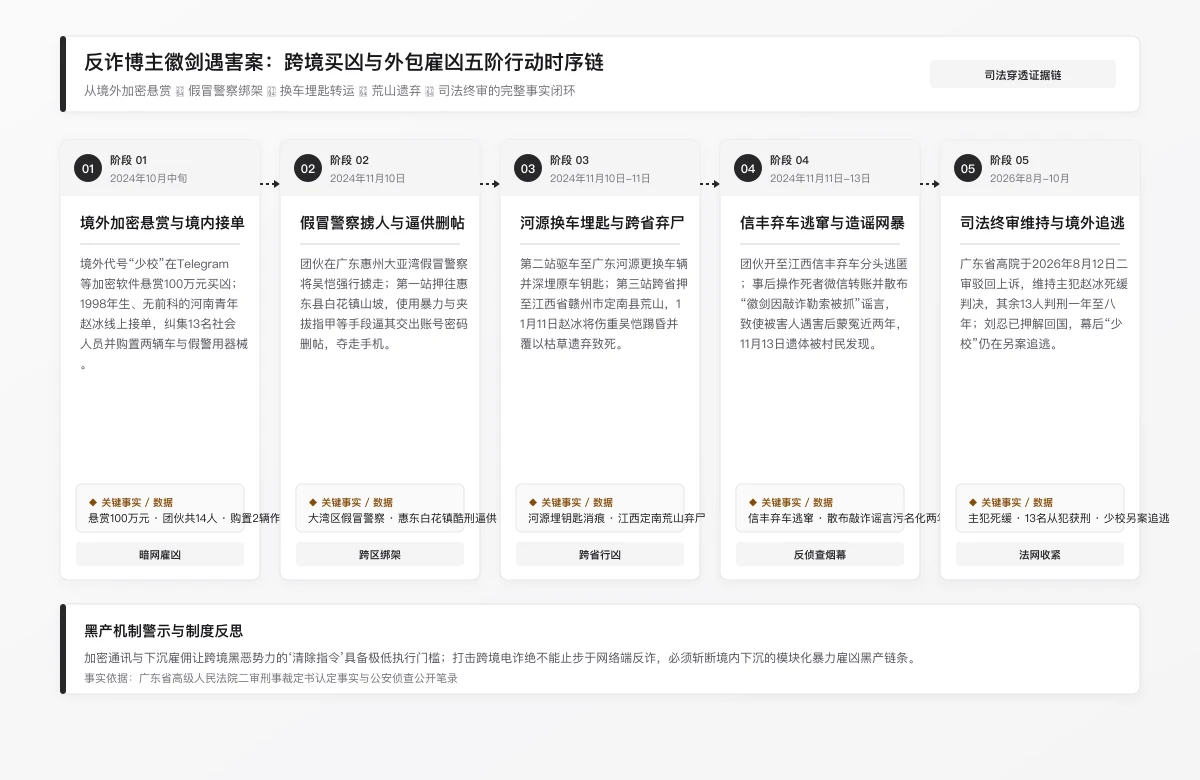
Figure 2: The end-to-end execution chain—from encrypted bounty placement abroad to modular, multi-stage physical violence within domestic borders.
These named disclosures struck directly at the economic core of these transnational syndicates. Retribution was mobilized rapidly across encrypted digital darknets. According to the Guangdong High Court ruling, by mid-October 2024, an overseas operative using the handle “The Major” (also known as “Brother Tai”) posted an open procurement request on Telegram and Yeechat for Wu’s forcible abduction. To guarantee swift execution, the bounty was raised to 1 million RMB. The mandate was clear: kidnap Wu, force him to yield administrative control of his media channels, and erase every investigative article targeting the syndicate.
This contract killing underscores a dangerous evolution in the organizational architecture of global crime. As state authorities tighten law enforcement pressure on physical fraud compounds abroad, these syndicates are leveraging end-to-end encrypted networks to project capital and tactical commands directly into domestic territories. We previously examined the underlying infrastructure of these cross-border capital transfers and digital darknet channels in Cross-Border Telecom Fraud, Global Governance, and the Banking Liability Frontier.
2. Mapping the 300-Kilometer Operational Arc
The court’s 30-page ruling draws on forensic records and confessions to reconstruct a highly calculated, cold-blooded operational trajectory across provincial borders. On the afternoon of November 10, 2024, the execution cell launched a targeted ambush in the Dayabay District of Huizhou, Guangdong. Outfitted in counterfeit police uniforms, carrying forged credentials, and wielding handcuffs, core members posed as law enforcement officers to force Wu into an unmarked vehicle.
| Operational Phase | Geographic Location | Tactical Details & Violent Mechanics | Counter-Surveillance & Evidence Disposal |
|---|---|---|---|
| Phase 1: Ambush & Abduction | Dayabay District, Huizhou, Guangdong | Operatives wearing fake police uniforms and presenting forged badges forced Wu into a vehicle. | Pre-cased location over multiple days; used low-profile second-hand vehicles with cloned plates. |
| Phase 2: Coerced Interrogation | Huidong County, Guangdong | Wu was subjected to sustained physical torture (including fingernail extraction) on an isolated hillside to yield account credentials. | Seized Wu’s personal mobile device to log into his platform backend and delete all investigative posts. |
| Phase 3: Vehicle Transfer | Heyuan City, Guangdong | Operatives transferred Wu into a secondary, pre-arranged vehicle before driving north. | Buried the key to the initial getaway vehicle in a dug hole to sever physical tracing. |
| Phase 4: Abandonment | Dingnan County, Jiangxi | On Nov 11, primary defendant Zhao Bing kicked the severely injured, comatose victim onto a barren hillside. | Covered Wu’s body with dried weeds and brush before fleeing the scene in the secondary vehicle. |
| Phase 5: Dissolution & Disinformation | Xinfeng County, Jiangxi | The group drove to a remote zone, abandoned the secondary vehicle entirely, and scattered. | Dispersed along independent escape routes while manipulating the victim’s phone to simulate life. |
The route—stretching from Dayabay to Huidong, through Heyuan, and into the remote hills of Southern Jiangxi—was engineered to exploit jurisdictional seams. Knowing that the Greater Bay Area maintains dense surveillance infrastructure and agile investigative units, the perpetrators opted to abduct the victim and immediately shift locations.
They executed the forced credential deletion in Huidong to satisfy the overseas handler’s primary mandate, swapped vehicles and buried key evidence in Heyuan to break the visual surveillance chain, and finally abandoned the dying victim beneath dry brush in the wilderness of Jiangxi. Dividing the violence across multiple municipal and provincial police jurisdictions was designed to stall emergency response times.
This case illustrates how physical security risks for investigative figures are now inextricably linked to digital social engineering. The foundational framework for mitigating targeted physical and digital threats of this nature was outlined in our analysis on Defensive Architectures Against Cross-Border Darknet Threat Vectors and Social Engineering.
3. Vocational Dropouts as Modular Mercenaries
A striking anomaly emerges from a close reading of the trial records. The operation involved 14 individuals who executed a complex sequence: physical surveillance, vehicle procurement, sourcing counterfeit police gear, long-haul transport, coerced account deletion, systematic vehicle abandonment, and post-crime cover-ups. Yet, the central organizer identified by the court was Zhao Bing—a young man born in 1998 with only a vocational secondary education and no prior criminal record.
How did an unemployed 26-year-old with zero law enforcement or high-level criminal background execute an operation of such logistics and brutality? The answer lies not in personal tactical genius, but in the modularization of illicit services thriving within encrypted software ecosystems.
On platforms like Telegram, channels dedicated to “offline cleaning,” “debt collection,” and “physical intimidation” operate with standardized service menus. An overseas handler like “The Major” posts a high-value bounty alongside the target’s public footprint. Unemployed or financially desperate individuals domestically act as local “prime contractors.”
Upon accepting the job, Zhao Bing leveraged social channels to assemble a temporary crew, subcontracting distinct sub-tasks for payments ranging from tens of thousands to over a hundred thousand RMB:
- One proxy was paid exclusively to source used cars and fraudulent license plates.
- Another was tasked solely with acquiring fake police gear and tactical restraints.
- Separate teams were assigned to physical surveillance and initial abduction.
This decentralized “Crime-as-a-Service” model presents a distinct security vector. Contract holders do not need specialized skills; motivated by immediate capital payouts, they can snap together a compartmentalized enforcement team like building blocks.
Following the assault, the gang went so far as to access Wu’s personal WeChat account to initiate minor money transfers and broadcast false rumors within media circles claiming that “Hui Jian had been detained by public security for extortion.” This digital smear campaign ensured that while the victim lay dead in a remote valley, his professional reputation remained under active attack for nearly two years.
4. Justice at Home, Impunity Abroad
Despite the gang’s deliberate attempt to create an untraceable, multi-jurisdictional crime scene, the physical operation unravelled quickly. Wu was abandoned on the Jiangxi hillside on November 11, 2024. Just two days later, on the morning of November 13, local villagers inspecting timber lines discovered his body beneath the brush. Utilizing automatic number-plate recognition (ANPR) systems and cross-regional forensic matching, public security forces identified the getaway vehicles and apprehended all 14 suspect participants.
In December 2025, the Huizhou Intermediate People’s Court issued its first-instance judgment. Primary defendant Zhao Bing was convicted of Intentional Injury causing death and sentenced to death with a two-year reprieve, alongside permanent deprivation of political rights. The remaining 13 defendants received prison terms ranging from one to eight years for intentional injury, illegal detention, or harboring criminals. Following an appeal, the Guangdong Higher People’s Court reviewed the case, ruled that the facts were clear and the sentencing appropriate, and officially upheld the original verdict on August 12, 2026.
While the domestic execution arm has been dismantled by the courts, the case leaves critical legal and geopolitical questions unresolved:
- Charge Classification and Legal Nuance: The court affirmed the charge of “Intentional Injury resulting in death” rather than “Intentional Homicide.” The ruling cited medical reports indicating that Wu’s pre-existing hypertension contributed to fatal systemic failure under stress, alongside a 500,000 RMB compensation settlement signed by select family members. However, during the appellate hearing, primary direct relatives strongly contested the leniency implied by the settlement and demanded maximum retribution. The court maintained that targeted retaliatory violence against whistleblowers poses extreme public harm, precluding any statutory sentence reduction based solely on financial restitution.
- The Unreached Mastermind: The primary source of capital and operational commands—the overseas handle “The Major”—remains unidentified and at large, subject to an active international fugitive warrant. Although the primary subject of Wu’s original exposés, Liu Ren, was extradited by the Ministry of Public Security from Phnom Penh in June 2026, the complete evidentiary link to the specific handler who posted the bounty remains open.
The systemic deterrents of high-density surveillance and grid-based policing in mainland China are documented in our study on Regional Crime Governance and Severe Violent Offense Prevention Mechanisms. Yet, when illicit capital residing in overseas safe havens pairs with encrypted communication networks, it creates an arbitrage loop: foreign syndicates can seamlessly purchase domestic violence on demand. Ex-post investigation, no matter how efficient, cannot fully neutralize this dynamic.
The 30 pages of the Guangdong High Court ruling serve as a warning. The existential threat posed by transnational fraud syndicates extends beyond phone scams and digital phishing. Armed with massive liquid capital, these groups can turn globalized communication platforms into gig-economy labor pipelines for real-world violence. Countering this threat requires aggressive transnational law enforcement, the dismantling of overseas safe havens, and the systematic closure of domestic proxy networks that act as foot soldiers for foreign capital.
Related Research & Topics
Tello Mobile eSIM
SafetyWing Nomad Insurance
* Disclosure: This post contains affiliate links. If you make a purchase through these links, V-G Journal may earn a small commission at no additional cost to you. We only recommend services we independently evaluate and trust.
FIRE and Golf:自由旅居之路
专注于为追求 FIRE 与品质生活的人群提供特惠打球权益与候鸟微度假。不持一砖一瓦,运营品质生活。