Golf Is Not a Game of Perfect: Ben Hogan’s Calculus of Good Misses
An examination of Ben Hogan’s core doctrine—that golf is won by whoever misses best—and Dr. Bob Rotella’s performance psychology. By reframing course strategy through dispersion physics and risk-control theory, golfers can shave five strokes without altering a single swing mechanism.

Executive Overview: The game of golf is governed by two timeless principles formulated half a century apart: sports psychologist Dr. Bob Rotella’s foundational thesis, “Golf is not a game of perfect,” and nine-time Major champion Ben Hogan’s pragmatic axiom, “Golf is a game of misses. The guy who misses the best is going to win.” Most amateur golfers remain trapped at the 90-to-100 scoring ceiling not because their physical mechanics lack form, but because they mistakenly approach golf as a judged aesthetic discipline like gymnastics. Over an 18-hole round, the upper bound of a scorecard is never dictated by the rare, breathtaking birdie putt tapped in from the fringe. It is governed by where the ball comes to rest when contact strays off-center: safely in the fat of the green, or buried in a short-sided bunker.
I. The Synthesis of Two Doctrines: Why Hogan Had Only Two “Perfect” Shots per Round
If any human ever approached mechanical perfection in golf, it was Ben Hogan. As the intellectual forebear of modern swing biomechanics, Hogan’s precision over the swing plane remains the gold standard for tour professionals. Yet, after accumulating 64 PGA Tour victories and 9 Major championships, Hogan left behind a confession that ought to reframe how every amateur evaluates their game:
In a standard 18-hole tournament round at the peak of his powers, Ben Hogan executed only one or two “perfect” shots—strokes that matched his intended trajectory, strike, and spot down to the yard.
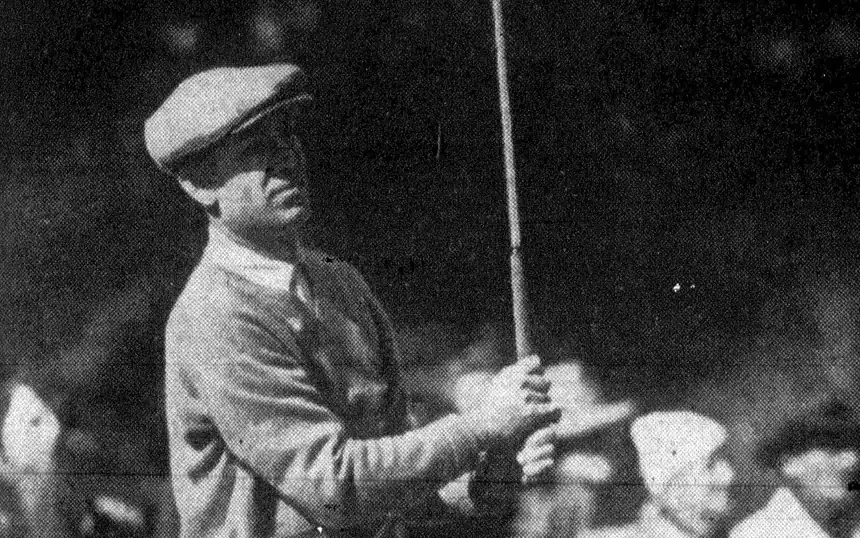
Figure 1: Nine-time Major winner Ben Hogan holding his follow-through. His relentless swing practice was never meant to eliminate error, but to lock it into a single, highly controllable dimension.
If a Major champion firing a 67 missteps on more than fifteen full swings per round, how does he win? Hogan’s answer was straightforward: He wins on the quality of his misses.
In 1995, Dr. Bob Rotella, long-time performance consultant to elite championship players, published Golf is Not a Game of Perfect. The book provided the cognitive neuroscience framework underpinning Hogan’s insight:
- The Range-Mat Delusion: Amateurs routinely hit fifty balls off a flat artificial mat at the driving range, select the three longest, straightest shots, and declare that outcome their “true ability.” When confronted on the course with uneven lies, wind turbulence, and competitive tension, any shot that falls short of those top 5% strokes triggers frustration—often prompting mid-round swing tear-downs as early as the third tee box.
- Perfectionism as a Biomechanical Inhibitor: The golf swing is a complex fluid motion requiring dozens of muscle groups to coordinate within 1.2 seconds. When the cerebral cortex becomes fixated on forcing a flawless strike, the sympathetic nervous system tightens under stress. This defense mechanism directly disrupts wrist release and torso rotation, inducing the early extension and over-the-top path detailed in our analysis of downswing mechanics and shoulder alignment fixes.
II. Dispersion Cones and the “Short-Side Trap”: What ShotLink Data Exposes
To understand why “whoever misses best wins” from a physical standpoint, one must look at modern tour data through shot dispersion cones.
Based on millions of shot coordinates recorded by the PGA Tour’s ShotLink tracking system, variance remains an immutable law of physics—even among the world’s premier players:
| Approach Distance & Scenario | PGA Tour Pro Avg Proximity | Single-Digit Amateur (Hcp 8) Proximity | Mid-Amateur (Hcp 18) Dispersion Envelope | Catastrophic Trigger (Bad Miss) |
|---|---|---|---|---|
| 100 Yards (Wedge) | 16–18 ft (5.5m) | 28–32 ft (9.5m) | Depth ±8 yd, Width ±10 yd | Thinning a front pin into water, or chunking into a deep front bunker |
| 150 Yards (7/8 Iron) | 23–26 ft (7.5m) | 42–48 ft (14m) | Depth ±12 yd, Width ±16 yd | Pin-hunting tight flags; a mild push drops into short-sided rough |
| 200 Yards (Mid-Iron/Hybrid) | 38–44 ft (13m) | 65–75 ft (21m) | Depth ±18 yd, Width ±25 yd | Attacking narrow zones over water; penalty strokes yield double bogeys |
These figures challenge the casual fan’s perception of tour-level execution: From a prime approach distance of 150 yards, the average PGA Tour player finishes 24 feet away from the cup.
Because every shot carries inherent variance, the gap between elite players and high handicappers comes down to where they position the center of their dispersion cone:
1. The Amateur’s “Pin-Hunting” Syndrome and Catastrophic Errors
Consider a 155-yard Par 3. The flag is tucked on the far-right edge of the green, three yards from a steep two-meter bunker. To the left of the flag lies a 25-yard expanse of flat, safe green.
- The Amateur Perfectionist: Target line: straight at the pin. Hitting the 5% dream shot yields a 3-foot birdie attempt. However, if the clubface opens by just 3 degrees—an error occurring on roughly 45% of amateur swings—the ball drifts 5 yards right, settling deep in the bunker.
- The Short-Sided Penalty: Because the pin sits on the margin, a ball in the right bunker leaves less than 3 yards of green to work with—a short-sided recovery. Tour pros save par from short-sided positions less than 25% of the time. For an amateur, failing to clear the lip or skulling the ball across the green turns a single mistake into a double (+2) or triple (+3) bogey.
2. Hogan’s Single-Side Lockdown and the Professional “Good Miss”
Faced with the exact same hole layout, a player focused on error management flips the risk equation:
- Aiming Away from Trouble: The smart player targets the fat part of the green, 8 to 10 yards left of the pin.
- Refactoring the Probability Distribution:
- If he pulls the shot 8 yards left (an error), the ball lands safely on the left fringe, setting up a stress-free two-putt par from 40 feet.
- If he pushes the shot 8 yards right (an error), the directional bleed leaks toward the tucked flag, yielding an accidental tap-in birdie opportunity.
- If he hits his target line dead straight, he secures a comfortable 25-foot green-in-regulation putt.
This is the underlying math behind “Whoever misses the best wins.” Elite players do not eliminate variance; they recalibrate their aim and club selection to keep their dispersion footprint clear of hazard lines and short-sided traps, guaranteeing that their worst shot results in a safe two-putt par or a straightforward chip.

Figure 2: Strategic matrix contrasting the amateur perfectionism trap against Ben Hogan’s probability-driven "Good Miss" methodology.
III. Golf and Capital Preservation: Charles Ellis and Winning the Loser’s Game
Step back from the fairway and view course management through the lens of long-term capital allocation, and the logic of Hogan and Rotella aligns directly with investment strategist Charles D. Ellis’s classic, Winning the Loser’s Game.
Drawing on research by physicist Simon Ramo, Ellis split competitive arenas into two distinct formats:
- The Winner’s Game: The elite domain of top-tier professional competition (the final round of a Major). When two players navigate the back nine without unforced errors, victory goes to whoever creates brilliant shotmaking under pressure.
- The Loser’s Game: The environment of 99.9% of amateur golf, commercial markets, and private wealth management. Outcome is determined not by how many brilliant winners a player hits, but by how many unforced errors they avoid.
This matches the survival math behind Monte Carlo FIRE simulations and safe withdrawal boundaries: Across a 30-year asset allocation horizon, long-term security is rarely built on catching an illiquid speculative surge (the eagle putt). It depends on sidestepping over-leveraged drawdowns and catastrophic tail risk during macro liquidity contractions (avoiding out-of-bounds stakes and water hazards).
If you erase triple (+3) and double (+2) bogeys from a scorecard, you do not need a single birdie to keep your total score bounded securely within the 76-to-82 range.
IV. Field Blueprint: Four Risk-Control Rules to Drop 5 Strokes Without Swing Changes
Adopting the “good miss” mindset does not require three years of swing reconstruction on the range. Implementing four practical guidelines on your next round can immediately shave 4 to 6 strokes off your card:
1. Anchor Target Distance to the Back Edge (Take Extra Club)
Course architects consistently design golf holes with a predictable bias: over 85% of steep bunkers, water features, and severe slopes are placed along the front edge of the green, while the space behind the green is usually flat and forgiving.
Amateurs often pick clubs based on their absolute best distance—assuming a 7-iron flies 155 yards when their true average strike is 142. A thin contact or light headwind drops the shot into the front hazard. Practical Rule: Measure the distance to the back edge of the green. Choose a club that will not fly long even on a flushed strike, ensuring that a 10% mis-hit still carries the front trouble safely.
2. Establish a One-Way Miss
Early in his career, Hogan struggled with a destructive hook that cost him championships. He restructured his grip and hip rotation to eliminate the left side of the course entirely. Accepting a slight loss in total distance, he ensured his ball would only ever curve gently to the right.
Before your round, assess your natural ball flight for the day. If your irons are fading slightly, lock your target line to the left edge of the fairway whenever water sits on the right. Never attempt an unfamiliar, counter-intuitive shot shape to attack a tight flag during a round.
3. Take Your Medicine in the Trees
When a drive strays into the trees, perfectionists often hunt for tiny 4-foot gaps in the foliage, attempting a low 4-iron “hero shot” toward the green. Statistically, this shot ricochets off a trunk 80% of the time, turning a manageable +1 bogey into an unforced +3 disaster.
The Good Miss Law: When out of position in the trees, take a wedge or mid-iron and punch out laterally into the open fairway using a controlled half-swing. Limiting the damage on a ruined hole to a single bogey (+1) is a net gain for any amateur scorecard.
4. Implement Rotella’s 10-Second Emotional Firewall
Dr. Bob Rotella required his tour clients to adhere to a strict pre-shot routine paired with a post-shot emotional reset. When a shot strays off-line, allow yourself exactly ten seconds to vent or reflect. The moment you clean your club and return it to the bag, that shot is over. Never analyze mechanical swing mechanics while walking down the fairway. Your only task on the course is using your present swing to pick the highest-margin target for the next stroke.
V. Strategic Audit
Strategic Audit & Verification:
- Audit 1 (Historical & Theoretical Framework): “Golf is not a game of perfect” originates from sports psychologist Dr. Bob Rotella’s 1995 book of the same title. “Golf is a game of misses; the guy who misses the best is going to win” represents the core philosophy of nine-time Major champion Ben Hogan. Together, these principles form the bedrock of modern quantitative course management systems (such as the DECADE model).
- Audit 2 (Amateur Cognitive Error): Treating golf as an aesthetic discipline requiring flawless execution causes high-handicap players to attempt low-probability hero shots. This habitually triggers short-sided bunker errors, blow-up holes, and swing anxiety mid-round.
- Audit 3 (Risk Control Parallel): Whether managing an 18-hole scorecard or constructing a long-term investment strategy, long-term results are secured not by low-probability miracle plays, but by shifting dispersion centers, locking out one-sided risk, and consistently producing manageable, non-fatal errors (Good Misses).
Related Research & Topics
Tello Mobile eSIM
SafetyWing Nomad Insurance
* Disclosure: This post contains affiliate links. If you make a purchase through these links, V-G Journal may earn a small commission at no additional cost to you. We only recommend services we independently evaluate and trust.
FIRE and Golf:自由旅居之路
专注于为追求 FIRE 与品质生活的人群提供特惠打球权益与候鸟微度假。不持一砖一瓦,运营品质生活。